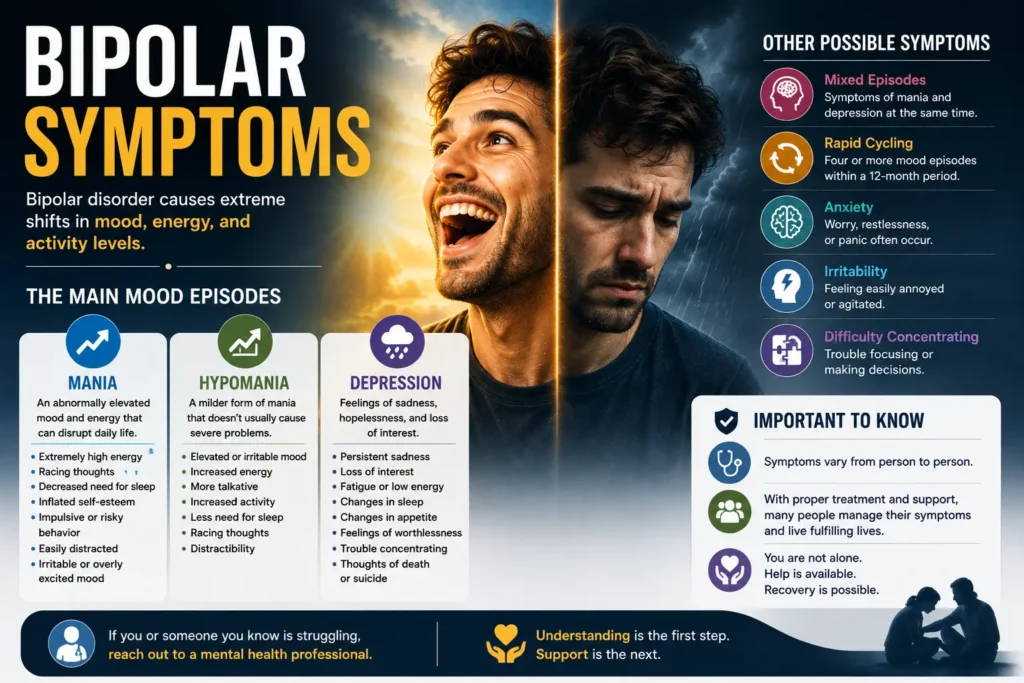
Bipolar disorder causes noticeable shifts between extreme moods — from the high energy of mania or hypomania to the heaviness of depression, and sometimes a mix of both at once. Common bipolar symptoms include unusually elevated or irritable mood, reduced need for sleep, racing thoughts, impulsive decisions, and, on the other end, deep sadness, low energy, and loss of interest in daily life. The exact pattern of bipolar disorder symptoms depends on the specific type of bipolar disorder a person has, so severity and duration can vary quite a bit from one person to the next.
Table of Contents
Introduction
If you’ve ever searched “symptoms of bipolar” at 2 a.m. because something about your mood — or someone else’s — doesn’t add up, you’re not alone. Bipolar disorder is one of the most misunderstood mental health conditions, partly because its symptoms don’t look the same in every person or every episode.
Some people picture bipolar disorder as simply “mood swings.” In reality, it’s a diagnosable brain-based condition involving distinct episodes of mania or hypomania, depression, and sometimes a mix of both, separated by periods of relative stability. Understanding what these symptoms actually look like — not the stereotype, but the clinical reality — is the first step toward getting an accurate diagnosis and the right support.
This guide breaks down every category of bipolar signs and symptoms in plain English: what a manic episode really feels like, how hypomania differs from mania, what bipolar depression looks like compared to ordinary sadness, and the warning signs that mean it’s time to get help right away. For a broader look at the condition itself, see our full guide to bipolar disorder and what bipolar disorder is.
Key Takeaways
- Bipolar disorder involves at least two mood states: an “up” phase (mania or hypomania) and a “down” phase (depression).
- Manic episodes last at least 7 days (or require hospitalization); hypomanic episodes last at least 4 days and are less severe.
- Depressive episodes typically last 2 weeks or longer and involve low mood, low energy, and loss of interest.
- Some people experience mixed features — manic and depressive symptoms at the same time.
- Symptoms differ somewhat between Bipolar 1 and Bipolar 2, and can present differently in men and women.
- Warning signs like psychosis or suicidal thoughts require immediate professional attention.
- A proper diagnosis requires a mental health professional — self-assessment is a starting point, not a substitute.
What Bipolar Disorder Actually Is (Brief Overview)
Bipolar disorder is a mental health condition marked by episodes of extreme mood change that go well beyond normal ups and downs. The American Psychiatric Association’s DSM-5 classifies it into several forms, most notably Bipolar I, Bipolar II, and cyclothymic disorder, each defined by the intensity and pattern of mood episodes. We cover the condition itself in depth in our dedicated bipolar disorder guide and compare the main forms in Bipolar 1 vs Bipolar 2. This article focuses specifically on the symptoms — what you or someone you love might actually notice day to day.
The Three (or Four) Faces of Bipolar Symptoms
Most bipolar symptoms fall into distinct episode types. Recognizing which “face” a symptom belongs to is often more useful than memorizing a long list, because treatment and urgency depend heavily on which phase someone is in.
1. Manic Episode Symptoms
A manic episode is a distinct period of abnormally elevated, expansive, or irritable mood along with persistently increased energy or activity, lasting at least one week (or any duration if hospitalization is required), according to the American Psychiatric Association’s DSM-5 criteria. Mania is the defining feature of Bipolar 1.
Common manic symptoms include:
- Inflated self-esteem or grandiosity
- Decreased need for sleep (feeling rested after 3 hours)
- Talking more than usual or feeling pressure to keep talking
- Racing thoughts or a sense that ideas are flying too fast to keep up with
- Being easily distracted
- Increase in goal-directed activity or physical restlessness
- Excessive involvement in risky activities — spending sprees, impulsive sexual behavior, reckless driving, risky investments
In severe cases, mania can include psychotic features such as delusions or hallucinations. We go into much more depth on this specific episode type in our guide to manic episodes and mania symptoms, including how psychosis can appear during mania.
2. Hypomanic Episode Symptoms
Hypomania shares the same symptom list as mania but is less intense and shorter — lasting at least 4 consecutive days rather than a full week — and it does not cause the severe impairment, hospitalization, or psychosis that full mania can. Hypomania is the hallmark of Bipolar 2.
People experiencing hypomania often feel unusually productive, confident, and social. Because it can feel pleasant, hypomania is frequently missed or dismissed — by the person experiencing it and by others around them — which is one reason Bipolar 2 is often underdiagnosed. Our dedicated pages on hypomania and hypomania symptoms explore this in detail, and our mania vs hypomania comparison explains exactly where the line is drawn.
3. Depressive Episode Symptoms
A major depressive episode in bipolar disorder looks clinically similar to major depressive disorder, but it occurs as part of the broader bipolar pattern. Symptoms, per DSM-5 criteria referenced by the American Psychiatric Association, include:
- Persistent sad, empty, or hopeless mood
- Loss of interest or pleasure in nearly all activities
- Significant weight or appetite change
- Insomnia or sleeping far more than usual
- Fatigue or loss of energy
- Feelings of worthlessness or excessive guilt
- Difficulty concentrating or making decisions
- Slowed movements or speech, or restlessness
- Recurrent thoughts of death or suicide
Bipolar depression can be harder to treat than unipolar depression and often carries a higher risk of misdiagnosis, since patients are more likely to seek help during the “down” phase than the “up” phase.
4. Mixed Features
Some episodes include symptoms of both mania (or hypomania) and depression at the same time — for example, racing thoughts and high energy alongside hopelessness and suicidal thinking. Clinicians call this “mixed features,” and it tends to carry a higher risk profile, partly because the combination of low mood and high energy can increase the likelihood of acting on difficult thoughts. If you notice this pattern in yourself or someone else, it’s worth flagging directly to a doctor rather than assuming it’s “just a bad day.”
Symptom Comparison Table
| Episode Type | Minimum Duration | Core Mood | Energy Level | Impairment | Psychosis Possible? |
| Mania | 7+ days (or hospitalization) | Elevated, expansive, or irritable | Very high | Severe — disrupts work/relationships | Yes |
| Hypomania | 4+ days | Elevated or irritable | High | Noticeable but not severely disabling | No |
| Major Depressive Episode | 2+ weeks | Low, empty, hopeless | Very low | Moderate to severe | Rare, only in severe cases |
| Mixed Features | Varies | Both elevated and low symptoms together | Variable/agitated | Often severe | Possible |
For a deeper visual breakdown of how these episodes map onto Bipolar 1 and Bipolar 2 specifically, see our Bipolar 1 vs 2 chart and Bipolar 1 vs 2 symptoms comparison.
How Symptoms Differ: Bipolar 1 vs Bipolar 2
While both types involve mood episodes, the intensity of the “up” phase is the key differentiator:
- Bipolar 1 requires at least one full manic episode, which may or may not be followed by depressive episodes.
- Bipolar 2 requires at least one hypomanic episode and at least one major depressive episode — full mania never occurs.
This distinction matters because it affects treatment planning and prognosis. We cover this comparison thoroughly in Bipolar 1 vs Bipolar 2 differences and Bipolar 1 vs 2 depression, including whether Bipolar 2 can become Bipolar 1 over time. If cyclothymia is on your radar too, our Bipolar 1 vs 2 vs cyclothymia guide explains where that milder condition fits in.
Symptoms in Men vs Women
Research summarized by organizations like the National Institute of Mental Health (NIMH) suggests bipolar disorder affects men and women at roughly similar overall rates, but symptom patterns can differ — for instance, women are more likely to experience rapid cycling and depressive episodes, while men may show more manic episodes and co-occurring substance use. These are general patterns, not rules, and individual presentation varies widely. We explore this topic in more depth in Bipolar 1 vs 2 in men and women, and separately for Bipolar 1 in men, Bipolar 1 in women, Bipolar 2 in men, and Bipolar 2 in women.
Causes and Risk Factors (Brief)
Bipolar disorder isn’t caused by one single thing. Genetics, brain chemistry and structure, and environmental stressors all appear to play a role, according to the National Institute of Mental Health. Having a first-degree relative with bipolar disorder increases risk, and high-stress life events can sometimes trigger the first episode in someone already predisposed. Because causes deserve their own deep dive, we cover them fully in bipolar disorder causes and causes of mania specifically.
Sleep and Symptom Triggers
Sleep disruption deserves special mention because it’s both a symptom and a trigger. Reduced need for sleep is a core symptom of mania and hypomania, but irregular sleep can also provoke an episode in someone already at risk. This two-way relationship is explored further in mania and sleep and mania triggers.
Myths vs Facts
| Myth | Fact |
| “Bipolar just means moody or unpredictable.” | Bipolar disorder involves clinically defined episodes lasting days to weeks, not brief mood shifts. |
| “Everyone with bipolar disorder is manic all the time.” | Many people spend more time depressed or stable than manic, especially in Bipolar 2. |
| “Hypomania isn’t a real problem since it feels good.” | Hypomania can still lead to poor decisions and is often followed by depressive crashes. |
| “Bipolar disorder can’t be managed.” | With proper treatment, many people achieve long periods of stability. |
We dedicate a full article to debunking misconceptions in bipolar disorder myths.
Warning Signs That Need Immediate Attention
Certain symptoms should never be brushed off or “waited out.” Seek urgent help — from a crisis line, emergency department, or trusted provider — if you or someone else shows:
- Talk of suicide, self-harm, or feeling like a burden to others
- Signs of psychosis — hallucinations, delusions, or disorganized thinking
- Extreme agitation combined with hopelessness (possible mixed features)
- Reckless behavior that puts safety at serious risk (dangerous driving, large financial risks, unsafe sexual behavior)
- Inability to care for basic needs like eating, sleeping, or personal safety
If you or someone you know is in crisis or having thoughts of suicide, contact the 988 Suicide & Crisis Lifeline (call or text 988 in the US) or your local emergency number immediately. This is a sensitive topic — if you’re personally struggling right now, please reach out to a crisis line or a trusted professional; you don’t have to manage it alone.
Complications of Untreated Symptoms
Left unmanaged, bipolar symptoms can affect relationships, employment, physical health, and safety. Recurrent untreated episodes are also associated with a higher risk of substance use and other co-occurring conditions. This topic has its own full breakdown in bipolar disorder complications.
Diagnosis: How Symptoms Are Confirmed
There’s no blood test for bipolar disorder. Diagnosis relies on a clinical interview, symptom history, and sometimes input from family members, using DSM-5 criteria as the reference standard, as outlined by resources such as Mayo Clinic and Cleveland Clinic. A mental health professional will typically ask about the duration, intensity, and pattern of your mood episodes, along with any family history. For the full diagnostic process, see bipolar disorder diagnosis, or explore type-specific pages like Bipolar 1 diagnosis and Bipolar 2 diagnosis. If you want a starting point before a clinical visit, our Bipolar 1 vs 2 test and Bipolar 1 vs 2 quiz can help you organize your thoughts — though neither replaces a professional evaluation.
Treatment Overview (Brief)
Treatment for bipolar symptoms generally combines medication (such as mood stabilizers), psychotherapy, and lifestyle strategies, tailored to whether someone has Bipolar 1, Bipolar 2, or another form. Since treatment deserves a dedicated deep dive, see our full guide to bipolar disorder treatment, along with type-specific approaches in Bipolar 1 treatment, Bipolar 2 treatment, and episode-specific pages like mania treatment and hypomania treatment.
Living With Bipolar Symptoms: Practical Lifestyle Tips
Alongside professional treatment, many people find these strategies helpful for managing day-to-day symptoms:
- Keep a consistent sleep schedule. Since sleep disruption is both a symptom and a trigger, protecting it matters.
- Track your mood. A simple daily log can help you and your provider spot early warning signs of an emerging episode.
- Limit alcohol and recreational drugs. These can worsen mood instability and interact poorly with medications.
- Build a support network. Trusted friends, family, or support groups can help you notice symptom shifts you might miss yourself.
- Have a crisis plan ready. Know who to call and what steps to take if symptoms escalate quickly.
For a broader look at day-to-day management, see living with Bipolar 1 and living with Bipolar 2.
Prognosis
With consistent treatment, many people with bipolar disorder experience long stretches of stability between episodes, though the condition is typically lifelong and requires ongoing management. Prognosis can vary based on type, how early treatment begins, and other individual factors. We explore this in more detail in bipolar disorder prognosis, Bipolar 1 prognosis, and Bipolar 2 prognosis.
Symptom Checklist
Use this as a conversation starter with a healthcare provider — not a diagnostic tool:
- [ ] Periods of unusually high energy or reduced need for sleep lasting several days
- [ ] Racing thoughts or rapid, hard-to-follow speech
- [ ] Impulsive or risky decisions during “up” periods
- [ ] Periods of persistent sadness, low energy, or loss of interest lasting two weeks or more
- [ ] Noticeable shifts between these two states, separated by periods of feeling “normal”
- [ ] Family history of bipolar disorder or other mood disorders
- [ ] Symptoms affecting work, relationships, or daily functioning
Frequently Asked Questions
What are the earliest signs of bipolar disorder? Early signs often include subtle sleep changes, brief periods of unusual energy or irritability, and mood shifts that don’t have an obvious cause. These are easy to miss because they can resemble normal stress.
Can bipolar symptoms come and go without treatment? Yes — many people experience periods of stability (“euthymia”) between episodes even without treatment, but episodes typically recur over time, which is why ongoing management matters.
Is it possible to have bipolar disorder without ever feeling depressed? It’s uncommon but possible, particularly in early Bipolar 1, where a manic episode may occur before any depressive episode. Most people eventually experience both mood poles.
How long does a bipolar episode usually last? Manic episodes last at least a week (or require hospitalization), hypomanic episodes at least four days, and depressive episodes typically two weeks or longer, per DSM-5 criteria.
Can children or teenagers show bipolar symptoms? Bipolar disorder can appear in adolescence, though diagnosis in children is more complex and requires careful evaluation by a specialist familiar with pediatric mood disorders.
Is irritability alone a sign of bipolar disorder? Irritability can be part of a manic or hypomanic episode, but on its own it isn’t enough for diagnosis — it needs to occur alongside other symptoms like decreased sleep need, racing thoughts, or increased activity, for the required duration.
What’s the difference between bipolar symptoms and regular mood swings? Regular mood swings are usually brief, tied to specific events, and don’t significantly impair functioning. Bipolar episodes last days to weeks, often without an obvious trigger, and noticeably affect sleep, energy, judgment, and daily life.
Summary
Bipolar disorder shows up as distinct episodes — mania, hypomania, depression, or a mix of the two — each with its own duration and symptom pattern. Recognizing which phase you’re seeing is more useful than looking for a single “bipolar symptom,” since treatment, urgency, and outlook depend on the type and severity of the episode. If any of this sounds familiar, the most reliable next step is a conversation with a mental health professional, who can walk through the criteria with you and rule out other explanations.
For related reading, explore our glossary of bipolar disorder terms, our data on bipolar disorder statistics, or jump to specific topics like manic depression and hypermania if you’re researching related terminology.
This article is for educational purposes and is not a substitute for a professional diagnosis. If you are experiencing thoughts of suicide or self-harm, please contact the 988 Suicide & Crisis Lifeline (call or text 988) or your local emergency services immediately.