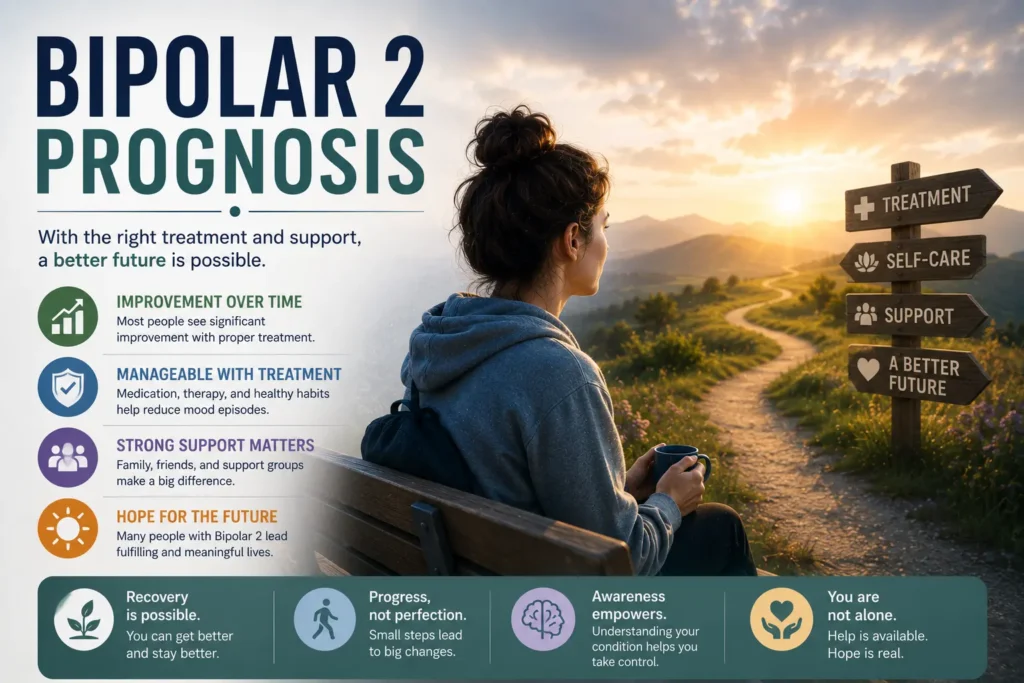
Bipolar 2 disorder is a lifelong condition, but “lifelong” doesn’t mean unmanageable. With consistent treatment, many people achieve long stretches of stability, hold down careers and relationships, and experience fewer, less severe episodes over time. Outcomes vary significantly from person to person, and are shaped by factors like how early treatment starts, how consistently it’s followed, and whether other conditions like substance use are also addressed. Bipolar disorder is also associated with increased health risks, including a higher risk of suicide, which is why ongoing care matters — but a diagnosis is not a fixed sentence about how someone’s life will go. For the foundational picture of the condition itself, see our guide to what is bipolar disorder.
Table of Contents
Key Takeaways
- Bipolar 2 disorder is chronic, but treatable — most people can achieve meaningful stability with the right care.
- Depressive episodes tend to dominate the course of bipolar 2 more than hypomanic ones.
- Early diagnosis and consistent treatment are strongly associated with better long-term outcomes.
- Bipolar disorder carries elevated health risks, including significantly higher suicide risk than the general population, particularly early in the illness course.
- Prognosis isn’t fixed — it shifts based on treatment adherence, lifestyle factors, and how well co-occurring conditions are managed.
What “Prognosis” Means for Bipolar 2 Disorder
Prognosis refers to the likely course and outcome of a condition over time — not a single prediction, but a range shaped by many factors specific to the individual. For bipolar 2, this means asking questions like: How often will episodes recur? How severe will they be? How much will the condition affect daily functioning, relationships, and physical health over a lifetime?
There’s no single answer that applies to everyone. Bipolar 2 disorder is classified as a chronic, recurring condition — episodes of hypomania and depression tend to come and go throughout life rather than resolving permanently — but the frequency, severity, and impact of those episodes differ enormously based on treatment, support, and individual biology. For the clinical basics behind this outlook, our overview of bipolar 2 disorder is a useful starting point, and if you haven’t yet reviewed the depressive and hypomanic sides of the illness individually, our guides to bipolar 2 hypomania and bipolar 2 depression cover those in depth.
The Typical Long-Term Course of Bipolar 2
Bipolar 2 disorder tends to be recurrent, meaning episodes come back over time rather than occurring once and resolving for good. A few patterns show up consistently in the research and clinical literature:
- Depression tends to dominate. People with bipolar 2 generally spend far more of their time in depressive episodes than in hypomanic ones, which is a major reason depression — not hypomania — is usually the bigger driver of long-term impairment.
- Residual symptoms between episodes are common. Many people continue to experience some mild depressive or hypomanic symptoms even outside of full episodes, rather than complete symptom-free stretches.
- The pattern can shift with age. Some research suggests the cycling between mood states can become more frequent over time in certain individuals, particularly without consistent treatment, though this varies widely.
- Function can improve even when mood symptoms persist somewhat. Many people learn to manage residual symptoms well enough to maintain stable work, relationships, and daily routines.
This is why treatment for bipolar 2 focuses on long-term management rather than a one-time cure — the goal is reducing the frequency and severity of episodes and protecting functioning between them, not eliminating the condition.
Factors That Influence Prognosis
| Factor | Effect on long-term outlook |
| Early diagnosis and treatment | Associated with better long-term outcomes; delayed diagnosis is linked to a more difficult course |
| Consistent medication adherence | Strongly linked to fewer relapses and more stable functioning |
| Ongoing therapy | Supports relapse prevention and helps manage residual symptoms |
| Substance use | Co-occurring alcohol or drug use is associated with a more severe course and worse outcomes |
| Sleep and routine stability | Disrupted sleep is a well-documented trigger for relapse |
| Social support | Strong support networks are linked to better functional outcomes |
| Co-occurring mental health conditions | Anxiety disorders and other comorbidities can complicate treatment and outcomes |
| Physical health conditions | Bipolar disorder is associated with higher rates of certain physical health conditions, which can affect overall prognosis |
| Access to consistent psychiatric care | Continuity of care is linked to more stable long-term management |
None of these factors work in isolation, and having one or more risk factors doesn’t determine a person’s individual outcome. They’re patterns seen across large groups of people, not predictions for any one individual. For a deeper look at what contributes to the condition in the first place, see our page on bipolar disorder causes.
Recurrence: What to Expect
Recurrence — the return of hypomanic or depressive episodes after a period of stability — is a defining feature of bipolar 2 disorder rather than a sign that treatment has failed. What varies is how often it happens and how severe each episode is.
Some general patterns worth understanding:
- Episodes can be triggered by identifiable factors (major stress, sleep disruption, substance use) or can occur without an obvious trigger.
- The risk of another episode is present throughout life, which is why ongoing treatment — even during stable periods — is typically recommended rather than stopping care once symptoms improve.
- Stopping medication without medical guidance, even after long stability, is strongly associated with relapse.
- Each person’s recurrence pattern tends to become more predictable over time as they and their care team learn their individual triggers and warning signs.
Our page on bipolar disorder treatment covers how ongoing, maintenance-phase treatment is structured to reduce recurrence risk.
Bipolar 2 Prognosis vs. Bipolar 1 Prognosis
This is a common point of confusion, since people often assume bipolar 2 automatically has a “better” outlook because it lacks full mania.
| Factor | Bipolar 2 | Bipolar 1 |
| Dominant mood state over time | Depression, more often | More variable; both depression and mania feature significantly |
| Psychosis risk | Not part of the diagnosis | Can occur during manic episodes |
| Hospitalization risk | Lower on average | Higher on average, particularly during mania |
| Functional impairment | Often driven more by chronic depressive symptoms | Often driven by acute manic episodes and their consequences |
| Overall course severity | Frequently underestimated; can be just as impairing as bipolar 1 | Often assumed to be more severe due to visible manic episodes |
Research increasingly challenges the idea that bipolar 2 is a “milder” version of bipolar 1. Depressive burden, in particular, is often comparable or even greater in bipolar 2, since these episodes tend to be more frequent and longer-lasting over a lifetime. Our dedicated comparison on bipolar 1 vs 2 which is worse explores this in more depth, and if you’re weighing the two conditions generally, bipolar 1 vs bipolar 2 is a good starting comparison.
Life Expectancy and Health Risks
This is a sensitive but important part of understanding prognosis. Large population studies have found that bipolar disorder overall is associated with reduced life expectancy compared to the general population — a gap attributed to both natural causes (such as cardiovascular disease) and unnatural causes, including suicide. This research generally covers bipolar disorder as a whole rather than separating bipolar 1 and bipolar 2 outcomes distinctly, so it’s important not to over-interpret specific numbers as applying precisely to bipolar 2 alone.
A few key points worth understanding:
- Suicide risk is significantly elevated in bipolar disorder compared to the general population, and this risk appears highest earlier in the course of illness.
- The depressive phase is specifically linked to elevated suicide risk, which reinforces why treating depressive episodes thoroughly — not just hypomanic ones — is so central to bipolar 2 care.
- Physical health conditions, including cardiovascular and metabolic conditions, occur at higher rates in people with bipolar disorder, which is part of why ongoing medical care (not just psychiatric care) matters.
- Early intervention and consistent treatment are associated with better outcomes on both fronts — reducing suicide risk and supporting better physical health management over time.
None of this is meant to be alarming for its own sake — it’s meant to underscore why sticking with treatment, even during stable periods, is protective in ways that go beyond mood symptoms alone. Our page on bipolar disorder complications covers these risks in more detail.
What Improves Long-Term Outcomes
| Action | Why it helps |
| Getting diagnosed and treated early | Associated with a less severe overall course |
| Staying consistent with medication | Reduces relapse frequency and severity |
| Continuing therapy even when stable | Supports relapse prevention, not just crisis management |
| Maintaining a regular sleep schedule | Sleep disruption is one of the most consistent relapse triggers |
| Limiting alcohol and substance use | Substance use is linked to worse outcomes and complicates treatment |
| Building a strong support system | Associated with better functional outcomes over time |
| Monitoring physical health | Addresses the broader health risks associated with the condition |
| Having a wellness or relapse-prevention plan | Helps catch early warning signs before a full episode develops |
Our practical guide to living with bipolar 2 walks through how to build these habits into daily life in more detail.
Myths vs. Facts About Bipolar 2 Prognosis
| Myth | Fact |
| “Bipolar 2 always gets worse over time.” | Course varies significantly; many people achieve long-term stability, especially with consistent treatment. |
| “Since there’s no full mania, bipolar 2 has an easy prognosis.” | Depressive burden in bipolar 2 is often substantial and can be just as impairing as bipolar 1’s manic episodes. |
| “Once you’re stable, you can stop treatment.” | Stopping treatment without medical guidance is strongly linked to relapse, even after long periods of stability. |
| “A bipolar 2 diagnosis means a shortened, difficult life no matter what.” | Outcomes vary widely and are strongly influenced by treatment access, consistency, and support — not fixed by diagnosis alone. |
| “Recurrence means treatment has failed.” | Recurrence is a known feature of the condition; it usually means treatment needs adjusting, not that it isn’t working at all. |
For a broader set of misconceptions about the condition, see our page on bipolar disorder myths.
A Practical Checklist for Supporting a Better Long-Term Outcome
- [ ] Working with a psychiatrist for ongoing medication management, not just during crises
- [ ] Attending therapy consistently, even during stable periods
- [ ] Keeping a regular sleep and daily routine
- [ ] Limiting alcohol and avoiding recreational drug use
- [ ] Having a written wellness or relapse-prevention plan
- [ ] Monitoring physical health with regular medical check-ups
- [ ] Staying connected to a support system of trusted people
- [ ] Addressing any co-occurring conditions (anxiety, substance use) directly with your care team
Warning Signs Worth Monitoring Long-Term
- A gradual increase in episode frequency or severity over time
- New or worsening physical health symptoms alongside mood symptoms
- Increasing difficulty maintaining daily routines or relationships over successive episodes
- Growing reliance on alcohol or substances to manage mood
- Any thoughts of suicide or self-harm, at any point in the illness course
When to Seek Emergency Help
Because suicide risk is a meaningful part of bipolar 2’s long-term picture, it’s important to take any of the following seriously:
- Thoughts of suicide or a specific plan to self-harm
- A sudden, severe worsening of depressive symptoms
- Statements suggesting someone no longer wants to be alive
- A sense of hopelessness that feels unmanageable
If you or someone else is in crisis, call or text 988 (Suicide & Crisis Lifeline) in the U.S., or contact local emergency services immediately. This is a sensitive topic, and if you’re personally struggling with these thoughts, reaching out to a mental health professional or crisis line is a meaningful, reasonable step to take.
Frequently Asked Questions
Does bipolar 2 get worse with age? Not necessarily. Course varies by individual; some research suggests episode frequency can increase without consistent treatment, but many people maintain stability long-term with proper care.
Can someone fully recover from bipolar 2? Bipolar 2 is generally understood as a chronic condition that’s managed rather than cured, but “recovery” in a functional sense — long stretches of stability, meaningful work and relationships — is achievable for many people with consistent treatment.
Does bipolar 2 shorten life expectancy? Research on bipolar disorder overall has found an association with reduced life expectancy compared to the general population, driven by both physical health conditions and suicide risk. This research generally covers bipolar disorder broadly rather than isolating bipolar 2 specifically, and consistent treatment is associated with better outcomes on both fronts.
Is bipolar 2 prognosis better or worse than bipolar 1? Neither is uniformly better. Bipolar 1 involves manic episodes and higher hospitalization risk, while bipolar 2 often involves a heavier, more chronic depressive burden. Severity in bipolar 2 is frequently underestimated for this reason.
What’s the biggest factor in improving prognosis? Consistent, ongoing treatment — medication and therapy — combined with stable routines and a strong support system are the factors most consistently linked to better long-term outcomes.
Does stopping medication once you feel better affect prognosis? Yes. Stopping medication without medical guidance, even after feeling stable for a long time, is strongly associated with relapse. Any medication changes should go through a prescriber.
How does bipolar 2 prognosis differ between men and women? Some research points to differences in symptom presentation and course between men and women with bipolar 2, though individual variation is significant. Our page on bipolar 1 vs 2 in men and women explores this further.
Summary
A bipolar 2 diagnosis describes a chronic, recurring condition — not a fixed outcome. Depression tends to be the dominant, most persistent challenge over time, and the illness does carry real long-term health risks, including elevated suicide risk, that deserve to be taken seriously rather than minimized. At the same time, consistent treatment, stable routines, and strong support are all linked to meaningfully better outcomes, and many people with bipolar 2 build full, stable lives around their diagnosis. If you’re trying to understand what your own long-term outlook might look like, that conversation belongs with a psychiatrist who knows your specific history — general patterns can inform that discussion, but they can’t replace it.
This article is for educational purposes and is not a substitute for professional medical advice. If you have concerns about your mental health, please consult a qualified healthcare provider.