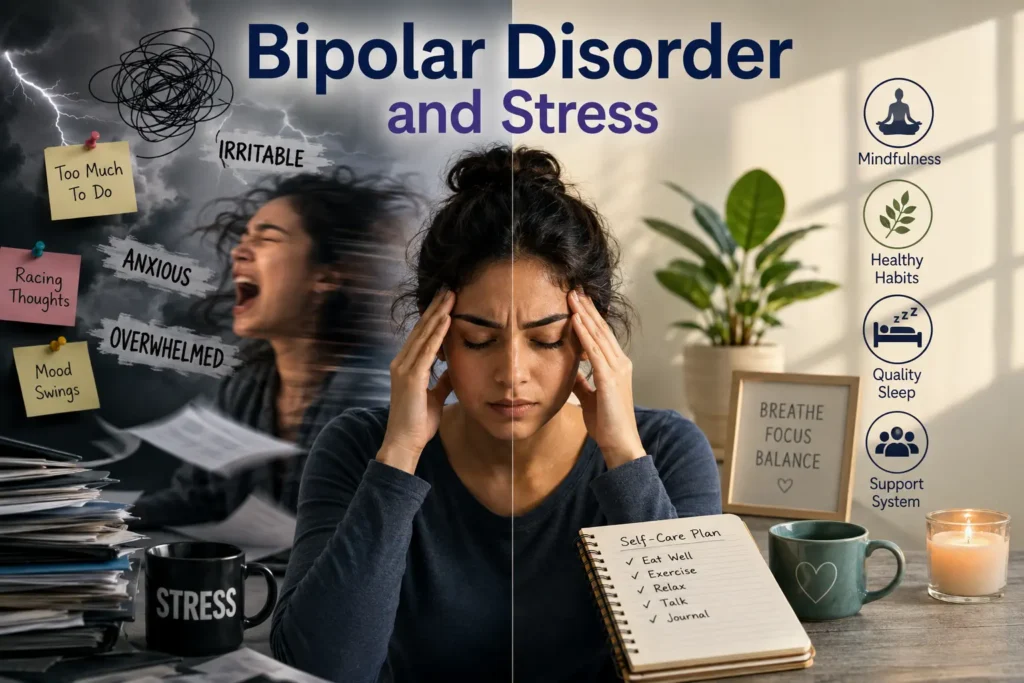
Bipolar Disorder and Stress are closely linked in both directions. Stressful events — from a job loss to a sleepless week to ongoing relationship conflict — are among the most common triggers for manic, hypomanic, and depressive episodes. At the same time, having bipolar disorder can make everyday stress harder to recover from, because the condition itself involves a stress-response system that doesn’t reset as easily as it does in people without the disorder. This isn’t a character flaw or a matter of willpower; it reflects real, measurable differences in how the body’s stress hormones behave in bipolar disorder. Managing stress well is one of the most practical, evidence-supported things a person can do to reduce the frequency and severity of episodes.
For the full clinical picture of the condition, see our guide to bipolar disorder.
Table of Contents
Key Takeaways
- Stress is one of the best-documented triggers for mood episodes in bipolar disorder, affecting mania, hypomania, and depression alike.
- People with bipolar disorder often show measurable differences in their stress hormone system (the HPA axis), including higher cortisol levels, which may explain why stress hits harder and lingers longer.
- The relationship runs both ways: stress can trigger episodes, and episodes create more stress in work, relationships, and finances, which raises the risk of future episodes.
- Not all stress is equal — sudden acute stress and chronic, low-grade stress affect mood differently, and both matter.
- Structured routines, therapy, and stress-reduction skills are core parts of relapse prevention, not optional extras.
- A stress-driven pattern of worsening symptoms is a signal to reach out for support early, before it escalates into a full episode.
Why Stress Affects Bipolar Disorder So Strongly
To understand why stress and bipolar disorder are so tightly connected, it helps to understand what stress actually does inside the body. When something stressful happens, the brain activates a chain of hormonal signals known as the hypothalamic-pituitary-adrenal axis, or HPA axis for short. This system releases cortisol, often called “the stress hormone,” which helps the body respond to short-term demands and then, ideally, settles back down once the stressor passes.
In bipolar disorder, this system doesn’t always settle back down the way it should. Research has repeatedly found that people with bipolar disorder tend to have elevated cortisol levels and reduced ability to shut the stress response off through normal feedback mechanisms. This pattern shows up not only during active mood episodes but, to some degree, even during stable periods — suggesting that HPA axis dysregulation may be a lasting feature of the condition rather than something that appears only when someone is unwell.
This matters clinically because a poorly regulated stress system means the same stressful event can have a bigger, longer-lasting effect on someone with bipolar disorder than it would on someone without the condition. It’s also part of why a difficult week doesn’t always “pass” the way it might for others — the biological stress response can stay activated longer, making a relapse more likely.
For background on the condition’s broader biology, see our guide on bipolar disorder causes and what is bipolar disorder.
The Two-Way Relationship Between Stress and Mood Episodes
It’s easy to think of stress as something that simply happens to a person with bipolar disorder. In reality, the relationship runs in a loop:
- Stress can trigger an episode. A stressful event — especially one that disrupts sleep, routine, or a sense of stability — can set off mania, hypomania, or depression, sometimes within days.
- Episodes create more stress. Missed work, strained relationships, financial strain, or hospitalization during an episode often generate new stressors that outlast the episode itself.
- HPA axis changes may persist between episodes. Because the stress-response system in bipolar disorder doesn’t fully normalize even during stable periods, each new stressor may have an outsized effect, especially if episodes have occurred repeatedly over time.
This cycle is one reason clinicians treat stress management as a genuine relapse-prevention tool rather than a “nice to have.” Breaking the loop earlier tends to be far easier than breaking it after several episodes have already occurred.
Acute Stress vs. Chronic Stress: Why the Difference Matters
Not all stress behaves the same way in bipolar disorder, and it’s worth separating two categories.
| Type of Stress | What It Looks Like | Typical Effect on Bipolar Disorder |
| Acute stress | A sudden, time-limited event: a car accident, an argument, a deadline, a piece of bad news | Can trigger a rapid shift toward mania, hypomania, or a depressive dip, especially if sleep is disrupted |
| Chronic stress | Ongoing pressure over weeks, months, or years: financial strain, caregiving, an unstable job, long-term relationship conflict | Associated with more frequent relapses, slower recovery between episodes, and greater treatment resistance over time |
Both matter, but chronic stress is often the harder one to recognize, because it doesn’t announce itself the way a single bad event does. Someone might not identify ongoing job insecurity or a strained marriage as “the cause” of a mood shift, even though the sustained pressure has been quietly keeping the HPA axis activated for months.
Common Stress Triggers in Bipolar Disorder
Stress triggers vary from person to person, but certain categories come up often enough to be worth naming directly:
- Sleep disruption — travel, shift work, a new baby, or an all-nighter (see our guide on bipolar disorder and sleep for how closely these two are linked)
- Major life transitions — a new job, moving, marriage, divorce, or having a child
- Financial pressure — job loss, debt, or sudden unexpected expenses
- Relationship conflict — ongoing tension with a partner, family member, or close friend
- Grief and loss — the death of a loved one or the end of a significant relationship
- Work or academic pressure — deadlines, exams, or a demanding workload
- Health scares — a new diagnosis, injury, or health concern, personal or in the family
- Seasonal and environmental shifts — some people notice patterns tied to daylight changes or time of year
For a fuller list of what can set off manic and depressive episodes beyond stress alone, see mania triggers and causes of mania.
How Stress Shows Up Differently Across Episode Types
Stress doesn’t always tip mood in the same direction. The response can look different depending on the phase someone is prone to.
| Episode Type | How Stress Often Shows Up | What It Can Look Like |
| Mania | Sudden onset following an acute stressor, especially one that disrupts sleep | Increased energy, racing thoughts, impulsivity, reduced need for sleep |
| Hypomania | Similar but milder pattern, sometimes following excitement as much as distress | Heightened productivity or sociability, subtle irritability |
| Bipolar depression | More often linked to chronic, ongoing stress than a single event | Withdrawal, fatigue, hopelessness, loss of interest |
| Mixed episode | Can follow either acute or chronic stress | Agitation and low mood occurring together, higher risk period |
To understand these episode types in more depth, see our guides on mania, hypomania, and mania vs. hypomania.
Building a Stress Management Plan That Actually Works for Bipolar Disorder
Generic stress-relief advice — “just relax,” “take a bath,” “think positive” — tends to fall short for bipolar disorder because it doesn’t address the underlying biology. A more effective approach usually combines a few specific strategies working together.
Core Strategies
- Protect a consistent daily routine. Regular sleep, meal, and activity timing helps stabilize the same circadian and stress-hormone systems that stress disrupts. Our guide to a bipolar daily routine covers this in detail.
- Build in early-warning tracking. A simple daily mood and stress log can catch a building pattern before it becomes a full episode.
- Use structured psychotherapy. Approaches like Cognitive Behavioral Therapy and Interpersonal and Social Rhythm Therapy are specifically designed to help identify stress-triggered thought patterns and stabilize routines. See bipolar therapy and cognitive behavioral therapy for bipolar disorder.
- Reduce avoidable chronic stressors where possible. This might mean addressing a toxic work situation, setting boundaries in a difficult relationship, or getting support with financial pressure — not eliminating stress entirely, but trimming what’s realistically changeable.
- Build a support network before a crisis hits. Family, friends, or support groups who understand the condition can help catch early warning signs that the person themselves might miss. See support for bipolar disorder.
- Stay consistent with medication and appointments, since untreated symptoms make the same stress hormone dysregulation worse, creating a harder cycle to break.
Dos and Don’ts for Managing Stress with Bipolar Disorder
| Do | Don’t |
| Keep sleep and routine as steady as possible during stressful periods | Let a stressful week completely upend your schedule |
| Track mood and stress together, even briefly | Wait until symptoms are severe to mention stress to your care team |
| Reach out to your support system early | Isolate when things start feeling overwhelming |
| Use structured coping skills learned in therapy | Rely on alcohol or substances to “take the edge off” |
| Talk to your prescriber if stress is escalating symptoms | Stop or change medication on your own during a stressful period |
| Recognize chronic, low-grade stress as a real risk factor | Assume only major crises count as “real” stress |
Myths vs. Facts About Stress and Bipolar Disorder
| Myth | Fact |
| “Stress causes bipolar disorder.” | Stress doesn’t cause bipolar disorder on its own — the condition develops from a mix of genetic and biological factors (see bipolar disorder causes) — but it’s a well-documented trigger for episodes in people who already have it. |
| “If I just stay calm, I won’t have an episode.” | Stress management reduces risk, but it doesn’t eliminate it. Bipolar disorder requires medical treatment, and stress reduction works best as one part of a broader plan, not a replacement for it. |
| “Only big, dramatic events count as stress triggers.” | Chronic, low-grade stress — an unhappy job, ongoing family tension — is just as capable of contributing to relapse as a single major life event, sometimes more so because it’s harder to notice. |
| “People with bipolar disorder are just more sensitive to stress.” | The heightened response reflects measurable differences in stress-hormone regulation, not a personality trait or lack of resilience. |
| “Positive stress, like a wedding or promotion, doesn’t count.” | Positive but disruptive events can still trigger episodes, particularly if they disrupt sleep or routine, so they’re worth monitoring too. |
For a broader list of misconceptions about the condition itself, see bipolar disorder myths.
Warning Signs That Stress Is Building Toward an Episode
Certain changes are worth paying closer attention to, since they often show up before a full episode develops:
- Increasing irritability or a shorter fuse than usual
- Sleep changes — either trouble falling asleep or a reduced need for sleep with no fatigue
- Racing thoughts, rapid speech, or a jump in energy and impulsivity
- Withdrawing from people, activities, or responsibilities
- A drop in motivation, mood, or interest lasting more than a few days
- Increased use of alcohol or other substances to cope
- A noticeable sense of being “on edge” that doesn’t ease up
Catching this pattern early — and reaching out to a therapist, psychiatrist, or trusted support person — tends to make a real difference in how severe the resulting episode becomes, if it happens at all.
When to Seek Emergency Help
Most stress-related mood shifts build gradually, which allows time to intervene. Some signs, though, call for immediate care rather than a scheduled appointment:
- Thoughts of suicide or self-harm
- Behavior that puts the person or others at immediate risk
- Signs of psychosis — hallucinations, delusions, or severely disorganized thinking
- A rapid escalation of manic or depressive symptoms over 24–48 hours
If any of these apply, contact a crisis line, go to an emergency department, or call emergency services. In the US, the 988 Suicide & Crisis Lifeline is available anytime by call or text. If you’re personally struggling right now, please reach out to one of these resources rather than waiting things out alone.
How Stress Fits Into Diagnosis and Long-Term Monitoring
Clinicians routinely ask about recent life stressors when assessing bipolar symptoms, both to understand what may have triggered a current episode and to help build a personalized relapse-prevention plan. Stress history doesn’t diagnose bipolar disorder on its own, but it’s part of the broader clinical picture used alongside criteria from the DSM-5. To understand the full diagnostic process, see our guides on bipolar disorder diagnosis and DSM-5 bipolar disorder.
Ongoing stress monitoring is also increasingly used as a maintenance tool. Because the HPA axis abnormalities seen in bipolar disorder appear to persist even during stable periods, some treatment plans incorporate regular stress check-ins, mood tracking apps, or scheduled therapy sessions specifically to catch a stress-driven pattern before it turns into a relapse.
Complications of Long-Term, Unmanaged Stress
Left unaddressed, chronic stress in bipolar disorder is linked to outcomes worth taking seriously:
- More frequent mood episodes and shorter periods of stability between them
- Greater treatment resistance over time, based on associations between HPA axis dysfunction and poorer illness outcomes
- Increased risk of cognitive difficulties, including memory and concentration problems
- Strained relationships, work instability, and reduced overall quality of life
- Higher likelihood of turning to alcohol or substances as an unhealthy coping mechanism
For more on how untreated symptoms compound over time, see bipolar disorder complications and bipolar disorder prognosis.
Frequently Asked Questions
Can stress cause bipolar disorder? No, stress alone doesn’t cause bipolar disorder — it develops from genetic and biological factors, explained in more detail in our guide to bipolar disorder causes. Stress is better understood as a trigger for episodes in people who already have the condition, or possibly a contributing factor in those who are genetically vulnerable.
Why does stress affect people with bipolar disorder more than others? Research has found that people with bipolar disorder often have measurable differences in their HPA axis, the body’s main stress-hormone system, including elevated cortisol and reduced ability to switch the stress response off efficiently. This may explain why stress tends to have a stronger and longer-lasting effect.
Can good stress, like a wedding or a promotion, trigger an episode? Yes. Positive events that are still disruptive — especially to sleep and routine — can trigger mania or hypomania in some people, even though they aren’t negative experiences.
How is stress-triggered bipolar disorder treated? There’s no separate “stress-triggered” category of bipolar disorder requiring different treatment. Management still combines medication, therapy, and lifestyle stability — stress management is simply one component. See our overview of bipolar disorder treatment.
Does chronic stress make bipolar disorder harder to treat over time? Evidence suggests that ongoing HPA axis dysregulation is associated with increased treatment resistance and more frequent relapses, which is part of why managing chronic stress early is considered valuable rather than optional.
What’s the fastest way to calm down during a stressful moment with bipolar disorder? There’s no universal quick fix, but grounding techniques, brief physical activity, and reaching out to a support person are commonly used short-term strategies. Longer-term stability depends more on consistent routine, therapy, and treatment than on any single in-the-moment technique.
Should I tell my psychiatrist about ongoing life stress even if I feel stable? Yes. Because stress effects can build up before symptoms appear, mentioning ongoing stressors — even during stable periods — helps your care team adjust support before a relapse develops.
Summary
Stress and bipolar disorder reinforce each other in a loop: stress can trigger episodes, and episodes generate more stress in return. Underlying this pattern are real, measurable differences in how the body’s stress-hormone system behaves in bipolar disorder, which is why stress often has an outsized and longer-lasting effect. The most effective response isn’t trying to eliminate stress — that’s not realistic for anyone — but building routines, therapy, tracking, and support that catch a stress-driven pattern early, before it escalates. If stress feels like it’s consistently pulling your mood off course, that’s worth raising with a psychiatrist or therapist directly rather than managing alone.
To understand how stress fits into the wider condition, start with our guide to bipolar disorder, or explore bipolar disorder symptoms and types of bipolar disorder for more on how the condition presents.
This article is for educational purposes and isn’t a substitute for personalized medical advice. If you’re concerned about your mood or stress levels, talk to a psychiatrist, therapist, or primary care provider.