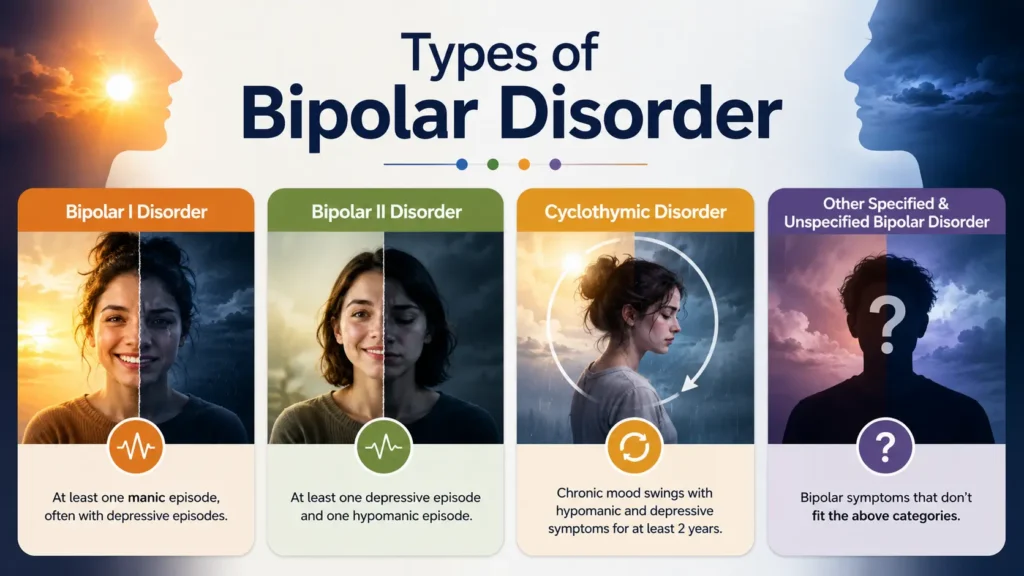
There are four recognized types of bipolar disorder: Bipolar I, Bipolar II, Cyclothymic disorder, and Other Specified or Unspecified Bipolar and Related Disorders. Each type is defined by the pattern, severity, and duration of mood episodes — not by how “bad” someone’s life looks from the outside. Bipolar I involves at least one full manic episode. Bipolar II involves hypomania paired with major depression, but never full mania. Cyclothymia is a milder, longer-lasting pattern of mood swings. The fourth category covers symptom patterns that don’t fit neatly into the other three.
If you’re trying to figure out which type applies to you or someone you love, this guide breaks down what actually separates them — with real diagnostic criteria, not guesswork.
Table of Contents
Key Takeaways
- Bipolar disorder isn’t one condition with different severity levels — it’s a spectrum of distinct diagnostic patterns.
- The main difference between Bipolar I and Bipolar II is the presence of full mania (Bipolar I) versus hypomania only (Bipolar II).
- Cyclothymia is often mistaken for a “personality trait” or mood instability, but it’s a genuine, diagnosable mood disorder.
- Only a licensed mental health professional can diagnose which type someone has — self-diagnosis based on online quizzes isn’t reliable.
- Rapid cycling (four or more mood episodes in a year) can happen within any of the bipolar types; it’s a course specifier, not a separate diagnosis.
- Getting an accurate diagnosis matters because treatment approaches differ between types.
What Bipolar Disorder Actually Is
Bipolar disorder is a brain-based condition that causes unusual, often intense shifts in mood, energy, and activity levels. It was once known as manic-depressive illness. If you want the full picture of what this condition involves — causes, prevalence, and how it develops — our complete guide to bipolar disorder covers that in depth. This article focuses specifically on the different subtypes.
The reason “types” matter so much is that bipolar disorder doesn’t look the same in every person. Two people can both technically have “bipolar disorder” and experience completely different symptom patterns, treatment needs, and day-to-day realities. The American Psychiatric Association’s Diagnostic and Statistical Manual (DSM-5-TR) splits bipolar and related disorders into distinct categories precisely because lumping them together led to missed diagnoses and mismatched treatment for years.
The 4 Recognized Types of Bipolar Disorder
Here’s the short version before we go deep on each one.
| Type | Core Feature | Mania Level | Typical Episode Length |
| Bipolar I | At least one manic episode | Full mania | Manic episode: 7+ days (or any length if hospitalized) |
| Bipolar II | Hypomania + major depression | Hypomania only, never full mania | Hypomanic episode: 4+ days |
| Cyclothymic Disorder | Chronic, milder mood swings | Sub-threshold hypomanic symptoms | Ongoing pattern for 2+ years |
| Other Specified/Unspecified | Symptoms that don’t fit the above | Varies | Varies |
Let’s unpack each one.
1. Bipolar I Disorder
Bipolar I is defined by the occurrence of at least one manic episode that lasts at least seven days, or mania so severe the person requires hospitalization. Most people with Bipolar I also experience major depressive episodes, typically lasting two weeks or longer, though technically a depressive episode isn’t required for diagnosis.
During a manic episode, a person might experience:
- Abnormally elevated, expansive, or irritable mood
- A sharp increase in energy or goal-directed activity
- Racing thoughts and rapid speech
- Decreased need for sleep (feeling rested after 2–3 hours)
- Inflated self-esteem or grandiosity
- Impulsive or risky behavior — spending sprees, reckless driving, risky sexual behavior
Some people with Bipolar I also experience psychotic features during severe manic or depressive episodes, such as delusions or hallucinations. This is one reason Bipolar I is generally considered the most acute type in terms of crisis risk, even though it isn’t necessarily “worse” in terms of overall quality of life than other types.
For a full symptom breakdown by episode type, see our dedicated bipolar disorder symptoms guide. We won’t duplicate that detail here.
2. Bipolar II Disorder
Bipolar II is defined by a pattern of major depressive episodes and hypomanic episodes — but the person has never had a full manic episode. If a full manic episode ever occurs, the diagnosis changes to Bipolar I.
Hypomania is a real and important clinical entity — it’s not “mild bipolar.” A hypomanic episode requires:
- Elevated, expansive, or irritable mood lasting at least 4 consecutive days
- Noticeable change in functioning that others can observe
- No psychotic features and no need for hospitalization (if either is present, it’s mania, not hypomania)
Here’s the part people often misunderstand: Bipolar II is not “less severe” than Bipolar I overall. Many people with Bipolar II spend extended stretches in a low-grade, persistent depressive state, and depressive episodes in Bipolar II tend to be more frequent and longer-lasting than in Bipolar I. Because hypomania can feel productive or even pleasant, it’s frequently missed by both patients and clinicians, which means Bipolar II is often misdiagnosed as major depression for years before it’s correctly identified.
If you want a side-by-side breakdown of exactly how these two types differ in practice, our guide on Bipolar 1 vs Bipolar 2 covers it in detail.
3. Cyclothymic Disorder (Cyclothymia)
Cyclothymic disorder is a chronic pattern of mood instability involving numerous periods of hypomanic symptoms and numerous periods of depressive symptoms, neither of which is severe enough or long enough to meet full criteria for a hypomanic or major depressive episode.
Diagnostic criteria generally require:
- Symptoms present for at least 2 years in adults (1 year in children and teens)
- The person has not been symptom-free for more than 2 months at a stretch during that period
- Symptoms cause meaningful distress or impairment, but don’t meet full episode criteria
Cyclothymia is frequently under-recognized because the mood swings can look like “just having an up-and-down personality.” But it’s a genuine mood disorder, and it carries real clinical significance: research indicates cyclothymia can progress into full Bipolar I or Bipolar II disorder over time in a meaningful subset of people, which is one reason early recognition matters.
4. Other Specified and Unspecified Bipolar and Related Disorders
This category exists for a simple reason: some people have real bipolar symptoms that genuinely don’t fit the exact timing or severity thresholds of the three types above. Rather than forcing an inaccurate diagnosis, clinicians use this category — previously called “Bipolar Disorder NOS” (not otherwise specified) in earlier diagnostic manuals.
This might apply to someone who has, for example, hypomanic episodes lasting only 2–3 days (instead of the required 4), or depressive episodes alongside hypomanic symptoms that don’t add up to a full 2-year cyclothymic pattern. It also includes bipolar-like symptoms caused by substance use or an underlying medical condition, which clinicians code separately as substance/medication-induced or medical-condition-related bipolar disorder.
This category is diagnosed more often in children and adolescents, partly because mood episode patterns in youth don’t always cleanly match adult diagnostic criteria, and partly because it can serve as a placeholder while a clinician gathers more information over time.
Bipolar I vs. Bipolar II vs. Cyclothymia: A Direct Comparison
| Feature | Bipolar I | Bipolar II | Cyclothymia |
| Full manic episode? | Yes (required) | Never | Never |
| Hypomanic episode? | Sometimes | Yes (required) | Sub-threshold symptoms only |
| Major depressive episode? | Common, not required | Required | Sub-threshold symptoms only |
| Psychosis possible? | Yes, during severe episodes | No | No |
| Minimum symptom duration | Mania: 7+ days | Hypomania: 4+ days | 2+ years of pattern |
| Hospitalization risk | Higher, due to mania | Lower, but depression risk is high | Lower |
| Common misdiagnosis | Schizophrenia (during psychosis) | Major depressive disorder | Personality disorder or “mood instability” |
Where “Rapid Cycling” Fits In
Rapid cycling isn’t a fifth type of bipolar disorder — it’s a course specifier that can apply to Bipolar I or Bipolar II. It describes experiencing four or more distinct mood episodes (manic, hypomanic, or depressive) within a 12-month period. Research suggests rapid cycling is more common in Bipolar II than Bipolar I, and more frequently reported in women. It tends to signal a more complicated course of illness and often calls for a different treatment approach — which is a good example of why knowing your specific type (and specifiers) matters for treatment planning, not just for labeling purposes.
Why Getting the Right Type Matters for Diagnosis and Treatment
A psychiatrist or clinical psychologist determines the type of bipolar disorder through a structured clinical interview, a detailed history of mood episodes, and often input from family members who may have observed episodes the patient doesn’t fully remember (this is especially true for mania, which can distort self-perception).
Misdiagnosis is common and understandable — hypomania can be mistaken for “just having a good week,” and depressive episodes in Bipolar II are often diagnosed as standalone major depressive disorder for years before a clinician recognizes the hypomanic pattern underneath. This is one reason antidepressant-only treatment can sometimes worsen bipolar symptoms if the bipolar nature of the illness hasn’t been identified yet.
We cover the full diagnostic process, mood charting, and what to expect from a psychiatric evaluation in our guide to bipolar disorder symptoms. For the biological, environmental, and genetic factors behind why some people develop one type over another, see our article on bipolar disorder causes.
Myths vs. Facts About Bipolar Types
| Myth | Fact |
| “Bipolar II is just a milder version of Bipolar I.” | Bipolar II involves different episode criteria, not simply “less” of the same thing. Depressive burden is often heavier in Bipolar II. |
| “Cyclothymia isn’t a real diagnosis, it’s just moodiness.” | Cyclothymia is a formally recognized DSM-5-TR diagnosis with specific duration and severity criteria. |
| “If you’ve never had a manic episode, you can’t have bipolar disorder.” | Bipolar II and cyclothymia both exist without full mania ever occurring. |
| “Rapid cycling means someone’s mood shifts within the same day.” | Rapid cycling refers to four or more distinct episodes across a year, not daily mood changes (which is sometimes called “ultradian cycling” and is far less common). |
| “Bipolar type never changes over a person’s life.” | A cyclothymia or Bipolar II diagnosis can shift to Bipolar I if a full manic episode later occurs. |
How Common Is Each Type?
Reliable population-level data broken down by specific bipolar subtype is limited, but the National Institute of Mental Health (NIMH) reports that <cite index=”14-1″>an estimated 2.8% of U.S. adults had bipolar disorder in the past year, with a lifetime prevalence of about 4.4% among adults.</cite> Broader estimates that include milder, subthreshold presentations across the full bipolar spectrum suggest the number affected globally may be higher. Rapid cycling, specifically, has been found in <cite index=”13-1″>roughly 16% of bipolar patients in research samples, and is more strongly associated with Bipolar II than Bipolar I.</cite>
Warning Signs That Warrant Professional Evaluation
Regardless of which type someone may have, these signs suggest it’s time to seek a professional evaluation rather than waiting things out:
- Periods of unusually high energy, minimal sleep need, and rapid speech that last several days
- Depressive periods that significantly interfere with work, relationships, or daily functioning
- Mood swings that feel disconnected from what’s actually happening in someone’s life
- A pattern noticed by close family or friends before the person notices it themselves
- Impulsive decisions made during “up” periods that cause regret or damage afterward
Emergency Help
If you or someone you know is experiencing thoughts of suicide or self-harm, this is a medical emergency. In the United States, call or text 988 to reach the Suicide & Crisis Lifeline, available 24/7. If there is immediate danger, call 911 or go to the nearest emergency room. Severe mania with psychosis or severe depression with suicidal thoughts both warrant urgent psychiatric evaluation — don’t wait for a scheduled appointment.
Frequently Asked Questions
What are the 4 main types of bipolar disorder? Bipolar I, Bipolar II, cyclothymic disorder, and other specified/unspecified bipolar and related disorders.
What is the most severe type of bipolar disorder? Bipolar I is generally considered the most acute in terms of crisis risk, since full manic episodes can involve psychosis and require hospitalization. However, “severity” also depends on depressive burden, which can be significant in Bipolar II as well.
Can Bipolar II turn into Bipolar I? Yes. If someone previously diagnosed with Bipolar II later experiences a full manic episode, their diagnosis is updated to Bipolar I.
Is cyclothymia a mild form of bipolar disorder? Cyclothymia involves milder, sub-threshold symptoms compared to Bipolar I or II, but it’s still a chronic condition that can meaningfully affect daily life and relationships, and it can progress to Bipolar I or II over time.
What’s the difference between mania and hypomania? Mania is more severe, lasts at least 7 days (or requires hospitalization), and can include psychosis. Hypomania lasts at least 4 days, doesn’t include psychosis, and doesn’t require hospitalization.
Can someone have more than one type of bipolar disorder? No — a person is diagnosed with one type based on their episode history at a given point in time, though that classification can be updated if their symptom pattern changes (for example, Bipolar II changing to Bipolar I).
Is rapid cycling a type of bipolar disorder? No, it’s a specifier that describes the frequency of episodes (four or more within a year) and can apply within Bipolar I or Bipolar II.
Do children get diagnosed with a specific bipolar type? Children and teens are more often diagnosed with “other specified or unspecified bipolar and related disorder” because their symptom patterns don’t always cleanly match adult diagnostic thresholds.
Summary
Bipolar disorder isn’t a single, uniform condition — it’s a spectrum made up of four distinct diagnostic types, each defined by the presence, severity, and duration of manic, hypomanic, and depressive episodes. Bipolar I requires full mania. Bipolar II requires hypomania alongside major depression, without ever crossing into full mania. Cyclothymia is a chronic, milder pattern lasting two years or more. And the “other specified/unspecified” category exists for symptom patterns that don’t fit neatly elsewhere.
None of these types can be accurately self-diagnosed from a checklist — an evaluation from a psychiatrist or licensed mental health professional is the only reliable way to know which type applies to you. If you recognize these patterns in yourself or someone you care about, reaching out for a professional evaluation is the most useful next step you can take.
This article is for educational purposes and is not a substitute for professional medical advice, diagnosis, or treatment. Always consult a qualified healthcare provider with questions about a medical condition.
Sources: National Institute of Mental Health (NIMH), American Psychiatric Association (DSM-5-TR), World Health Organization (WHO), Cleveland Clinic, Mayo Clinic, NHS.