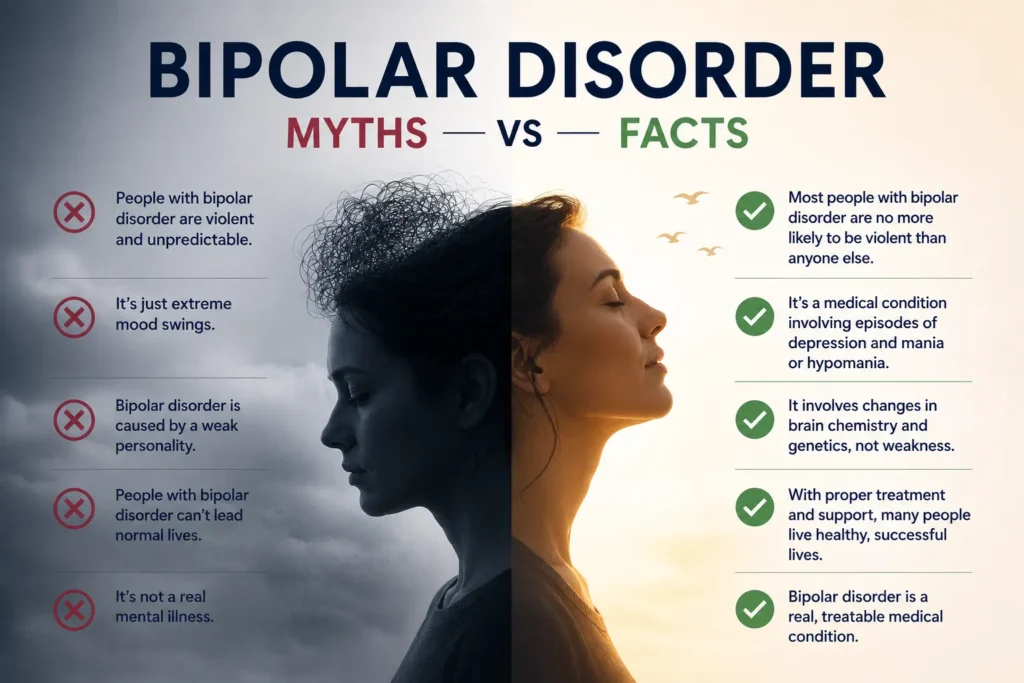
Bipolar Disorder Myths vs Facts: Bipolar disorder is one of the most misunderstood conditions in mental health. It isn’t “just mood swings,” it isn’t the same as being unpredictable or dramatic, and it isn’t something a person can simply “snap out of.” It’s a chronic brain-based condition marked by distinct episodes of mania or hypomania and depression, and it’s treatable with the right combination of medication, therapy, and lifestyle support. Below, we break down the most common Bipolar Disorder Myths vs Facts and replace them with what the clinical evidence actually shows.
Table of Contents
Key Takeaways
- Bipolar disorder is a diagnosable medical condition, not a personality trait or a character flaw.
- Mood episodes in bipolar disorder are distinct, sustained shifts — not everyday moodiness.
- Bipolar disorder is treatable, and many people manage it well long-term with consistent care.
- Myths about bipolar disorder fuel stigma, delay diagnosis, and discourage people from seeking help.
- Understanding the real symptoms (covered in our bipolar disorder symptoms guide) is the first step toward recognizing misinformation.
Why Bipolar Myths Are So Persistent
Bipolar disorder gets misrepresented constantly — in movies, in casual conversation, and even in workplaces where the word “bipolar” is used as a throwaway insult for someone who changed their mind twice in a day. That casual misuse has consequences. It trains people to picture bipolar disorder as unpredictability or drama rather than what it actually is: a diagnosable mental health condition involving distinct types of mood episodes that can seriously affect a person’s functioning, relationships, and safety.
The gap between public perception and clinical reality isn’t harmless. According to the National Institute of Mental Health (NIMH), bipolar disorder is a recognized, well-studied condition with established diagnostic criteria under the DSM-5, published by the American Psychiatric Association. Yet myths continue to shape how people are treated at home, at work, and even in some healthcare settings. Getting the facts right matters — for people living with bipolar disorder and for everyone who knows someone who does.
If you’re new to the topic, our overview of what bipolar disorder is is a good starting point before diving into the myths below.
Myth 1: “Bipolar Disorder Just Means Mood Swings”
The myth: Anyone who’s moody, indecisive, or has a bad day is “a little bipolar.”
The fact: Bipolar disorder involves distinct mood episodes — mania, hypomania, or depression — that typically last days to weeks and represent a clear change from a person’s normal functioning. This is fundamentally different from everyday emotional ups and downs, which are usually tied to specific triggers and pass within hours.
A manic episode, for example, isn’t just “being in a great mood.” It can include a sharply reduced need for sleep, racing thoughts, impulsive decision-making, and behavior that’s noticeably out of character. A depressive episode isn’t just sadness — it can include persistent low energy, loss of interest in daily activities, and difficulty functioning at work or school. For a full breakdown of what these episodes look like, see our detailed guide to bipolar disorder symptoms.
Myth 2: “There’s Only One Type of Bipolar Disorder”
The myth: All bipolar disorder looks the same.
The fact: Bipolar disorder exists on a spectrum, and the DSM-5 recognizes several distinct forms, including Bipolar I, Bipolar II, and cyclothymic disorder. They differ mainly in the intensity and pattern of manic, hypomanic, and depressive episodes. Bipolar I involves at least one full manic episode, while Bipolar II involves hypomanic episodes (a less severe form of mania) paired with depressive episodes.
This distinction matters clinically because treatment approaches and monitoring needs can differ. For a full comparison, visit our guide to the types of bipolar disorder.
Myth 3: “People With Bipolar Disorder Are Always Either Manic or Depressed”
The myth: Someone with bipolar disorder is constantly cycling between extreme highs and lows.
The fact: Many people with bipolar disorder spend significant stretches of time in a stable, euthymic (balanced) mood state, especially with consistent treatment. Episodes are not constant — they come and go, often with periods of normal functioning in between. Believing otherwise can make people assume every mood a person shows is “part of their bipolar,” which isn’t accurate and can be dismissive.
Myth 4: “Bipolar Disorder Is Caused By Bad Parenting or a Weak Character”
The myth: People develop bipolar disorder because of poor upbringing, lack of discipline, or personal weakness.
The fact: Bipolar disorder is understood to result from a combination of genetic, biological, and environmental factors — not personal failings. Research referenced by organizations like the NIMH points to differences in brain structure and function, along with a strong genetic component; having a close relative with bipolar disorder increases risk. Environmental stressors can act as triggers, but they don’t “cause” the condition on their own.
Blaming the person — or their family — for a medical condition is both inaccurate and harmful. For a deeper look at contributing factors, see our article on bipolar disorder causes.
Myth 5: “Only Adults Get Bipolar Disorder”
The myth: Bipolar disorder only affects grown adults.
The fact: Bipolar disorder can begin in adolescence, and while diagnosis in children is more complex and requires careful evaluation, it isn’t exclusively an adult condition. Symptoms can look different in younger people, which is one reason accurate diagnosis at any age should involve a qualified mental health professional rather than self-assessment.
Myth 6: “Bipolar Disorder Means Someone Is Dangerous or Violent”
The myth: People with bipolar disorder are unpredictable and prone to violence.
The fact: This is one of the most damaging myths, and it isn’t supported by clinical evidence. The overwhelming majority of people with bipolar disorder are not violent. Mental health conditions, including bipolar disorder, are far more likely to result in a person being a victim of violence than a perpetrator of it. This myth contributes directly to workplace discrimination, social exclusion, and reluctance to disclose a diagnosis — all forms of stigma that make recovery harder, not easier.
Myth 7: “You Can Tell Someone Has Bipolar Disorder Just By Looking at Them”
The myth: Bipolar disorder is obvious from someone’s behavior or appearance.
The fact: Bipolar disorder is an internal, often invisible condition. Many people manage it well and function effectively at work, in relationships, and in daily life without others ever suspecting a diagnosis. Assuming you can “spot” bipolar disorder in someone reinforces stereotypes and can lead to misdiagnosis or missed diagnosis in people who don’t fit the stereotype.
Myth 8: “Bipolar Disorder Can Be Diagnosed With a Quick Online Quiz”
The myth: A short internet quiz or checklist can confirm whether someone has bipolar disorder.
The fact: A proper diagnosis requires a comprehensive clinical evaluation by a qualified professional — typically a psychiatrist or psychologist — using established criteria such as those in the DSM-5. This process usually involves a detailed history of mood episodes, family history, and ruling out other conditions that can mimic bipolar disorder, such as thyroid problems or substance-related mood changes. Online quizzes can raise awareness, but they are not a substitute for clinical assessment. Learn more about what an accurate evaluation involves in our guide to bipolar disorder diagnosis.
Myth 9: “Medication Is the Only Treatment That Matters”
The myth: Once medication is prescribed, nothing else about treatment matters.
The fact: Medication, such as mood stabilizers, is often a central part of managing bipolar disorder, but it’s usually most effective alongside psychotherapy, routine-building, and lifestyle strategies like consistent sleep. The American Psychiatric Association and organizations like the Mayo Clinic and Cleveland Clinic generally describe treatment as a combined approach rather than medication alone. Our guide to bipolar disorder treatment covers this in more depth.
Myth 10: “People With Bipolar Disorder Can’t Live Normal, Successful Lives”
The myth: A bipolar diagnosis means someone can’t hold a job, maintain relationships, or live independently.
The fact: With consistent treatment and support, many people with bipolar disorder lead full, stable, and successful lives — building careers, maintaining relationships, and raising families. Outcomes vary from person to person, as they do with many chronic health conditions, but “can’t live a normal life” is not an accurate blanket statement. This myth can be especially discouraging to someone newly diagnosed, and it doesn’t reflect the reality that many people describe once they find an effective treatment routine.
Myth 11: “Bipolar Disorder Is Rare”
The myth: Almost no one actually has bipolar disorder — it’s an overused label.
The fact: Bipolar disorder is a well-documented condition that affects a meaningful portion of the population worldwide, according to data tracked by organizations like the WHO and NIMH. It’s far from a fringe diagnosis, even though public understanding hasn’t caught up with how common and well-studied it is. For a closer look at prevalence data, see our page on bipolar disorder statistics.
Myth 12: “If Someone Seems Fine, They Don’t Really Have Bipolar Disorder”
The myth: A stable-looking person must have been misdiagnosed, or wasn’t “really” ill in the first place.
The fact: Stability is often a sign that treatment is working — not evidence the diagnosis was wrong. Effective management can mean a person shows no visible symptoms for long stretches. Treating stability as proof someone “doesn’t really have it” discourages people from staying consistent with treatment, since visible improvement gets misread as unnecessary care.
Myth 13: “Bipolar Disorder Is the Same as Borderline Personality Disorder”
The myth: Bipolar disorder and borderline personality disorder (BPD) are basically the same thing because both involve mood instability.
The fact: These are distinct diagnoses with different clinical criteria. Bipolar disorder involves discrete mood episodes lasting days to weeks, while BPD is characterized by rapid mood shifts often tied to interpersonal triggers, along with patterns affecting identity and relationships. They can share some surface features, which is exactly why an accurate, professional evaluation matters instead of self-diagnosis based on symptom overlap.
Myth 14: “People With Bipolar Disorder Enjoy the Manic Highs, So It’s Not That Serious”
The myth: Mania is basically a fun, energized state, so bipolar disorder isn’t a “real” hardship.
The fact: While some people describe early hypomania as enjoyable or productive-feeling, full manic episodes often become distressing and destabilizing — leading to impaired judgment, risky decisions, financial or relational damage, and sometimes hospitalization. Mania is not simply a pleasant burst of energy; left unmanaged, it can be one of the most disruptive and dangerous aspects of the condition.
Myth 15: “There’s Nothing You Can Do to Prevent a Bipolar Episode”
The myth: Episodes come out of nowhere and can’t be managed or anticipated.
The fact: While bipolar disorder can’t be “cured” or entirely prevented from developing, many people learn to recognize early warning signs of an oncoming episode — like changing sleep patterns — and work with their care team to intervene early. Structured routines, medication adherence, stress management, and regular check-ins with a provider can meaningfully reduce the frequency and severity of episodes for many people.
Bipolar Myths vs. Facts: Quick Comparison Table
| Myth | Fact |
| Bipolar disorder is just mood swings | It involves distinct, sustained episodes of mania/hypomania and depression |
| There’s only one type of bipolar disorder | Bipolar I, Bipolar II, and cyclothymic disorder are clinically distinct |
| People with bipolar are always manic or depressed | Many experience stable, balanced periods between episodes |
| It’s caused by bad parenting or weak character | It stems from genetic, biological, and environmental factors |
| Only adults develop bipolar disorder | It can begin in adolescence |
| People with bipolar disorder are violent | Most are not violent; they’re more often victims of violence |
| You can spot it by looking at someone | It’s often invisible and well-managed |
| An online quiz can diagnose it | Diagnosis requires a full clinical evaluation |
| Medication alone is the whole treatment | Treatment usually combines medication, therapy, and lifestyle support |
| People with bipolar can’t succeed in life | Many live stable, successful lives with treatment |
| Bipolar disorder is rare | It’s a well-documented condition affecting a meaningful share of the population |
| A stable person must be misdiagnosed | Stability often reflects effective treatment |
| It’s the same as borderline personality disorder | They are distinct diagnoses with different criteria |
| Mania is just a fun high | Mania is often distressing and can be dangerous if unmanaged |
| Episodes can’t be anticipated or reduced | Early warning signs and routine can help reduce episode severity |
How Bipolar Stigma Shows Up in Everyday Life
Bipolar stigma doesn’t usually show up as an outright insult. It’s often quieter than that:
- A manager quietly passing someone over for a promotion after learning about their diagnosis.
- Friends walking on eggshells, unsure how to act around someone who’s disclosed a diagnosis.
- Family members dismissing a depressive episode as “just laziness.”
- People avoiding treatment or refusing to disclose their diagnosis at work out of fear of judgment.
This kind of stigma is one of the main reasons myths matter beyond simple misinformation — they shape real decisions about hiring, relationships, and whether someone feels safe seeking help in the first place.
Warning Signs Worth Knowing
Understanding real symptoms helps counter myths more effectively than any list of “don’ts.” Some patterns worth being aware of include:
- A sudden, sustained drop in need for sleep without feeling tired
- Rapid, pressured speech or racing thoughts
- Impulsive spending, risk-taking, or decision-making that’s out of character
- Prolonged low mood, hopelessness, or loss of interest in daily activities
- Noticeable changes in energy or activity levels lasting more than a few days
These are general patterns, not a diagnostic checklist. For the full clinical picture, see our guide to bipolar disorder symptoms.
When to Seek Emergency Help
If you or someone you know is experiencing thoughts of suicide or self-harm, or is in a state of severe mania that includes danger to themselves or others, this is a mental health emergency. In the United States, you can call or text 988 to reach the Suicide & Crisis Lifeline, available 24/7. If there is immediate danger, call 911 or go to the nearest emergency room. Outside the U.S., contact your local emergency services or a crisis line in your country.
Frequently Asked Questions
Is bipolar disorder just extreme mood swings? No. It involves distinct episodes of mania, hypomania, or depression that last for days or weeks and represent a clear shift from someone’s usual functioning — not the everyday emotional ups and downs everyone experiences.
Can someone with bipolar disorder live a completely normal life? Yes, many people manage bipolar disorder effectively with consistent treatment and go on to have stable careers, relationships, and daily routines. Outcomes vary by individual, as with many chronic conditions.
Is bipolar disorder the same thing as being “moody”? No. Everyday moodiness is usually short-lived and tied to specific situations. Bipolar mood episodes are longer, more intense, and can significantly affect functioning.
Are people with bipolar disorder more likely to be violent? No. Most people with bipolar disorder are not violent, and research consistently shows they’re more likely to be victims of violence than perpetrators.
Can bipolar disorder be cured? There’s currently no cure, but it’s a manageable, treatable condition. Many people achieve long periods of stability with medication, therapy, and consistent lifestyle habits.
Is bipolar disorder the same as borderline personality disorder? No. They’re separate diagnoses with different patterns and criteria, though they can share some overlapping features, which makes professional evaluation important.
Can children have bipolar disorder? Yes, though diagnosis in children and adolescents requires careful, specialized evaluation, since symptoms can present differently than they do in adults.
Does having bipolar disorder mean someone can’t hold a job? No. Many people with bipolar disorder work successfully, especially when they have consistent treatment and supportive workplace conditions.
Summary Bipolar Disorder Myths vs. Facts
Bipolar disorder is a real, well-documented mental health condition — not a personality quirk, a character flaw, or a synonym for unpredictability. The myths that surround it, from “it’s just mood swings” to “people with bipolar are dangerous,” don’t just misinform people. They actively discourage diagnosis, treatment, and honest conversations about mental health.
The most effective way to push back against bipolar stigma is with accurate information: understanding what the condition actually looks like, how it’s diagnosed, and how it’s treated. If you want to go deeper, explore our full guides on what bipolar disorder is, bipolar disorder symptoms, and bipolar disorder treatment — and if you suspect you or someone you love may be affected, talk to a qualified healthcare professional for an accurate evaluation.
This article is for educational purposes and isn’t a substitute for professional medical advice. If you have concerns about bipolar disorder, please consult a licensed healthcare provider.