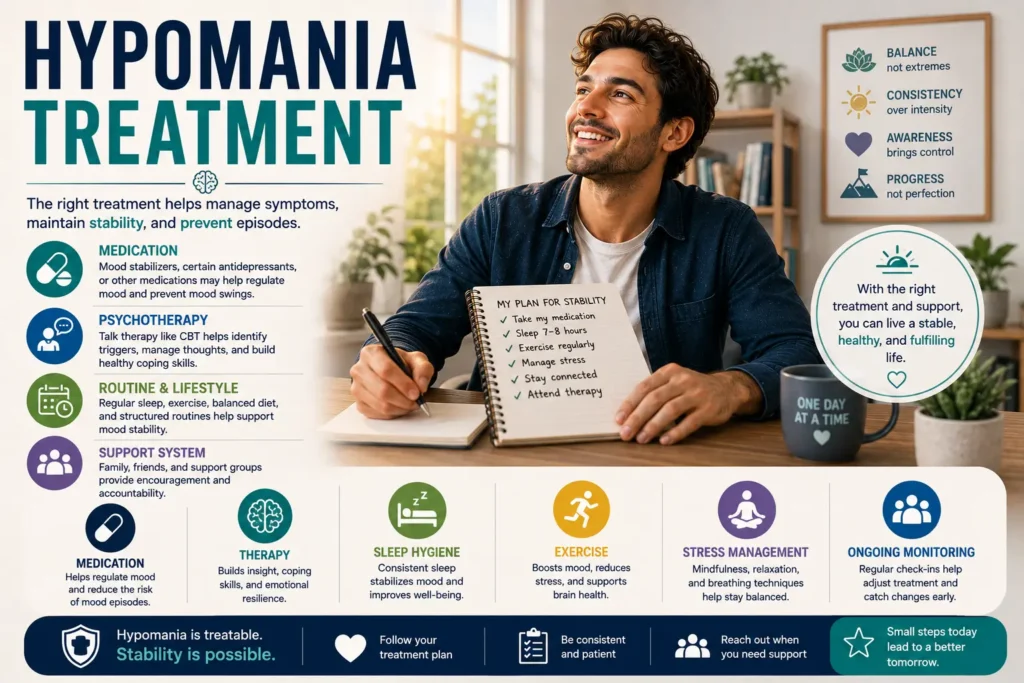
Hypomania treatment usually combines mood-stabilizing or antipsychotic medication with structured psychotherapy and lifestyle changes such as regular sleep and stress management. The goal isn’t to “shut down” energy or creativity — it’s to prevent the episode from escalating into full mania or crashing into depression. Most people are treated on an outpatient basis by a psychiatrist, often alongside a therapist, and treatment is typically long-term rather than a one-time fix.
Table of Contents
Key Takeaways
- Hypomania is most often a feature of bipolar II disorder, though it can occur in bipolar I and cyclothymia as well.
- Treatment centers on three pillars: medication, psychotherapy, and lifestyle stability.
- Mood stabilizers and second-generation antipsychotics are the main medication classes used.
- Untreated hypomania can escalate into mania or flip into a depressive episode — early treatment matters.
- A written relapse-prevention plan, made with your care team, is one of the most effective long-term tools.
What Hypomania Actually Is (and Why It’s Trickier to Treat Than It Sounds)
Hypomania is a distinct period of elevated, expansive, or unusually irritable mood along with increased energy and activity that lasts at least four days and is noticeable to others — but it doesn’t cause the severe impairment, psychosis, or hospitalization that defines full mania. For a deeper breakdown of the diagnostic criteria, see our full guide to hypomania and how it’s different from mania vs hypomania.
That “in-between” quality is exactly what makes treatment tricky. People often feel productive, confident, and sharp during a hypomanic episode, so they may resist treatment or stop medication because they don’t feel sick. Clinicians have to balance symptom control with respecting how disruptive treatment can feel when someone is functioning — sometimes even functioning very well — on the surface.
If you haven’t already reviewed the broader symptom picture, our guide to hypomania symptoms and causes of mania is a useful starting point before diving into treatment specifics.
Why Hypomania Needs Treatment at All
A common misconception is that hypomania is harmless since it doesn’t reach the severity of mania. In practice, treatment is still important for a few reasons:
- It can escalate. In bipolar I disorder, a hypomanic-like period can tip into a full manic episode with psychosis or dangerous impulsivity.
- It often precedes a depressive crash. Many people with bipolar II cycle from hypomania into a depressive episode; treating the hypomania early can soften that crash.
- It damages relationships and finances. Impulsive spending, oversharing, or risky decisions made during hypomania frequently need to be “cleaned up” afterward.
- Repeated untreated episodes are linked to a less stable long-term course. Left unmanaged, cycling can become more frequent over time — a pattern discussed further in our guide to bipolar prognosis.
According to the National Institute of Mental Health and the American Psychiatric Association’s DSM-5, hypomania is a required diagnostic feature of bipolar II disorder, and ongoing mood-stabilizing treatment is the standard of care for preventing relapse.
How Diagnosis Shapes the Treatment Plan
Before treatment starts, a psychiatrist or clinical psychologist will typically confirm the diagnosis through a clinical interview, mood history, and sometimes input from family members who’ve observed the episodes. This step matters because hypomania treatment differs depending on whether it occurs in bipolar I, bipolar II, or cyclothymia, and because other conditions (thyroid issues, certain medications, or substance use) can mimic hypomanic symptoms.
For the full diagnostic process, see bipolar disorder diagnosis and bipolar 1 vs 2 diagnosis. If you’re unsure which type applies to you, our bipolar 1 vs 2 chart and bipolar 1 vs 2 quiz can help you understand the distinctions before your appointment — though only a licensed clinician can make an official diagnosis.
The Three Pillars of Hypomania Treatment
1. Medication
2. Psychotherapy
3. Lifestyle and Self-Management
Each pillar plays a different role. Medication provides the biological floor and ceiling on mood swings. Therapy builds the skills to recognize early warning signs and manage triggers. Lifestyle habits — sleep, routine, and stress reduction — reduce how often episodes are triggered in the first place. Most treatment plans use all three together rather than relying on just one.
Medications Used to Treat Hypomania
Medication choice depends on episode frequency, severity, whether depression is also present, side-effect tolerance, and personal history. A psychiatrist usually starts with one agent and adjusts based on response — this is rarely a “first prescription, done” process.
| Medication Class | Examples | Primary Role | Common Considerations |
| Mood stabilizers | Lithium, valproate (divalproex), lamotrigine | Long-term mood leveling, relapse prevention | Requires blood-level monitoring (lithium, valproate); lamotrigine is more protective against depression than hypomania |
| Atypical antipsychotics | Quetiapine, olanzapine, risperidone, aripiprazole | Faster control of active hypomanic symptoms | May cause sedation, weight gain, or metabolic changes; often used short-term or at lower doses than in mania |
| Antidepressants (used cautiously) | SSRIs, bupropion | Only for co-occurring depressive episodes | Usually combined with a mood stabilizer, since using them alone can trigger hypomania |
| Anticonvulsants | Carbamazepine | Alternative mood stabilizer when others aren’t tolerated | Interacts with many other medications |
A few important clarifications:
- Lithium remains one of the most well-studied treatments for bipolar spectrum disorders and has evidence for reducing suicide risk over the long term, according to research summarized by the World Health Organization and major psychiatric associations.
- Antidepressants alone are generally avoided in bipolar II because they can trigger a switch into hypomania — this is why they’re almost always paired with a mood stabilizer.
- Medication response is individual. What stabilizes one person may barely help another, which is why follow-up appointments and dose adjustments are a normal part of the process, not a sign that treatment “isn’t working.”
For readers weighing bipolar I versus bipolar II medication approaches specifically, see our dedicated guide on bipolar 1 vs 2 treatment and the broader bipolar disorder treatment overview.
Psychotherapy for Hypomania
Medication manages the biology; therapy manages the pattern. Several evidence-based therapy models are commonly used alongside medication:
Cognitive Behavioral Therapy (CBT) helps identify the thoughts and behaviors that accompany early hypomanic symptoms — for example, the racing thought “I don’t need sleep tonight, I have too many ideas” — and builds structured responses before the episode escalates.
Interpersonal and Social Rhythm Therapy (IPSRT) is specifically designed for bipolar spectrum conditions. It focuses on stabilizing daily routines (sleep, meals, activity) because irregular rhythms are a known trigger for mood episodes.
Family-Focused Therapy involves close family members in recognizing early warning signs and reducing high-conflict or high-stress household dynamics that can trigger episodes.
Psychoeducation — simply learning about the condition, its triggers, and its early signs — is consistently shown to reduce relapse rates, because it helps people catch an episode in its earliest, most manageable stage.
Therapy is rarely a one-time intervention; most people benefit from ongoing sessions, especially during the first year after diagnosis while a personalized pattern of triggers and warning signs is being mapped out.
Lifestyle Strategies That Support Treatment
These don’t replace medication or therapy, but they meaningfully reduce how often episodes occur and how severe they get:
- Protect your sleep schedule. Sleep disruption is one of the most consistent triggers for hypomanic episodes. A consistent bedtime and wake time matters more than total hours.
- Track your mood daily. A simple 1–10 mood log (paper or app) helps you and your clinician spot patterns before they become full episodes.
- Limit alcohol and recreational stimulants. Both can trigger or intensify hypomanic symptoms and interact with medications.
- Build a predictable daily routine. Regular meal times, work hours, and exercise reduce the “rhythm disruption” that IPSRT specifically targets.
- Identify your personal early warning signs. Common ones include needing less sleep without feeling tired, talking faster than usual, or taking on more commitments than normal.
- Keep a trusted person in the loop. Because hypomania can distort self-insight, a partner, close friend, or family member who knows your baseline can flag changes you might miss.
For a deeper look at how bipolar-related lifestyle patterns connect to underlying triggers, see bipolar disorder causes.
Building a Treatment Plan With Your Care Team
A well-built plan usually includes:
- A confirmed diagnosis from a psychiatrist or clinical psychologist.
- A medication plan, with a clear schedule for follow-ups and lab monitoring if needed.
- A therapy plan, often weekly at first, tapering as stability improves.
- A written relapse-prevention plan listing personal early warning signs and exactly what to do when they appear (who to call, whether to adjust sleep, when to contact the psychiatrist).
- A support contact — someone who knows the plan and can help you follow it if insight becomes limited during an episode.
This kind of structured plan is one of the most protective factors in long-term outcomes for bipolar spectrum disorders, according to guidance from the NHS and Mayo Clinic.
Hypomania Treatment vs. Mania Treatment: What’s Different
| Factor | Hypomania | Mania |
| Setting | Almost always outpatient | May require hospitalization |
| Medication approach | Often lower doses, sometimes started before symptoms peak | Higher doses, faster-acting antipsychotics frequently needed |
| Urgency | Important but rarely an emergency | Can be a psychiatric emergency, especially with psychosis |
| Insight | Often partially preserved | Frequently impaired or absent |
| Therapy timing | Can start or continue during the episode | Usually resumes once acute symptoms are controlled |
For the full comparison, see our guide to mania treatment and bipolar 1 vs 2 which is worse.
Myths vs. Facts About Treating Hypomania
| Myth | Fact |
| “Hypomania doesn’t need treatment since it’s not full mania.” | Untreated hypomania can escalate into mania or precede a depressive crash. |
| “Medication will make me lose my creativity and drive.” | The goal of treatment is stability, not sedation — most plans are adjusted specifically to preserve functioning. |
| “If I feel good, I don’t need my medication anymore.” | Stopping medication during a good period is one of the most common causes of relapse. |
| “Therapy is only for depression, not hypomania.” | Structured therapies like CBT and IPSRT are specifically studied for hypomania and mania prevention. |
| “One medication should fix everything right away.” | Finding the right medication and dose is often a gradual process of adjustment. |
For more common misconceptions about the broader condition, see bipolar disorder myths.
Warning Signs Treatment Isn’t Working
Contact your psychiatrist promptly if you notice:
- Symptoms lasting longer or becoming more intense despite treatment
- Sleep dropping to a few hours a night without feeling tired
- Increasingly risky decisions (spending, driving, sexual behavior)
- Racing thoughts that are hard to slow down even briefly
- Any signs of psychosis — unusual beliefs, hearing things others don’t
These can signal a shift from hypomania toward full mania, which may need a faster medication response or a higher level of care. Reviewing bipolar disorder complications can help you understand what’s at stake with delayed treatment adjustments.
When to Seek Emergency Help
Bipolar spectrum conditions, including bipolar II, carry an elevated risk of suicidal thinking — often during depressive phases or mixed states rather than during hypomania itself. If you or someone you know is having thoughts of suicide or self-harm, don’t wait for a scheduled appointment.
- In the US, call or text 988 (Suicide & Crisis Lifeline), available 24/7.
- In the UK, contact the Samaritans at 116 123.
- If there’s immediate danger, go to the nearest emergency room or call emergency services.
This is a sensitive topic — if you’re personally experiencing distress, please reach out to one of the resources above or a mental health professional; I’m glad to help you think through next steps as well.
Frequently Asked Questions
Is hypomania treated the same way as bipolar disorder in general? Not exactly. Hypomania treatment is usually gentler and more focused on prevention, since it doesn’t carry the same immediate risk as full mania. It still fits within the broader bipolar disorder treatment framework, but dosing and urgency differ.
Can hypomania go away without medication? Individual episodes typically resolve on their own within days to weeks. However, without ongoing treatment, episodes tend to recur, and the underlying condition remains untreated.
Do I need medication forever? Many people with bipolar II or cyclothymia stay on maintenance medication long-term to prevent relapse, though this is a decision made individually with a psychiatrist based on episode frequency and severity.
What’s the difference between hypomania treatment and cyclothymia treatment? Cyclothymia involves milder, more chronic mood swings that don’t meet full criteria for hypomania or depression, so treatment often leans more heavily on therapy and lifestyle management, with medication added if symptoms intensify. See bipolar 1 vs 2 vs cyclothymia for more detail.
Can therapy alone treat hypomania without medication? For some people with milder or infrequent symptoms, therapy and lifestyle management may be enough, but this should be a decision made with a psychiatrist rather than a default assumption, since untreated hypomania can still escalate.
How long does it take for hypomania treatment to work? Medication effects often take two to six weeks to fully stabilize mood, while therapy skills tend to build gradually over several months.
Is hospitalization ever needed for hypomania? Rarely — hospitalization is typically reserved for full mania, especially with psychosis or safety risks, not hypomania itself.
Summary
Hypomania treatment works best as a long-term, three-part approach: medication to stabilize mood biology, therapy to build early-warning-sign awareness and coping skills, and lifestyle habits — especially sleep — to reduce triggers. Because hypomania can feel good in the moment, treatment adherence is often the hardest part, which is why a written relapse plan and a trusted support person make a real difference. If you’re noticing symptoms escalating or having thoughts of self-harm, don’t wait — reach out to a psychiatrist or a crisis line today.
For a broader understanding of how hypomania fits into the bigger picture, explore our guides on bipolar disorder symptoms, bipolar 1 vs bipolar 2, and what is bipolar.