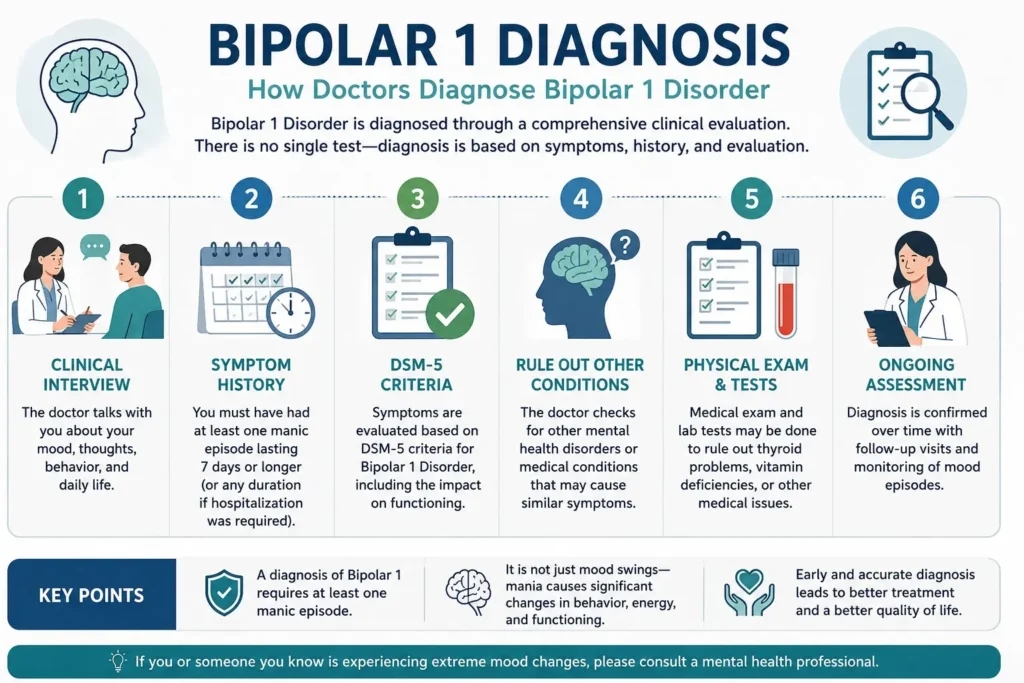
Bipolar 1 disorder is diagnosed through a clinical evaluation, not a blood test or brain scan. A psychiatrist or qualified mental health professional gathers a detailed history of mood episodes, checks them against the DSM-5 criteria for a manic episode, and rules out other medical or psychiatric explanations. The defining requirement is at least one manic episode lasting a week or longer (or any length if it leads to hospitalization) — depressive episodes are common but not required for a bipolar 1 diagnosis.
Table of Contents
Introduction
Getting diagnosed with bipolar 1 disorder can feel like a strange mix of relief and worry. Relief, because there’s finally a name for what’s been happening. Worry, because the process to get there can feel confusing, slow, or unclear.
Unlike conditions with a lab test or scan, bipolar 1 is diagnosed almost entirely through conversation, observation, and pattern recognition over time. That makes the process feel less concrete, but it doesn’t make it less rigorous. Mental health professionals follow a structured framework — the DSM-5 — to reach a diagnosis, and understanding that framework can make the entire experience feel far less like a mystery.
This guide walks through exactly how bipolar 1 disorder is diagnosed: the criteria clinicians use, what an evaluation actually involves, and how it’s distinguished from similar conditions. If you’re not yet sure what separates bipolar 1 from other types, our guide on bipolar 1 vs bipolar 2 is a useful place to start, and our overview of what bipolar disorder is covers the basics.
Key Takeaways
- Bipolar 1 disorder is diagnosed clinically, using DSM-5 criteria centered on the presence of at least one manic episode.
- No blood test, brain scan, or genetic test can confirm bipolar 1 — testing is used only to rule out other causes.
- A full evaluation includes a psychiatric interview, personal and family history, symptom timeline, and sometimes input from family members.
- Bipolar 1 is frequently misdiagnosed as unipolar depression, especially when a depressive episode is the reason someone first seeks help.
- Diagnosis typically involves a psychiatrist, though primary care providers often make the initial referral.
What Makes Bipolar 1 Diagnosis Different From Other Mood Disorders
The single defining feature of bipolar 1 disorder is the manic episode. This is what separates it from bipolar 2 disorder, which involves a less severe form called hypomania, and from depressive disorders, which don’t involve manic or hypomanic episodes at all.
Because mania often includes euphoria, high energy, and bursts of productivity, people experiencing it rarely feel like something is wrong. Many individuals with bipolar 1 first seek help during a depressive episode, not a manic one — which is one of the main reasons misdiagnosis happens. A doctor who only hears about depressive symptoms, without asking about past manic periods, may reasonably diagnose major depressive disorder instead. This is why a thorough history is central to accurate diagnosis, and why mentioning any period of unusually elevated mood, even briefly, matters during an evaluation.
For a deeper look at what a manic episode actually looks like day to day, see our guide on bipolar disorder symptoms.
The DSM-5 Criteria for Bipolar 1 Disorder
The DSM-5 (Diagnostic and Statistical Manual of Mental Disorders, Fifth Edition), published by the American Psychiatric Association, is the standard reference clinicians in the U.S. use to diagnose bipolar 1. Here’s what it requires.
Criteria for a Manic Episode
To meet the threshold for bipolar 1, a person must have experienced at least one manic episode. The DSM-5 defines this as a distinct period of abnormally and persistently elevated, expansive, or irritable mood, along with abnormally increased energy or activity, lasting at least one week — or any length of time if hospitalization becomes necessary.
During that period, at least three of the following symptoms must be present (four if the mood is irritable rather than elevated), and they must represent a noticeable change from the person’s usual behavior:
- Inflated self-esteem or grandiosity
- Decreased need for sleep (feeling rested after very little sleep)
- Unusual talkativeness or pressure to keep talking
- Racing thoughts or a rapid flow of ideas
- Being easily distracted
- A marked increase in goal-directed activity, or physical restlessness
- Engaging in risky behavior with a high potential for painful consequences (e.g., spending sprees, impulsive decisions, risky sexual behavior)
The episode must also be severe enough to cause significant problems at work, socially, or in relationships — or require hospitalization to prevent harm — or involve psychotic features such as hallucinations or delusions.
Ruling Out Other Explanations
The DSM-5 also requires that the episode isn’t better explained by substance use (such as stimulant intoxication) or another medical condition, like a thyroid disorder. This is why medical tests, while not diagnostic for bipolar 1 itself, are still a routine part of the process — they help rule out mimicking conditions.
Depressive Episodes Are Common, But Not Required
Many people assume a bipolar 1 diagnosis requires both manic and depressive episodes. That’s not accurate. While the majority of people with bipolar 1 do experience major depressive episodes at some point, the diagnosis only technically requires one manic episode. This distinction matters for understanding your own diagnosis, and it’s covered in more depth in our guide on bipolar disorder causes, which explains why episodes occur the way they do.
The Diagnostic Process, Step by Step
| Step | What Happens | Why It Matters |
| 1. Initial consultation | Often starts with a primary care doctor or during a mental health crisis | Identifies the need for specialist evaluation |
| 2. Psychiatric referral | Primary care provider refers to a psychiatrist or psychologist | Bipolar 1 requires specialist-level assessment |
| 3. Clinical interview | Detailed discussion of current symptoms and mood history | Identifies patterns consistent with mania or depression |
| 4. Personal and family history | Questions about past episodes and relatives with mood disorders | Family history is a key risk factor |
| 5. Physical exam and lab tests | Blood tests, thyroid panel, sometimes imaging | Rules out medical causes that mimic bipolar symptoms |
| 6. Symptom tracking (if needed) | Mood charting over weeks or months | Helps confirm episode patterns when history is unclear |
| 7. Diagnosis and discussion | Clinician applies DSM-5 criteria and discusses findings | Leads to a treatment plan tailored to bipolar 1 |
The Clinical Interview
This is the core of the diagnostic process. A psychiatrist or psychologist will typically ask about:
- Specific periods of unusually high energy, elevated mood, or irritability
- How long those periods lasted, and how they affected daily functioning
- Sleep patterns during those periods
- Any history of depressive episodes
- Substance use, including caffeine, alcohol, and recreational drugs
- Family history of bipolar disorder, depression, or other psychiatric conditions
- Any past hospitalizations or psychiatric treatment
Because people often underreport or forget manic symptoms — especially if the episode felt good at the time — clinicians sometimes ask permission to speak with a family member or close friend who witnessed the episode firsthand. This isn’t a formality; it’s often what makes an accurate diagnosis possible.
Physical Examination and Lab Testing
There’s no lab test that diagnoses bipolar 1 disorder directly, but bloodwork plays an important supporting role. Common tests include:
- Thyroid function tests (an overactive thyroid can cause manic-like symptoms)
- Complete blood count and metabolic panel
- Vitamin B12 and folate levels in some cases
- Drug and alcohol screening
In select cases, a doctor may order brain imaging (like an MRI) if there’s reason to suspect a neurological cause, but this isn’t a standard or required part of bipolar 1 diagnosis.
Mood Charting and Screening Tools
Screening questionnaires, such as the Mood Disorder Questionnaire (MDQ), are sometimes used to flag the possibility of bipolar disorder. It’s important to understand that these tools are screening instruments, not diagnostic ones — a positive result suggests further evaluation is worthwhile, but it doesn’t confirm bipolar 1 on its own. Formal diagnosis always requires a full clinical assessment against DSM-5 criteria.
Some clinicians also ask patients to keep a daily mood chart over several weeks, tracking sleep, energy, and mood shifts. This can be especially useful when episode history is unclear or when distinguishing bipolar 1 from other conditions is difficult.
Conditions Often Confused With Bipolar 1
Because mood symptoms overlap across many psychiatric conditions, an accurate bipolar 1 diagnosis depends on ruling out — or identifying alongside — several other possibilities.
| Condition | Key Difference From Bipolar 1 |
| Major depressive disorder | No history of manic episodes; mood stays low without elevated periods |
| Bipolar 2 disorder | Involves hypomania (less severe) instead of full mania; see our bipolar 1 vs 2 differences guide |
| Cyclothymic disorder | Milder, chronic mood swings that don’t meet full criteria for mania or major depression; compared in our bipolar vs cyclothymia guide |
| ADHD | Distractibility and impulsivity overlap, but ADHD lacks distinct manic episodes with elevated mood |
| Borderline personality disorder | Mood shifts are usually rapid (hours) and reactive to events, rather than sustained over days or weeks |
| Schizophrenia or schizoaffective disorder | May share psychotic features, but lacks the sustained mood elevation seen in mania |
| Substance-induced mood changes | Symptoms resolve once the substance is out of the person’s system |
This overlap is a major reason bipolar 1 is sometimes diagnosed years after symptoms first appear. If you want to understand how bipolar 1 specifically differs from bipolar 2 in practice, our bipolar 1 vs 2 chart breaks it down visually, and our bipolar 1 vs 2 symptoms guide compares the episodes side by side.
Why Misdiagnosis Happens
A few patterns show up repeatedly in why bipolar 1 gets missed or misidentified early on:
- Seeking help during depression, not mania. Depressive episodes are more likely to drive someone to a doctor, so mania may never come up unless specifically asked about.
- Mania feels good, at least initially. Elevated mood, confidence, and energy don’t usually feel like “symptoms” to the person experiencing them.
- Short or mild episodes go unnoticed. A manic episode that doesn’t require hospitalization can be dismissed as just having “a good week.”
- Overlap with other conditions. ADHD, anxiety, and personality disorders share enough surface features to complicate an initial assessment.
If you suspect a previous diagnosis (like depression or anxiety) may have missed an underlying bipolar 1 pattern, it’s worth raising past periods of elevated mood directly with a psychiatrist, even if they seem irrelevant or long past.
Diagnosis in Children, Teens, and Adults
Bipolar 1 disorder can be diagnosed at any age, though it most commonly first appears in the late teens or early twenties. Diagnosing bipolar 1 in children and adolescents is more complex, since symptoms like irritability and impulsivity can overlap with typical developmental behavior or other conditions such as ADHD. Specialist child and adolescent psychiatrists are generally best positioned to make this distinction accurately, and diagnosis in younger patients typically involves closer collaboration with parents or guardians throughout the evaluation.
A Simple Checklist Before Your Evaluation
Preparing ahead of time can make the diagnostic process faster and more accurate. Before an appointment, it can help to have:
- A rough timeline of mood episodes, including approximate start and end dates
- Notes on sleep patterns during high-energy or low-mood periods
- A list of any family members with bipolar disorder, depression, or other psychiatric diagnoses
- A record of any substance use, including alcohol and recreational drugs
- Input from a trusted family member or friend who has observed mood changes
- A list of current medications and supplements
Bringing this information doesn’t just speed up the process — it also reduces the chance that a manic episode gets overlooked.
Myths vs. Facts About Bipolar 1 Diagnosis
| Myth | Fact |
| “A blood test can confirm bipolar 1.” | No blood test diagnoses bipolar 1. Diagnosis is clinical, based on history and DSM-5 criteria. |
| “You need both mania and depression to be diagnosed.” | Only one manic episode is required for a bipolar 1 diagnosis, though depression commonly occurs too. |
| “Bipolar 1 is diagnosed quickly and easily.” | Diagnosis is frequently delayed, especially when the first presentation is depressive. |
| “Online quizzes can diagnose bipolar 1.” | Self-assessment tools can flag concerns but cannot replace a professional evaluation. |
| “Only psychiatrists can ever raise the possibility of bipolar 1.” | Primary care doctors and psychologists can identify warning signs and refer for specialist diagnosis. |
For more misconceptions about the condition as a whole, see our guide on bipolar disorder myths.
Warning Signs Worth Bringing Up With a Doctor
If any of the following sound familiar, it’s worth mentioning them specifically during an evaluation, even if they happened years ago:
- A period of unusually high energy with little need for sleep
- Uncharacteristic spending, risk-taking, or impulsive decisions
- Racing thoughts or feeling like your mind won’t slow down
- Family members expressing concern about your behavior during a “high” period
- Alternating stretches of depression and unusually elevated mood
When to Seek Emergency Help
If mania involves symptoms of psychosis (such as hearing things that aren’t there or holding beliefs disconnected from reality), poses a safety risk, or is paired with thoughts of self-harm, this is a medical emergency. Contact emergency services or go to the nearest emergency department immediately rather than waiting for a scheduled appointment.
What Happens After a Bipolar 1 Diagnosis
A diagnosis is the starting point for a treatment plan, not the end of the process. Most plans include a combination of mood-stabilizing medication and structured therapy, tailored to the person’s specific episode history and needs. Our bipolar disorder treatment guide walks through what that typically involves, and our bipolar disorder prognosis guide covers what long-term outlook tends to look like with consistent care.
It’s also worth understanding potential complications that can arise without treatment, covered in our bipolar disorder complications guide, and reviewing key terms in our bipolar disorder glossary if any clinical language feels unfamiliar.
Frequently Asked Questions
Can bipolar 1 be diagnosed with a blood test? No. Blood tests can rule out other medical conditions, like thyroid problems, that mimic bipolar symptoms, but there is no lab test that diagnoses bipolar 1 itself.
How long does it take to get diagnosed with bipolar 1? It varies widely. Some people are diagnosed shortly after a manic episode requiring hospitalization, while others go years without a correct diagnosis, particularly if depression was the only symptom initially reported.
Do I need to have had a manic episode to be diagnosed with bipolar 1? Yes. At least one manic episode lasting a week or longer (or requiring hospitalization) is required under DSM-5 criteria for a bipolar 1 diagnosis.
Can a primary care doctor diagnose bipolar 1? Primary care doctors can recognize warning signs and refer patients for specialist evaluation, but a formal bipolar 1 diagnosis is typically made by a psychiatrist or psychologist.
What’s the difference between diagnosing bipolar 1 and bipolar 2? Bipolar 1 diagnosis requires a full manic episode, while bipolar 2 requires hypomania (a milder form) along with at least one major depressive episode. See our bipolar 1 vs 2 diagnosis guide for a full comparison.
Can an online quiz diagnose bipolar 1? No. Online screening tools, including our own bipolar 1 vs 2 quiz and bipolar 1 vs 2 test, can highlight patterns worth discussing with a professional, but they are not diagnostic tools.
Is bipolar 1 diagnosis different for men and women? The diagnostic criteria are identical, though presentation and co-occurring conditions can differ. Our bipolar 1 vs 2 in men and women guide explores these patterns.
What if I only had depressive episodes and no obvious mania? This is common and is one of the most frequent reasons for delayed or missed diagnosis. A detailed history, sometimes involving input from family, can help identify overlooked manic periods. Our bipolar 1 vs 2 depression guide explains how depressive episodes differ between the two types.
Can bipolar 2 be later rediagnosed as bipolar 1? Yes, this can happen if a person originally diagnosed with bipolar 2 later experiences a full manic episode. Our guide on can bipolar 2 become bipolar 1 explains how and why this shift in diagnosis occurs.
Summary
Bipolar 1 disorder is diagnosed through a structured clinical process built around DSM-5 criteria, not through a single test or scan. The defining requirement is at least one manic episode, evaluated through a detailed psychiatric interview, personal and family history, and often input from people close to the patient. Physical exams and lab tests help rule out other causes but don’t confirm bipolar 1 on their own.
Because early presentations often involve depression rather than mania, misdiagnosis is common — which makes an honest, detailed history one of the most valuable things a person can bring to an evaluation. If you recognize patterns described here, the most useful next step is a conversation with a psychiatrist or psychologist, not a guess based on symptoms alone. From there, our guides on bipolar disorder treatment and bipolar disorder prognosis can help you understand what comes next.