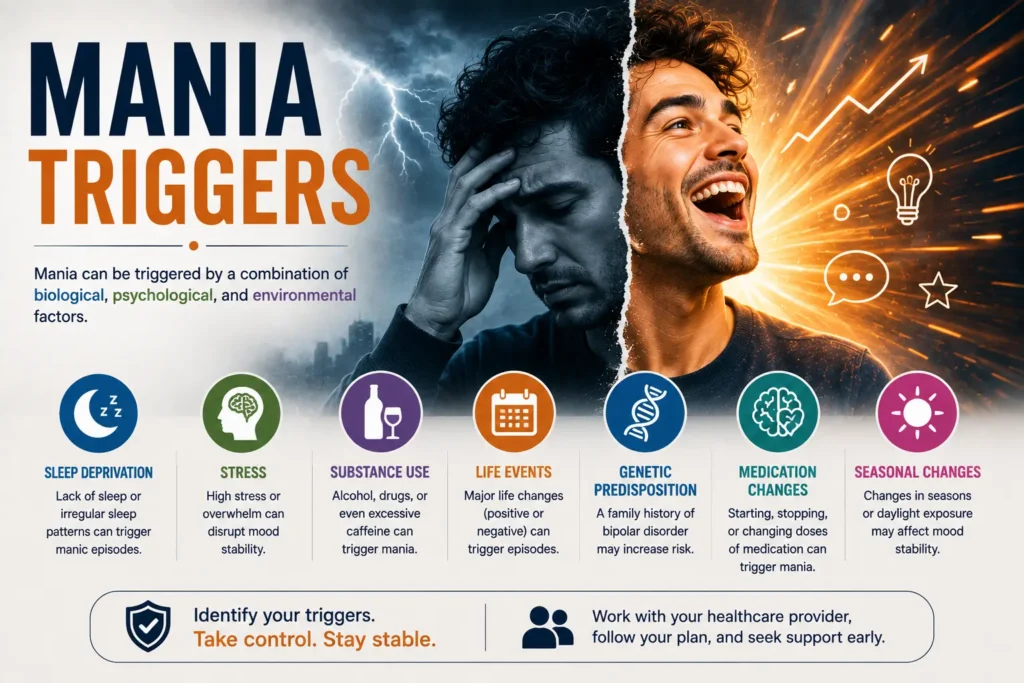
Mania triggers are the specific events, habits, or changes that can set off a manic episode in someone with bipolar disorder — most commonly sleep disruption, high stress, substance use, medication changes, and major life transitions. Triggers are different from underlying causes: a trigger is the spark, while the underlying vulnerability to mania comes from genetics and brain chemistry. Recognizing personal triggers early is one of the most effective ways to prevent or shorten an episode.
Table of Contents
Key Takeaways
- Sleep disruption is the single most well-documented trigger for mania.
- Triggers differ from root causes — see causes of mania for the biological and genetic side of the picture.
- Common triggers include stress, substance use, seasonal changes, and stopping medication.
- Everyone’s trigger pattern is different, which is why tracking personal patterns matters more than any generic list.
- Early recognition of triggers, paired with a relapse-prevention plan, can prevent hypomania from escalating into full mania.
Triggers vs. Causes: An Important Distinction
People often use “trigger” and “cause” interchangeably, but in bipolar disorder they mean different things.
Causes are the underlying vulnerability — genetics, brain chemistry, and neurological factors that make someone susceptible to manic episodes in the first place. Our dedicated guide on bipolar disorder causes and causes of mania covers this in depth.
Triggers are the specific events or circumstances that activate that underlying vulnerability at a particular moment. Someone can carry the genetic and neurological susceptibility for years without an episode until a trigger — often sleep loss or major stress — sets one off.
Think of it like a smoke alarm: the wiring (cause) has to be there for the alarm to ever go off, but it’s the smoke (trigger) that actually sets it ringing on a given day.
Why Understanding Triggers Matters
Knowing your personal triggers doesn’t cure bipolar disorder, but it gives you and your care team a practical tool for prevention. According to guidance from the NHS and Mayo Clinic, trigger awareness is a core part of relapse prevention alongside medication and therapy — not a replacement for either.
Catching an episode at the trigger stage, before symptoms fully develop, often means the difference between a manageable hypomanic episode and a severe manic episode that requires hospitalization. For more on how severity differs across the spectrum, see mania vs hypomania.
Common Mania Triggers
Sleep Disruption
Sleep loss is the most consistently documented trigger for mania across bipolar research. Even one or two nights of significantly reduced sleep can set off an episode in someone predisposed to bipolar disorder. This works in both directions too — early mania often reduces the need for sleep, which then feeds the episode further, creating a cycle that’s hard to break without intervention.
Common sleep-related triggers include:
- Jet lag or dramatic time zone shifts
- Shift work with irregular hours
- Staying up late for work deadlines or celebrations
- New parenthood and infant sleep disruption
- Untreated insomnia
Stress
Both negative stress (loss, conflict, financial pressure) and positive stress (a wedding, a promotion, a big move) can act as triggers. The nervous system doesn’t always distinguish between “good” and “bad” stress — what matters is the intensity and how much it disrupts routine.
High-stress life events linked to manic episodes include:
- Job loss or a major career change
- Relationship conflict or breakup
- Financial strain
- Grief or major loss
- Moving, especially across time zones
Substance Use
Stimulants and certain recreational substances can directly trigger manic symptoms, and alcohol withdrawal has also been associated with triggering episodes. This is a well-established risk factor discussed by organizations including the National Institute of Mental Health.
| Substance | How It Can Trigger Mania |
| Cocaine, amphetamines | Directly stimulate the nervous system in ways that can mimic or trigger manic symptoms |
| Excessive caffeine | Can worsen sleep disruption, which then triggers mania indirectly |
| Alcohol (withdrawal) | Sudden cessation after heavy use can destabilize mood |
| Recreational stimulant misuse | Increases arousal and reduces sleep, compounding risk |
Medication Changes
Stopping a mood stabilizer, missing doses, or in some cases starting an antidepressant without a mood stabilizer can trigger a manic or hypomanic episode. This is one of the most preventable triggers, since it’s directly tied to treatment adherence.
- Abruptly discontinuing lithium or another mood stabilizer
- Antidepressant-induced mood switching, particularly in bipolar I
- Interactions between psychiatric medication and other new prescriptions
Never adjust or stop a psychiatric medication without first talking to the prescribing clinician — sudden changes carry real relapse risk.
Seasonal Changes
Some people notice a seasonal pattern to their episodes, with manic or hypomanic symptoms more likely in spring or early summer, possibly linked to changes in light exposure and circadian rhythm. This isn’t universal, but it’s common enough that tracking mood by season can reveal a personal pattern worth discussing with a psychiatrist.
Overstimulation and Sensory Overload
Loud, chaotic, or overstimulating environments — concerts, crowded events, constant screen exposure late at night — can contribute to triggering an episode, particularly when combined with sleep loss.
Major Life Transitions
Even positive transitions, like starting a new job, having a baby, or graduating, disrupt routine and sleep enough to act as a trigger. This overlaps with the stress category but is worth naming separately because these events often aren’t recognized as “stressful” until after an episode has already started.
Mania Triggers at a Glance
| Trigger Category | Examples | Why It Matters |
| Sleep disruption | Jet lag, shift work, insomnia | Most well-documented and preventable trigger |
| Stress | Grief, conflict, job loss, weddings | Both negative and positive stress can trigger episodes |
| Substance use | Stimulants, alcohol withdrawal | Directly affects brain chemistry involved in mood regulation |
| Medication changes | Stopping mood stabilizers, antidepressant switching | Highly preventable with consistent treatment adherence |
| Seasonal shifts | Spring/summer light changes | Useful for spotting personal seasonal patterns |
| Overstimulation | Crowded events, screen exposure, sensory overload | Compounds risk, especially alongside sleep loss |
| Life transitions | New job, new baby, moving | Disrupts routine even when the event itself is positive |
How to Track and Identify Your Personal Triggers
Because triggers vary from person to person, a generic list is a starting point, not a diagnosis. A practical approach:
- Keep a daily mood and sleep log. Rate mood on a simple scale and note sleep hours, stress events, and substance use each day.
- Look back after each episode. With your psychiatrist or therapist, review the two to four weeks before onset to identify what changed.
- Watch for patterns, not single events. One late night rarely causes an episode on its own — it’s usually a combination of factors stacking up.
- Involve a trusted person. Family members or partners often notice trigger-related changes (irritability, less sleep, faster speech) before the person having the episode does.
- Bring your findings to appointments. A documented pattern helps your psychiatrist fine-tune both medication and your personal relapse-prevention plan.
Prevention: Reducing Trigger Exposure
Prevention doesn’t mean eliminating every stressor — that’s not realistic. It means building buffers around your most consistent triggers.
- Protect a consistent sleep schedule, even during travel or busy periods, as much as possible.
- Build in recovery time after major life events, whether positive or negative.
- Limit stimulants and monitor alcohol use, especially during high-stress periods.
- Never stop or adjust medication without medical guidance.
- Create a written relapse-prevention plan listing your top personal triggers and early warning signs, along with exactly what to do if they appear.
- Check in regularly with your psychiatrist, especially around known high-risk periods like seasonal shifts or major transitions.
For more on how these preventive habits fit into overall management, see bipolar disorder treatment and mania treatment.
Myths vs. Facts About Mania Triggers
| Myth | Fact |
| “Only bad or stressful events can trigger mania.” | Positive events like weddings, promotions, or vacations can trigger episodes too, largely through sleep and routine disruption. |
| “If I feel fine, I don’t need to worry about triggers.” | Triggers can build up quietly before symptoms become obvious, which is why tracking matters even during stable periods. |
| “One bad night of sleep won’t matter.” | Even short-term sleep loss is one of the most consistent documented triggers for mania. |
| “Triggers cause bipolar disorder.” | Triggers activate episodes in someone already vulnerable to bipolar disorder — they don’t cause the underlying condition. |
| “Everyone with bipolar disorder has the same triggers.” | Trigger patterns are highly individual; tracking your own history matters more than a general list. |
For broader misconceptions about the condition, see bipolar disorder myths.
Warning Signs a Trigger Is Turning Into an Episode
Watch for these early shifts, especially after a known trigger event:
- Needing noticeably less sleep without feeling tired
- Talking faster or jumping between topics
- Increased spending, risk-taking, or impulsive decisions
- Rising irritability or agitation
- Racing thoughts that are hard to slow down
- A growing sense of grandiosity or invincibility
Catching these signs early — ideally within the first day or two — gives you and your care team the best chance to intervene before the episode fully develops. If symptoms progress to include hallucinations, delusions, or a complete loss of touch with reality, this becomes a medical emergency; see our guide on psychosis in mania for what that looks like and how it’s treated.
When to Seek Emergency Help
Contact a psychiatrist promptly if early warning signs appear after a known trigger. Seek immediate emergency care if you notice:
- Hallucinations or delusions
- Extreme agitation or inability to communicate coherently
- Behavior that puts safety at risk
- Any thoughts of self-harm or harming others
In the US, call 988 (Suicide & Crisis Lifeline) or 911 in an emergency. In the UK, contact the Samaritans at 116 123 or call 999. Don’t wait for symptoms to resolve on their own.
Frequently Asked Questions
What is the most common trigger for mania? Sleep disruption is the most consistently documented trigger across bipolar research, though stress and substance use are also frequent contributors.
Can positive events trigger mania? Yes. Weddings, promotions, vacations, and other exciting events can trigger episodes, primarily by disrupting sleep and routine.
How long after a trigger does mania usually start? This varies widely — some people notice symptoms within a day or two of a major trigger like sleep loss, while others may take longer to develop full symptoms.
Can mania be triggered without any bipolar diagnosis? Manic-like symptoms can sometimes occur from substance use or certain medical conditions even without bipolar disorder, but recurring manic episodes are specifically associated with bipolar I disorder.
Is stress a bigger trigger than sleep loss? Both are major triggers, and they often overlap, since stressful periods frequently come with reduced or disrupted sleep.
Can weather or season really trigger mania? Some people report a seasonal pattern, often linked to spring and summer light changes, though this isn’t universal and should be tracked individually.
How can I prevent stress from triggering an episode? Consistent sleep, medication adherence, and having a written relapse-prevention plan are the most effective tools, alongside regular contact with a psychiatrist during high-stress periods.
Summary
Mania triggers are the specific events — sleep loss, stress, substance use, medication changes, seasonal shifts, and major life transitions — that activate an episode in someone already vulnerable to bipolar disorder. They’re different from the underlying causes of the condition, but recognizing them early gives you a real chance to prevent or shorten an episode. Tracking your personal patterns, protecting your sleep, staying consistent with medication, and building a written relapse-prevention plan with your care team are the most effective ways to stay ahead of them.
To understand the full picture, explore our guides on mania symptoms, manic episode, and bipolar disorder.