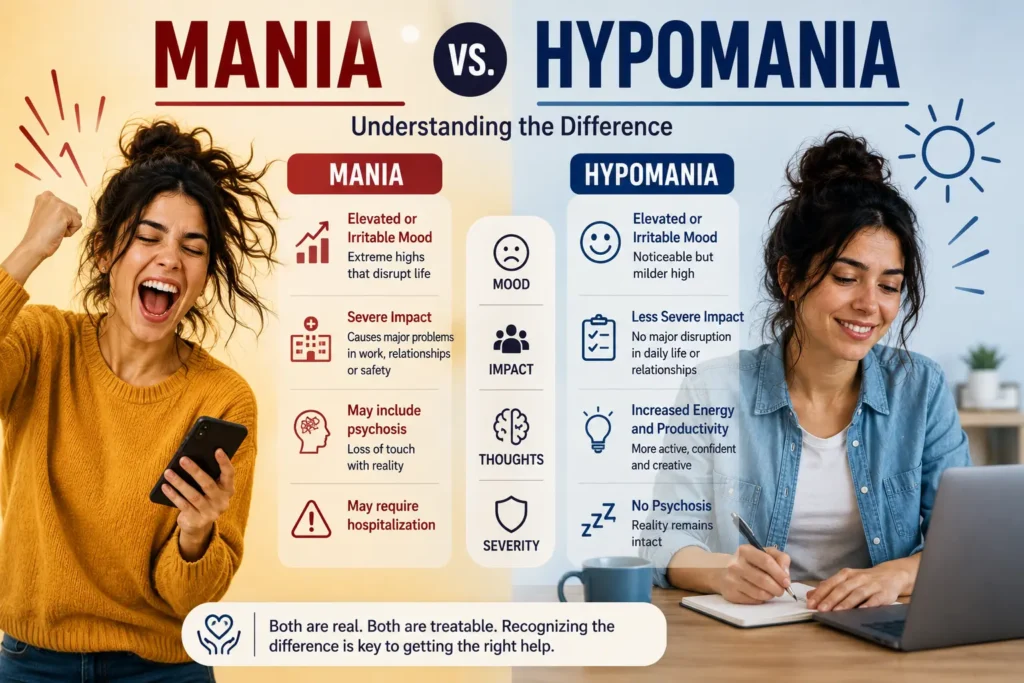
Mania vs. Hypomania: Mania and hypomania are both periods of abnormally elevated or irritable mood and high energy, but they differ in severity, duration, and consequence.
Mania lasts at least seven days (or any length if hospitalization is needed), can include psychosis, and severely disrupts daily life. Hypomania lasts at least four days, never includes psychosis, and — while still disruptive — doesn’t typically stop someone from working or functioning. The distinction matters clinically: mania points toward bipolar 1 disorder, while hypomania is the defining feature of bipolar 2 disorder. Getting this distinction right is central to an accurate diagnosis and the right treatment plan.
Table of Contents
Key Takeaways
- Mania and hypomania sit on the same spectrum but differ in intensity, duration, and risk.
- Mania lasts 7+ days and can involve psychosis; hypomania lasts 4+ days and never does.
- Mania typically disrupts work, relationships, and safety; hypomania is noticeable but usually more manageable.
- A manic episode indicates bipolar 1; a hypomanic episode (plus a depressive episode) indicates bipolar 2.
- Hypomania is easier to miss because it can feel pleasant or productive rather than distressing.
- Both are treatable with mood stabilizers, therapy, and consistent routines.
Mania and Hypomania at a Glance
Both mania and hypomania involve a real, sustained shift away from a person’s normal mood and energy — this isn’t the same as an ordinary good day or a burst of motivation. The American Psychiatric Association’s DSM-5 defines both as distinct episodes with overlapping symptoms, separated mainly by severity and length.
If you haven’t already, it’s worth reading the dedicated guides on mania and hypomania individually — this article focuses specifically on how the two compare, not on fully explaining either one from scratch.
The Core Comparison Table
| Feature | Mania | Hypomania |
| Minimum duration | 7 days (or any length if hospitalized) | 4 days |
| Severity | Severe; clearly disrupts functioning | Noticeable but generally manageable |
| Psychosis possible? | Yes (hallucinations, delusions) | No |
| Hospitalization typically needed? | Often | Rarely |
| Impact on work/relationships | Frequently significant disruption | Sometimes disruptive, often not incapacitating |
| Insight during episode | Often reduced or absent | Usually retained, though judgment may be off |
| Associated bipolar diagnosis | Bipolar 1 | Bipolar 2 |
| Can occur without depression for diagnosis? | Yes — one manic episode is enough for bipolar 1 | No — bipolar 2 requires a depressive episode too |
For a broader visual reference covering the two related conditions themselves, see our bipolar 1 vs 2 chart.
Symptom Overlap and Differences
Mania and hypomania share the same core symptom list under the DSM-5 — elevated or irritable mood plus at least three additional symptoms (four if mood is only irritable). What changes is intensity and consequence.
| Symptom | How It Shows Up in Hypomania | How It Shows Up in Mania |
| Mood | Elevated, upbeat, or irritable — noticeable to others | Intensely elevated, euphoric, or highly irritable |
| Sleep | Needs less sleep, still functions the next day | Barely sleeps for days, functioning breaks down |
| Speech | Talkative, energetic | Pressured, rapid, hard to interrupt |
| Thoughts | Fast-moving, creative | Racing, disorganized, jumping unpredictably |
| Confidence | Increased self-esteem | Grandiosity, sometimes delusional beliefs |
| Judgment | Some impulsivity | Significant risk-taking, reckless decisions |
| Reality testing | Intact | Can include hallucinations or delusions |
For the complete symptom breakdown of each, our mania and hypomania articles go into full detail, including how these symptoms present day to day. For the wider bipolar symptom picture, including depressive episodes, see bipolar disorder symptoms.
Real-World Examples: Same Symptom, Different Intensity
Seeing the two side by side in everyday terms makes the distinction clearer.
| Situation | Hypomanic Version | Manic Version |
| Sleep | Sleeping 4–5 hours and feeling fine | Not sleeping for 2–3 days straight |
| Spending | Making one larger-than-usual purchase | Spending far beyond means across multiple purchases |
| Work | Taking on extra projects and finishing them | Starting many projects, unable to complete any |
| Social behavior | More talkative and outgoing than usual | Talking non-stop, difficult to interrupt or redirect |
| Beliefs | Feeling confident about abilities | Believing in special powers, missions, or importance |
Why the Distinction Matters for Diagnosis
The difference between mania and hypomania isn’t just academic — it changes the diagnosis entirely.
- A single manic episode is enough to diagnose bipolar 1 disorder, regardless of whether a depressive episode has occurred.
- A hypomanic episode alone doesn’t meet criteria for bipolar 2 — it must occur alongside at least one major depressive episode, as explained in our bipolar 2 guide.
- If someone previously diagnosed with bipolar 2 later experiences a full manic episode, the diagnosis shifts to bipolar 1 — a change covered in detail in our can bipolar 2 become bipolar 1 article.
- Getting the episode type right guides which medications and monitoring plan a clinician recommends.
Diagnosis for either relies on clinical history rather than a lab test. Our bipolar disorder diagnosis guide explains that process in full, and if you want to explore symptom patterns yourself before an appointment, our bipolar 1 vs 2 test and bipolar 1 vs 2 quiz are useful starting points — though neither replaces a professional evaluation.
Causes and Risk Factors: What’s Shared
Mania and hypomania are driven by largely the same combination of factors:
- Genetics and family history of bipolar disorder
- Neurotransmitter imbalances involving dopamine and serotonin
- Sleep disruption, which can trigger either type of episode
- High-stress life events, whether positive or negative
- Substance use and certain medications, including some antidepressants
The main difference isn’t in what causes the episode, but in how far it escalates — which can depend on individual biology, medication history, and how early the episode is recognized and managed. Full detail on causes is available in our bipolar disorder causes guide.
Treatment Differences
| Aspect | Hypomania | Mania |
| First-line medication | Mood stabilizers (e.g., lithium, lamotrigine) | Mood stabilizers plus antipsychotics for acute symptoms |
| Setting | Usually outpatient | Often requires hospitalization, especially with psychosis |
| Antidepressant use | Used cautiously, typically with a mood stabilizer | Generally avoided during an active manic episode |
| Therapy focus | Routine stability, early symptom recognition | Crisis stabilization first, then relapse prevention |
Both conditions respond well to consistent treatment. For full detail on medications, dosing, and therapy approaches, see our bipolar disorder treatment, bipolar 1 treatment, and bipolar 2 treatment guides.
Warning Signs: When Hypomania May Be Escalating to Mania
Because hypomania can shift into full mania, it’s worth knowing the signs that an episode is intensifying:
- Sleep drops from “less than usual” to almost none at all
- Confidence turns into grandiose or unrealistic beliefs
- Judgment becomes markedly reckless rather than mildly impulsive
- Any hallucinations or delusions appear — this always signals mania, not hypomania
- Family or friends express serious concern, not just noticing a mood shift
Emergency Help
Hypomania rarely constitutes an emergency on its own, but full mania can be one. Seek immediate help if you notice:
- Signs of psychosis (hallucinations or delusions)
- Thoughts of harming oneself or others
- Extreme recklessness that threatens safety
- Total inability to sleep for multiple days in a row
If you or someone you know is in crisis, contact emergency services or, in the U.S., call or text 988 to reach the Suicide & Crisis Lifeline, available 24/7.
Myths vs. Facts
| Myth | Fact |
| Hypomania and mania are basically the same thing | They differ meaningfully in duration, severity, and risk of psychosis |
| Hypomania doesn’t need treatment since it’s “milder” | Untreated hypomania still causes harm and often precedes depression |
| Only mania is linked to bipolar disorder | Hypomania is just as diagnostic — it defines bipolar 2 |
| People can’t tell the difference themselves | Clinicians distinguish them using clear, defined criteria — not guesswork |
| Mania is always obvious to others | Early mania can look like hypomania before it escalates |
Frequently Asked Questions
What’s the main difference between mania and hypomania? Duration and severity. Mania lasts at least seven days, can include psychosis, and usually disrupts daily functioning. Hypomania lasts at least four days, never includes psychosis, and is typically more manageable.
Can hypomania turn into mania? Yes, in some cases hypomanic symptoms can intensify into full mania. When that happens, the diagnostic picture shifts from bipolar 2 toward bipolar 1.
Is hypomania a sign of bipolar 1 or bipolar 2? Hypomania, combined with at least one depressive episode, points to bipolar 2. A full manic episode, on the other hand, is enough on its own to diagnose bipolar 1.
Which is more dangerous, mania or hypomania? Mania carries greater risk due to its severity, potential for psychosis, and higher likelihood of hospitalization. Hypomania is milder but still carries real risks, including impulsive decisions and a higher chance of a following depressive episode.
Can someone have both mania and hypomania? Someone can experience both types of episodes over their lifetime, but a manic episode reclassifies the diagnosis as bipolar 1 rather than bipolar 2.
Do mania and hypomania require different treatments? Both are treated with mood stabilizers and therapy, but mania often requires antipsychotic medication and sometimes hospitalization, while hypomania is more often managed on an outpatient basis.
How can a doctor tell if it’s mania or hypomania? Clinicians rely on the DSM-5 criteria — checking episode duration, presence of psychosis, and degree of functional impairment — along with input from the patient’s history and, often, family observations.
Summary
Mania and hypomania sit on the same spectrum of elevated mood and energy, but they’re not interchangeable. Mania is the more severe, longer-lasting version that can include psychosis and often requires hospitalization; hypomania is shorter, milder, and generally more manageable, though still clinically significant. The distinction shapes diagnosis directly — mania points to bipolar 1, while hypomania paired with depression points to bipolar 2. If you’re noticing either pattern in yourself or someone close to you, a mental health professional can help determine which one is present and build the right treatment plan. For the full picture, explore our in-depth guides on mania, hypomania, and bipolar 1 vs bipolar 2.
This article is for educational purposes and is not a substitute for professional medical advice. If you or someone you know is experiencing symptoms of mania or hypomania, please consult a qualified healthcare provider.