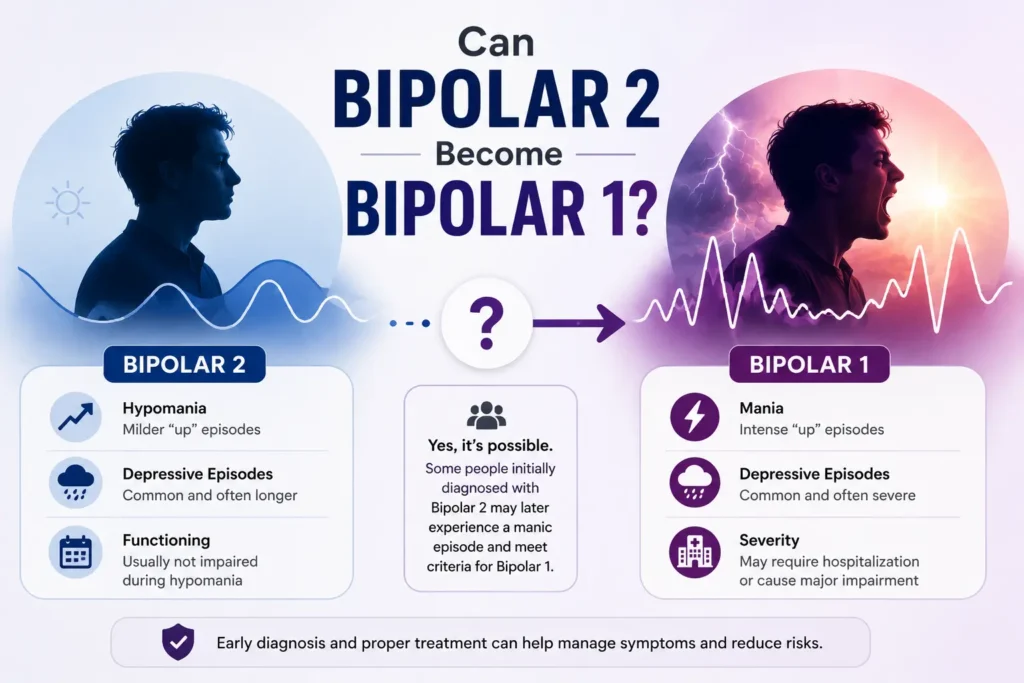
Can Bipolar 2 Become Bipolar 1? Yes, bipolar 2 disorder can progress to bipolar 1 disorder, but it doesn’t happen to most people. Research following patients over time finds that somewhere between 5% and 25% of people with bipolar 2 eventually experience a full manic episode that meets the criteria for bipolar 1, with the higher rates seen in studies of children and teens followed for several years, and lower rates in adults followed over a decade. The shift happens when hypomania — a milder, shorter high — escalates into full mania, which is more intense, lasts longer, and can involve psychosis or the need for hospitalization. Younger age of onset is one of the most consistent predictors of this progression.
If you have bipolar 2, this doesn’t mean you’re destined to develop bipolar 1. It means it’s worth knowing the warning signs, staying in regular care, and understanding what separates the two diagnoses. For a full side-by-side breakdown, see our bipolar 1 vs bipolar 2 guide.
Table of Contents
Key Takeaways
- Bipolar 2 becoming bipolar 1 is a documented but uncommon course of illness, not the typical path.
- The defining line is the switch from hypomania to full-blown mania.
- Studies show conversion rates roughly between 5% and 25%, depending on age group and follow-up length.
- Earlier age of onset is the most reliable predictor of progression.
- A single manic episode — even one — is enough to change the diagnosis from bipolar 2 to bipolar 1.
- There’s no cure that stops progression outright, but consistent treatment and monitoring lower the risk of a missed or delayed diagnosis.
- This isn’t a sign of personal failure or “getting worse” through anything you did.
Understanding the Two Diagnoses Before Talking About Progression
Before getting into whether one can turn into the other, it helps to be clear on what separates them. Both conditions fall under the umbrella of bipolar disorder, a brain-based condition marked by extreme shifts in mood, energy, and activity levels. If you’re new to the topic entirely, our guide on what bipolar disorder is is a good starting point.
The difference between bipolar 1 and bipolar 2 comes down to the intensity of the “up” episodes, not the “down” ones. Depressive episodes can look similar in both.
Bipolar 1 requires at least one manic episode. Mania is severe enough to disrupt work, relationships, or safety, and often requires hospital care. It can include psychotic features like delusions or hallucinations.
Bipolar 2 requires at least one hypomanic episode plus at least one major depressive episode. Hypomania is a real, noticeable change in mood and energy, but it’s shorter and less disabling than mania. People with hypomania are often still able to function, and some even describe it as productive.
For a deeper dive into how these categories differ across every dimension — severity, duration, treatment approach — see our full bipolar 1 vs bipolar 2 differences page and our symptom-by-symptom comparison.
Mania vs. Hypomania: The Line That Matters Most
This is the single most important distinction for understanding progression, because moving from bipolar 2 to bipolar 1 is really just one mood episode crossing this line.
| Feature | Hypomania (Bipolar 2) | Mania (Bipolar 1) |
| Minimum duration | At least 4 consecutive days | At least 7 days, or any duration if hospitalization is needed |
| Severity | Noticeable change, but daily functioning is usually intact | Severe disruption to work, relationships, or safety |
| Psychosis | Never present | Can be present (delusions, hallucinations) |
| Hospitalization | Not typically required | Often required |
| Insight | Person usually still recognizes something is different | Insight can be lost entirely |
For a visual reference you can save or share, our bipolar 1 vs 2 chart lays this out side by side.
So, Can Bipolar 2 Really Turn Into Bipolar 1?
The honest answer is: sometimes, yes. This is often called “diagnostic conversion” or “bipolar disorder progression” in clinical literature, and it’s a real, studied phenomenon rather than a myth or a scare tactic.
Here’s what’s actually happening biologically and clinically. Bipolar 2 isn’t a “lesser” or “early” version of bipolar 1 that’s simply waiting to grow up. Most people with bipolar 2 live their entire lives without ever having a manic episode. But for a minority, the underlying mood instability intensifies over time, and a hypomanic episode eventually crosses the threshold into full mania. Once that happens — even a single time — the diagnosis changes to bipolar 1, because the diagnostic criteria are based on the most severe episode a person has ever had, not the most frequent one.
Researchers have debated for years whether bipolar 2 is a genuinely separate condition or a point on a spectrum that can shift toward bipolar 1 in some people. A case report published in the Journal of Neurosciences in Rural Practice documented this directly: a 60-year-old woman with a long-standing diagnosis of bipolar 2 experienced her first manic episode, complete with psychotic symptoms, after two decades of stable hypomanic and depressive episodes. Her diagnosis changed to bipolar 1 at that point.<br>
What made her case notable wasn’t just that conversion happened, but when. It challenged the assumption that if progression hasn’t happened within the first few years of illness, it won’t happen at all.
How Often Does This Actually Happen?
Numbers vary by study population and how long people were followed, which is normal in longitudinal psychiatric research. Here’s what the evidence shows:
| Study Population | Follow-Up Length | Conversion Rate (Bipolar 2 → Bipolar 1) |
| Children and adolescents with bipolar spectrum disorders | 2–4 years | Approximately 20–25% |
| Adults with bipolar 2, long-term cohort | 10 years | Approximately 5–7% |
The takeaway isn’t that one number is “correct” and the other is wrong. It’s that age of onset matters a great deal. People diagnosed with bipolar spectrum conditions in childhood or adolescence appear to convert to bipolar 1 more often, and sooner, than people diagnosed as adults. This lines up with what’s already known about bipolar disorder causes and risk factors more broadly — earlier onset is consistently linked to a more variable or severe course of illness.
It’s worth being clear about what these numbers don’t mean. They don’t mean a random 1-in-5 or 1-in-15 chance applies equally to everyone with bipolar 2. Individual risk depends on family history, age of onset, symptom severity, substance use, sleep patterns, and other factors covered below.
Risk Factors That Raise the Chances of Progression
No single factor guarantees progression, and the absence of these factors doesn’t guarantee it won’t happen. But research points to a consistent pattern of who is more likely to experience this shift.
| Risk Factor | Why It Matters |
| Early age of onset (childhood or adolescence) | Most consistently replicated predictor of conversion to bipolar 1 |
| Strong family history of bipolar 1 disorder | Suggests shared genetic vulnerability toward more severe mania |
| High reward sensitivity / behavioral approach system reactivity | Some researchers link heightened sensitivity to reward cues with more severe mood episode escalation |
| Substance use, especially stimulants or alcohol misuse | Can trigger or intensify manic symptoms |
| Sleep disruption or major sleep loss | A well-known trigger for manic switches in bipolar spectrum conditions |
| Antidepressant use without a mood stabilizer | Can, in some people, provoke a switch into mania |
| Untreated or inconsistently treated hypomanic episodes | Leaves mood instability unaddressed over time |
If several of these apply to you or someone you’re supporting, it doesn’t mean bipolar 1 is inevitable. It means these are worth discussing openly with a psychiatrist so monitoring can be adjusted accordingly. For a broader look at what drives bipolar disorder in general, see our guide on bipolar disorder causes.
Warning Signs That Hypomania May Be Escalating Into Mania
This is the practical part most articles skip. If you or someone you love has bipolar 2, knowing what a shift toward mania looks like in real time is more useful than any statistic.
Signs that a hypomanic episode may be crossing into mania:
- Sleep drops to just a few hours a night, or stops altogether, without exhaustion following
- Speech becomes very rapid, hard to interrupt, or jumps between unrelated topics
- Grandiose beliefs appear — for example, unrealistic certainty about special abilities, wealth, or importance
- Judgment becomes noticeably impaired: reckless spending, risky sexual behavior, impulsive decisions with real consequences
- Irritability turns into aggression or hostility rather than just restlessness
- Reality testing slips — hearing, seeing, or believing things that aren’t happening (psychosis)
- Family or friends express serious concern, or the person’s ability to function at work or home breaks down entirely
- The episode lasts a full week or longer without letting up
A full bipolar disorder symptoms breakdown and a dedicated bipolar 1 vs 2 symptoms comparison can help you track these distinctions in more detail.
When to Seek Emergency Help
Some signs need immediate attention rather than a scheduled appointment. Seek emergency care right away if you notice:
- Psychotic symptoms (delusions, hallucinations, paranoia)
- Any thoughts of suicide or self-harm
- Behavior that puts the person or others at immediate risk of harm
- Complete inability to sleep for multiple consecutive nights combined with escalating agitation
In the U.S., the 988 Suicide & Crisis Lifeline is available by call or text, 24 hours a day. If someone is in immediate danger, call 911 or go to the nearest emergency room. This applies regardless of whether a formal diagnosis has changed — safety always comes first.
How Diagnosis Changes When Progression Happens
A diagnosis of bipolar 1 versus bipolar 2 isn’t fixed for life in the way something like a broken bone is. Psychiatric diagnoses are based on the complete history of episodes a person has had, and that history can be updated as new episodes occur.
Here’s how it plays out in practice. A psychiatrist re-evaluates the person’s full episode history, not just the most recent event. If a single episode meets full criteria for mania — regardless of how many hypomanic or depressive episodes came before it — the diagnosis is updated to bipolar 1. This typically involves:
- A detailed clinical interview covering the current episode and full psychiatric history
- A review of episode duration, severity, and functional impact
- Ruling out other causes, such as substance use, medication effects, or a medical condition mimicking mania
- Input from family or close contacts, since insight is often reduced during mania itself
For more on how clinicians reach either diagnosis in the first place, see our guides on bipolar disorder diagnosis and the more specific bipolar 1 vs 2 diagnosis process. If you’re trying to get a general sense of where your symptoms fall before an appointment, our bipolar 1 vs 2 test and bipolar 1 vs 2 quiz are educational starting points — not replacements for a professional evaluation.
Does Treatment Change If Progression Happens?
Yes, often significantly. Because mania carries higher risks — including psychosis, hospitalization, and safety concerns — treatment for bipolar 1 tends to be more intensive than for bipolar 2.
| Treatment Area | Typical Bipolar 2 Approach | Typical Bipolar 1 Approach |
| Mood stabilizers | Often used, sometimes at lower intensity | Frequently central to treatment, especially after a manic episode |
| Antipsychotic medication | Used selectively | More commonly used, especially if psychosis is present |
| Antidepressants | Sometimes used cautiously alongside a mood stabilizer | Used with more caution, since they carry a risk of triggering mania |
| Hospitalization | Uncommon | More common during acute manic episodes |
| Monitoring frequency | Regular follow-up | Often more frequent, especially right after a manic episode |
This is a general overview rather than individual medical guidance — treatment decisions depend on the person’s full history and should be made with a psychiatrist. For a complete look at treatment approaches for both conditions, visit our dedicated guides on bipolar disorder treatment and bipolar 1 vs 2 treatment.
Myths vs. Facts About Bipolar Progression
| Myth | Fact |
| “Bipolar 2 always eventually becomes bipolar 1.” | Most people with bipolar 2 never develop bipolar 1. Progression is documented but not the typical course. |
| “If it hasn’t happened in the first few years, it never will.” | Progression has been documented even decades after initial diagnosis. |
| “Bipolar 2 is just a milder form of the same illness that will get worse with age.” | Bipolar 2 is its own diagnosis with its own criteria, not a waiting room for bipolar 1. |
| “Taking medication caused the progression.” | Untreated or inconsistently treated mood episodes are more strongly linked to instability than properly managed treatment. |
| “A single manic-like episode after stress or substance use always means bipolar 1.” | Episodes triggered solely by substances or another medical condition are assessed separately and may not meet criteria for bipolar 1. |
For a broader collection of misconceptions worth clearing up, see our bipolar disorder myths page.
Prognosis and Complications After Progression
Developing bipolar 1 after a bipolar 2 diagnosis is a meaningful shift, but it isn’t a life sentence of instability. Many people who transition to bipolar 1 go on to achieve good long-term stability with consistent treatment, particularly once a mood stabilizer regimen is established and monitored closely.
That said, it’s worth being realistic about the added risks that can come with manic episodes specifically, including:
- Higher likelihood of hospitalization during severe episodes
- Increased risk of impulsive decisions with lasting financial, legal, or relational consequences
- A greater chance of psychotic symptoms during acute episodes
- The need for closer, more frequent psychiatric follow-up
For more detail on long-term outlook, see our dedicated pages on bipolar disorder prognosis and bipolar disorder complications.
What You Can Do If You Have Bipolar 2
You can’t control whether progression happens, but you can control how well-positioned you are to catch it early if it does.
A practical checklist:
- [ ] Keep a mood and sleep log, even a simple one — sudden sleep loss is one of the earliest red flags
- [ ] Stay in regular contact with a psychiatrist rather than only during crises
- [ ] Involve a trusted family member or friend who can flag changes you might not notice in yourself
- [ ] Ask your prescriber directly whether any current medications carry a risk of triggering mania
- [ ] Limit alcohol and recreational stimulant use, both known triggers for mood episode escalation
- [ ] Protect your sleep schedule as a non-negotiable part of treatment, not an afterthought
- [ ] Know your local emergency resources before you need them, not after
None of this guarantees progression won’t happen. It simply means that if it does, it’s caught and treated sooner rather than later.
Frequently Asked Questions
Can bipolar 2 turn into bipolar 1? Yes, it can, though it isn’t the typical course. Studies show conversion happens in roughly 5% to 25% of cases, depending on age of onset and how long people are followed.
Does bipolar 2 always get worse over time? No. Many people with bipolar 2 maintain a stable pattern of hypomanic and depressive episodes throughout their lives without ever developing mania.
What triggers the shift from bipolar 2 to bipolar 1? There’s no single trigger, but sleep deprivation, substance use, and antidepressant use without a mood stabilizer are commonly associated with manic switches. In many cases, no clear external trigger is identified at all.
How long does it usually take for bipolar 2 to progress, if it does? It varies widely. Some studies of children and teens show conversion within 2 to 4 years, while a documented adult case showed progression after two decades of stable bipolar 2 symptoms. There’s no fixed timeline.
Is bipolar 1 worse than bipolar 2? They involve different levels of severity in the manic episodes specifically, but both carry real risks, including depression, which can be equally severe in either diagnosis. Our page on bipolar 1 vs 2, which is worse breaks this down in more depth.
Can medication prevent bipolar 2 from becoming bipolar 1? There’s no guaranteed way to prevent progression, but consistent treatment with a mood stabilizer, regular psychiatric follow-up, and protecting sleep are associated with better overall mood stability.
If I’m diagnosed with bipolar 1 after having bipolar 2, does that mean my original diagnosis was wrong? No. Diagnoses reflect the most severe episode documented up to that point. An earlier bipolar 2 diagnosis was accurate for the information available at the time; an update after a manic episode reflects new information, not a past mistake.
Is one manic episode enough to change the diagnosis? Yes. Diagnostic criteria are based on lifetime history, so even a single episode that meets full criteria for mania is enough to update a diagnosis from bipolar 2 to bipolar 1.
Summary
Bipolar 2 can progress to bipolar 1, but for most people, it doesn’t. The available research points to conversion rates roughly between 5% and 25%, with younger age of onset consistently linked to higher likelihood and earlier timing of progression. The shift itself comes down to one thing: a hypomanic episode crossing the line into full mania.
If you have bipolar 2, the most useful thing you can do isn’t worrying about a percentage — it’s understanding the warning signs of mania, staying engaged with a psychiatrist, and protecting the basics that keep mood stable, especially sleep. If symptoms ever escalate into psychosis, complete sleeplessness, or thoughts of self-harm, treat that as an emergency, not something to monitor and wait out.
For a broader understanding of where bipolar 2 fits within bipolar disorder as a whole, explore our guides on types of bipolar disorder and bipolar disorder statistics, or check our glossary if any terms here were new to you.
This article is for educational purposes and isn’t a substitute for a diagnosis or treatment plan from a licensed mental health professional. If you’re concerned about symptoms in yourself or someone else, please consult a psychiatrist or other qualified healthcare provider.