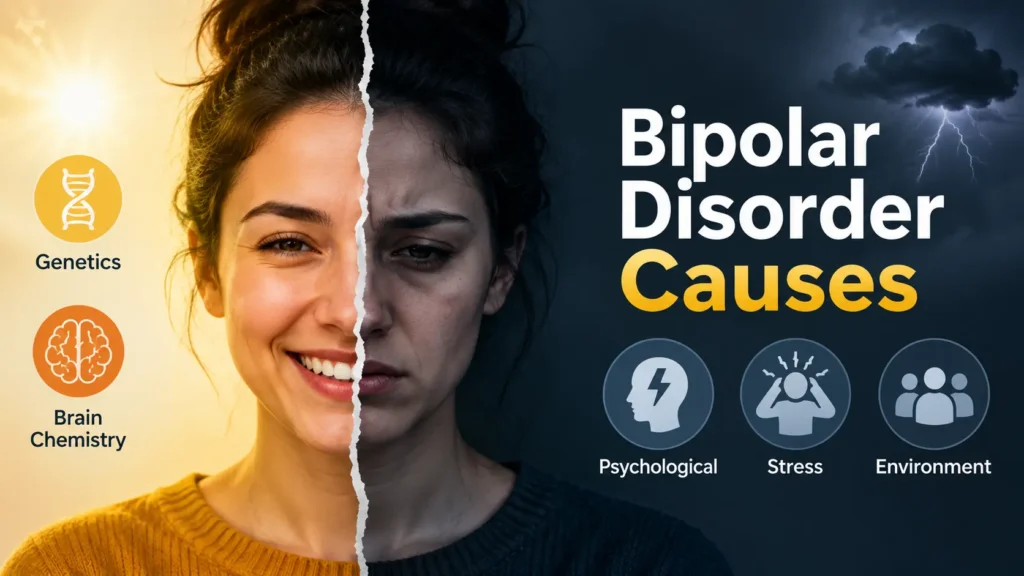
Bipolar Disorder Causes are complex and involve multiple factors rather than a single trigger. There is no single cause of bipolar disorder. Research points to a combination of genetics, brain structure and chemistry, and environmental triggers such as chronic stress or trauma. Having a close relative with bipolar disorder raises your risk, but genes alone don’t decide the outcome—most people with a family history never develop the condition. Understanding bipolar disorder causes doesn’t tell you exactly why you developed bipolar disorder, but it does explain why it isn’t caused by weakness, poor parenting, or a single bad decision.
Table of Contents
Key Takeaways
- Bipolar disorder comes from an interaction of genetic risk, brain biology, and environmental stress — not one isolated cause.
- It’s one of the most heritable psychiatric conditions, but no single “bipolar gene” exists.
- Differences in brain structure, neurotransmitter activity, and the body’s stress-response system all appear to play a role.
- Trauma, major life changes, substance use, and disrupted sleep can trigger episodes in people who are already genetically vulnerable.
- Bipolar disorder is a recognized medical condition, not a personal failing — and effective treatment is available.
Why “What Causes Bipolar Disorder” Doesn’t Have a Simple Answer
If you’re searching for the cause of bipolar disorder, you might expect a tidy explanation — a faulty gene, a chemical imbalance, a childhood event. Instead, decades of research from institutions like the National Institute of Mental Health (NIMH) describe something closer to a puzzle with many interlocking pieces.
Scientists now generally agree that bipolar disorder develops through a mix of inherited vulnerability and outside influences that act on that vulnerability. Two people can share the same genetic risk, yet only one develops the condition, because the environmental piece — stress, trauma, substance use, sleep disruption — differs between them.
This article breaks down what’s actually known about the causes and risk factors behind bipolar disorder, in plain language. If you’re looking for information on symptoms rather than causes, our guide to bipolar disorder symptoms covers that separately, and our overview of bipolar disorder explains the condition as a whole.
Genetics: The Strongest Known Risk Factor
Of everything researchers have studied, genetics shows the clearest and most consistent link to bipolar disorder.
Bipolar Disorder Runs in Families
<cite index=”4-1″>Bipolar disorder tends to run in families, and some research suggests people with certain genes are more likely to develop it than others.</cite> <cite index=”8-1″>A person’s chances of having bipolar disorder are higher if they have a close family member with the illness, which may reflect shared genetic variations.</cite>
That said, family history is not destiny. <cite index=”4-1″>Most children with a family history of bipolar disorder will not go on to develop the illness themselves.</cite> Genetics loads the dice; it doesn’t decide the roll.
There’s No Single “Bipolar Gene”
It’s tempting to imagine one gene flipping a switch, but that isn’t how it works. <cite index=”8-1″>Many genes are involved in bipolar disorder, and no single gene causes it.</cite> A landmark 2025 genome-wide study — the largest of its kind, analyzing a genetically diverse group of participants — <cite index=”7-1″>found an over four-fold increase in the number of genes linked to bipolar disorder, identifying nearly 300 gene locations and 36 unique genes most strongly associated with the condition.</cite> <cite index=”7-1″>Many of these genes overlap with genes already implicated in schizophrenia and depression, and the genetic patterns differ somewhat across bipolar disorder subtypes.</cite>
Earlier genetic work identified individual genes worth watching too. <cite index=”10-1″>One large study pinpointed a gene called AKAP11 as a particularly strong risk factor for both bipolar disorder and schizophrenia — the first time a single gene had been shown to have such a major individual impact on bipolar risk.</cite>
Just How Heritable Is Bipolar Disorder?
Heritability estimates vary by study design, but the general message is consistent: genetics carries substantial weight. <cite index=”6-1″>According to Dr. Francis McMahon, chief of NIMH’s Human Genetics Branch, roughly three-quarters of the risk for bipolar disorder can be explained by inherited genes — though many different genes are involved, making the picture complex.</cite> Other reviews cite a wide range, <cite index=”10-1″>with some research showing a 44 to 90 percent increased risk of bipolar disorder if a close family member has the condition.</cite>
Twin studies add an important nuance. <cite index=”3-1″>The identical twin of a person with bipolar disorder does not always develop the disorder themselves — and because identical twins share essentially all their genes, this tells researchers that factors beyond genetics must also be at work.</cite>
Genetics and Bipolar Subtypes
Genetic risk isn’t identical across every form of bipolar disorder. <cite index=”10-1″>Family studies suggest bipolar 1 and bipolar 2 disorder are partly genetically distinct — relatives of people with bipolar 2 appear to carry a higher risk for bipolar 2 specifically than relatives of people with bipolar 1.</cite> If you want to understand how these two presentations differ in symptoms and course, see our dedicated comparison at bipolar1vs2.com.
Brain Structure and Chemistry
Genetics doesn’t act in a vacuum — it shapes the brain, and researchers have found measurable differences in the brains of people with bipolar disorder compared to those without it.
<cite index=”8-1″>Some research has identified differences in brain structure and function between people with bipolar disorder and people without the condition.</cite> These differences show up in brain regions responsible for regulating mood, impulse control, and reward processing — areas that are also influenced by neurotransmitters like dopamine, serotonin, and norepinephrine.
It’s worth being cautious here: you may have heard bipolar disorder described simply as a “chemical imbalance.” That phrase oversimplifies a genuinely complex process. Neurotransmitter activity, hormone regulation, and neural circuitry all interact, and researchers are still mapping exactly how these systems misfire in bipolar disorder. What’s clear is that the brain itself — not just mood or behavior — is different in measurable, biological ways.
Environmental and Life-Event Triggers
Genes and brain biology explain vulnerability. Environmental factors often explain timing — why an episode happens now rather than years earlier or later.
<cite index=”8-1″>Research suggests that people with a genetic risk of bipolar disorder may be more likely to develop the disorder after experiencing trauma or other stressful life events.</cite> In other words, genetics can load the gun, but a stressful or traumatic experience often pulls the trigger.
Commonly studied environmental contributors include:
- Childhood trauma or abuse — early adverse experiences are associated with earlier onset and, in some studies, more severe illness course.
- Chronic or acute stress — major life changes (job loss, divorce, bereavement, financial strain) can precede a first episode.
- Substance use — alcohol and drug use can trigger mood episodes and complicate diagnosis and treatment.
- Sleep disruption — irregular sleep patterns, shift work, or sleep deprivation are well-documented triggers for manic and hypomanic episodes.
- Major hormonal shifts — pregnancy and the postpartum period are associated with new-onset mood episodes in some women with genetic vulnerability.
- Significant life transitions — even positive changes, like starting a new job or having a baby, can act as a stressor that destabilizes mood regulation.
None of these factors “causes” bipolar disorder on their own in someone without underlying vulnerability. Their role is best understood as tipping a genetically susceptible brain into an active episode.
Causes vs. Risk Factors: What’s the Difference?
People often use “cause” and “risk factor” interchangeably, but they’re not quite the same thing. A cause is something that directly produces a condition. A risk factor increases the likelihood of a condition without guaranteeing it. Because bipolar disorder has no single direct cause, most of what researchers have identified are risk factors that combine to raise or lower someone’s overall vulnerability.
| Factor | Type | What research shows |
| Family history of bipolar disorder | Genetic | Strongest and most consistent risk factor; risk rises significantly with a close affected relative |
| Specific gene variants (e.g., AKAP11) | Genetic | Individual genes identified as contributing meaningfully to risk, though none acts alone |
| Differences in brain structure/function | Biological | Measurable differences observed in mood-regulating brain regions |
| Childhood trauma or abuse | Environmental | Associated with earlier onset and, in some studies, greater symptom severity |
| Chronic stress or major life changes | Environmental | Frequently precedes first or subsequent mood episodes |
| Substance use | Environmental/Behavioral | Can trigger episodes and worsen course |
| Sleep disruption | Environmental/Behavioral | Well-established trigger for manic or hypomanic episodes |
| Postpartum period | Hormonal | Increased risk of new-onset or recurrent episodes in genetically vulnerable women |
Myths vs. Facts About Bipolar Disorder Causes
| Myth | Fact |
| Bad parenting causes bipolar disorder | There is no credible evidence that parenting style causes bipolar disorder; genetics and biology are the dominant known factors |
| Bipolar disorder is caused by one single gene | Research has identified hundreds of gene locations linked to risk; no single gene is responsible on its own |
| If a parent has bipolar disorder, their child will definitely develop it too | Most children with a family history never develop the condition themselves |
| Stress alone causes bipolar disorder | Stress can trigger episodes in someone already vulnerable, but it does not create bipolar disorder in someone without that underlying vulnerability |
| Bipolar disorder is just a “chemical imbalance” that any adult can develop equally | Genetic vulnerability substantially shapes who is at risk; environment interacts with — rather than replaces — that vulnerability |
Who Is Most at Risk?
Based on current research, the people at highest risk of developing bipolar disorder generally include:
- Those with a parent or sibling who has bipolar disorder
- Those with a family history of major depression or schizophrenia (given overlapping genetic risk)
- People who experienced significant childhood trauma or chronic early-life stress
- Individuals with a history of substance use alongside mood instability
- People going through major hormonal transitions, such as the postpartum period, in combination with a genetic predisposition
Having one or more of these risk factors doesn’t guarantee you’ll develop bipolar disorder — it simply means your baseline risk is higher than someone without them. If you’re noticing mood changes and want to understand whether they match the clinical picture, our guide to bipolar disorder symptoms is the right next stop.
Can Bipolar Disorder Be Prevented?
Because genetic vulnerability can’t be changed, bipolar disorder can’t be fully prevented in someone who carries significant genetic risk. However, for people who know they’re at elevated risk — for example, those with a close family member who has the condition — some strategies may help reduce the likelihood or severity of episodes:
- Maintaining a consistent sleep schedule
- Limiting alcohol and recreational drug use
- Managing chronic stress through therapy or structured routines
- Seeking early evaluation if mood symptoms appear, rather than waiting
- Building a support system that can help spot early warning signs
These steps don’t eliminate risk, but they address the environmental side of the equation — the part that’s actually within a person’s control.
When to Seek Professional Help
If you recognize several of these risk factors in yourself or a loved one, or if you’re noticing mood swings that affect daily functioning, relationships, or work, it’s worth speaking with a psychiatrist, psychologist, or primary care doctor. A qualified healthcare professional can evaluate your history and symptoms against clinical criteria — something no online article can do on its own.
If you or someone you know is in crisis or having thoughts of suicide, contact the 988 Suicide & Crisis Lifeline (call or text 988 in the US) or your local emergency services immediately.
Frequently Asked Questions
Is bipolar disorder genetic? Yes, genetics is the strongest known risk factor. <cite index=”6-1″>Roughly three-quarters of bipolar disorder risk is estimated to come from inherited genes</cite>, though many genes are involved and environment also plays a role.
Can bipolar disorder skip a generation? It can appear to. Because many genes contribute to risk rather than a single dominant gene, inheritance doesn’t follow a simple, predictable pattern the way some genetic conditions do. A grandparent may have it, a parent may not, and a grandchild may.
What triggers a bipolar episode? Common triggers include major stress, trauma, sleep disruption, substance use, and significant life changes such as childbirth. These triggers tend to affect people who already carry underlying genetic or biological vulnerability.
Can trauma alone cause bipolar disorder? Trauma is considered a contributing environmental factor rather than a standalone cause. <cite index=”8-1″>Research suggests trauma and stressful life events are more likely to trigger bipolar disorder in people who already have a genetic risk</cite>, rather than causing it in someone without that vulnerability.
Is bipolar disorder caused by a chemical imbalance? That phrase is an oversimplification. Differences in neurotransmitter activity are part of the picture, but they interact with genetics, brain structure, and environmental factors rather than acting as a standalone explanation.
Does having a parent with bipolar disorder mean I will get it too? No. <cite index=”4-1″>Most children with a family history of bipolar disorder do not develop the illness</cite>, even though their risk is higher than average.
Are bipolar 1 and bipolar 2 caused by the same genes? Not entirely. <cite index=”10-1″>Research suggests the two are partly genetically distinct, with bipolar 2 risk running more strongly in relatives of people who have bipolar 2</cite>. For a full breakdown of how the two types differ, visit our guide at bipolar1vs2.com.
Summary
Bipolar disorder doesn’t have one cause — it emerges from the interaction of inherited genetic risk, differences in brain structure and chemistry, and environmental factors like stress, trauma, and sleep disruption. Family history remains the single strongest known risk factor, but genetics alone doesn’t determine who develops the condition. If you recognize risk factors in your own life or family, the most useful next step isn’t self-diagnosis — it’s a conversation with a qualified healthcare professional who can assess your full history and symptoms. For more on how bipolar disorder presents day to day, see our guides on what bipolar disorder is and bipolar disorder symptoms.
This article is for educational purposes and is not a substitute for professional medical advice, diagnosis, or treatment. Always consult a qualified healthcare provider with questions about a medical condition.
SEO Title: Bipolar Disorder Causes: Genetics, Brain & Risk Factors
Meta Description: What causes bipolar disorder? Explore the genetic, biological, and environmental risk factors research links to bipolar disorder — explained simply.
URL Slug: /bipolar-disorder-causes
Bipolar Disorder Causes: What Genetics, Brain Chemistry, and Life Events Have to Do With It
Quick Answer
There is no single cause of bipolar disorder. Research points to a combination of genetics, brain structure and chemistry, and environmental triggers such as chronic stress or trauma. Having a close relative with bipolar disorder raises your risk, but genes alone don’t decide the outcome — most people with a family history never develop the condition. Understanding these causes doesn’t tell you exactly why you developed bipolar disorder, but it does explain why it isn’t caused by weakness, poor parenting, or a single bad decision.
Key Takeaways
- Bipolar disorder comes from an interaction of genetic risk, brain biology, and environmental stress — not one isolated cause.
- It’s one of the most heritable psychiatric conditions, but no single “bipolar gene” exists.
- Differences in brain structure, neurotransmitter activity, and the body’s stress-response system all appear to play a role.
- Trauma, major life changes, substance use, and disrupted sleep can trigger episodes in people who are already genetically vulnerable.
- Bipolar disorder is a recognized medical condition, not a personal failing — and effective treatment is available.
Why “What Causes Bipolar Disorder” Doesn’t Have a Simple Answer
If you’re searching for the cause of bipolar disorder, you might expect a tidy explanation — a faulty gene, a chemical imbalance, a childhood event. Instead, decades of research from institutions like the National Institute of Mental Health (NIMH) describe something closer to a puzzle with many interlocking pieces.
Scientists now generally agree that bipolar disorder develops through a mix of inherited vulnerability and outside influences that act on that vulnerability. Two people can share the same genetic risk, yet only one develops the condition, because the environmental piece — stress, trauma, substance use, sleep disruption — differs between them.
This article breaks down what’s actually known about the causes and risk factors behind bipolar disorder, in plain language. If you’re looking for information on symptoms rather than causes, our guide to bipolar disorder symptoms covers that separately, and our overview of bipolar disorder explains the condition as a whole.
Genetics: The Strongest Known Risk Factor
Of everything researchers have studied, genetics shows the clearest and most consistent link to bipolar disorder.
Bipolar Disorder Runs in Families
<cite index=”4-1″>Bipolar disorder tends to run in families, and some research suggests people with certain genes are more likely to develop it than others.</cite> <cite index=”8-1″>A person’s chances of having bipolar disorder are higher if they have a close family member with the illness, which may reflect shared genetic variations.</cite>
That said, family history is not destiny. <cite index=”4-1″>Most children with a family history of bipolar disorder will not go on to develop the illness themselves.</cite> Genetics loads the dice; it doesn’t decide the roll.
There’s No Single “Bipolar Gene”
It’s tempting to imagine one gene flipping a switch, but that isn’t how it works. <cite index=”8-1″>Many genes are involved in bipolar disorder, and no single gene causes it.</cite> A landmark 2025 genome-wide study — the largest of its kind, analyzing a genetically diverse group of participants — <cite index=”7-1″>found an over four-fold increase in the number of genes linked to bipolar disorder, identifying nearly 300 gene locations and 36 unique genes most strongly associated with the condition.</cite> <cite index=”7-1″>Many of these genes overlap with genes already implicated in schizophrenia and depression, and the genetic patterns differ somewhat across bipolar disorder subtypes.</cite>
Earlier genetic work identified individual genes worth watching too. <cite index=”10-1″>One large study pinpointed a gene called AKAP11 as a particularly strong risk factor for both bipolar disorder and schizophrenia — the first time a single gene had been shown to have such a major individual impact on bipolar risk.</cite>
Just How Heritable Is Bipolar Disorder?
Heritability estimates vary by study design, but the general message is consistent: genetics carries substantial weight. <cite index=”6-1″>According to Dr. Francis McMahon, chief of NIMH’s Human Genetics Branch, roughly three-quarters of the risk for bipolar disorder can be explained by inherited genes — though many different genes are involved, making the picture complex.</cite> Other reviews cite a wide range, <cite index=”10-1″>with some research showing a 44 to 90 percent increased risk of bipolar disorder if a close family member has the condition.</cite>
Twin studies add an important nuance. <cite index=”3-1″>The identical twin of a person with bipolar disorder does not always develop the disorder themselves — and because identical twins share essentially all their genes, this tells researchers that factors beyond genetics must also be at work.</cite>
Genetics and Bipolar Subtypes
Genetic risk isn’t identical across every form of bipolar disorder. <cite index=”10-1″>Family studies suggest bipolar 1 and bipolar 2 disorder are partly genetically distinct — relatives of people with bipolar 2 appear to carry a higher risk for bipolar 2 specifically than relatives of people with bipolar 1.</cite> If you want to understand how these two presentations differ in symptoms and course, see our dedicated comparison at bipolar1vs2.com.
Brain Structure and Chemistry
Genetics doesn’t act in a vacuum — it shapes the brain, and researchers have found measurable differences in the brains of people with bipolar disorder compared to those without it.
<cite index=”8-1″>Some research has identified differences in brain structure and function between people with bipolar disorder and people without the condition.</cite> These differences show up in brain regions responsible for regulating mood, impulse control, and reward processing — areas that are also influenced by neurotransmitters like dopamine, serotonin, and norepinephrine.
It’s worth being cautious here: you may have heard bipolar disorder described simply as a “chemical imbalance.” That phrase oversimplifies a genuinely complex process. Neurotransmitter activity, hormone regulation, and neural circuitry all interact, and researchers are still mapping exactly how these systems misfire in bipolar disorder. What’s clear is that the brain itself — not just mood or behavior — is different in measurable, biological ways.
Environmental and Life-Event Triggers
Genes and brain biology explain vulnerability. Environmental factors often explain timing — why an episode happens now rather than years earlier or later.
<cite index=”8-1″>Research suggests that people with a genetic risk of bipolar disorder may be more likely to develop the disorder after experiencing trauma or other stressful life events.</cite> In other words, genetics can load the gun, but a stressful or traumatic experience often pulls the trigger.
Commonly studied environmental contributors include:
- Childhood trauma or abuse — early adverse experiences are associated with earlier onset and, in some studies, more severe illness course.
- Chronic or acute stress — major life changes (job loss, divorce, bereavement, financial strain) can precede a first episode.
- Substance use — alcohol and drug use can trigger mood episodes and complicate diagnosis and treatment.
- Sleep disruption — irregular sleep patterns, shift work, or sleep deprivation are well-documented triggers for manic and hypomanic episodes.
- Major hormonal shifts — pregnancy and the postpartum period are associated with new-onset mood episodes in some women with genetic vulnerability.
- Significant life transitions — even positive changes, like starting a new job or having a baby, can act as a stressor that destabilizes mood regulation.
None of these factors “causes” bipolar disorder on their own in someone without underlying vulnerability. Their role is best understood as tipping a genetically susceptible brain into an active episode.
Causes vs. Risk Factors: What’s the Difference?
People often use “cause” and “risk factor” interchangeably, but they’re not quite the same thing. A cause is something that directly produces a condition. A risk factor increases the likelihood of a condition without guaranteeing it. Because bipolar disorder has no single direct cause, most of what researchers have identified are risk factors that combine to raise or lower someone’s overall vulnerability.
| Factor | Type | What research shows |
| Family history of bipolar disorder | Genetic | Strongest and most consistent risk factor; risk rises significantly with a close affected relative |
| Specific gene variants (e.g., AKAP11) | Genetic | Individual genes identified as contributing meaningfully to risk, though none acts alone |
| Differences in brain structure/function | Biological | Measurable differences observed in mood-regulating brain regions |
| Childhood trauma or abuse | Environmental | Associated with earlier onset and, in some studies, greater symptom severity |
| Chronic stress or major life changes | Environmental | Frequently precedes first or subsequent mood episodes |
| Substance use | Environmental/Behavioral | Can trigger episodes and worsen course |
| Sleep disruption | Environmental/Behavioral | Well-established trigger for manic or hypomanic episodes |
| Postpartum period | Hormonal | Increased risk of new-onset or recurrent episodes in genetically vulnerable women |
Myths vs. Facts About Bipolar Disorder Causes
| Myth | Fact |
| Bad parenting causes bipolar disorder | There is no credible evidence that parenting style causes bipolar disorder; genetics and biology are the dominant known factors |
| Bipolar disorder is caused by one single gene | Research has identified hundreds of gene locations linked to risk; no single gene is responsible on its own |
| If a parent has bipolar disorder, their child will definitely develop it too | Most children with a family history never develop the condition themselves |
| Stress alone causes bipolar disorder | Stress can trigger episodes in someone already vulnerable, but it does not create bipolar disorder in someone without that underlying vulnerability |
| Bipolar disorder is just a “chemical imbalance” that any adult can develop equally | Genetic vulnerability substantially shapes who is at risk; environment interacts with — rather than replaces — that vulnerability |
Who Is Most at Risk?
Based on current research, the people at highest risk of developing bipolar disorder generally include:
- Those with a parent or sibling who has bipolar disorder
- Those with a family history of major depression or schizophrenia (given overlapping genetic risk)
- People who experienced significant childhood trauma or chronic early-life stress
- Individuals with a history of substance use alongside mood instability
- People going through major hormonal transitions, such as the postpartum period, in combination with a genetic predisposition
Having one or more of these risk factors doesn’t guarantee you’ll develop bipolar disorder — it simply means your baseline risk is higher than someone without them. If you’re noticing mood changes and want to understand whether they match the clinical picture, our guide to bipolar disorder symptoms is the right next stop.
Can Bipolar Disorder Be Prevented?
Because genetic vulnerability can’t be changed, bipolar disorder can’t be fully prevented in someone who carries significant genetic risk. However, for people who know they’re at elevated risk — for example, those with a close family member who has the condition — some strategies may help reduce the likelihood or severity of episodes:
- Maintaining a consistent sleep schedule
- Limiting alcohol and recreational drug use
- Managing chronic stress through therapy or structured routines
- Seeking early evaluation if mood symptoms appear, rather than waiting
- Building a support system that can help spot early warning signs
These steps don’t eliminate risk, but they address the environmental side of the equation — the part that’s actually within a person’s control.
When to Seek Professional Help
If you recognize several of these risk factors in yourself or a loved one, or if you’re noticing mood swings that affect daily functioning, relationships, or work, it’s worth speaking with a psychiatrist, psychologist, or primary care doctor. A qualified healthcare professional can evaluate your history and symptoms against clinical criteria — something no online article can do on its own.
If you or someone you know is in crisis or having thoughts of suicide, contact the 988 Suicide & Crisis Lifeline (call or text 988 in the US) or your local emergency services immediately.
Frequently Asked Questions
Is bipolar disorder genetic? Yes, genetics is the strongest known risk factor. <cite index=”6-1″>Roughly three-quarters of bipolar disorder risk is estimated to come from inherited genes</cite>, though many genes are involved and environment also plays a role.
Can bipolar disorder skip a generation? It can appear to. Because many genes contribute to risk rather than a single dominant gene, inheritance doesn’t follow a simple, predictable pattern the way some genetic conditions do. A grandparent may have it, a parent may not, and a grandchild may.
What triggers a bipolar episode? Common triggers include major stress, trauma, sleep disruption, substance use, and significant life changes such as childbirth. These triggers tend to affect people who already carry underlying genetic or biological vulnerability.
Can trauma alone cause bipolar disorder? Trauma is considered a contributing environmental factor rather than a standalone cause. <cite index=”8-1″>Research suggests trauma and stressful life events are more likely to trigger bipolar disorder in people who already have a genetic risk</cite>, rather than causing it in someone without that vulnerability.
Is bipolar disorder caused by a chemical imbalance? That phrase is an oversimplification. Differences in neurotransmitter activity are part of the picture, but they interact with genetics, brain structure, and environmental factors rather than acting as a standalone explanation.
Does having a parent with bipolar disorder mean I will get it too? No. <cite index=”4-1″>Most children with a family history of bipolar disorder do not develop the illness</cite>, even though their risk is higher than average.
Are bipolar 1 and bipolar 2 caused by the same genes? Not entirely. <cite index=”10-1″>Research suggests the two are partly genetically distinct, with bipolar 2 risk running more strongly in relatives of people who have bipolar 2</cite>. For a full breakdown of how the two types differ, visit our guide at bipolar1vs2.com.
Summary
Bipolar disorder doesn’t have one cause — it emerges from the interaction of inherited genetic risk, differences in brain structure and chemistry, and environmental factors like stress, trauma, and sleep disruption. Family history remains the single strongest known risk factor, but genetics alone doesn’t determine who develops the condition. If you recognize risk factors in your own life or family, the most useful next step isn’t self-diagnosis — it’s a conversation with a qualified healthcare professional who can assess your full history and symptoms. For more on how bipolar disorder presents day to day, see our guides on what bipolar disorder is and bipolar disorder symptoms.
This article is for educational purposes and is not a substitute for professional medical advice, diagnosis, or treatment. Always consult a qualified healthcare provider with questions about a medical condition.