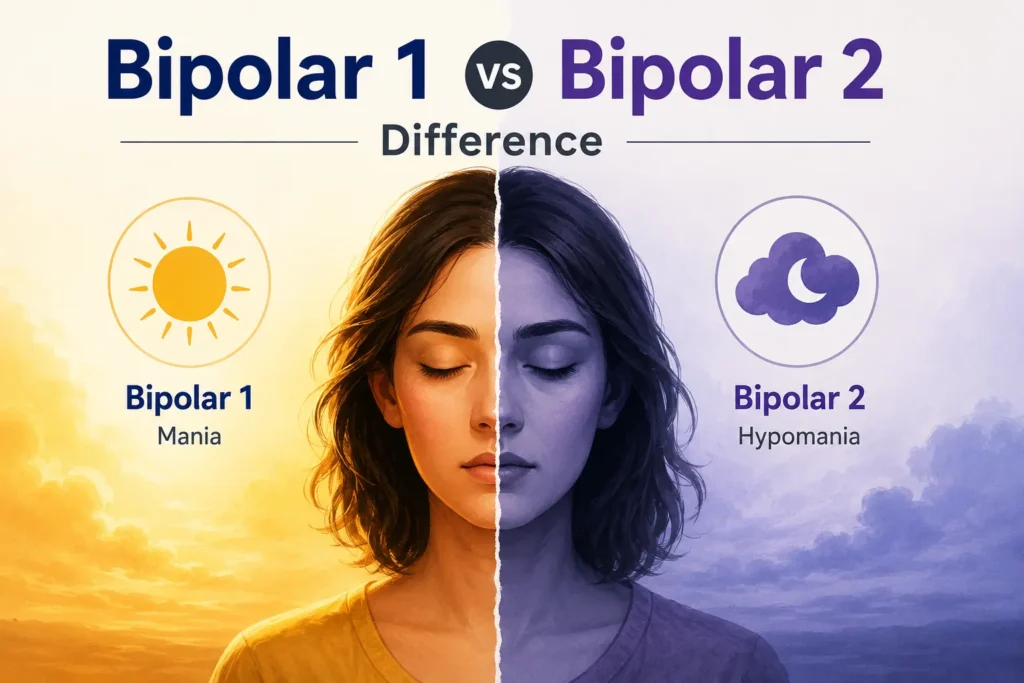
Understanding the Bipolar 1 vs Bipolar 2 Difference starts with one key distinction: the intensity of the “up” episodes. The main Bipolar 1 vs Bipolar 2 difference comes down to this—Bipolar 1 involves at least one full manic episode, an intense high that can include hospitalization, psychosis, or severe impulsivity. Bipolar 2 involves hypomania, a milder and shorter version of that high, paired with depressive episodes that are often longer and harder to shake. Neither type is “worse” or “better” overall—they’re simply different patterns of the same underlying condition, and both deserve serious treatment.
If you want the fuller picture of what bipolar disorder is before diving into the comparison, our guide on what is bipolar disorder is a good starting point.
Table of Contents
Key Takeaways
- Bipolar 1 requires at least one manic episode lasting 7+ days or severe enough to need hospital care.
- Bipolar 2 requires at least one hypomanic episode plus at least one major depressive episode — but never a full manic episode.
- Hypomania is a milder, shorter version of mania. It doesn’t usually cause psychosis or require hospitalization.
- People with bipolar 2 often spend more total time in depression than people with bipolar 1.
- Both types are diagnosed using the same manual (the DSM-5) and both are treated with medication and therapy, though the specific approach differs.
- Misdiagnosis is common, especially mistaking bipolar 2 for depression, since hypomania can go unnoticed or feel like “a good week.”
Bipolar 1 vs Bipolar 2 at a Glance
| Bipolar 1 Disorder | Bipolar 2 Disorder | |
| Defining episode | At least one manic episode | At least one hypomanic episode plus one major depressive episode |
| Episode length (mania/hypomania) | Mania lasts 7+ days, or any length if hospitalization is needed | Hypomania lasts at least 4 consecutive days |
| Severity of high episodes | Can include psychosis, delusions, or dangerous impulsivity | Noticeable mood and energy change, but daily functioning is usually intact |
| Hospitalization for mania | Common during severe manic episodes | Not typical for hypomania alone |
| Depression | Occurs in most, but not required for diagnosis | Required for diagnosis; often more frequent and longer-lasting |
| Common misdiagnosis | Schizophrenia (during psychotic mania) | Major depressive disorder |
| Everyday functioning during “up” phase | Often significantly disrupted | Often still functional, sometimes even more productive |
| Suicide risk | Elevated, particularly during mixed or depressive episodes | Elevated, and some research suggests depressive burden is heavier |
For a deeper breakdown of how these episodes present day to day, see our bipolar disorder symptoms guide.
What Is Bipolar 1 Disorder?
Bipolar 1 is defined by the presence of at least one manic episode. According to the <cite index=”2-1″>National Institute of Mental Health, bipolar I disorder is defined by manic episodes that last at least 7 days, most of the day nearly every day, or by manic symptoms so severe that hospital care is needed</cite>. Depressive episodes usually happen too, typically lasting at least two weeks, but a person can technically be diagnosed with bipolar 1 based on mania alone — a depressive episode isn’t required for the diagnosis.
During a manic episode, someone might feel unstoppable — full of energy, barely needing sleep, talking fast, jumping between ideas, and making decisions they’d never normally make, like emptying a bank account or quitting a job on a whim. In more severe cases, mania can escalate into psychosis: hearing things that aren’t there, or holding beliefs that don’t match reality. This is one reason bipolar 1 is sometimes mistaken for schizophrenia when the psychotic features are prominent.
Some people with bipolar 1 also experience “mixed features” — manic and depressive symptoms happening at the same time, which can feel especially disorienting and is linked to higher risk during that period.
For the full symptom list, causes, and how clinicians confirm this specific type, our dedicated pages on types of bipolar disorder and bipolar disorder causes go into more depth than we will here.
What Is Bipolar 2 Disorder?
Bipolar 2 is defined differently. It requires at least one hypomanic episode and at least one major depressive episode — but a person with bipolar 2 has never had a full manic episode. If they ever do, the diagnosis changes to bipolar 1.
Hypomania is the key word here. It’s a real, distinct mood shift — elevated energy, less need for sleep, more talkativeness, more confidence — but it doesn’t reach the intensity of mania. People are usually still able to go to work, keep up conversations, and function, even if those around them notice they seem “different” or unusually energized. It rarely involves psychosis and rarely requires hospitalization on its own.
What tends to define the experience of bipolar 2 more than the highs is the lows. <cite index=”2-1″>Many people with bipolar II disorder spend extended periods in a persistent, low-grade depressive state</cite>, and research following patients over time has found that <cite index=”5-1″>bipolar II patients tend to experience faster return of depressive symptoms compared with bipolar I patients</cite>. In plain terms: the depression in bipolar 2 often shows up more often and sticks around longer than the depression in bipolar 1.
This is a big part of why bipolar 2 gets missed. A short burst of hypomania can look like someone just having a great, productive week — nobody complains about that. It’s usually the depression that eventually brings someone to a doctor, and if the hypomanic episodes were never mentioned or noticed, the diagnosis can land on major depressive disorder instead.
Mania vs Hypomania: The Core Distinction
Since the whole bipolar 1 vs bipolar 2 question hinges on this difference, it’s worth laying out side by side.
| Feature | Mania (Bipolar 1) | Hypomania (Bipolar 2) |
| Minimum duration | 7 days (or any length if hospitalized) | 4 consecutive days |
| Impact on functioning | Marked impairment; often can’t work or manage normal responsibilities | Noticeable change, but usually still able to function |
| Psychosis possible? | Yes, in severe cases | No — by definition, hypomania does not include psychosis |
| Hospitalization | Often necessary in severe episodes | Not typically required |
| How it’s often described | “Out of control,” “unrecognizable,” “dangerous” | “Unusually confident,” “on top of the world,” “productive” |
Both involve elevated mood, high energy, reduced sleep need, racing thoughts, and impulsive behavior. The difference is one of degree and consequence, not of which symptoms show up.
Symptoms Compared
While the manic/hypomanic distinction gets the most attention, it helps to see how the broader symptom picture compares.
| Symptom Area | Bipolar 1 | Bipolar 2 |
| Elevated/irritable mood | Present during mania, can be extreme | Present during hypomania, milder |
| Depressive episodes | Common, not required for diagnosis | Required for diagnosis; often more frequent |
| Sleep changes | Drastically reduced need for sleep during mania | Reduced need for sleep during hypomania |
| Impulsivity/risk-taking | Often high, sometimes dangerous | Present, generally less extreme |
| Psychotic symptoms | Can occur during severe mania | Does not occur in hypomania |
| Rapid cycling | Can happen in either type | Can happen in either type |
We cover the full symptom checklist, including depressive-phase symptoms, in our detailed bipolar disorder symptoms article rather than repeating it here.
How Are Bipolar 1 and Bipolar 2 Diagnosed?
Both conditions are diagnosed using the same clinical framework: the <cite index=”5-1″>DSM-5, the diagnostic manual published by the American Psychiatric Association</cite>. There’s no blood test or brain scan that confirms bipolar disorder on its own. Instead, a mental health professional builds a picture from:
- A detailed history of mood episodes — when they happened, how long they lasted, and how severe they were
- Input from family members, since people in the middle of hypomania or mania often don’t recognize how different they seem
- A physical exam and basic medical testing to rule out other causes (thyroid issues, substance use, certain medications)
- Comparison against DSM-5 criteria for mania, hypomania, and major depression
One of the trickiest parts of diagnosis is that hypomania is easy to underreport. A person might only mention the depressive episodes that brought them to treatment, without volunteering the “good weeks” that came before — because those weeks didn’t feel like a problem. This is a major reason bipolar 2 sometimes takes longer to correctly identify than bipolar 1, where the manic episode is usually impossible to miss.
For the step-by-step diagnostic process, including which questionnaires and interviews clinicians typically use, see our full guide to bipolar disorder diagnosis.
Causes and Risk Factors
Bipolar 1 and bipolar 2 share the same general risk factors rather than having entirely separate causes. Genetics play a substantial role — having a close family member with bipolar disorder raises risk. Brain structure and function differences, stress, trauma, and disrupted sleep patterns are also linked to onset and relapse.
There isn’t strong evidence that one specific cause leads to bipolar 1 while a different one leads to bipolar 2. Instead, researchers generally view bipolar 1 and bipolar 2 as points on the same spectrum, with shared genetic and environmental contributors that happen to express differently from person to person. For the full breakdown of genetic, environmental, and neurological risk factors, our dedicated page on bipolar disorder causes covers this in depth.
Treatment Differences
Treatment for both types typically combines medication and psychotherapy, but the specifics can differ.
| Treatment Area | Bipolar 1 | Bipolar 2 |
| Mood stabilizers | Frequently first-line (e.g., lithium, valproate) | Often used, sometimes at different dosing strategies |
| Antipsychotics | Commonly used, especially if psychosis is present | Used less often, mainly if symptoms are more severe |
| Antidepressants | Used cautiously — can trigger mania if not paired with a mood stabilizer | Also used cautiously, since hypomania can be triggered too, though the risk profile differs |
| Hospitalization | More often needed during acute mania | Rarely needed for hypomania alone; more relevant during severe depression or suicidality |
| Psychotherapy | CBT, family-focused therapy, psychoeducation | Same approaches, often with more focus on managing chronic depressive symptoms |
A notable challenge in bipolar 2 treatment is that antidepressants are sometimes prescribed for the depressive episodes before the hypomanic history is recognized, which can be counterproductive if the hypomania was never accounted for. This is one more reason an accurate diagnosis matters before treatment begins.
For medication classes, dosing considerations, and therapy approaches in full detail, visit our complete bipolar disorder treatment guide.
Prognosis: Which Type Is “Worse”?
This is one of the most common questions, and it doesn’t have a simple answer. Bipolar 1 involves more dramatic and dangerous manic episodes, which can lead to hospitalization, job loss, legal trouble, or risky behavior during the manic phase itself. Bipolar 2, on the other hand, often carries a heavier overall burden of depression, and some research indicates <cite index=”5-1″>bipolar II patients experience hastened depressive recurrence compared to bipolar I patients</cite>, meaning the lows tend to come back sooner.
Suicide risk is elevated in both conditions and shouldn’t be underestimated in either one — the idea that bipolar 2 is the “milder” or “safer” version is a misconception worth retiring. Long-term outlook depends far more on getting an accurate diagnosis, sticking with treatment, and having strong support than on which type someone has.
We go into course, relapse patterns, and long-term outlook in more detail in our dedicated bipolar disorder prognosis article.
Possible Complications
Left untreated or poorly managed, both types can lead to serious complications: relationship strain, job instability, financial problems from impulsive spending during manic or hypomanic phases, substance use as a coping mechanism, and an increased risk of suicide, particularly during depressive or mixed episodes. Bipolar 1’s manic episodes carry added risks tied to impaired judgment and, in severe cases, psychosis. Bipolar 2’s chronic depressive pattern carries added risk of functional decline over time if it isn’t recognized and treated.
For a full rundown of physical, psychological, and social complications linked to bipolar disorder, see our bipolar disorder complications page.
Myths vs Facts
| Myth | Fact |
| “Bipolar 2 is just a mild version of bipolar 1.” | They’re distinct diagnoses defined by different episode types, not a severity scale of the same illness. |
| “If you’ve never been hospitalized, you can’t have bipolar disorder.” | Most people with bipolar 2, and even some with bipolar 1, are never hospitalized. |
| “Hypomania always feels good.” | Many people describe hypomania as unsettling, irritable, or hard to control, not simply pleasant. |
| “Bipolar 2 doesn’t need medication since it’s ‘less severe.'” | Bipolar 2 is a serious, treatable condition with its own significant depressive burden and suicide risk. |
| “You can diagnose yourself by comparing symptoms online.” | Diagnosis requires a full clinical history and evaluation by a qualified mental health professional. |
Our broader bipolar disorder myths guide addresses more misconceptions beyond the bipolar 1 vs 2 comparison.
Living With Bipolar 1 or Bipolar 2: Practical Tips
Whichever type someone is managing, a few habits consistently help stabilize mood over time:
- Keep a consistent sleep schedule. Sleep disruption is one of the most common triggers for both manic/hypomanic and depressive episodes.
- Track mood daily. A simple mood chart makes early warning signs easier to catch before a full episode develops.
- Build a relapse plan with a clinician. Knowing which symptoms signal an oncoming episode — and what to do about it — reduces how severe episodes become.
- Limit alcohol and recreational drug use. Both can destabilize mood and interfere with medication effectiveness.
- Loop in a trusted person. Family or close friends often notice early signs of hypomania or mania before the person experiencing it does.
- Stay consistent with treatment, even during stable periods. Stopping medication once symptoms improve is one of the most common causes of relapse.
Warning Signs That Need Attention
Certain signs suggest a mood episode is escalating and warrant reaching out to a healthcare provider promptly:
- Sleeping very little (or not at all) for several nights while still feeling energized
- Rapid, disorganized speech or racing thoughts that are hard to follow
- Sudden, uncharacteristic spending, risk-taking, or impulsive decisions
- Believing things that others say aren’t true, or hearing/seeing things others don’t (a sign of possible psychosis)
- Persistent hopelessness, loss of interest in everything, or withdrawing from daily life for weeks
- Any thoughts of self-harm or suicide
When to Get Emergency Help
If someone is experiencing thoughts of suicide, self-harm, or symptoms of psychosis (such as delusions or hallucinations), this is a mental health emergency. In the United States, call or text 988 to reach the Suicide & Crisis Lifeline, available 24/7. If there is immediate danger, call 911 or go to the nearest emergency room. In the UK, the Samaritans can be reached at 116 123. Wherever you are, don’t wait for an appointment — acute symptoms like these need urgent, in-person support.
Frequently Asked Questions
Can bipolar 2 turn into bipolar 1? Yes. If someone previously diagnosed with bipolar 2 later experiences a full manic episode, the diagnosis changes to bipolar 1, since bipolar 1 only requires one manic episode to qualify.
Is bipolar 2 more common than bipolar 1? Estimates vary by study and population, and prevalence figures shift depending on how carefully hypomania is assessed. Rather than quoting a specific split here, it’s worth discussing prevalence with a clinician, since bipolar 2 in particular is thought to be underdiagnosed.
Which is harder to live with, bipolar 1 or bipolar 2? Neither is uniformly “harder.” Bipolar 1’s manic episodes can be more disruptive and dangerous in the moment, while bipolar 2’s depressive episodes tend to be more frequent and longer-lasting. Day-to-day difficulty depends heavily on the individual, their support system, and how well their treatment plan fits them.
Does bipolar 2 always include depression? Yes — a major depressive episode is required for a bipolar 2 diagnosis, alongside at least one hypomanic episode. This is different from bipolar 1, where a depressive episode is common but not required for diagnosis.
Can you have both mania and hypomania? No, not as separate diagnoses. If a person has ever had a full manic episode, they’re diagnosed with bipolar 1, even if they’ve also had hypomanic episodes. Hypomania without any history of full mania points toward bipolar 2.
Is one type genetic and the other not? No. Both bipolar 1 and bipolar 2 share similar genetic and environmental risk factors. There’s no strong evidence that they stem from fundamentally different causes.
How long does a hypomanic episode last compared to a manic episode? Hypomania must last at least 4 consecutive days to meet diagnostic criteria, while mania must last at least 7 days, or any length of time if hospitalization becomes necessary.
Can someone be misdiagnosed with depression when they actually have bipolar 2? Yes, and it’s fairly common. Because hypomanic episodes can be brief, mild, and not experienced as distressing, a person may only report the depressive symptoms, leading a clinician to initially diagnose major depressive disorder instead of bipolar 2.
Summary
Bipolar 1 and bipolar 2 sit on the same spectrum but are defined by different criteria: bipolar 1 requires a full manic episode, while bipolar 2 requires hypomania paired with major depression and no history of full mania. Bipolar 1 tends to bring more intense, disruptive highs; bipolar 2 tends to bring a heavier and more persistent load of depression. Neither is inherently milder in terms of impact on someone’s life, and both require an accurate diagnosis and consistent treatment.
If any of this sounds familiar — whether it’s unexplained mood swings, cycles of depression, or episodes that friends or family have described as “not like you” — the most useful next step is a full evaluation from a qualified mental health professional rather than a checklist comparison. For general background on the condition as a whole, our bipolar disorder hub page links out to every stage of the journey, from symptoms and causes to diagnosis, treatment, and long-term outlook. You can also review current bipolar disorder statistics for a broader sense of how common these conditions are.
This article is for educational purposes and is not a substitute for a professional diagnosis. If you recognize these patterns in yourself or someone you love, talk to a psychiatrist, psychologist, or primary care provider. Sources referenced include the National Institute of Mental Health (NIMH), the American Psychiatric Association’s DSM-5, and peer-reviewed clinical research on bipolar I and II disorder.