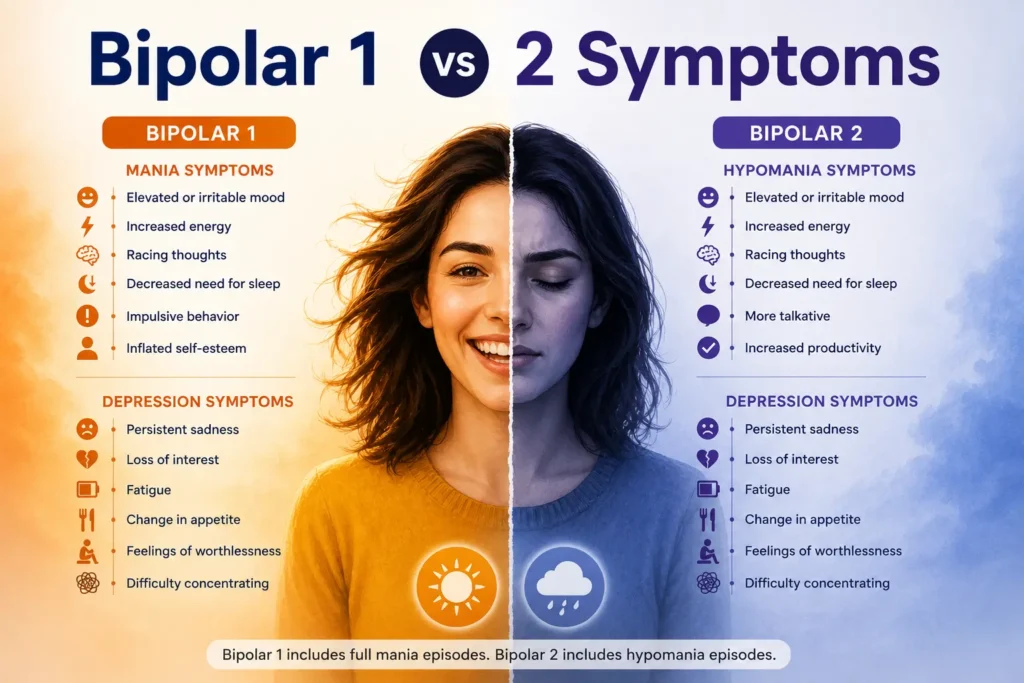
The biggest difference between Bipolar 1 vs 2 Symptoms comes down to the “up” episodes. Bipolar 1 involves full mania — intense enough to disrupt work, relationships, or safety, and sometimes serious enough to require hospitalization. Bipolar 2 involves hypomania, a milder and shorter version of that high that doesn’t wreck daily functioning the same way. Depressive episodes, on the other hand, tend to show up more often and last longer in bipolar 2. Neither type is “worse” than the other — they’re just different patterns of the same underlying condition. For a full breakdown of what separates the two conditions overall, see our guide on Bipolar 1 vs Bipolar 2 Difference.
Table of Contents
Key Takeaways
- Bipolar 1 requires at least one manic episode lasting a week or longer (or any length if hospitalization is needed).
- Bipolar 2 requires at least one hypomanic episode plus at least one major depressive episode — full mania never occurs.
- Psychosis (losing touch with reality) can happen during bipolar 1 mania but not during bipolar 2 hypomania.
- People with bipolar 2 typically spend more total time depressed than people with bipolar 1.
- Both types share core mood, energy, and sleep symptoms, which is why they’re easy to confuse without a professional evaluation.
Introduction
If you’ve spent any time comparing bipolar 1 and bipolar 2, you’ve probably noticed most articles describe them in isolation — one page on bipolar 1, another on bipolar 2 — and leave you to do the comparing yourself. That’s the gap this guide fills.
Bipolar 1 and bipolar 2 disorder both fall under the umbrella of bipolar disorder, a condition marked by shifts between elevated and depressed mood states. What separates them isn’t a different illness — it’s the intensity and combination of symptoms a person experiences. Getting this distinction right matters because it shapes diagnosis, treatment planning, and what kind of support someone actually needs.
This article focuses specifically on symptoms — what each type looks like day to day, where they overlap, and where they clearly diverge. For background on the condition as a whole, our guide on what bipolar disorder is is a good starting point.
Mania vs. Hypomania: The Core Difference
Everything about bipolar 1 vs 2 symptoms starts here. Both conditions include an “up” phase, but the two versions of that phase aren’t the same experience.
Mania (bipolar 1) is an intense, sustained period of abnormally elevated, expansive, or irritable mood along with a surge in energy and activity. It lasts at least seven days — or less if it’s severe enough to need hospital care. During mania, functioning is clearly disrupted. A person might stop sleeping for days without feeling tired, spend money impulsively, take on grandiose plans, or, in more severe cases, lose touch with reality through delusions or hallucinations.
Hypomania (bipolar 2) shares the same flavor — elevated mood, more energy, faster thinking, less need for sleep — but it’s dialed down. Episodes last at least four days. Functioning changes are noticeable to people close to the person, but they don’t cause the same level of damage. Someone with hypomania might seem unusually productive, chatty, or confident rather than clearly “unwell.” Psychosis does not occur in hypomania — if it does, the diagnosis shifts toward bipolar 1.
That last point trips up a lot of people, so it’s worth repeating: any episode involving psychosis, or any episode requiring hospitalization, automatically qualifies as mania, not hypomania — which points toward bipolar 1.
Symptom-by-Symptom Comparison Table
| Symptom Area | Bipolar 1 (Mania) | Bipolar 2 (Hypomania) |
| Minimum duration | 7+ days (or any length if hospitalized) | 4+ days |
| Mood | Elevated, expansive, or irritable | Elevated, expansive, or irritable — less extreme |
| Energy & activity | Sharp, often disruptive increase | Noticeable increase, more manageable |
| Sleep | Little to no sleep, no fatigue | Reduced need for sleep, still functional |
| Speech | Rapid, pressured, hard to interrupt | Talkative, more animated than usual |
| Thoughts | Racing, flight of ideas | Quicker thinking, more ideas than usual |
| Judgment/risk-taking | Impulsive spending, risky decisions, poor judgment | Some impulsivity, generally less severe |
| Psychosis | Can occur (delusions, hallucinations) | Does not occur |
| Impact on daily life | Significant disruption; hospitalization sometimes needed | Noticeable to others, but daily function usually continues |
| Depressive episodes | Occur, though often less frequent/prolonged than in bipolar 2 | Occur more often and typically last longer |
What Depression Looks Like in Each Type
Depressive symptoms are largely similar between bipolar 1 and bipolar 2 — persistent low mood, loss of interest in things that used to feel enjoyable, fatigue, changes in appetite or sleep, difficulty concentrating, feelings of worthlessness, and in some cases thoughts of death or suicide. The DSM-5 criteria for a major depressive episode, as outlined by the American Psychiatric Association, apply the same way regardless of bipolar type.
Where the types diverge is in pattern, not symptom content. People with bipolar 2 tend to spend more of their time unwell in a depressive state, and those depressive episodes are often what brings them to a doctor in the first place — the hypomanic episodes can feel good and go unreported. People with bipolar 1 may experience depression too, but the manic episodes are usually what draws clinical attention, since they’re harder to miss.
This is one reason bipolar 2 is sometimes under-recognized or misdiagnosed as regular depression — the “up” periods are subtle enough that neither the person nor their doctor flags them as hypomania. For a closer look at how these mood swings show up in everyday life across both types, see our full guide on bipolar disorder symptoms.
Shared Symptoms Between Bipolar 1 and Bipolar 2
It helps to know what overlaps, since this is where a lot of the confusion starts:
- Mood episodes that clearly differ from a person’s usual baseline
- Changes in sleep, appetite, and energy tied to mood state
- Racing or slowed thinking depending on the episode
- Irritability, which can appear in both elevated and depressed states
- Difficulty with concentration and decision-making
- Impact on relationships, work, or school during active episodes
Because so much overlaps, self-diagnosis based on symptoms alone is unreliable. A mental health professional looks at episode history, duration, severity, and functional impact together — not just a checklist of feelings. Our guide on bipolar disorder diagnosis walks through what that evaluation process actually involves.
Severity, Function, and Real-World Impact
One of the clearest practical differences is how each type affects daily functioning during an episode.
During bipolar 1 mania, it’s common for relationships, jobs, or finances to take a real hit. Some people need inpatient care to stay safe, especially if psychosis or severe risk-taking is present. During bipolar 2 hypomania, people often continue working and functioning, sometimes even feeling unusually capable — which is part of why hypomania can be mistaken for simply having “a good week.”
But bipolar 2 isn’t the milder condition overall. Because depressive episodes tend to dominate more of the timeline and can be just as severe as those in bipolar 1, bipolar 2 carries its own significant burden — particularly around the risk of prolonged depression and, in some cases, suicidal thinking. Severity in bipolar disorder isn’t a single scale; it depends on which symptoms you’re measuring.
Myths vs. Facts
| Myth | Fact |
| “Bipolar 2 is just a mild version of bipolar 1.” | Bipolar 2 involves a milder high, but often more frequent and longer depressive episodes. Overall symptom burden can be just as significant. |
| “If you’ve never been hospitalized, you don’t have bipolar disorder.” | Most people with bipolar 2, and many with bipolar 1, are never hospitalized. Hospitalization is one possible marker of severity, not a requirement for diagnosis. |
| “Hypomania always feels bad.” | Hypomania often feels good — more energy, more confidence, more productivity — which is exactly why it can go unreported to a doctor. |
| “You can tell bipolar 1 from bipolar 2 just by how someone acts during depression.” | Depressive symptoms look similar across both types. The distinguishing factor is the nature of the “up” episodes, not the depression itself. |
| “Bipolar disorder means constant, rapid mood swings.” | Episodes typically last days to weeks or longer, not hours. Rapid mood changes within a single day are more often linked to other causes. |
For a broader list of misconceptions about the condition as a whole, visit our dedicated page on bipolar disorder myths.
Warning Signs That Need Prompt Attention
Certain symptoms deserve faster follow-up with a healthcare provider rather than a wait-and-see approach:
- Not sleeping for multiple days without feeling tired
- Rapidly escalating spending, risk-taking, or impulsive decisions
- Beliefs that don’t match reality, or hearing/seeing things others don’t
- Depressive symptoms that last more than two weeks and interfere with daily life
- Any thoughts of self-harm or suicide
When Symptoms Become an Emergency
Some symptoms cross the line from “needs a doctor’s appointment” to “needs help right now.” Seek emergency care or call a crisis line immediately if someone shows:
- Suicidal thoughts, statements, or plans
- Intent or attempts to harm themselves or others
- Psychosis combined with agitation or unsafe behavior
- Severe confusion or inability to care for basic needs
In the United States, the 988 Suicide & Crisis Lifeline is available by call or text, 24/7. If there is immediate danger, call 911 or go to the nearest emergency room. This is a sensitive topic — if you’re personally struggling with any of this, please don’t wait to reach out for support.
Causes and Risk Factors (Brief Overview)
Bipolar 1 and bipolar 2 share overlapping risk factors, including genetics, brain chemistry, and stress or trauma exposure, though research hasn’t pinned down a single cause for either type. Family history is one of the more consistently identified risk factors according to organizations like the National Institute of Mental Health (NIMH). Since causes deserve their own deep dive, see our full article on bipolar disorder causes for the complete picture, along with our guide to the different types of bipolar disorder beyond just types 1 and 2.
How Symptoms Guide Diagnosis and Treatment
Because bipolar 1 and bipolar 2 are diagnosed based on episode history rather than a blood test or scan, accurately describing symptoms — including past episodes a person may not have flagged as unusual at the time — is central to getting the right diagnosis. Clinicians follow DSM-5 criteria from the American Psychiatric Association, often supported by structured interviews and, where relevant, input from family members who may have noticed hypomanic periods the person didn’t recognize as anything but a good stretch.
Treatment approaches differ somewhat based on type, since medications that stabilize mood in bipolar 1 mania aren’t always the same ones prioritized for bipolar 2’s depression-heavy pattern. That said, treatment specifics are covered in depth in our dedicated guide on bipolar disorder treatment — worth reading once you have a diagnosis or are working toward one with a provider.
How Common Is Each Type?
Bipolar 1 tends to be diagnosed at roughly similar rates in men and women, while bipolar 2 is diagnosed more frequently in women, according to data summarized by organizations like the NIMH and echoed by resources such as the NHS and Mayo Clinic. Exact prevalence figures vary between studies, so if you want the full statistical breakdown — including onset age and course over time — our dedicated page on bipolar disorder statistics is the better resource than trying to summarize it here.
Complications and Long-Term Outlook
Left untreated, both types can lead to strain on relationships, work or academic disruption, and in the case of bipolar 1, safety risks during severe manic episodes. Bipolar 2’s heavier depressive load carries its own long-term risks, including a higher cumulative burden of depressive symptoms over a person’s life. Neither type is static — with an accurate diagnosis and consistent treatment, many people manage symptoms effectively and maintain stable, fulfilling lives. For more on what to expect over time, see our guides on bipolar disorder complications and bipolar disorder prognosis.
Frequently Asked Questions
Is bipolar 2 easier to live with than bipolar 1? Not necessarily. Bipolar 2’s manic-type episodes (hypomania) are milder, but the more frequent and often longer depressive episodes can make bipolar 2 just as challenging to manage day to day.
Can bipolar 2 turn into bipolar 1? It’s possible, though not typical, for someone diagnosed with bipolar 2 to later experience a full manic episode, which would change the diagnosis to bipolar 1. This is one reason ongoing follow-up with a provider matters.
Do people with bipolar 1 always get psychosis during mania? No. Psychosis can occur during severe mania, but plenty of people with bipolar 1 never experience delusions or hallucinations.
How long do manic and hypomanic episodes typically last? Mania must last at least seven days (or be severe enough to require hospitalization sooner). Hypomania must last at least four days. Both can last longer, and depressive episodes often stretch on for weeks or months.
Can you have both mania and hypomania if you have bipolar 1? Yes. A bipolar 1 diagnosis requires at least one manic episode, but hypomanic and depressive episodes can also occur over the course of the illness.
Is it possible to have symptoms of both types at once? Some people experience “mixed features,” where depressive and manic/hypomanic symptoms occur together or in rapid succession. This is a recognized specifier in the DSM-5, not a separate diagnosis, and it’s worth flagging clearly to a provider if it happens.
What’s the fastest way to tell bipolar 1 and bipolar 2 apart? The presence of a full manic episode — especially one involving psychosis or requiring hospitalization — points to bipolar 1. If the highest “up” period has always stayed in hypomania territory alongside depressive episodes, bipolar 2 is more likely. Only a qualified clinician can confirm this with certainty.
Summary
Bipolar 1 and bipolar 2 share the same core building blocks — elevated mood episodes and depressive episodes — but differ in how intense and how frequent each one is. Bipolar 1 is defined by full mania, which can include psychosis and may require hospitalization. Bipolar 2 is defined by hypomania paired with more prominent depressive episodes. Neither is simply a “lighter” version of the other; they carry different challenges. If any of these symptom patterns sound familiar, the most reliable next step is a full evaluation from a mental health professional — for the bigger-picture comparison of both conditions, our guide on bipolar 1 vs bipolar 2 is a solid place to continue.
This article is for educational purposes and is not a substitute for a professional diagnosis. If you recognize these symptoms in yourself or someone you know, please consult a licensed healthcare provider or mental health professional.