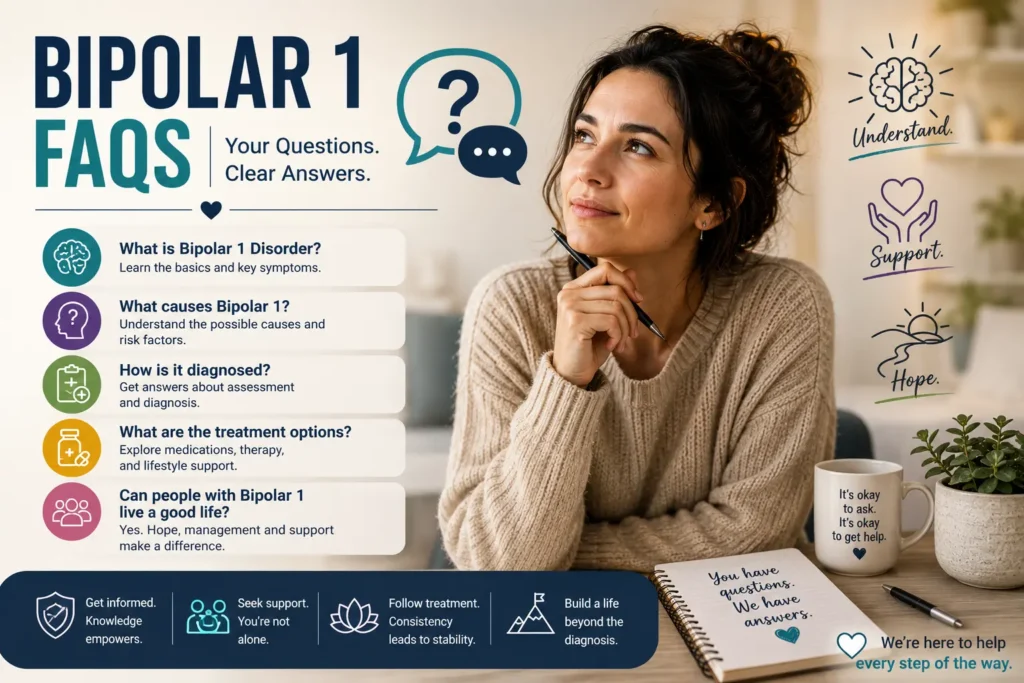
Bipolar 1 FAQs answer the most common questions about bipolar 1 disorder. Bipolar 1 disorder is a mood condition defined by at least one manic episode — a period of unusually high energy, elevated or irritable mood, and impulsive behavior lasting at least a week. Most people also experience depressive episodes, though they aren’t required for diagnosis. It’s a lifelong but highly treatable condition, typically managed with medication, therapy, and consistent routines. Below, we answer the questions people ask most often, organized by topic so you can jump straight to what you need.
Table of Contents
Key Takeaways
- Bipolar 1 requires only one manic episode to be diagnosed; depression is common but not mandatory.
- It’s different from bipolar 2, which involves hypomania (a milder elevated state) rather than full mania.
- There’s no blood test for bipolar 1 — diagnosis relies on a clinical interview using DSM-5 criteria.
- Treatment usually combines mood-stabilizing medication, therapy, and lifestyle structure.
- With consistent treatment, most people with bipolar 1 lead stable, functional lives.
What Is Bipolar 1 Disorder? (A Quick Refresher)
Before diving into specific questions, here’s the short version: bipolar 1 disorder is a mental health condition marked by extreme shifts in mood and energy. The defining feature is a manic episode — not just a good mood, but a sustained period of elevated, expansive, or irritable mood combined with abnormally high energy, reduced need for sleep, and often impulsive or risky decisions.
For a full definition and overview, see our main guide to bipolar disorder and our dedicated explainer on what bipolar actually means as a diagnosis. If you want the full picture of bipolar 1 specifically, our bipolar 1 guide is the best starting point.
With that foundation in place, let’s get into the questions people ask most.
Basic Questions About Bipolar 1
What’s the difference between bipolar 1 and bipolar 2? Bipolar 1 requires at least one full manic episode. Bipolar 2 involves hypomania — a milder, shorter version of elevated mood — alongside major depressive episodes, without ever reaching full mania. Our detailed bipolar 1 vs bipolar 2 guide and bipolar 1 vs bipolar 2 differences breakdown cover this comparison in full, and our bipolar 1 vs 2 symptoms page and bipolar 1 vs 2 chart offer a quick visual reference.
Is bipolar 1 worse than bipolar 2? “Worse” depends on what you’re measuring. Bipolar 1’s manic episodes tend to be more intense and can involve psychosis, which sometimes requires hospitalization. Bipolar 2, meanwhile, tends to involve more time spent in depression, which carries its own serious risks, including a higher reported rate of suicide attempts in some studies. Our bipolar 1 vs 2: which is worse guide unpacks this comparison in more depth.
Can bipolar 2 turn into bipolar 1? It’s possible for someone initially diagnosed with bipolar 2 to later experience a full manic episode, which would update their diagnosis to bipolar 1. This isn’t the illness “progressing” in every case — sometimes it reflects that a manic episode simply hadn’t occurred yet, or hadn’t been recognized. Our page on can bipolar 2 become bipolar 1 explains this in detail.
How is bipolar 1 different from cyclothymia? Cyclothymia involves milder mood swings — hypomanic and depressive symptoms that don’t meet the full criteria for either a manic or major depressive episode, but persist for at least two years. Bipolar 1 involves at least one full manic episode, which is a more intense and clearly defined presentation. See our comparison of bipolar 1 vs 2 vs cyclothymia for the full picture.
Do bipolar 1 and bipolar 2 involve the same kind of depression? Depressive episodes in both conditions share the same diagnostic criteria, but people with bipolar 2 tend to experience depression more frequently and for longer stretches overall. Our bipolar 1 vs 2 depression guide compares how depressive episodes tend to play out in each condition.
Are there different types of bipolar disorder besides bipolar 1 and bipolar 2? Yes. Beyond bipolar 1 and bipolar 2, clinicians also recognize cyclothymic disorder and other specified/unspecified bipolar disorders that don’t fit neatly into either category. Our types of bipolar disorder guide maps out how each type differs.
Questions About Symptoms
What are the core symptoms of a manic episode? Mania typically involves at least a week of elevated, expansive, or irritable mood along with several of the following: decreased need for sleep, rapid or pressured speech, racing thoughts, distractibility, increased goal-directed activity, and risky or impulsive behavior. Our full guide to bipolar disorder symptoms and the bipolar-1-specific version at bipolar 1 symptoms walk through each symptom in detail.
Do people with bipolar 1 always experience depression too? No. A manic episode alone is enough for a bipolar 1 diagnosis. That said, the majority of people with bipolar 1 do experience depressive episodes at some point in their lives.
Can mania feel good? In the early stages, mania can feel energizing, confident, and even euphoric — which is part of why it’s often not recognized as a problem right away. As it progresses, though, it typically becomes disruptive, and in severe cases, can include psychosis (hallucinations or delusions).
What is a mixed episode? A mixed episode involves symptoms of mania and depression occurring together — for example, high energy combined with hopelessness, or agitation combined with feelings of worthlessness. This presentation can be harder to recognize because it doesn’t fit a clean “up” or “down” pattern.
Do symptoms of bipolar 1 look different in men and women? On average, yes, though the diagnostic criteria are identical. Men more often show irritability, risk-taking, and substance use during episodes, while women more often experience mood-congruent depression, mixed episodes, and rapid cycling. Our dedicated guides on bipolar 1 in men and bipolar 1 in women explore these patterns, and our bipolar 1 vs 2 in men and women guide compares them directly.
Questions About Causes
What causes bipolar 1 disorder? There’s no single cause. Bipolar 1 develops from a combination of genetic predisposition, differences in brain chemistry and structure, and environmental factors such as major stress or trauma. Our full guide on bipolar disorder causes and the condition-specific version at bipolar 1 causes go deeper into each contributing factor.
Is bipolar 1 genetic? Family history is one of the strongest known risk factors. Having a parent or sibling with bipolar disorder increases risk significantly, though it doesn’t guarantee someone will develop the condition.
Can stress or trauma cause bipolar 1? Stress and trauma don’t create bipolar 1 out of nothing, but they’re well-documented triggers for a first episode in people who already have an underlying vulnerability.
Can substance use cause bipolar 1? Substance use can trigger or worsen manic and depressive episodes and can complicate diagnosis, but it isn’t considered a root cause of bipolar 1 on its own.
Questions About Diagnosis
How is bipolar 1 diagnosed? There’s no blood test or brain scan for bipolar 1. Diagnosis is based on a structured clinical interview conducted by a psychiatrist or licensed mental health professional, typically guided by the DSM-5 criteria from the American Psychiatric Association. Our full guide on bipolar 1 diagnosis and the broader bipolar disorder diagnosis resource walk through the full process.
How long does someone need manic symptoms before being diagnosed? Under DSM-5 criteria, a manic episode must last at least seven days, or any duration if hospitalization becomes necessary due to severity.
Can an online quiz diagnose bipolar 1? No. Online screening tools, including our own bipolar 1 vs 2 quiz, can help you decide whether to seek an evaluation, but only a licensed professional can make an actual diagnosis. Our bipolar 1 vs 2 test guide explains what a real diagnostic process looks like compared to a self-screening tool.
How do doctors tell the difference between bipolar 1 and bipolar 2 during diagnosis? The key factor is whether a full manic episode has ever occurred. If so, the diagnosis is bipolar 1, regardless of how depression has presented. Our bipolar 1 vs 2 diagnosis guide covers how clinicians distinguish between the two.
Why does bipolar 1 sometimes get misdiagnosed? It’s often mistaken for major depression (if depressive episodes are more visible), ADHD, anxiety, or a substance use disorder, especially if a full manic episode hasn’t been reported or recognized yet.
Questions About Treatment
Can bipolar 1 be cured? No — bipolar 1 is considered a lifelong condition. But it’s highly manageable, and many people go long stretches with few or no significant episodes when treatment is consistent.
What’s the standard treatment for bipolar 1? Most effective treatment plans combine mood-stabilizing medication (such as lithium), sometimes alongside certain antipsychotic medications, with talk therapy and lifestyle structure like consistent sleep. Our full guide on bipolar disorder treatment and the bipolar-1-specific version at bipolar 1 treatment cover this in detail, and our bipolar 1 vs 2 treatment comparison explains how treatment approaches can differ slightly between the two conditions.
Do people with bipolar 1 need medication forever? Many people need long-term medication to prevent relapse, since stopping treatment is one of the most common triggers for a new episode. Any decision to adjust or stop medication should be made together with a psychiatrist, not on your own.
Does therapy actually help with bipolar 1? Yes. While medication addresses the biological component, therapy — particularly cognitive behavioral therapy (CBT) and interpersonal and social rhythm therapy — helps people recognize early warning signs, manage triggers, and rebuild relationships affected by past episodes.
Can lifestyle changes really make a difference? Yes, especially consistent sleep. Sleep disruption is one of the most reliable triggers for manic episodes, so maintaining a stable sleep schedule is one of the most protective habits available.
Questions About Daily Life and Long-Term Outlook
Can someone with bipolar 1 live a normal life? Yes. With consistent treatment, many people with bipolar 1 maintain stable careers, relationships, and daily routines. “Normal” looks different for everyone, but a full, functional life is absolutely realistic. Our guide on living with bipolar 1 covers practical day-to-day strategies.
What’s the long-term outlook for bipolar 1? Prognosis varies, but early diagnosis, consistent treatment, and strong support systems are all associated with better long-term outcomes. Our detailed page on bipolar 1 prognosis and the broader bipolar disorder prognosis guide explore this further.
What happens if bipolar 1 goes untreated? Untreated bipolar 1 can lead to worsening episode severity over time, along with complications like relationship breakdown, job loss, financial strain, and increased risk of substance use or self-harm. Our page on bipolar disorder complications covers this in full.
Can bipolar 1 include psychosis? Yes. Severe manic (and sometimes depressive) episodes can include psychotic features like delusions or hallucinations. This is a distinct and more intensive presentation, covered in our guide on bipolar 1 with psychotic features.
Is bipolar 1 more common in men or women? It occurs at similar rates overall, though the illness course often looks different — men tend to show more irritability and risk-taking, while women tend to experience more mixed episodes and rapid cycling. Our bipolar 1 vs 2 men and women guide and our separate articles on bipolar 1 in men and bipolar 1 in women go deeper into each.
Common Myths vs. Facts
| Myth | Fact |
| “Bipolar 1 just means someone has mood swings.” | It involves distinct, sustained episodes of mania — and often depression — not everyday emotional ups and downs. |
| “People with bipolar 1 can’t hold stable jobs or relationships.” | With consistent treatment, many people manage full careers, families, and long-term relationships. |
| “Bipolar 1 and bipolar 2 are basically the same thing.” | They’re distinguished by whether a full manic episode has ever occurred, which affects treatment and course of illness. |
| “Medication alone is enough to manage bipolar 1.” | Most effective plans combine medication with therapy and lifestyle structure, not medication in isolation. |
| “If someone seems fine most of the time, they can’t have bipolar 1.” | Many people with bipolar 1 function well between episodes — stability between episodes doesn’t rule out the diagnosis. |
| “Bipolar 1 is the same as being ‘a little moody.'” | It’s a clinically defined condition with specific diagnostic criteria under the DSM-5, not a personality description. |
For a full breakdown of common misconceptions, see our page on bipolar disorder myths. If you’re comparing myths specific to bipolar 1 and bipolar 2 side by side, our bipolar 1 vs 2 FAQs page covers additional comparison-focused questions.
Checklist: Signs It’s Worth Talking to a Professional
Consider scheduling an evaluation if several of the following apply to you or someone you’re concerned about:
- [ ] A period of at least a week with unusually high energy, elevated or irritable mood, and reduced need for sleep
- [ ] Impulsive decisions made during a high-energy period that seemed out of character
- [ ] Episodes of significant depression, possibly previously diagnosed on their own
- [ ] A close family member with bipolar disorder or another mood condition
- [ ] Mood symptoms that seem to intensify at certain hormonal or life-stage transitions
- [ ] Increased substance use alongside mood changes
None of these alone confirm a diagnosis, but together they’re a strong signal that a full evaluation is worth pursuing.
Warning Signs and When to Get Emergency Help
Certain signs call for immediate professional attention rather than a wait-and-see approach:
- Thoughts of suicide or self-harm
- Signs of psychosis, such as hallucinations, delusions, or disorganized thinking
- Behavior that puts the person or others at serious risk
- Inability to sleep for multiple consecutive days combined with escalating agitation or confusion
If you or someone you know is in crisis or having thoughts of suicide, call or text 988 (Suicide & Crisis Lifeline) in the US, or go to the nearest emergency room. This applies immediately, whether or not a formal diagnosis has been made yet.
Summary
Bipolar 1 disorder raises a lot of understandable questions — about diagnosis, causes, treatment, and what daily life actually looks like with the condition. The short version: it’s defined by at least one manic episode, it’s diagnosed through clinical evaluation rather than a lab test, and it’s manageable long-term with the right combination of medication, therapy, and consistent routines.
If you recognized yourself or someone you care about in several of the questions above, the most useful next step isn’t more searching — it’s a conversation with a psychiatrist or licensed mental health professional who can look at the complete picture.
This article is for educational purposes and does not replace a professional medical evaluation. If you or someone you know is in crisis, contact 988 (Suicide & Crisis Lifeline) or your local emergency services immediately.