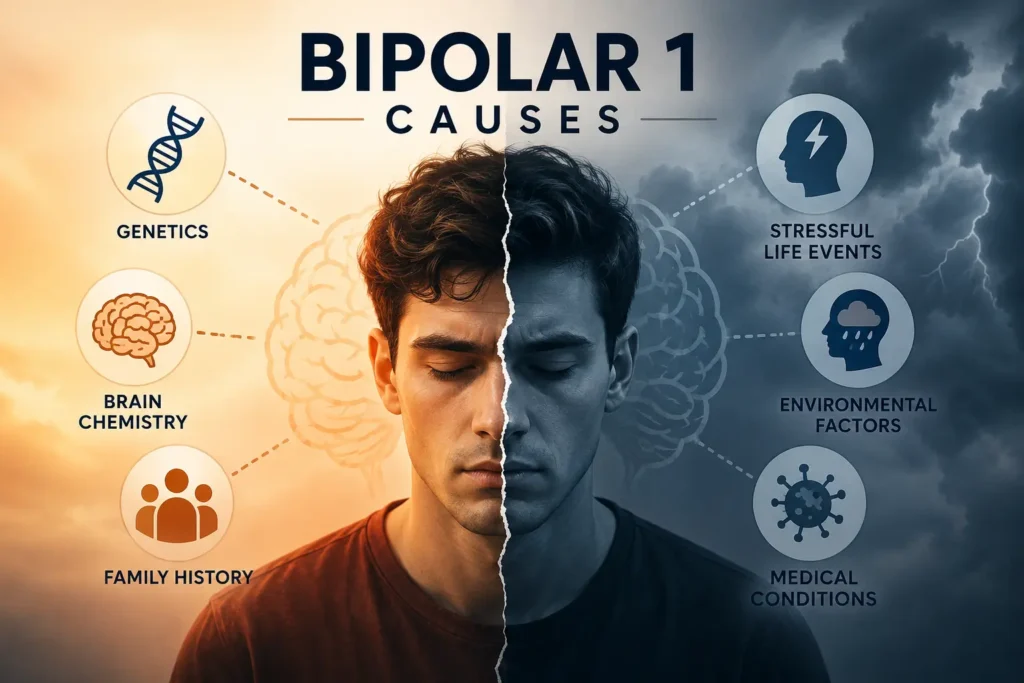
What Causes Bipolar 1 Disorder? Bipolar 1 disorder doesn’t have one single cause. Research points to a combination of genetics, brain structure and chemistry, and environmental triggers such as chronic stress, trauma, or major sleep disruption. Having a close relative with bipolar disorder is one of the strongest known risk factors, but genes alone don’t guarantee someone will develop the condition. Most experts describe bipolar 1 as arising from an interaction between an inherited vulnerability and life experiences that act as triggers.
Table of Contents
Introduction
If you or someone you love has just been told “this looks like bipolar 1,” the first question that comes to mind is usually why. Why does this happen? Did I do something to cause it? Could it have been prevented?
These are fair questions, and the honest answer is that bipolar 1 disorder isn’t caused by a single gene, a single event, or a personal failing. It’s what researchers call a multifactorial condition — meaning several things line up together to produce it. Genetics load the gun, so to speak, and certain life circumstances can pull the trigger.
This guide breaks down what’s actually known about the causes of bipolar 1 disorder, based on research from organizations like the National Institute of Mental Health (NIMH), the American Psychiatric Association (APA), and the World Health Organization (WHO). If you’re still working out what bipolar 1 even is, our guide on what bipolar 1 disorder is is a good starting point, and if you want to understand how it differs from other forms of the condition, see bipolar 1 vs bipolar 2.
Key Takeaways
- Bipolar 1 disorder is caused by a mix of genetic, biological, and environmental factors — not one single thing.
- Having a parent or sibling with bipolar disorder significantly raises risk, but most relatives of people with bipolar 1 never develop it themselves.
- Differences in brain structure and neurotransmitter activity are consistently linked to bipolar 1, though they aren’t diagnostic on their own.
- Stressful life events, trauma, substance use, and disrupted sleep can trigger a first manic episode in someone who is already vulnerable.
- No blood test or brain scan can currently confirm bipolar 1 — diagnosis relies on clinical evaluation, which you can read about in our bipolar disorder diagnosis guide.
Is Bipolar 1 Genetic, or Caused by Environment?
This is the question researchers get asked most, and the honest answer is: both, working together.
Bipolar 1 tends to run in families, which points strongly toward a genetic component. But twin and family studies also show that genetics alone don’t determine the outcome — otherwise, identical twins (who share virtually all their DNA) would always share a bipolar 1 diagnosis, and they don’t. Something else has to be involved.
The current scientific model treats bipolar 1 as a gene-environment interaction. A person can inherit a biological predisposition to mood instability, and that predisposition may stay dormant unless specific triggers — like major stress, trauma, or sleep loss — activate it. This is sometimes called the “stress-diathesis” model in psychiatric research: diathesis meaning the underlying vulnerability, and stress meaning the environmental push.
Genetic Causes of Bipolar 1 Disorder
Family History and Heritability
Bipolar 1 disorder is one of the more heritable psychiatric conditions. Family studies consistently show that people with a first-degree relative (a parent, sibling, or child) who has bipolar disorder face a meaningfully higher lifetime risk of developing it themselves compared with the general population.
Twin studies add more weight to this. Identical twins share the condition far more often than non-identical twins do, which tells researchers that genetics plays a substantial role — even though it isn’t the whole picture. The APA and NIMH both describe bipolar disorder as having a strong hereditary pattern, while stressing that inheritance is complex rather than following a single dominant or recessive pattern like eye color.
| Relationship to person with bipolar 1 | General pattern seen in research |
| Identical twin | Highest concordance among relatives |
| Parent, sibling, or child (first-degree) | Notably elevated risk compared to general population |
| Extended family (grandparent, aunt/uncle, cousin) | Modestly elevated risk |
| No family history | Lowest baseline risk, though bipolar 1 can still occur |
It’s worth repeating: most children of a parent with bipolar 1 do not go on to develop it. A family history raises the odds, but it isn’t a prediction.
No Single “Bipolar Gene”
Despite decades of genetic research, scientists have not identified one gene responsible for bipolar 1 disorder. Instead, large genome studies suggest that many different genes, each contributing a small effect, combine to raise overall risk. Some of these genes overlap with those linked to schizophrenia and major depression, which may explain why these conditions sometimes appear together in the same families.
This is an active area of research, and genetic testing for bipolar 1 is not currently available or recommended as a diagnostic tool. If you’re curious how bipolar 1 is distinguished from other conditions genetically and clinically, our types of bipolar disorder guide covers how the different diagnoses relate to one another.
Brain Structure and Neurochemistry
Genetics doesn’t act alone — it shapes how the brain develops and functions, and researchers have found several consistent differences in the brains of people with bipolar 1 disorder.
Neurotransmitter Imbalances
Neurotransmitters are the brain’s chemical messengers. Three in particular are studied closely in bipolar 1:
- Dopamine — linked to motivation, reward, and energy; overactivity is associated with manic symptoms.
- Serotonin — involved in mood regulation and sleep; imbalances are linked to depressive episodes.
- Norepinephrine — related to alertness and stress response; fluctuations may contribute to mood swings.
These chemicals don’t work in isolation, and no blood test currently measures them accurately enough to diagnose bipolar 1. But medications used to treat the condition — which you can read about in our bipolar disorder treatment guide — often target these same systems, which is part of why they help stabilize mood.
Brain Structure Differences
Brain imaging studies have found some consistent, though not universal, patterns in people with bipolar 1:
- Differences in the size and activity of the amygdala, a region involved in processing emotion.
- Altered activity in the prefrontal cortex, which helps regulate impulses and decision-making.
- Changes in connectivity between brain regions responsible for emotional regulation.
None of these findings are used to diagnose bipolar 1 in clinical practice today — diagnosis is still based on symptoms and history, not scans. But they help explain why the condition produces such intense, biologically-driven mood episodes rather than being something a person can simply “snap out of.”
Environmental and Life Event Triggers
Even with a strong genetic predisposition, many people with bipolar 1 can point to a period in their life when things changed — often before their first manic episode.
Major Stress and Life Transitions
Significant life stress is one of the most consistently reported triggers for a first manic or depressive episode. This can include:
- The loss of a loved one
- Divorce or the end of a significant relationship
- Job loss or major financial strain
- Becoming a parent
- Moving, relocating, or major life transitions
Stress doesn’t cause bipolar 1 in someone with no underlying vulnerability. But in someone who is predisposed, it can act as the spark that triggers the first episode.
Childhood Trauma and Adverse Experiences
Research has found a link between early-life adversity — such as abuse, neglect, or an unstable home environment — and an earlier onset or more severe course of bipolar 1 disorder. Trauma appears to interact with genetic vulnerability, potentially affecting brain development in ways that make mood episodes more likely later in life.
This doesn’t mean everyone with bipolar 1 experienced childhood trauma, and it doesn’t mean everyone who experienced trauma will develop bipolar 1. It’s one contributing factor among several.
Substance Use
Alcohol and recreational drug use don’t create bipolar 1 disorder out of nothing, but they can trigger episodes in someone already vulnerable, and they frequently make the condition harder to manage once it’s present. Stimulants in particular can provoke or worsen manic symptoms, while heavy alcohol use is closely tied to worsening depressive episodes.
Because bipolar 1 and substance use disorders co-occur often, clinicians typically screen for both. If misuse is present, it’s usually addressed alongside — not instead of — bipolar 1 treatment.
Sleep Disruption and Circadian Rhythm Changes
Sleep isn’t just a symptom of bipolar 1 — it can also be a trigger. Major disruptions to sleep patterns, such as jet lag, shift work, or a stretch of insomnia, are strongly associated with the onset of manic episodes in people with bipolar 1. This is thought to relate to the body’s circadian rhythm, the internal clock that regulates sleep, hormones, and mood.
This is one reason sleep stability is such a central part of long-term management, alongside the medications and therapy options covered in our bipolar disorder treatment guide.
Hormonal and Physical Health Factors
Hormonal shifts — including postpartum changes, thyroid dysfunction, and, in some cases, perimenopause — have been associated with mood episode onset or worsening in people with bipolar 1. Certain medical conditions and medications can also mimic or trigger manic symptoms, which is why a full medical workup is a standard part of proper diagnosis.
Genetic Risk vs. Environmental Triggers: A Side-by-Side Look
| Factor Type | Examples | Role in Bipolar 1 |
| Genetic | Family history, inherited gene variants | Creates underlying vulnerability |
| Neurobiological | Neurotransmitter activity, brain structure | Shapes how mood is regulated |
| Environmental | Trauma, chronic stress, substance use | Can trigger onset or relapse |
| Physiological | Sleep loss, hormonal shifts, illness | Can precipitate episodes |
No single column on its own typically explains bipolar 1 — it’s the combination that matters.
Risk Factors That Increase the Likelihood of Bipolar 1
Not every risk factor is a direct “cause,” but each one raises the statistical likelihood of developing bipolar 1 disorder:
| Risk Factor | Why It Matters |
| First-degree relative with bipolar disorder | Strongest known risk factor |
| History of major depressive episodes | May precede a first manic episode |
| Childhood trauma or adversity | Linked to earlier, more severe onset |
| Substance use disorder | Can trigger or worsen episodes |
| Chronic high stress | Common trigger for first episode |
| Significant sleep disruption | Linked to onset of mania |
For a full breakdown of how these risk factors translate into symptoms, see our guide on bipolar disorder symptoms.
Myths vs. Facts About the Causes of Bipolar 1
| Myth | Fact |
| “Bipolar 1 is caused by bad parenting.” | There is no credible evidence that parenting style alone causes bipolar 1. Genetics and biology are central factors. |
| “If it’s genetic, lifestyle doesn’t matter.” | Genetics create vulnerability, but stress, sleep, and substance use strongly influence whether and when episodes occur. |
| “Only people with a family history get bipolar 1.” | Many people with bipolar 1 have no known family history of the condition. |
| “It’s caused by personal weakness or lack of willpower.” | Bipolar 1 is a biologically-based medical condition, not a character flaw. |
For more common misconceptions, visit our dedicated guide on bipolar disorder myths.
Can Bipolar 1 Disorder Be Prevented?
There’s currently no known way to prevent bipolar 1 disorder in someone genetically predisposed to it, since the underlying vulnerability is biological. However, for people who already know they’re at higher risk — for example, those with a parent or sibling who has bipolar 1 — certain habits may reduce the risk of triggering an episode or help catch one earlier:
- Maintaining a consistent sleep schedule
- Limiting alcohol and recreational drug use
- Managing chronic stress through healthy coping strategies
- Seeking early support for mood changes, rather than waiting for a crisis
- Staying connected with a mental health professional if depression or anxiety appears early
None of these guarantee prevention, but they can reduce the frequency or severity of episodes for people already living with the condition, and they’re a core part of the lifestyle strategies discussed in our treatment guide.
Warning Signs That May Point to an Underlying Cause
If you’re trying to understand whether what you’re experiencing fits a bipolar 1 pattern, some signs worth paying attention to include:
- A close relative with bipolar disorder or severe mood episodes
- A recent period of extreme, unexplained stress or trauma
- Sudden, drastic changes in sleep followed by unusual energy or euphoria
- Increasing substance use during periods of low mood
- Episodes of depression that seem to “flip” into unusually elevated, impulsive, or irritable states
These aren’t a diagnosis on their own. A full clinical evaluation is the only reliable way to confirm bipolar 1, and our diagnosis guide explains exactly what that process involves.
When to Seek Help
If a first manic episode is underway — marked by extreme energy, little need for sleep, risky decisions, or a loss of touch with reality — this is a medical situation that needs prompt attention, not something to wait out. Contact a psychiatrist, primary care doctor, or local emergency services if there’s any risk of harm to the person or others. If you’re supporting someone in crisis and safety is a concern, contact emergency services in your country immediately.
Frequently Asked Questions
Is bipolar 1 disorder hereditary? Yes, genetics play a significant role. Having a parent, sibling, or child with bipolar disorder increases the likelihood of developing bipolar 1, though most relatives never develop the condition themselves.
Can bipolar 1 develop without any family history? Yes. While family history raises risk, many people diagnosed with bipolar 1 have no known relatives with the condition. New genetic variations and environmental factors can contribute independently.
What usually triggers the first manic episode? Common triggers include major life stress, trauma, substantial sleep loss, and substance use. In some cases, no clear trigger is ever identified.
Does trauma cause bipolar 1 disorder? Trauma doesn’t create bipolar 1 in someone without an underlying vulnerability, but it’s associated with earlier onset and more severe symptoms in people who are already predisposed.
Can stress alone cause bipolar 1? Stress is a common trigger, but it’s not considered a standalone cause. It typically interacts with a person’s genetic and biological vulnerability.
Is bipolar 1 caused by a chemical imbalance? Neurotransmitter differences are part of the picture, but “chemical imbalance” oversimplifies a more complex process involving genetics, brain structure, and environment together.
Are bipolar 1 and bipolar 2 caused by the same things? They share overlapping genetic and environmental risk factors, but the two conditions differ in the severity of manic episodes. Our bipolar 1 vs bipolar 2 differences guide explains how they diverge.
Can bipolar 1 be misdiagnosed as something else? Yes. Because early symptoms can resemble depression, anxiety, or ADHD, misdiagnosis is common. A structured clinical evaluation, covered in our diagnosis guide, is the best way to confirm bipolar 1.
Does having bipolar 1 mean my children will have it too? Not necessarily. It raises their risk compared to the general population, but most children of a parent with bipolar 1 do not develop the condition.
Summary
Bipolar 1 disorder develops from a layered combination of genetic vulnerability, brain chemistry, and environmental triggers — not from any single cause, and not from anything a person did wrong. Family history plays a meaningful role, but it works alongside factors like chronic stress, trauma, substance use, and disrupted sleep to determine whether and when the condition appears.
Understanding these causes matters most as a foundation for getting the right support. If you recognize risk factors in your own life or a loved one’s, the next step is a proper clinical evaluation — not self-diagnosis. Learn more about how bipolar 1 is identified in our diagnosis guide, what the long-term outlook can look like in our prognosis guide, and how it’s managed in our treatment guide.