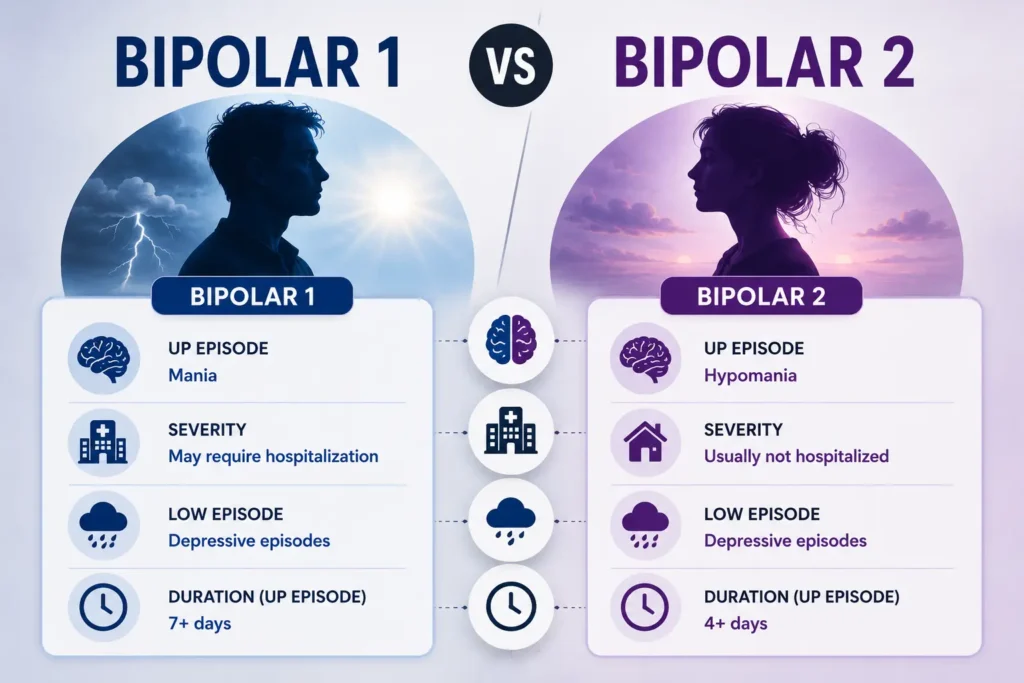
Neither Bipolar 1 vs 2 is universally “worse” — they’re severe in different ways. Bipolar 1 involves more intense manic episodes that can include psychosis and often require hospitalization, making the highs more dangerous. Bipolar 2 tends to involve more frequent and longer-lasting depressive episodes, which means people with bipolar 2 often spend more total time struggling day to day. Severity ultimately depends on the individual, not just the diagnostic type.
Table of Contents
Key Takeaways
- Bipolar 1’s mania is more intense and can include psychosis; bipolar 2’s hypomania never does.
- Bipolar 2 is associated with more time spent in depressive episodes overall.
- Hospitalization is more common in bipolar 1 due to the severity of manic episodes.
- Bipolar 2 carries a real risk of being underestimated, both by patients and, at times, by clinicians.
- Both conditions carry meaningful risks, including suicide risk during depressive episodes.
- “Worse” depends on which symptoms you’re measuring — episode intensity or overall time impaired.
Why This Question Doesn’t Have a Simple Answer
It’s a completely understandable question to ask, especially if you or someone you love has just been diagnosed with one type and you’re trying to make sense of what that means. But “which is worse” assumes severity can be measured on a single scale, and bipolar 1 and bipolar 2 don’t really work that way. They’re different in shape, not just different in degree.
If you haven’t already looked at how the two conditions are formally defined, our guide on bipolar 1 vs bipolar 2 and our comparison chart lay out the core distinctions before we get into severity specifically.
The Case for Bipolar 1 Being More Severe
There’s a real argument for bipolar 1 being the more intense condition, and it comes down to what happens during a manic episode:
- Mania can include psychosis. Hallucinations or delusions can occur during severe manic episodes, something that never happens with hypomania in bipolar 2.
- Hospitalization is more common. Manic episodes can involve dangerous impulsivity, poor judgment, or safety risks severe enough to require inpatient care.
- The behavioral consequences can be more dramatic. Reckless spending, risky sexual behavior, or aggressive behavior during mania can cause damage that takes a long time to repair, even after the episode ends.
- Onset can feel sudden and disorienting. Manic episodes can escalate quickly, sometimes catching both the person experiencing it and those around them off guard.
On these specific dimensions, bipolar 1 is generally considered the more acutely dangerous condition, and clinical resources like the Cleveland Clinic and Mayo Clinic typically describe mania as the more severe of the two elevated states.
The Case for Bipolar 2 Being More Severe
At the same time, there’s substantial evidence that bipolar 2 carries its own serious burden, often underestimated because hypomania sounds mild by comparison:
- More time spent depressed. Research on the course of bipolar disorder has found that people with bipolar 2 tend to spend a greater share of their time in depressive episodes compared to those with bipolar 1.
- Depression is where most of the disability comes from. Across bipolar disorder generally, depressive episodes tend to be more disabling day-to-day than elevated episodes, and bipolar 2’s heavier depressive load reflects that.
- Higher risk of being missed or misdiagnosed. Because hypomania doesn’t look like a crisis, bipolar 2 is frequently misdiagnosed as major depressive disorder, which can delay proper treatment for years.
- Chronic course. Bipolar 2 is often described as having a more chronic, lower-grade pattern of mood instability, rather than the more episodic crisis-and-recovery pattern sometimes seen in bipolar 1.
This is why some clinicians and researchers push back on the idea that bipolar 2 is simply the “milder” version of bipolar disorder. In terms of overall quality of life and day-to-day functioning, it can be just as burdensome, if not more so, over the long run.
Bipolar 1 vs Bipolar 2: Severity Comparison Table
| Severity Factor | Bipolar 1 | Bipolar 2 |
| Intensity of elevated episode | Higher (mania) | Lower (hypomania) |
| Risk of psychosis | Present | Absent |
| Likelihood of hospitalization | Higher | Lower |
| Time spent in depressive episodes | Significant, but often less than bipolar 2 | Typically greater |
| Risk of misdiagnosis | Lower | Higher |
| Day-to-day functional impact over time | Episodic, tied to acute episodes | Often more chronic and cumulative |
| Danger during acute crisis | Higher, due to severity of mania | Lower during hypomania, but depressive crises carry real risk |
The honest takeaway from this table is that the two conditions are severe along different axes: bipolar 1 is more acutely dangerous during elevated episodes, while bipolar 2 often carries a heavier long-term depressive burden.
Why “Milder” Is the Wrong Word for Bipolar 2
One of the most persistent misconceptions about bipolar 2 is that it’s a watered-down version of bipolar 1. That framing misses what actually makes bipolar 2 difficult to live with. Because hypomania can feel productive or even pleasant, it’s easy to overlook how much of a toll the depressive episodes take, especially since those episodes tend to be both more frequent and longer-lasting.
People with bipolar 2 also face a specific risk: because their symptoms don’t look as severe on the surface, they may not receive the same level of concern or urgency from others, including, at times, healthcare providers, which can delay diagnosis and treatment. That delay itself can make the long-term course of the illness harder to manage.
For more on how this plays out in the diagnostic process, see our guide on bipolar 1 vs 2 diagnosis.
Suicide Risk: A Serious Consideration for Both Types
This is a topic that deserves direct, careful attention rather than being folded into a severity debate. Depressive episodes in both bipolar 1 and bipolar 2 carry a meaningful risk of suicidal thinking, and this risk should never be minimized based on which type someone has. Mixed episodes, where symptoms of depression and mania or hypomania occur together, can be particularly high-risk and are seen in both types.
If you or someone you know is having thoughts of suicide, this is not something to wait out or manage alone. See the Emergency Help section below for immediate resources.
Myths vs Facts About Severity
| Myth | Fact |
| “Bipolar 2 is basically a mild version of bipolar 1.” | Bipolar 2 often involves more time spent depressed and carries a real risk of being under-treated because it’s mistaken for something less serious. |
| “If you’ve never been hospitalized, your bipolar disorder isn’t severe.” | Severity isn’t defined only by hospitalization. Chronic depressive burden, functional impact, and quality of life all matter. |
| “Bipolar 1 is always more disabling day-to-day.” | Bipolar 1 involves more acute danger during mania, but bipolar 2’s frequent depressive episodes can be more disabling over time. |
| “Doctors agree on which type is worse.” | Clinical literature generally frames the two as severe in different ways, not as one being categorically worse than the other. |
| “Severity is fixed once you’re diagnosed.” | Severity within either type varies a great deal between individuals and can change with treatment, life circumstances, and time. |
For a broader list of common misunderstandings, see our bipolar disorder myths guide.
What Actually Determines How “Severe” Someone’s Experience Is
Diagnostic type is only one factor. In practice, how much bipolar disorder affects someone’s life also depends on:
- How frequently episodes occur
- How quickly the condition is diagnosed and treated
- Whether co-occurring conditions, like anxiety or substance use, are present
- Access to consistent treatment and a stable support system
- How well someone responds to medication and therapy
This is part of why two people with the same diagnosis can have very different experiences of severity. For a deeper look at what shapes long-term outcomes, see our guide on bipolar disorder prognosis, and for how untreated symptoms can escalate over time, see our page on bipolar disorder complications.
Why Comparing Severity Shouldn’t Change How Seriously You Take Either Diagnosis
Whether someone has bipolar 1 or bipolar 2, both are recognized as serious, treatable mental health conditions by major organizations including the National Institute of Mental Health and the World Health Organization. Neither diagnosis should be treated as “not that bad” just because it isn’t the more intense of the two. Both benefit from consistent treatment, typically involving a combination of medication and therapy.
If you’re trying to understand what treatment actually looks like for each type, our guide on bipolar 1 vs 2 treatment breaks down how the approaches differ, and our bipolar disorder treatment guide covers the full picture.
Checklist: Questions Worth Asking Instead of “Which Is Worse”
If you’re processing a diagnosis, or trying to understand one for someone you care about, these questions tend to be more useful than ranking severity:
- How frequent are the episodes, and what tends to trigger them?
- What does treatment look like for this specific diagnosis?
- What early warning signs should we watch for?
- What kind of support does the person need during a depressive versus an elevated episode?
- Where can we go if a situation becomes urgent?
Warning Signs That Need Immediate Attention
Regardless of bipolar type, certain symptoms call for urgent professional attention:
- Thoughts of suicide or self-harm
- Severe agitation or an inability to sleep for multiple days
- Hallucinations or delusions
- Reckless or dangerous behavior
- A sudden, severe shift in mood or functioning
Getting Emergency Help
If you or someone you know is in crisis or having thoughts of suicide, reach out for immediate support:
- 988 Suicide & Crisis Lifeline (US): call or text 988
- Emergency services: call 911 (US) or your local emergency number
- Outside the US, search for your country’s crisis line or go to the nearest emergency department
Crisis support is available regardless of diagnosis, severity, or whether a formal evaluation has happened yet.
Frequently Asked Questions
Is bipolar 1 more dangerous than bipolar 2? During an acute episode, bipolar 1 mania is generally considered more dangerous because it can include psychosis and often requires hospitalization. Bipolar 2 carries its own serious risks, particularly around frequent and long-lasting depression.
Does bipolar 2 ever turn into bipolar 1? In some cases, yes. If someone diagnosed with bipolar 2 later experiences a full manic episode, the diagnosis would change to bipolar 1. This isn’t the typical course, but it can happen.
Why do some people say bipolar 2 is harder to live with? Because bipolar 2 often involves more frequent and longer depressive episodes, some people report that the day-to-day burden feels heavier, even though the elevated episodes are less intense than mania.
Is one type more likely to lead to suicide risk than the other? Depressive episodes, which occur in both types, carry meaningful suicide risk. Risk isn’t neatly divided by bipolar type — it depends more on the severity and frequency of depressive and mixed episodes.
Can severity change over time within the same diagnosis? Yes. Episode frequency, intensity, and overall impact can shift over a person’s life, influenced by treatment, stress, life changes, and other health factors.
Should treatment be more aggressive for bipolar 1 than bipolar 2? Not necessarily “more aggressive” — different in focus. Bipolar 1 treatment often prioritizes preventing and managing mania, while bipolar 2 treatment often emphasizes long-term depression management. Both require consistent, ongoing care.
Summary
Asking whether bipolar 1 or bipolar 2 is “worse” is a fair question, but the honest answer is that they’re serious in different ways. Bipolar 1’s manic episodes are more intense and carry a higher risk of psychosis and hospitalization, while bipolar 2’s depressive episodes tend to be more frequent and longer-lasting, creating a heavier day-to-day burden over time. Both are recognized as serious conditions that deserve consistent treatment and should never be minimized based on how they compare to each other.
If you’re trying to understand more about either condition specifically, start with our guide on bipolar 1 vs bipolar 2, or explore our bipolar 1 vs 2 symptoms guide for a closer look at how each condition presents.
This article is for educational purposes and is not a substitute for professional medical advice, diagnosis, or treatment. Always consult a qualified healthcare provider with questions about a medical condition.