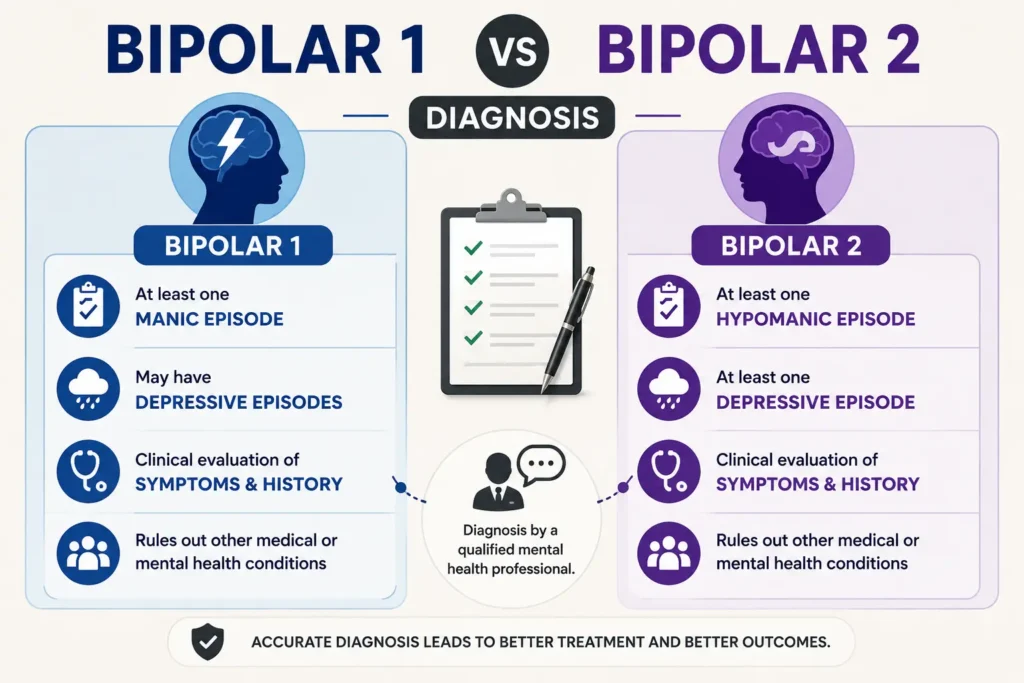
Bipolar 1 vs 2 Diagnosis is based on different DSM-5 criteria centered on the type of elevated mood episode a person has experienced. Bipolar 1 requires at least one full manic episode, confirmed through a clinical evaluation, and doesn’t require a depressive episode to be diagnosed. Bipolar 2 requires at least one hypomanic episode plus at least one major depressive episode. There’s no blood test or brain scan that diagnoses either condition — diagnosis comes from a structured clinical interview, a detailed history of past mood episodes, and ruling out other medical or psychiatric explanations.
Table of Contents
Key Takeaways
- Diagnosis is based on DSM-5 criteria, not a symptom checklist or online quiz.
- Bipolar 1 diagnosis hinges on documenting a full manic episode.
- Bipolar 2 diagnosis requires both a hypomanic episode and a major depressive episode.
- Misdiagnosis is common, especially mistaking bipolar 2 for major depressive disorder.
- A full mood history, often going back years, is central to an accurate diagnosis.
- Only a licensed psychiatrist or clinical psychologist can make this diagnosis.
Why Diagnosis Is More Complicated Than It Sounds
On paper, the distinction between bipolar 1 and bipolar 2 sounds simple: one involves mania, the other involves hypomania. In practice, diagnosis is often harder than that because episodes aren’t always remembered clearly, symptoms overlap with other conditions, and patients frequently seek help during a depressive episode rather than during the elevated phase that actually determines the diagnosis.
This is why the diagnostic process typically involves more than a single conversation. If you want a broader comparison of the two conditions before getting into diagnostic detail, our guide on bipolar 1 vs bipolar 2 and our comparison chart both lay out the core differences side by side.
The DSM-5 Framework: What Clinicians Actually Use
In the United States and in much of clinical practice internationally, bipolar disorder is diagnosed using criteria from the American Psychiatric Association’s Diagnostic and Statistical Manual of Mental Disorders, Fifth Edition (DSM-5). This manual defines specific, structured criteria for each mood episode type — manic, hypomanic, and major depressive — and bipolar 1 and bipolar 2 are distinguished by which combination of episodes a person has experienced.
Understanding the DSM-5 approach matters because it explains why two people can describe very similar-sounding “highs” and still receive different diagnoses. The difference isn’t about how a person describes their mood in casual terms — it’s about specific, measurable criteria: duration, severity, and functional impact.
Bipolar 1 vs Bipolar 2 Diagnostic Criteria: Comparison Table
| Diagnostic Element | Bipolar 1 Disorder | Bipolar 2 Disorder |
| Required episode type | At least one manic episode | At least one hypomanic episode AND at least one major depressive episode |
| Minimum duration of elevated episode | 7+ days (or any length if hospitalized) | 4+ consecutive days |
| Functional impairment required | Yes, mania must cause significant impairment or require hospitalization | Hypomania causes a noticeable change but not severe impairment |
| Psychotic features | Can be present during mania | Never present during hypomania |
| Depressive episode required | Not required for diagnosis | Required for diagnosis |
| Number of symptoms needed (beyond mood change) | At least 3 (4 if mood is only irritable) | At least 3 (4 if mood is only irritable) |
| Rule-outs required | Substance use, medical conditions, other psychiatric disorders | Same |
This table reflects general DSM-5 criteria structure and is meant for educational understanding only. It is not a diagnostic instrument.
What a Clinical Evaluation Actually Involves
A proper bipolar diagnosis isn’t based on a single symptom list. Clinicians typically go through a structured process that includes:
- A detailed mood history. This covers not just current symptoms, but past episodes going back months or years, including how long they lasted and how they affected daily functioning.
- Input from family or close contacts, when possible. People often underreport hypomanic or manic symptoms because those periods didn’t feel like a problem at the time. Someone close to the patient may remember details the patient doesn’t.
- A review of sleep, energy, and behavior patterns. Since hypomania and mania both involve reduced need for sleep and increased energy, clinicians look closely at these patterns across time.
- Screening for other conditions. Thyroid disorders, substance use, ADHD, borderline personality disorder, and major depressive disorder can all present with overlapping symptoms, so clinicians work to rule these out or identify co-occurring conditions.
- Use of structured clinical interviews or rating scales. Tools like structured diagnostic interviews can help standardize the evaluation, though they’re used alongside clinical judgment, not as a replacement for it.
For a deeper look at the full evaluation process, including what to expect at an appointment, see our complete guide on bipolar disorder diagnosis.
Why Bipolar 2 Is Diagnosed Later and More Often Missed
One of the most well-documented issues in bipolar care is how often bipolar 2 gets misdiagnosed, typically as major depressive disorder. There are a few specific reasons this happens during the diagnostic process:
- Hypomania doesn’t look like a crisis. Unlike mania, hypomania rarely disrupts work or relationships enough for someone to seek help during that phase. Patients often present for care during a depressive episode instead.
- Patients underreport hypomanic symptoms. Increased energy, confidence, or productivity can feel like a return to “normal,” not a symptom worth mentioning.
- A single appointment isn’t always enough. Diagnosing bipolar 2 accurately usually requires reviewing a mood history that spans a meaningful period of time, not just the current depressive episode.
- Overlap with other conditions. Symptoms of hypomania can resemble anxiety, ADHD, or even just a naturally energetic personality, which can delay accurate diagnosis.
This is also why treating what looks like straightforward depression with antidepressants alone, before bipolar 2 is properly identified, can sometimes trigger a hypomanic episode. That risk is one of the practical reasons an accurate diagnosis matters, beyond simply having the correct label.
Diagnostic Symptom Checklist: What Clinicians Look For
While self-assessment isn’t a substitute for a professional evaluation, understanding what clinicians are trained to look for can help you have a more informed conversation with a provider.
Signs suggestive of a manic episode (bipolar 1):
- Sustained elevated, expansive, or irritable mood lasting a week or more
- Sharply decreased need for sleep without feeling tired
- Grandiosity or inflated sense of self-importance
- Rapid, pressured speech or racing thoughts
- Impulsive, risky behavior with potential for serious consequences
- In severe cases, hallucinations or delusions
Signs suggestive of a hypomanic episode (bipolar 2):
- Noticeably elevated or irritable mood lasting at least 4 days
- Increased energy or activity that’s out of character
- Decreased need for sleep
- Increased talkativeness or racing thoughts
- Behavior changes that others notice, but without severe impairment
- No psychotic symptoms
Signs suggestive of a major depressive episode (relevant to both types):
- Persistent low mood or loss of interest lasting two weeks or more
- Significant changes in sleep, appetite, or energy
- Difficulty concentrating
- Feelings of worthlessness or excessive guilt
- Thoughts of death or suicide
If several of these patterns sound familiar, the right next step is a conversation with a psychiatrist or licensed mental health professional, not a self-diagnosis. For an overview of how these symptoms present specifically in each type, see our guide on bipolar 1 vs 2 symptoms.
Bipolar 1 vs Bipolar 2: How Diagnostic Timing Differs
| Factor | Bipolar 1 | Bipolar 2 |
| Typical episode that prompts diagnosis | Manic episode, often a crisis event | Depressive episode, often mistaken for unipolar depression |
| Speed of diagnosis | Often faster, due to the visible severity of mania | Often slower, due to underreported hypomania |
| Common initial (incorrect) diagnosis | Less commonly misdiagnosed | Frequently misdiagnosed as major depressive disorder |
| Role of hospitalization in diagnosis | Sometimes occurs during a manic crisis, prompting evaluation | Rarely part of the diagnostic path |
Conditions Commonly Confused With Bipolar 1 or Bipolar 2
Accurate diagnosis depends partly on ruling out conditions that share overlapping features:
| Condition | Why It’s Confused With Bipolar Disorder |
| Major depressive disorder | Depressive episodes look identical; hypomania may go unreported |
| ADHD | Impulsivity, distractibility, and high energy can resemble hypomania or mania |
| Borderline personality disorder | Mood instability can look similar, but the pattern and duration differ |
| Anxiety disorders | Restlessness and racing thoughts can overlap with hypomanic symptoms |
| Substance use | Stimulant or substance use can mimic manic or hypomanic symptoms |
| Thyroid dysfunction | Can cause mood and energy changes that resemble mood episodes |
This is part of why a thorough clinical workup, sometimes including basic medical tests to rule out conditions like thyroid dysfunction, is a standard part of the diagnostic process referenced by organizations such as the Cleveland Clinic and Mayo Clinic.
Myths vs Facts About Bipolar Diagnosis
| Myth | Fact |
| “You can diagnose yourself with an online quiz.” | Diagnosis requires a clinical evaluation by a trained professional using DSM-5 criteria, not a self-administered quiz. |
| “If you’ve never been hospitalized, it can’t be bipolar 1.” | Hospitalization isn’t required for a bipolar 1 diagnosis — severe impairment from mania is enough, even without hospitalization. |
| “Bipolar 2 is easier to diagnose than bipolar 1.” | Bipolar 2 is often harder to diagnose accurately because hypomania is easy to overlook or underreport. |
| “One appointment is enough to confirm the diagnosis.” | Diagnosis usually requires a detailed history, sometimes gathered over multiple visits. |
| “A mood chart alone can confirm bipolar type.” | Mood tracking is a helpful tool, but it supports a clinical evaluation rather than replacing one. |
For a broader list of misconceptions about bipolar disorder overall, see our bipolar disorder myths guide.
What Happens After Diagnosis
A confirmed diagnosis of bipolar 1 or bipolar 2 is the starting point for building a treatment plan, not the end of the process. Treatment typically combines medication, therapy, and lifestyle strategies, with the specific approach shaped by which type someone has and how their symptoms present. Our guide on bipolar 1 vs 2 treatment breaks down how treatment priorities differ between the two types, and our full bipolar disorder treatment guide covers the broader treatment landscape.
It’s also worth knowing that a bipolar 2 diagnosis can, in rare cases, change to bipolar 1 later if a person eventually experiences a full manic episode. This is one reason ongoing follow-up with a mental health provider matters even after an initial diagnosis is made.
Checklist: Preparing for a Diagnostic Evaluation
If you’re preparing to see a psychiatrist or psychologist for a possible bipolar diagnosis, it helps to have the following ready:
- A timeline of mood episodes, including approximate start and end dates
- Notes on how each episode affected sleep, energy, and daily functioning
- Any history of hospitalization or crisis-level episodes
- A list of current and past medications
- Family history of mood disorders, if known
- Input from a close family member or partner, if they’re willing to share observations
Warning Signs That Need Immediate Attention
Regardless of where someone is in the diagnostic process, certain symptoms call for urgent care rather than waiting for a scheduled evaluation:
- Thoughts of suicide or self-harm
- Severe agitation or days without sleep
- Hallucinations or delusions
- Reckless behavior that puts someone at risk
- A sudden, severe shift in mood or functioning
Getting Emergency Help
If you or someone you know is in crisis or having thoughts of suicide, get help right away:
- 988 Suicide & Crisis Lifeline (US): call or text 988
- Emergency services: call 911 (US) or your local emergency number
- Outside the US, search for your country’s crisis line or go to the nearest emergency department
A formal diagnosis is never a prerequisite for getting emergency help.
Frequently Asked Questions
Can bipolar 1 and bipolar 2 be diagnosed with a blood test? No. There is no blood test or brain scan that diagnoses bipolar disorder. Diagnosis is based on a clinical evaluation, though blood tests may be used to rule out other causes, like thyroid dysfunction.
How long does it take to get a bipolar diagnosis? It varies. Some people are diagnosed relatively quickly, especially after a severe manic episode, while others, particularly those with bipolar 2, may take longer because hypomania is easy to overlook. An accurate diagnosis sometimes takes multiple appointments.
Can you have bipolar 2 without ever feeling depressed? No. A major depressive episode is a required part of the bipolar 2 diagnostic criteria. Without one, a diagnosis of bipolar 2 wouldn’t be made.
Is it possible to be misdiagnosed with bipolar 1 when you actually have bipolar 2? It’s less common than the reverse, but it can happen, especially if an episode is misjudged as more severe than it was. This is part of why a full history matters.
Do children get diagnosed with bipolar 1 or bipolar 2 the same way as adults? The same core DSM-5 criteria apply, but diagnosing bipolar disorder in children and teens is more complex and typically requires evaluation by a clinician experienced in pediatric mood disorders.
What’s the difference between a diagnostic quiz and a real evaluation? Online quizzes can raise awareness of symptoms worth discussing with a professional, but they can’t apply DSM-5 criteria, review episode history, or rule out other conditions the way a clinical evaluation can.
Summary
Diagnosing bipolar 1 versus bipolar 2 comes down to which type of elevated mood episode a person has experienced — a full manic episode for bipolar 1, or hypomania paired with major depression for bipolar 2 — evaluated against DSM-5 criteria by a qualified clinician. Because hypomania is easy to overlook and depressive episodes often dominate the clinical picture, bipolar 2 in particular is prone to misdiagnosis. A thorough evaluation, built on a detailed mood history and often input from people close to the patient, is the only reliable way to reach an accurate diagnosis.
If you think you or someone you care about may be dealing with bipolar disorder, the most useful step is scheduling an evaluation with a psychiatrist or licensed mental health professional. For more background before that conversation, our guide on bipolar 1 vs bipolar 2 is a good starting point.
This article is for educational purposes and is not a substitute for professional medical advice, diagnosis, or treatment. Always consult a qualified healthcare provider with questions about a medical condition.