How to Know If You Have Bipolar: You can’t diagnose bipolar disorder from a checklist, but you can recognize the pattern.
The core sign is a shift between distinct mood episodes — periods of unusually high, energized, or irritable mood (mania or hypomania) and periods of low mood or depression — that last for days or weeks, disrupt your life, and are noticeably different from your normal self. If that pattern sounds familiar, the only way to know for certain is a full evaluation with a psychiatrist or psychologist. This article walks through the signs, how professionals tell bipolar apart from other conditions, and exactly what to do next.
Table of Contents
Key Takeaways
- Bipolar disorder isn’t just “mood swings” — it’s defined by distinct episodes of mania/hypomania and depression that last for a set minimum period.
- A single bad week or a personality trait like being “moody” is not the same as a mood episode.
- There are several forms of bipolar disorder, and the symptom pattern differs between Bipolar 1 and Bipolar 2.
- Online quizzes can be a useful starting point, but only a licensed clinician can diagnose bipolar disorder.
- Getting an accurate diagnosis early tends to lead to better long-term outcomes, so it’s worth pursuing even if the process feels intimidating.
What Bipolar Disorder Actually Is
Bipolar disorder is a brain-based mental health condition that affects mood, energy, and activity levels. For a full breakdown of the condition, see our guide on what bipolar disorder is. In short, it causes a person to cycle between emotional “highs” (mania or hypomania) and emotional “lows” (depression), with periods of stable mood in between.
This is different from everyday mood changes. Everyone has good days and bad days. Bipolar disorder involves episodes — sustained, clearly defined stretches of altered mood, energy, sleep, and behavior that are noticeably different from how the person normally functions. The American Psychiatric Association’s DSM-5 sets specific time and symptom requirements for each episode type, which is part of why self-diagnosis is so difficult.
The Core Pattern: Two Kinds of Episodes
Almost every question about “how do I know if I have bipolar” comes down to recognizing two opposite states.
1. The “Up” Episodes: Mania and Hypomania
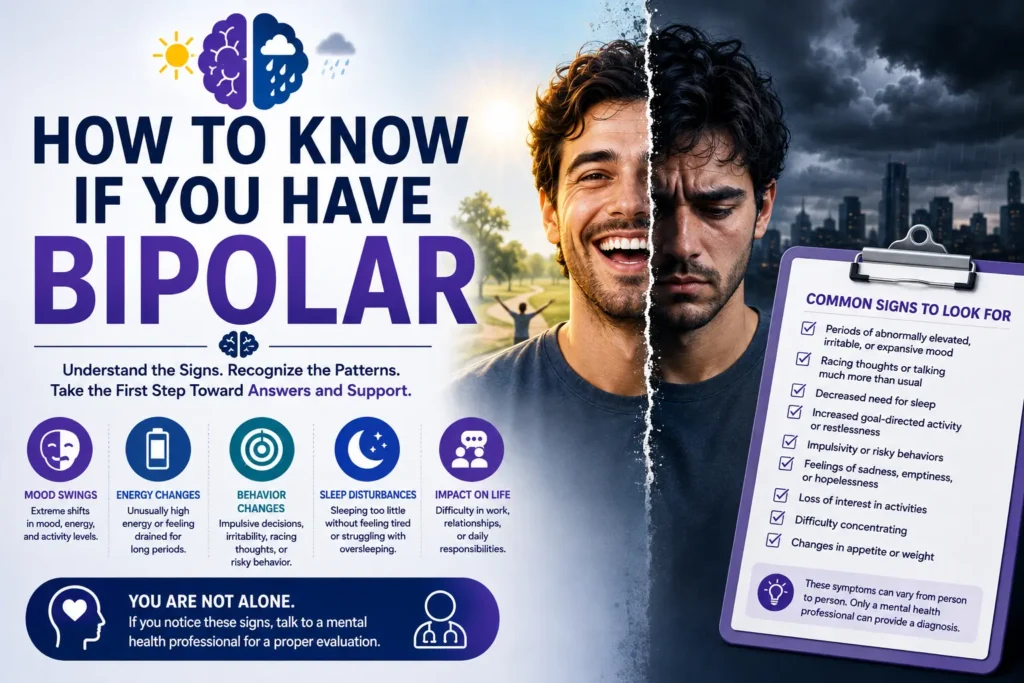
During a manic or hypomanic episode, a person may experience:
- Elevated, expansive, or unusually irritable mood
- A sharp increase in energy or goal-directed activity
- Needing very little sleep but not feeling tired
- Racing thoughts or fast, pressured speech
- Inflated self-esteem or grandiosity
- Being easily distracted
- Impulsive decisions — spending sprees, risky sex, sudden business ideas, reckless driving
The difference between mania and hypomania is largely about severity and length. Mania is more intense, lasts at least seven days (or requires hospitalization), and can include psychotic features. Hypomania is milder, lasts at least four days, and — while noticeable to others — doesn’t usually stop someone from functioning. Our dedicated comparison of mania vs. hypomania breaks this down in more detail, and you can read about what typically causes a manic episode as well.
2. The “Down” Episodes: Bipolar Depression
The depressive side often looks similar to standard major depression, but it’s important not to explain it away as “just depression” if highs are also present. Signs include:
- Persistent sadness, emptiness, or hopelessness
- Loss of interest in activities once enjoyed
- Major changes in sleep (too much or too little)
- Fatigue or loss of energy nearly every day
- Difficulty concentrating or making decisions
- Feelings of worthlessness or excessive guilt
- Thoughts of death or suicide
For a closer look at how this presents, see our full guide to bipolar depression symptoms.
The Pattern That Matters
What points toward bipolar disorder specifically is the back-and-forth — a documented history of both types of episodes (or, in Bipolar 1, at least one manic episode, with or without depressive episodes). A mixed episode, where manic and depressive symptoms occur at the same time, is also possible and can be harder to recognize.
Symptom Comparison Table
| Feature | Manic Episode | Hypomanic Episode | Depressive Episode |
| Minimum duration | 7+ days (or any length if hospitalized) | 4+ days | 2+ weeks |
| Mood | Elevated, expansive, or irritable | Elevated or irritable, milder | Sad, empty, hopeless |
| Energy/sleep | Little need for sleep, high energy | Reduced sleep need, high energy | Fatigue, sleep disruption |
| Impact on functioning | Significant; may need hospitalization | Noticeable but generally manageable | Significant impairment |
| Psychotic features | Possible | Not present | Possible in severe cases |
This table is a simplified summary, not a diagnostic tool. For the complete clinical picture, see bipolar disorder symptoms.
A Practical Self-Check (Not a Diagnosis)
Before seeking a professional opinion, it can help to reflect honestly on your history. Ask yourself:
- Have I had a period of at least 4 days where I felt unusually “high,” wired, or irritable — and other people noticed?
- During that period, did I need much less sleep than usual without feeling tired?
- Have I also had separate stretches of at least 2 weeks with low mood, low energy, or loss of interest in things I normally enjoy?
- Do these episodes feel clearly different from my “baseline” personality — not just a bad mood, but a shift?
- Have these episodes affected my work, relationships, finances, or health?
- Does a close family member have bipolar disorder or another mood disorder?
If you answered yes to several of these, it’s worth exploring further. A structured bipolar screening or bipolar quiz can help organize your answers before an appointment, but treat these tools as a conversation-starter, not an answer. You can also try a more detailed bipolar test designed to mirror the questions a clinician might ask.
Bipolar 1, Bipolar 2, and Other Types
Not all bipolar disorder looks the same, and the type affects both symptoms and treatment.
- Bipolar 1 requires at least one full manic episode. Depressive episodes are common but not required for diagnosis. Learn more in our guide to Bipolar 1.
- Bipolar 2 requires at least one hypomanic episode and at least one major depressive episode — without ever having a full manic episode. See Bipolar 2 for details.
- Cyclothymia involves numerous periods of hypomanic and depressive symptoms that don’t meet full episode criteria, lasting at least two years.
Because these types are easy to confuse, we cover the distinctions in depth in Bipolar 1 vs. Bipolar 2, including a symptom-by-symptom comparison and a visual chart. If you’re unsure which pattern fits you, that guide — along with our types of bipolar disorder overview — is a good next stop.
Does Bipolar Look Different by Age or Sex?
Symptoms can present somewhat differently depending on who’s affected:
- In men, irritability, risk-taking, and substance use sometimes stand out more than classic euphoria. See bipolar symptoms in men.
- In women, depressive episodes and rapid cycling tend to be more common, and hormonal shifts can play a role. See bipolar symptoms in women.
- In teenagers, symptoms can be mistaken for typical adolescent moodiness or ADHD. See bipolar symptoms in teenagers.
- In children, presentation is less clear-cut and often debated among clinicians. See bipolar symptoms in children.
For the full list of early warning signs across age groups, our guide to early signs of bipolar disorder is a helpful starting point.
Myths vs. Facts
| Myth | Fact |
| “Bipolar just means being moody.” | Bipolar disorder involves distinct, sustained episodes — not everyday mood shifts. |
| “You can diagnose yourself with an online quiz.” | Quizzes can flag a pattern worth discussing, but only a licensed clinician can diagnose bipolar disorder. |
| “People with bipolar disorder are always either manic or depressed.” | Many people have long stable periods between episodes. |
| “Bipolar disorder is rare.” | It’s uncommon compared to some conditions, but it affects a meaningful portion of the population — see the National Institute of Mental Health (NIMH) for prevalence data. |
| “Medication is the only treatment.” | Treatment usually combines medication with therapy and lifestyle strategies. |
We go deeper into common misconceptions in our full bipolar disorder myths article.
What Causes This, and Am I at Risk?
Bipolar disorder isn’t caused by one single thing. Research points to a mix of genetics, brain chemistry and structure, and environmental triggers such as major stress, sleep disruption, or substance use. Having a first-degree relative with bipolar disorder or another mood disorder raises risk. For a full explanation of contributing factors, see bipolar disorder causes.
How Diagnosis Actually Works
Because there’s no blood test or brain scan that confirms bipolar disorder, diagnosis relies on a detailed clinical interview. A psychiatrist or psychologist will typically:
- Ask about your current symptoms and how long they’ve lasted.
- Review your full mood history, including past episodes you may not have recognized as significant at the time.
- Ask about family history of mood disorders.
- Rule out other explanations — thyroid problems, substance use, medication side effects, ADHD, borderline personality disorder, or unipolar depression.
- Compare your symptoms against the criteria in the DSM-5.
- Sometimes involve input from family members, since people in a manic episode don’t always recognize it in themselves.
This process is explained step by step in our guide to bipolar disorder diagnosis, including how clinicians apply DSM-5 criteria for bipolar disorder in practice.
Warning Signs You Shouldn’t Ignore
Certain symptoms mean it’s time to seek help sooner rather than later:
- Not sleeping for multiple days without feeling tired
- Spending, sexual, or driving decisions that are clearly out of character and risky
- Hearing or seeing things others don’t (psychotic symptoms)
- Persistent hopelessness lasting more than two weeks
- Withdrawing completely from work, school, or relationships
- Any thought of self-harm or suicide
Read more about the full range of psychotic symptoms in bipolar disorder and physical symptoms of bipolar disorder if you want to understand how these episodes can affect the body, not just mood.
Emergency Help
If you or someone you know is having thoughts of suicide or self-harm, this is a medical emergency. In the US, call or text 988 (Suicide & Crisis Lifeline) at any time. In the UK, call 111 or the Samaritans on 116 123. If you’re elsewhere, contact your local emergency number or the nearest emergency room. You don’t need a diagnosis to reach out — trained counselors can help regardless of what’s causing the crisis.
What Happens If It Goes Undiagnosed
Untreated bipolar disorder tends to become more disruptive over time — episodes can grow more frequent, relationships and careers can be affected, and the risk of substance use or self-harm rises. It’s a serious condition, but with proper care, most people see real improvement. Learn more in our guides to bipolar disorder complications and bipolar disorder prognosis.
What Treatment Looks Like
Once diagnosed, most treatment plans combine mood-stabilizing medication, talk therapy, and lifestyle adjustments like consistent sleep and stress management. This is a large topic on its own — our full bipolar disorder treatment guide covers medication options, therapy approaches, and what ongoing management typically involves.
Frequently Asked Questions
Can I have bipolar disorder without ever feeling “manic”? Yes. In Bipolar 2, people experience hypomania — a milder, shorter high — rather than full mania. It’s still bipolar disorder, just a different type.
Is it possible to have bipolar disorder and not know it? Yes, this is common. Hypomanic episodes can feel like a productive, good period rather than a symptom, so many people only recognize the pattern in hindsight, often after seeking help for depression.
How long do I need to track my moods before seeing a doctor? You don’t need to wait. If you recognize the pattern described above, it’s reasonable to book an appointment now. Mood tracking from this point forward can still help your clinician confirm the diagnosis.
Can stress or lack of sleep cause bipolar disorder? They don’t cause it on their own, but they’re well-documented triggers for episodes in someone who already has the underlying condition.
What’s the difference between bipolar disorder and just having intense emotions? Bipolar disorder involves sustained episodes with physical and behavioral changes — sleep, energy, and functioning — not just intense feelings in the moment.
Should I see a psychiatrist or a psychologist first? Either is a reasonable starting point. Psychiatrists can prescribe medication and are often best equipped to make the initial diagnosis; psychologists can also assess and refer you onward if needed.
Can a primary care doctor diagnose bipolar disorder? A primary care doctor can screen you and rule out physical causes, but a full diagnosis typically comes from a psychiatrist or psychologist with mental health training.
Summary
Knowing if you have bipolar disorder starts with recognizing a specific pattern: distinct episodes of unusually high or irritable mood alternating with episodes of depression, each lasting days to weeks and clearly different from your normal self. No self-test can replace a professional evaluation, but understanding these signs is the first step toward getting one. If the pattern in this article sounds familiar, reaching out to a mental health professional — using organizations like the NIMH, WHO, or your national health service as a starting resource — is the most reliable way to get clarity and, if needed, effective treatment.