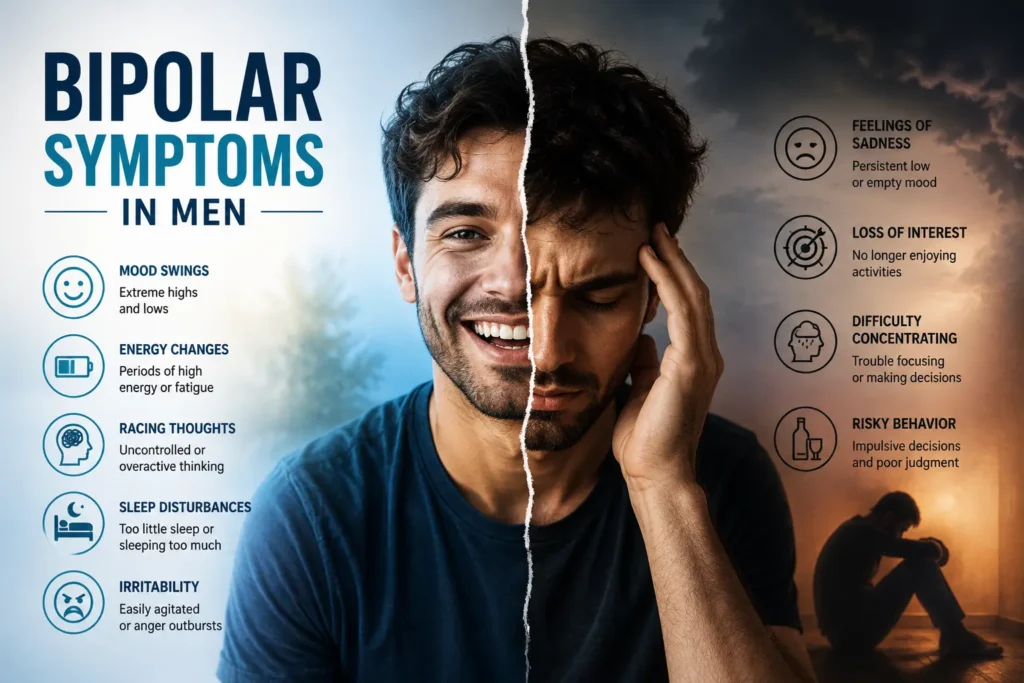
Bipolar symptoms in men often show up less as visible sadness and more as irritability, anger, risk-taking, and increased substance use. Men are also more likely to be diagnosed with a manic episode as their first noticeable episode, while depressive symptoms can go unspoken or get written off as stress or a short temper. These differences don’t change the underlying condition — the same bipolar disorder symptoms apply — but they do change how symptoms get noticed, described, and acted on. For the full symptom breakdown across mood episodes, see our complete guide to bipolar symptoms.
Table of Contents
Introduction
Ask most people to picture bipolar disorder, and they picture extremes — euphoric highs, tearful lows. What that picture usually leaves out is how differently those extremes can be expressed, and how much that expression depends on things like upbringing, social expectations, and what a person feels safe admitting out loud.
For men, that gap matters. A growing body of clinical observation — echoed by resources like HeadsUpGuys and reflected in broader mental health literature from the National Institute of Mental Health (NIMH) — points to men more often expressing mood symptoms through irritability, anger, risk-taking, or withdrawal rather than open sadness. That doesn’t mean men experience a “different disorder.” It means the same condition can look different on the outside, which affects how quickly it gets recognized.
This guide walks through what bipolar symptoms tend to look like in men specifically, why they’re commonly missed or misread, and what steps actually help. For background on the condition itself, see bipolar disorder and what bipolar disorder is.
Key Takeaways
- Bipolar disorder in men often presents with irritability and anger rather than visible sadness during low periods.
- Men are more likely to have their first recognized episode be manic rather than depressive.
- Substance use frequently overlaps with bipolar symptoms in men and can mask or worsen the underlying condition.
- Social expectations around masculinity can delay men from recognizing symptoms or seeking help.
- The clinical criteria for diagnosis are the same regardless of gender — what differs is presentation and help-seeking behavior.
- Left unaddressed, symptoms can affect relationships, work, and physical safety.
How Bipolar Disorder Shows Up Differently in Men
To be clear: the underlying condition — the DSM-5 criteria for mania, hypomania, and depression as defined by the American Psychiatric Association — doesn’t change based on gender. What differs is which symptoms tend to be more visible, more commonly reported, and more likely to be recognized by the people around a man experiencing them.
Clinical observations and patient-reported patterns suggest a few consistent differences:
- Irritability over sadness. During depressive episodes, men more often report or display irritability, agitation, or a short temper rather than the tearful sadness more commonly associated with depression.
- More manic first episodes. Men are somewhat more likely than women to have a manic episode as their first clearly identified episode, which tends to bring them to clinical attention earlier for the “up” phase specifically.
- Higher rates of co-occurring substance use. Alcohol and drug use overlap frequently with bipolar disorder in men, sometimes as an attempt to manage symptoms and sometimes worsening them.
- Risk-taking as a more visible symptom. Impulsive spending, reckless driving, or risky behavior during manic or hypomanic periods can be more outwardly obvious than internal mood changes.
These are general patterns observed in clinical settings, not universal rules — plenty of men experience textbook depressive sadness, and plenty of women experience irritability-led episodes. For a direct comparison, see our dedicated Bipolar 1 vs 2 in men and women guide.
Manic and Hypomanic Symptoms in Men
The core features of mania and hypomania — elevated or irritable mood, decreased need for sleep, racing thoughts, increased activity, and impulsivity — apply regardless of gender. In men, a few of these tend to be reported or noticed more often:
- Increased confidence that tips into grandiosity or risk-taking
- Impulsive financial decisions — large purchases, risky investments, sudden business ideas
- Increased alcohol use during high-energy periods
- More noticeable aggression or short temper alongside elevated mood
- Reduced sleep with a sense of high productivity rather than exhaustion
We cover the full clinical picture of this episode type in our dedicated manic episode and mania symptoms guides, and the milder version in hypomania symptoms. The distinction between the two is explained in mania vs hypomania.
Depressive Symptoms in Men
This is where the presentation gap tends to be widest. Instead of openly expressing sadness or hopelessness, men experiencing a depressive episode more often show:
- Increased irritability, frustration, or a noticeably shorter temper
- Withdrawal from friends, family, or social activities, sometimes framed as “just being busy”
- Overworking or throwing themselves into tasks as a way to avoid sitting with low mood
- Increased alcohol or substance use
- Physical complaints — fatigue, low energy, aches — rather than emotional ones
- Reduced interest in previously enjoyed activities, sometimes dismissed as boredom
Because these symptoms don’t match the stereotypical picture of depression, they’re more easily attributed to work stress, personality, or “just going through something,” delaying recognition. For the complete diagnostic picture of depressive episodes, see our bipolar disorder symptoms guide.
Symptom Comparison Table: Common Presentation Patterns
| Symptom Area | Commonly Reported Pattern in Men | Commonly Reported Pattern in Women |
| Depressive mood | Irritability, anger, withdrawal | Sadness, tearfulness, guilt |
| First noticeable episode | More often manic | More often depressive |
| Coping behavior | Overworking, substance use | Emotional expression, seeking support |
| Manic risk behavior | Financial risk-taking, aggression | Impulsivity, but often less externally aggressive |
| Help-seeking | Often delayed | Often earlier |
These are general clinical patterns, not fixed rules, and individual presentation varies. For a deeper look at these differences, see Bipolar 1 vs 2 in men and women, or gender-specific pages like Bipolar 1 in men, Bipolar 1 in women, Bipolar 2 in men, and Bipolar 2 in women.
Why Symptoms in Men Often Go Unrecognized
A few overlapping factors contribute to delayed recognition:
Social expectations around masculinity. Many men are raised with messaging that discourages openly discussing sadness, fear, or vulnerability, which pushes emotional symptoms toward more “acceptable” expressions like anger or withdrawal.
Substance use as a mask. Alcohol or drugs can temporarily blunt mood symptoms or explain away behavior changes, delaying the point at which an underlying mood disorder gets identified.
Irritability being misread. A short temper or increased conflict at home or work is often chalked up to stress, work pressure, or “just his personality” rather than flagged as a possible mood symptom.
Fewer men initiating mental health conversations. Broader public health data on mental health service use suggests men are generally less likely to seek help for emotional or psychological symptoms compared to women, which can delay both recognition and treatment.
This recognition gap is one reason bipolar disorder in men sometimes isn’t identified until a more disruptive event — a job loss, a relationship crisis, or a legal issue tied to impulsive behavior — forces the issue.
Substance Use and Bipolar Symptoms in Men
Alcohol and drug use deserve specific mention because the overlap with bipolar disorder in men is significant. Substances can be used to:
- Take the edge off manic energy or restlessness
- Numb depressive symptoms
- Cope with sleep disruption
The problem is that substance use tends to worsen mood instability over time and can complicate diagnosis, since intoxication or withdrawal symptoms can mimic or mask mood episode symptoms. If substance use is part of the picture, it’s important to raise this directly with a healthcare provider rather than treating it as a separate issue — the two are often connected.
Myths vs Facts About Bipolar Disorder in Men
| Myth | Fact |
| “Men don’t get depressed with bipolar disorder — just manic.” | Men experience depressive episodes too; they’re just more likely to show up as irritability or withdrawal than visible sadness. |
| “Anger issues are separate from bipolar disorder.” | Irritability and anger can be direct symptoms of both manic and depressive episodes. |
| “Real men don’t need therapy for mood problems.” | Evidence-based treatment, including therapy, is effective regardless of gender and is a normal part of managing the condition. |
| “If he seems fine at work, nothing’s wrong.” | Many men mask symptoms effectively in structured environments like work, while symptoms show up more at home or in private. |
For a broader look at common misconceptions, see bipolar disorder myths.
Risk Factors Relevant to Men
Risk factors for bipolar disorder overall include genetics, brain chemistry, and environmental stress, as outlined by the National Institute of Mental Health. A few considerations are particularly relevant when looking at male presentation:
- Family history of bipolar disorder or depression, including in male relatives who may have gone undiagnosed
- Co-occurring substance use disorders
- High-stress occupational environments that reward overworking and discourage emotional disclosure
- History of undiagnosed depressive episodes misattributed to stress or burnout
For the full picture of causes, see bipolar disorder causes and causes of mania.
Warning Signs That Need Immediate Attention
Regardless of gender, certain symptoms require urgent attention rather than a wait-and-see approach:
- Talk of suicide, self-harm, or feeling like a burden to others
- Signs of psychosis — hallucinations or firmly held false beliefs
- Extreme reckless behavior that puts personal safety or others at risk
- Aggression that escalates toward harming oneself or others
- A combination of high energy and hopelessness occurring together
If you or someone you know is having thoughts of suicide, contact the 988 Suicide & Crisis Lifeline (call or text 988 in the US) or your local emergency number immediately. Men are statistically less likely to reach out during a crisis, which makes it especially important for those around them to take warning signs seriously and encourage immediate support rather than waiting for the person to ask.
Diagnosis: What the Process Looks Like
Diagnosis doesn’t differ by gender — it relies on a clinical interview and DSM-5 criteria, the same standard used by Mayo Clinic and Cleveland Clinic in their diagnostic approach. What can differ is what gets reported. A clinician working with a man presenting with irritability, overworking, or substance use may need to specifically ask about sleep changes, energy shifts, and past mood episodes rather than relying on the person to volunteer emotional symptoms unprompted.
For the full diagnostic process, see bipolar disorder diagnosis. If you want a starting point to organize your thoughts before an appointment, our Bipolar 1 vs 2 test and Bipolar 1 vs 2 quiz can help, though they don’t replace a professional evaluation.
Treatment Considerations
Treatment for bipolar disorder in men follows the same evidence-based approach as for anyone else: mood stabilizers or other medications, psychotherapy, and lifestyle strategies, tailored to the specific type and pattern of episodes. Where it can differ is engagement — some men are more receptive to therapy framed around practical problem-solving and functioning (work, relationships, sleep) than around open emotional processing, at least initially. A good therapist will adapt to this rather than force one style.
For the full treatment overview, see bipolar disorder treatment, and type-specific guides like Bipolar 1 treatment and Bipolar 2 treatment.
Lifestyle Tips That Support Recovery
- Address substance use directly. If alcohol or drugs are part of the pattern, raise this with your provider rather than treating it as separate.
- Protect sleep. Sleep disruption is closely tied to mood episodes in both directions — cause and symptom.
- Find one person to check in with. Isolation makes early warning signs harder to catch; a trusted friend, partner, or family member can help flag changes.
- Reframe therapy as skills training, not weakness. Many men find it easier to engage with therapy framed around managing specific problems (sleep, anger, work performance) rather than abstract emotional exploration.
- Track patterns, not just feelings. A simple log of sleep, energy, and irritability can surface patterns that are easier to notice on paper than in the moment.
For broader day-to-day strategies, see living with Bipolar 1 and living with Bipolar 2.
Complications If Symptoms Go Unaddressed
Untreated bipolar symptoms in men are associated with a higher risk of relationship strain, job instability, legal or financial consequences from impulsive behavior, and worsening substance use. These risks compound over time, which is part of why earlier recognition matters. For the full picture, see bipolar disorder complications and bipolar disorder prognosis.
Checklist: Recognizing Bipolar Symptoms in Men
- [ ] Periods of high energy, reduced sleep need, and increased confidence lasting several days
- [ ] Irritability or anger that feels disproportionate or out of character
- [ ] Increased alcohol or substance use during mood shifts
- [ ] Withdrawal from relationships or overworking as a coping pattern
- [ ] Impulsive financial or personal decisions during high-energy periods
- [ ] Physical complaints (fatigue, low energy) without a clear medical cause
- [ ] Family history of bipolar disorder, depression, or substance use
If several of these apply, it’s worth raising with a healthcare provider, even if the symptoms don’t match the stereotypical picture of bipolar disorder.
Frequently Asked Questions
Do men and women have different types of bipolar disorder? No — the same diagnostic categories (Bipolar 1, Bipolar 2, cyclothymia) apply regardless of gender. What differs is how symptoms tend to present and get reported.
Why do men get diagnosed later than women in some cases? Several factors contribute, including a tendency to express mood symptoms as irritability or substance use rather than sadness, and broader patterns of men delaying mental health help-seeking.
Is aggression a real symptom of bipolar disorder? Irritability and aggression can occur during both manic and depressive episodes and are recognized symptoms, not a separate personality issue.
Can substance use hide bipolar disorder in men? Yes. Alcohol or drug use can mask, mimic, or worsen mood symptoms, which is why clinicians assess substance use and mood symptoms together rather than separately.
Are men more likely to have Bipolar 1 or Bipolar 2? Both types occur in men. Some clinical observations suggest men may be somewhat more likely to have a manic (Bipolar 1) episode recognized first, but this varies by individual, and Bipolar 2 is not uncommon in men.
What should I do if I notice these signs in my partner or friend? Approach the conversation without judgment, mention specific changes you’ve noticed rather than labeling the person, and encourage a professional evaluation. If there are safety concerns, don’t wait for the person to ask for help.
Summary
Bipolar disorder in men involves the same clinical condition as in anyone else, but it frequently shows up through irritability, risk-taking, overworking, and substance use rather than the more commonly recognized picture of visible sadness. That gap in presentation — combined with social patterns around men and help-seeking — often delays recognition and treatment. Understanding what to actually look for, rather than relying on the stereotype, is the first step toward getting an accurate evaluation and appropriate support.
For related reading, see our bipolar disorder statistics, bipolar disorder glossary, or our guide to early signs of bipolar disorder if you’re noticing subtler changes before a full pattern has emerged.
This article is for educational purposes and is not a substitute for a professional diagnosis. If you are experiencing thoughts of suicide or self-harm, please contact the 988 Suicide & Crisis Lifeline (call or text 988) or your local emergency services immediately.