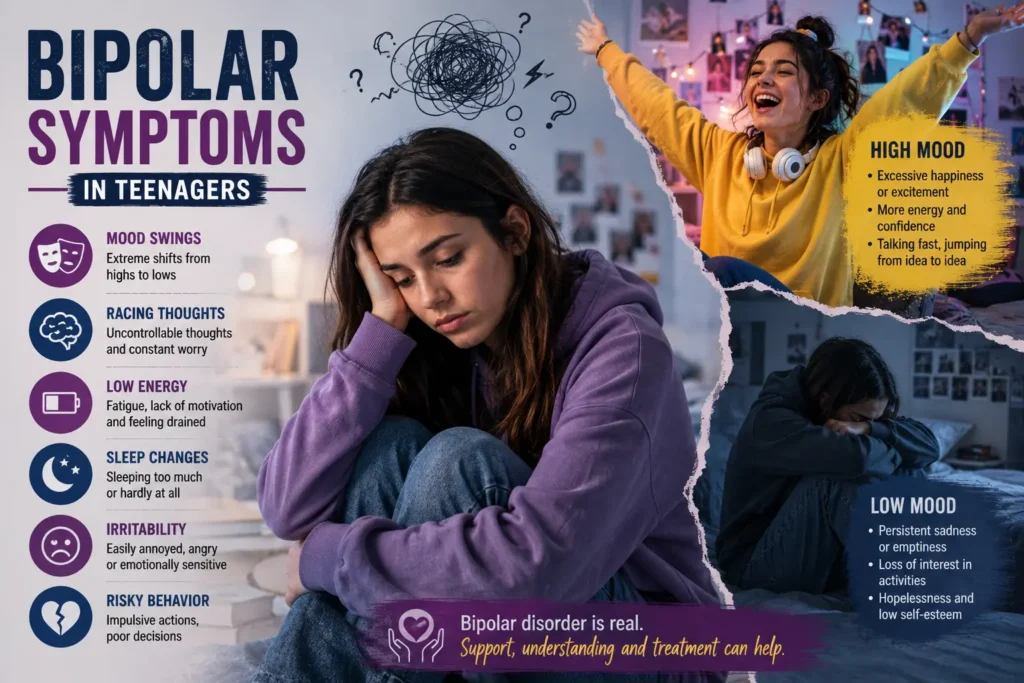
Bipolar symptoms in teenagers involve distinct episodes of elevated, irritable, or depressed mood that last days to weeks and clearly disrupt school, friendships, or family life — not the shorter, situational mood swings typical of adolescence. Warning signs include stretches of little need for sleep combined with high energy or grandiosity, alternating with periods of persistent sadness, withdrawal, or hopelessness. Because normal teenage development already involves plenty of emotional ups and downs, distinguishing bipolar disorder symptoms from typical adolescence takes a careful look at duration, intensity, and functional impact — which is why a professional evaluation matters rather than guesswork at home.
Table of Contents
Introduction
Every parent of a teenager has had the thought: is this just being a teenager, or is something else going on? Adolescence is naturally a period of mood swings, identity shifts, and unpredictable behavior, which makes bipolar disorder in teens genuinely harder to spot than in adults.
The condition doesn’t always look like the adult version either. According to the National Institute of Mental Health (NIMH), bipolar disorder can begin in the teenage years, and when it does, irritability and explosive outbursts are often more prominent than the classic image of euphoric mania. That overlap with typical teen intensity — and with conditions like ADHD, depression, and disruptive behavior disorders — is exactly why bipolar disorder in teenagers is frequently misread or missed for years.
This guide breaks down what actually distinguishes bipolar symptoms from ordinary teenage mood swings, what parents and caregivers should watch for, and how the diagnostic process works for adolescents specifically. For the broader condition, see bipolar disorder and what bipolar disorder is.
Key Takeaways
- Bipolar disorder can begin during adolescence, often with irritability rather than euphoria as the dominant “up” symptom.
- The core distinguishing feature is duration and impairment: bipolar episodes last days to weeks and clearly disrupt daily functioning, unlike typical teen mood swings.
- Bipolar disorder in teens is frequently misdiagnosed as ADHD, depression, anxiety, or a disruptive behavior disorder.
- A specific condition called disruptive mood dysregulation disorder (DMDD) is sometimes confused with pediatric bipolar disorder but is diagnostically distinct.
- Family involvement is a central part of both diagnosis and treatment for adolescents.
- Warning signs like self-harm, suicidal thoughts, or psychosis require immediate professional attention.
Why Bipolar Disorder Is Harder to Spot in Teens
Two things make adolescent bipolar disorder especially tricky to identify.
First, normal teenage development already includes emotional intensity, risk-taking, sleep pattern shifts, and identity exploration — all things that can resemble early symptoms. Second, unlike in many adults, the “up” phase in teens often shows up as irritability, agitation, and explosive anger rather than the stereotypical euphoric mania.
That combination means a lot of the behaviors that raise concern — slamming doors, staying up all night, extreme reactions to minor frustrations — get chalked up to “just being a teenager” long after they’ve become a genuine pattern. Recognizing bipolar disorder in this age group means looking past single incidents and paying attention to the overall pattern: how long symptoms last, how intense they are, and how much they interfere with school, friendships, and family life.
Manic and Hypomanic Symptoms in Teens
When a teenager experiences a manic or hypomanic episode, common features include:
- A marked, sustained shift in mood — either unusually elevated/euphoric or intensely irritable — lasting several days or more
- Decreased need for sleep without feeling tired the next day
- Rapid or pressured speech, jumping between topics
- Grandiosity — an inflated sense of importance, talent, or ability beyond what’s typical for the teen’s age
- Increased goal-directed activity, sometimes starting many projects at once
- Impulsive or risky behavior — reckless driving, unsafe decisions, or uncharacteristic rule-breaking
- Distractibility that’s noticeably worse than the teen’s usual baseline
The core clinical criteria for these episodes are the same as in adults and are covered in depth in our manic episode and mania symptoms guides, along with the milder hypomania symptoms. The key difference in teens is that irritability and agitation are often more prominent than euphoria.
Depressive Symptoms in Teens
Depressive episodes in adolescents with bipolar disorder can include:
- Persistent sadness, hopelessness, or a flat, “empty” mood
- Loss of interest in activities, friends, or hobbies the teen previously enjoyed
- Sudden drop in academic performance or difficulty concentrating
- Significant changes in sleep or appetite
- Fatigue or low energy
- Withdrawal from friends and family
- Increased sensitivity to rejection or criticism
- Thoughts of death or suicide
Because teenage depression can look similar regardless of the underlying cause, distinguishing bipolar depression from major depressive disorder in adolescents often depends on whether there’s also a history of manic or hypomanic symptoms. This is one reason a thorough evaluation matters rather than treating a depressive episode in isolation. For the full clinical picture of depressive episodes, see bipolar disorder symptoms.
Comparison Table: Normal Teen Moodiness vs Bipolar Episode
| Feature | Typical Teen Mood Swings | Possible Bipolar Episode |
| Duration | Hours to a day or two | Days to weeks, sustained |
| Trigger | Usually tied to a specific event | Can occur without a clear trigger |
| Sleep | Mostly normal, occasional late nights | Days of minimal sleep without fatigue, or excessive sleep |
| Functioning | Generally able to manage school/friends | Noticeable disruption to school, friendships, or family life |
| Recovery | Returns to baseline mood fairly quickly | Mood stays shifted for an extended period |
| Pattern over time | Variable, situational | Distinct episodes, sometimes recurring |
This table is a general guide, not a diagnostic tool. If several “possible bipolar episode” features apply and persist, it’s worth discussing with a pediatrician or mental health professional.
Conditions Often Confused With Teen Bipolar Disorder
Several conditions overlap with bipolar disorder symptoms in adolescents, which contributes to frequent misdiagnosis:
ADHD. Restlessness, distractibility, and impulsivity are common to both conditions. The key difference is pattern: ADHD symptoms are typically consistent over time, while bipolar symptoms occur in distinct episodes with clear shifts in mood, sleep, and energy.
Depression (unipolar). If a teen has only ever experienced depressive episodes with no history of mania or hypomania, standard major depressive disorder — rather than bipolar disorder — may be the more accurate diagnosis, at least until any manic-type symptoms emerge.
Disruptive mood dysregulation disorder (DMDD). This is a specific diagnosis for children and teens with chronic, severe irritability and frequent temper outbursts that occur most days, without the distinct episodic pattern seen in bipolar disorder. DMDD was introduced in the DSM-5 partly to reduce overdiagnosis of pediatric bipolar disorder in kids with chronic irritability rather than episodic mood shifts.
Oppositional defiant disorder (ODD) or conduct-related concerns. Defiance and anger can overlap with irritable mania, but ODD typically lacks the sleep changes, grandiosity, or sustained mood shift seen in a manic or hypomanic episode.
Because these conditions share overlapping features, an accurate diagnosis usually requires a mental health professional experienced in adolescent evaluation — not a single conversation or a checklist alone.
Myths vs Facts About Bipolar Disorder in Teens
| Myth | Fact |
| “Teenagers can’t really have bipolar disorder — it’s just hormones.” | Bipolar disorder can begin during adolescence and is a recognized diagnosis in this age group. |
| “If a teen isn’t euphoric, it’s not mania.” | Irritability and explosive anger are common and sometimes more prominent than euphoria in adolescent mania. |
| “Every moody or defiant teen might have bipolar disorder.” | Most teenage moodiness is developmentally normal; bipolar disorder involves a distinct, sustained episodic pattern. |
| “Medication is the only option for teens.” | Treatment typically combines therapy, family involvement, and medication when appropriate, tailored to the individual. |
For a broader look at common misconceptions, see bipolar disorder myths.
Risk Factors in Adolescents
Risk factors for bipolar disorder in teens are similar to those in adults, per the National Institute of Mental Health, with a few points especially relevant to this age group:
- A parent or sibling with bipolar disorder or another mood disorder
- A prior episode of depression, particularly one with a rapid onset or unusual features
- High-stress life events, including family conflict or major transitions
- Sleep disruption, which can both signal and worsen mood instability in teens specifically
For a deeper dive into causes, see bipolar disorder causes and causes of mania.
Warning Signs That Need Immediate Attention
Some signs in a teenager should never wait for a routine appointment. Seek help right away if you notice:
- Any talk of suicide, self-harm, or feeling like a burden to others
- Signs of psychosis — hearing or seeing things that aren’t there, or firmly held false beliefs
- Extremely reckless behavior that puts safety at serious risk
- A combination of high energy and hopelessness at the same time
- Sudden, severe withdrawal from all friends, family, and previously enjoyed activities
If your teen is having thoughts of suicide or you’re worried about their immediate safety, contact the 988 Suicide & Crisis Lifeline (call or text 988 in the US) or your local emergency number right away. This is a sensitive area, and if you’re a teen reading this and struggling yourself, please reach out to a trusted adult, a school counselor, or a crisis line rather than handling it alone.
How Diagnosis Works for Teenagers
Diagnosing bipolar disorder in adolescents relies on the same DSM-5 criteria used for adults, but the evaluation process typically involves more than just the teen’s self-report. A thorough assessment, ideally by a child and adolescent psychiatrist or psychologist, usually includes:
- A detailed history from parents or caregivers about mood patterns, sleep, and behavior over time
- Input from the teen themselves about their internal experience
- School information when relevant, such as academic changes or teacher observations
- Screening for overlapping conditions like ADHD, anxiety, and depression
- A careful look at episode duration and functional impact, not just isolated incidents
For the full diagnostic process used across age groups, see bipolar disorder diagnosis.
Treatment Approaches for Teens
Treatment for adolescent bipolar disorder typically combines several elements, tailored by a child and adolescent psychiatrist:
- Medication, when appropriate, chosen carefully with attention to the unique considerations of a developing adolescent
- Individual therapy, often cognitive behavioral therapy or similar approaches adapted for teens
- Family-focused therapy, since family involvement and psychoeducation are strongly associated with better outcomes in adolescent mood disorders
- School coordination, including accommodations if academic performance has been affected
For the full treatment picture used across bipolar disorder generally, see bipolar disorder treatment.
Guidance for Parents and Caregivers
- Track patterns, not incidents. A single meltdown doesn’t confirm anything; a repeated pattern of sustained mood shifts, sleep changes, and functional impact is what matters.
- Talk to the school. Teachers and counselors often notice changes in a different context than parents do, and their observations can be valuable during an evaluation.
- Involve your teen in the process. Adolescents are more likely to engage with treatment when they feel heard rather than diagnosed “at” them.
- Don’t wait for a crisis to seek help. An evaluation after noticing a pattern is far preferable to waiting until symptoms become severe or dangerous.
- Take care of yourself too. Supporting a teen through a mood disorder diagnosis is stressful; your own support system matters as well.
Complications of Untreated Symptoms
Untreated bipolar disorder in teens is associated with academic struggles, relationship difficulties, increased risk of substance use, and a higher likelihood of more severe episodes later on. Early, appropriate treatment is linked to better long-term outcomes. For more detail, see bipolar disorder complications and bipolar disorder prognosis.
Checklist: Should Your Teen Be Evaluated?
- [ ] Distinct periods of unusually high energy, reduced sleep need, or grandiosity lasting several days
- [ ] Intense irritability or explosive anger that’s out of proportion and sustained, not situational
- [ ] Periods of persistent sadness, withdrawal, or hopelessness lasting two weeks or more
- [ ] A noticeable drop in school performance or engagement
- [ ] Sleep changes that don’t match typical teen patterns
- [ ] A family history of bipolar disorder or other mood disorders
- [ ] These patterns clearly disrupting friendships, family life, or daily functioning
If several of these apply and have repeated over time, it’s worth scheduling an evaluation with a pediatrician or child and adolescent mental health specialist.
Frequently Asked Questions
At what age can bipolar disorder first appear? Bipolar disorder often first emerges in the teenage years or early twenties, according to the National Institute of Mental Health, though it can occasionally appear earlier in childhood.
How is bipolar mania different in teens compared to adults? Teen mania often shows up more as irritability, agitation, and explosive anger, whereas adults are somewhat more likely to display classic euphoria alongside high energy — though both patterns can occur at any age.
Can ADHD be mistaken for bipolar disorder in teens? Yes. Both can involve impulsivity, restlessness, and distractibility. The key difference is pattern: ADHD symptoms tend to be consistent day to day, while bipolar symptoms occur in distinct episodes with mood, sleep, and energy changes.
What is DMDD, and how is it different from bipolar disorder? Disruptive mood dysregulation disorder involves chronic, severe irritability and frequent outbursts most days, without the episodic mood shifts that define bipolar disorder. It’s a distinct diagnosis introduced partly to avoid overdiagnosing bipolar disorder in chronically irritable children.
Should I bring up a family history of bipolar disorder when getting my teen evaluated? Yes. Family history is a meaningful risk factor and gives the evaluating clinician important context.
Is it normal for teenagers to have big mood swings? Yes, to a degree — adolescence naturally involves emotional intensity. The concern arises when mood shifts are sustained for days or weeks, occur without a clear trigger, and significantly disrupt school, friendships, or family life.
Can teen bipolar disorder go away on its own? Bipolar disorder is generally a lifelong condition requiring ongoing management, though with appropriate treatment, many teens go on to have long periods of stability. It typically doesn’t resolve without treatment.
Summary
Bipolar disorder in teenagers can be genuinely difficult to separate from typical adolescent moodiness, especially since irritability — rather than classic euphoria — is often the more prominent “up” symptom in this age group. The clearest signal isn’t any single behavior but the overall pattern: sustained mood and energy shifts lasting days to weeks that clearly disrupt school, friendships, and family life. If that pattern sounds familiar, the next step isn’t guesswork at home — it’s an evaluation with a professional experienced in adolescent mental health.
For related reading, see our bipolar disorder statistics, bipolar disorder glossary, or our guide to early signs of bipolar disorder for a broader look at how symptoms can present before a full pattern emerges.
This article is for educational purposes and is not a substitute for a professional diagnosis. If you or your teen is experiencing thoughts of suicide or self-harm, please contact the 988 Suicide & Crisis Lifeline (call or text 988) or your local emergency services immediately.