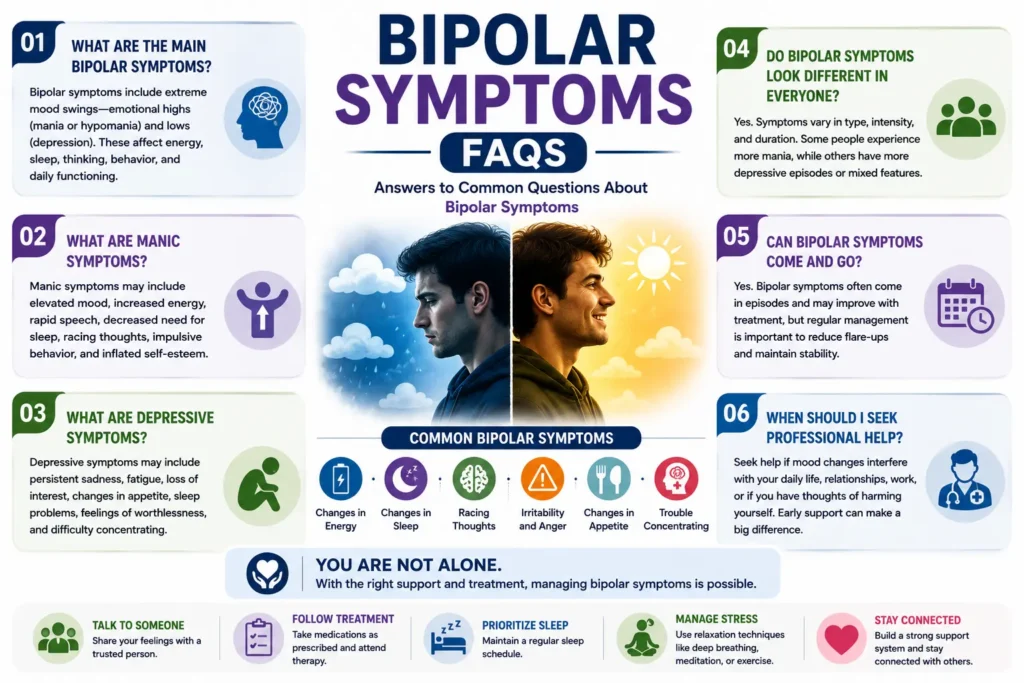
Bipolar Symptoms FAQs: Searching “bipolar symptoms” usually leads to long, dense medical pages that are hard to skim when you just need a straight answer. This Bipolar Symptoms FAQs guide takes a different approach: it’s organized entirely around the real questions people ask about bipolar symptoms, answered clearly and directly, without burying the useful part in paragraphs of background information.
Whether you’re trying to understand your own experience, recognize signs in someone you care about, or simply make sense of clinical terms like “hypomania” or “mixed episode,” this FAQ-style guide is built to get you a clear answer fast. For a full structured overview of bipolar disorder itself, our bipolar disorder and what is bipolar guides are good companion reading.
Table of Contents
Key Takeaways
- Bipolar disorder symptoms fall into distinct categories: manic, hypomanic, depressive, and mixed, each with its own emotional and physical pattern.
- According to the American Psychiatric Association’s DSM-5, a manic episode requires a mood change plus a genuine increase in energy or activity lasting at least one week.
- Symptoms can look different depending on age, sex, and whether someone has bipolar I or bipolar II.
- Many symptoms overlap with other conditions, which is why professional diagnosis matters more than self-assessment.
- Some symptoms, like suicidal thoughts or a break from reality, require immediate medical attention.
The most common bipolar symptoms questions center on how to tell mania from hypomania, what depressive symptoms feel like, whether mood swings are normal or a sign of bipolar disorder, how symptoms differ between bipolar I and bipolar II, and how symptoms show up differently by age and sex. This guide answers those questions directly, along with less commonly covered ones like emotional numbness, mixed episodes, and how long symptoms typically last.
General Questions About Bipolar Symptoms
What are the main symptoms of bipolar disorder? Bipolar disorder symptoms fall into two broad categories: manic or hypomanic symptoms (elevated mood, high energy, reduced need for sleep, impulsivity) and depressive symptoms (low mood, fatigue, hopelessness, loss of interest). A full breakdown of both categories is available in our bipolar disorder symptoms guide.
How do I know if my mood swings are just normal or a sign of bipolar disorder? Ordinary mood changes are usually brief and tied to specific events. Bipolar symptoms are more intense, last for days or weeks at a time, and noticeably interfere with work, relationships, or daily functioning. A licensed mental health professional is the only reliable way to tell the difference.
Are physical symptoms part of bipolar disorder, or is it only emotional? Both. Bipolar disorder affects sleep, appetite, energy, and even heart rate, not just mood. Our dedicated guide to physical symptoms of bipolar disorder covers this in depth, while our emotional symptoms of bipolar disorder guide focuses specifically on the mood-related side.
How long do bipolar symptoms usually last? By DSM-5 criteria, a manic episode must last at least one week (or less if hospitalization is required), a hypomanic episode at least four days, and a major depressive episode at least two weeks. Without treatment, episodes can sometimes last longer.
Can bipolar disorder symptoms come and go without warning? Episodes often build gradually rather than appearing instantly, though they can sometimes escalate quickly. Some people also experience rapid cycling, where mood episodes shift more frequently, covered in our guide to rapid cycling bipolar symptoms.
What triggers bipolar symptoms to appear? Common triggers include sleep disruption, high stress, major life changes, and substance use, though episodes can also occur without an obvious trigger. Our full guide to bipolar disorder causes explains the underlying factors in more detail.
Questions About Manic and Hypomanic Symptoms
What does a manic episode actually feel like? People often describe mania as a surge of energy, confidence, and excitement, though it can just as easily feel agitated and irritable rather than euphoric. Common signs include a reduced need for sleep, racing thoughts, rapid speech, and impulsive decisions. Our full guide to mania symptoms covers the complete picture.
What’s the difference between mania and hypomania? Mania is more intense, typically severe enough to disrupt daily functioning or require hospitalization, and it can include psychotic features. Hypomania is milder, doesn’t cause the same level of impairment, and usually doesn’t involve a break from reality. Our guide to mania vs hypomania breaks this down clearly.
Can mania make someone feel unusually happy, or is it always agitation? Both patterns occur. Some people primarily experience euphoria and grandiosity, while others experience irritability and agitation as the dominant emotional tone of a manic episode.
Does mania always come with a decreased need for sleep? Reduced need for sleep is one of the most common symptoms of mania, but it isn’t universal. Some people sleep very little during mania and still feel fully rested; others may show different sleep patterns. Our guide to mania and sleep explains this connection.
Can mania include hallucinations or delusions? In severe cases, yes. Psychotic features, such as hallucinations or delusional beliefs, can occur during severe manic episodes, particularly in bipolar I disorder. Our guide to psychotic symptoms in bipolar disorder explains what this looks like and why it needs prompt medical attention.
What causes a manic episode to start? Triggers can include sleep loss, high stress, certain medications, or substance use, layered on top of the underlying biological factors involved in bipolar disorder. Our guide to causes of mania covers this in more detail, along with common mania triggers.
Questions About Depressive Symptoms
What does bipolar depression feel like compared to regular sadness? Bipolar depression tends to be more persistent, more intense, and less responsive to reassurance or positive events than everyday sadness. It often includes hopelessness, loss of interest in activities, fatigue, and changes in sleep or appetite. Our full guide to bipolar depression symptoms covers this in depth.
Can depression in bipolar disorder look like irritability instead of sadness? Yes. Depressive episodes don’t always present as overt sadness. Some people primarily experience irritability, restlessness, or a flat, numb emotional state instead.
Is fatigue always part of bipolar depression? Fatigue is very common during depressive episodes, though its severity can vary. Some people also experience physical slowing, called psychomotor retardation, alongside low energy.
How is bipolar depression different from major depressive disorder? The depressive episodes themselves can look similar, but bipolar depression occurs alongside manic or hypomanic episodes, while major depressive disorder does not involve these “up” phases. This distinction matters significantly for treatment, since some standard depression medications can potentially trigger mania in someone with bipolar disorder if used without a mood stabilizer.
Questions About Mixed Episodes and Rapid Cycling
What is a mixed episode? A mixed episode involves symptoms of mania and depression occurring at the same time, such as feeling agitated and energized while also feeling hopeless or sad. Our guide to mixed episode symptoms explains this pattern and why it carries additional risk.
Why are mixed episodes considered more serious? Combining the energy and impulsivity of mania with the despair of depression has been linked to a higher risk of impulsive or self-harming behavior, making mixed episodes a pattern that warrants close clinical attention.
What does rapid cycling mean? Rapid cycling refers to experiencing four or more mood episodes within a 12-month period. It’s a pattern, not a separate diagnosis, and it can occur in either bipolar I or bipolar II. Our guide to rapid cycling bipolar symptoms covers this in more detail.
Questions About Bipolar 1 vs. Bipolar 2 Symptoms
Do bipolar 1 and bipolar 2 have different symptoms? The core symptom categories are similar, but the intensity differs. Bipolar I involves full manic episodes, while bipolar II involves hypomania and tends to feature more prominent depressive episodes. Our full comparison is available in bipolar 1 vs bipolar 2.
Is bipolar 2 “milder” than bipolar 1? Bipolar II isn’t necessarily milder overall. While its manic-spectrum episodes (hypomania) are less severe than full mania, people with bipolar II often experience more frequent or longer depressive episodes, which can be just as impairing.
Can bipolar 2 turn into bipolar 1? It’s possible, though not typical, for someone diagnosed with bipolar II to later experience a full manic episode that would reclassify their diagnosis as bipolar I. This is uncommon and should be evaluated by a psychiatric professional if it occurs.
Questions About Symptoms by Age and Sex
Do bipolar symptoms look different in men and women? There can be some differences in symptom timing and presentation between men and women, though the core symptom categories remain the same. Our guides to bipolar symptoms in men and bipolar symptoms in women explore this further.
What do bipolar symptoms look like in teenagers? In teens, irritability and intense emotional reactivity are often more prominent than classic euphoria, which can make bipolar disorder harder to distinguish from typical teenage mood changes. Our guide to bipolar symptoms in teenagers explains what to look for.
Can children show symptoms of bipolar disorder? Yes, though symptoms in children can present differently than in adults, and diagnosis in this age group requires careful, specialized evaluation. Our guide to bipolar symptoms in children covers this in more depth.
What are the earliest signs of bipolar disorder to watch for? Early signs can include noticeable sleep changes, unusual shifts in energy or mood, and behavior that represents a clear change from someone’s usual baseline. Our guide to early signs of bipolar disorder walks through this in detail.
Questions About Diagnosis and Overlapping Conditions
Can I diagnose myself based on symptoms I read online? No. Many bipolar symptoms overlap with other conditions, including depression, ADHD, and borderline personality disorder. Self-assessment based on a symptom list isn’t a substitute for a full clinical evaluation. Our guide to bipolar disorder diagnosis explains what a proper evaluation involves.
What conditions get mistaken for bipolar disorder? Conditions like major depressive disorder, ADHD, and borderline personality disorder can share overlapping symptoms with bipolar disorder, which is why an accurate diagnosis requires a detailed history, not just a checklist.
How many symptoms are needed for a bipolar diagnosis? According to the DSM-5, a manic episode requires at least three additional symptoms (four if the mood is only irritable) alongside the core mood and energy change, present most of the day for at least a week. A qualified clinician applies these criteria as part of a full evaluation, not the person themselves.
Are there different types of bipolar disorder beyond bipolar 1 and 2? Yes. Cyclothymic disorder involves milder mood fluctuations that don’t meet the full criteria for mania, hypomania, or major depression. Our guide to types of bipolar disorder covers the full spectrum.
Quick Symptom Comparison Table
| Episode Type | Core Emotional Signs | Core Physical/Behavioral Signs | Minimum Duration (DSM-5) |
| Manic episode | Euphoria, grandiosity, irritability | Reduced sleep need, rapid speech, impulsivity | 1 week (or any length if hospitalized) |
| Hypomanic episode | Elevated mood, mild irritability | Increased energy, mild behavior change | 4 days |
| Depressive episode | Sadness, hopelessness, guilt | Fatigue, appetite/sleep changes | 2 weeks |
| Mixed episode | Simultaneous highs and lows | Agitation combined with low energy or sadness | Varies; assessed by symptom overlap |
Myths vs. Facts About Bipolar Symptoms
Myth: Bipolar disorder just means mood swings. Fact: Symptoms involve distinct, sustained episodes affecting mood, energy, sleep, and behavior, not brief emotional shifts.
Myth: Someone with bipolar disorder is always either “manic” or “depressed.” Fact: Many people experience stable periods, called euthymia, between episodes, especially with treatment.
Myth: You can tell if someone has bipolar disorder just by watching them for a day. Fact: Diagnosis requires a detailed history over time, not a single observation, since symptoms fluctuate and can resemble other conditions.
A more complete list of misconceptions is available in our guide to bipolar disorder myths.
Warning Signs That Need Immediate Attention
Most bipolar symptoms can be managed with proper treatment, but some require urgent care. Seek immediate help if someone shows:
- Thoughts of suicide or self-harm
- Hallucinations, delusions, or a significant break from reality
- Severe agitation combined with hopelessness, especially during a mixed episode
- Behavior that puts their safety or others’ safety at risk
If you or someone you know is in crisis, contact the 988 Suicide & Crisis Lifeline (call or text 988 in the US) or local emergency services immediately.
Questions About Treatment and Living With Symptoms
Do bipolar symptoms go away completely with treatment? Treatment can significantly reduce the frequency and severity of episodes, and many people experience long stretches of stability, but bipolar disorder is generally a lifelong condition managed through ongoing care rather than one that’s permanently “cured.” Our guide to bipolar disorder treatment covers the full range of options.
What happens if bipolar symptoms go untreated? Untreated symptoms can worsen over time and contribute to complications affecting relationships, work, and physical health. Our guide to bipolar disorder complications explains these risks in more detail.
What’s the long-term outlook for someone with bipolar symptoms? With consistent treatment, many people manage their symptoms effectively and lead full, stable lives. Our guide to bipolar disorder prognosis covers what long-term management typically looks like.
Where can I find clear definitions of bipolar-related terms? Our bipolar disorder glossary breaks down clinical terms like euthymia, psychomotor retardation, and mixed features in plain language. For a broader look at how common bipolar disorder is, see our bipolar disorder statistics page.
Summary
Bipolar symptoms raise a lot of specific, practical questions, and this guide covers the ones people ask most: how mania differs from hypomania, what depression feels like inside a bipolar diagnosis, how mixed episodes work, and how symptoms shift across age, sex, and bipolar type. Bipolar disorder involves real, distinct symptom patterns, not simple mood swings, and understanding those patterns is often the first step toward getting proper support.
If your own questions about bipolar symptoms go beyond what’s covered here, or if what you’re reading sounds familiar in your own life, the next best step is a conversation with a qualified healthcare professional, alongside exploring our full library of guides on diagnosis, treatment, and living with bipolar disorder.