
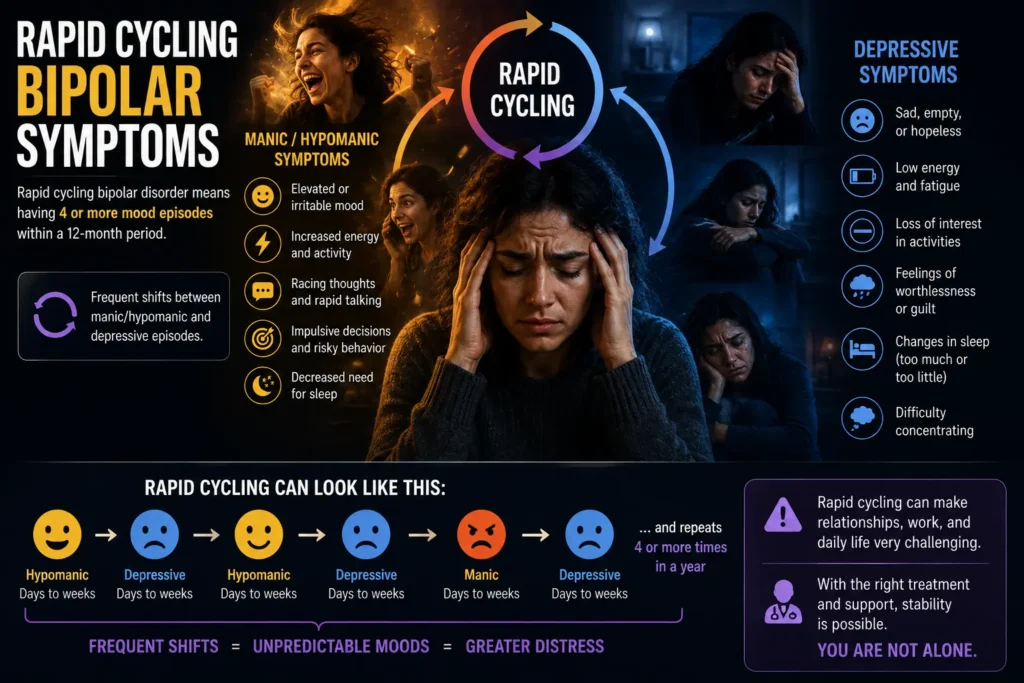
Rapid Cycling Bipolar Symptoms: Rapid cycling isn’t a separate type of bipolar disorder—it’s a pattern where someone has four or more distinct mood episodes (manic, hypomanic, depressive, or mixed) within a single year. The episodes are still full episodes, just packed closer together than the more typical months-long gaps. It can affect anyone with bipolar 1 or bipolar 2, tends to make daily life harder to plan around, and usually calls for a treatment adjustment rather than just “waiting it out.”
Table of Contents
Introduction
Bipolar disorder is often described as long stretches of high mood followed by long stretches of low mood. Rapid cycling breaks that pattern. Instead of months between episodes, a person might shift from depression to hypomania to depression again within weeks — sometimes faster.
This isn’t the same as ordinary moodiness, and it isn’t the same as a mixed episode either, where opposite symptoms overlap at the same time. Rapid cycling is about frequency: how often full mood episodes occur, not what happens within a single one.
Because this pattern can be mistaken for other conditions — or dismissed as someone just being “unpredictable” — understanding what actually counts as rapid cycling helps in getting the right diagnosis and treatment sooner. For the full range of how bipolar disorder can present, see our guide on bipolar disorder symptoms.
Key Takeaways
- Rapid cycling means four or more mood episodes within 12 months, as defined by the DSM-5.
- It’s a course specifier, not a distinct bipolar diagnosis — it can occur in bipolar 1 or bipolar 2.
- Episodes must meet full diagnostic criteria for mania, hypomania, depression, or a mixed episode, separated by either a return to baseline mood or a switch to the opposite pole.
- It’s associated with a somewhat harder-to-treat course, though it’s manageable with the right treatment plan.
- Certain antidepressants and thyroid issues are linked to a higher likelihood of rapid cycling.
What Is Rapid Cycling? (Definition)
Rapid cycling is a specifier used to describe the course of bipolar disorder — how often episodes happen — rather than a symptom set of its own. According to the American Psychiatric Association’s DSM-5, it applies when someone has experienced four or more mood episodes in a 12-month period.
Those episodes can be any combination of:
- Manic episodes
- Hypomanic episodes
- Major depressive episodes
- Mixed episodes (episodes with features of both poles at once)
To count as separate episodes, each one needs to either be separated by at least two months of full or partial remission, or involve a direct switch to the opposite mood pole (for example, going straight from mania into depression). Someone whose mood simply fluctuates day to day without meeting full episode criteria wouldn’t be classified as rapid cycling — the term specifically describes frequent, complete episodes, not general mood instability.
If you’re not familiar with what a full manic or depressive episode looks like on its own, our guides on manic episode and bipolar depression symptoms explain each in detail.
Rapid Cycling Symptoms: What to Look For
Because rapid cycling is defined by frequency rather than a unique symptom list, the symptoms during any given episode look like standard mania, hypomania, depression, or mixed features. What changes is how often a person moves between them.
Symptoms During Manic or Hypomanic Phases
| Symptom | What It Looks Like |
| Elevated or irritable mood | Feeling unusually high, expansive, or on edge |
| Increased energy | Restlessness, less need to sit still |
| Decreased need for sleep | Functioning on very little rest |
| Rapid speech | Talking quickly, jumping between topics |
| Impulsivity | Overspending, risky decisions, impulsive plans |
| Inflated self-esteem | Grandiose thinking or overconfidence |
Symptoms During Depressive Phases
| Symptom | What It Looks Like |
| Low mood | Persistent sadness or emptiness |
| Loss of interest | Pulling away from things once enjoyed |
| Fatigue | Low energy, even after rest |
| Sleep changes | Sleeping far more or far less than usual |
| Difficulty concentrating | Trouble focusing at work or school |
| Feelings of worthlessness | Harsh self-judgment, guilt |
The Pattern That Defines Rapid Cycling
What sets rapid cycling apart isn’t any single symptom — it’s the turnover. A person might notice:
- Feeling stable for a few weeks, then dropping into depression, then rising into hypomania, all within a couple of months
- Having a harder time identifying a “normal” baseline, since stable periods are shorter
- Struggling to plan work, relationships, or routines because mood states shift before adjustments can be made
This turnover is also what makes rapid cycling harder to track without professional support — the mood shifts can be mistaken for reactions to daily stress rather than recognized as distinct clinical episodes.
Rapid Cycling vs. Mixed Episodes vs. Standard Bipolar Course
These three terms get mixed up often, but they describe different things.
| Feature | Rapid Cycling | Mixed Episode | Standard Bipolar Course |
| What it describes | Frequency of episodes over a year | Overlap of manic and depressive symptoms within one episode | Typical spacing between episodes |
| Minimum threshold | 4+ episodes in 12 months | 3+ symptoms of the opposite pole during one episode | No fixed frequency |
| Time between episodes | Short (weeks to a couple months) | Not applicable — symptoms co-occur | Often months to years |
| Diagnostic status | Course specifier | Episode specifier | Baseline pattern, not a specifier |
For a full explanation of how overlapping symptoms present within a single episode, see our dedicated guide on mixed episode symptoms.
Causes and Risk Factors
Rapid cycling doesn’t have one single cause. It’s better understood as a pattern that emerges from a mix of biological vulnerability and outside influences. Research points to several associated risk factors, though not every person with these factors develops rapid cycling.
| Risk Factor | Why It Matters |
| Antidepressant use without a mood stabilizer | Can potentially destabilize mood cycling in bipolar disorder |
| Thyroid dysfunction | Hypothyroidism has been linked to rapid cycling in some studies |
| Substance use | Alcohol and stimulant use can worsen mood instability |
| Sleep disruption | Irregular sleep is both a trigger and a symptom |
| Earlier age of bipolar onset | Associated with a higher likelihood of a rapid-cycling course |
| Female sex | Some studies report rapid cycling more frequently in women, though findings vary |
For a broader look at what contributes to bipolar disorder overall, see bipolar disorder causes. If sleep is a factor you suspect plays a role, mania and sleep covers that connection in more depth.
How Common Is Rapid Cycling?
Rapid cycling is considered a less common course of bipolar disorder compared to the standard episodic pattern, though estimates vary between studies depending on how strictly the criteria are applied. It can occur at any point in the illness and isn’t necessarily permanent — some people experience a rapid-cycling course for a period of time and then return to a more typical episode spacing, especially with treatment adjustments.
For general prevalence data on bipolar disorder as a whole, see bipolar disorder statistics.
Diagnosis: How Clinicians Confirm Rapid Cycling
Diagnosing rapid cycling requires tracking mood episodes over time, not just describing a rough impression of “moodiness.” A clinician typically will:
- Take a detailed history to confirm each episode met full DSM-5 criteria for mania, hypomania, depression, or mixed features
- Confirm episodes were separated appropriately (remission period or switch to the opposite pole)
- Rule out other explanations, including thyroid disorders, substance use, and other psychiatric conditions that can mimic mood cycling
- Often ask the person to keep a mood chart over several weeks or months to track patterns accurately
Because this pattern can be difficult to reconstruct from memory alone, mood tracking tools are frequently used to support an accurate diagnosis. For a full explanation of how bipolar disorder is diagnosed overall, see bipolar disorder diagnosis.
Treatment for Rapid Cycling
Rapid cycling can respond differently to treatment than a standard episodic course, so clinicians often adjust the approach specifically for this pattern.
- Mood stabilizers, such as lithium or valproate, remain a core treatment, though response can vary more than in non-rapid-cycling bipolar disorder
- Antidepressant caution — clinicians often avoid or carefully limit antidepressant use, since it may worsen cycling frequency in some individuals
- Thyroid evaluation and treatment, since correcting an underlying thyroid problem can sometimes reduce cycling frequency
- Atypical antipsychotics, which may be added depending on episode type and severity
- Psychotherapy, including cognitive behavioral therapy (CBT) and psychoeducation, to support coping and early symptom recognition
- Structured routines, especially consistent sleep and wake times, which can reduce triggers for new episodes
Treatment is highly individualized, and what stabilizes one person’s cycling pattern may not work the same way for someone else. A psychiatrist experienced in bipolar disorder is the right resource for building this plan. For a complete overview of options, see bipolar disorder treatment.
Lifestyle Factors That Can Help
While lifestyle changes aren’t a replacement for medical treatment, they can support stability alongside it:
- Keeping a consistent sleep schedule, since irregular sleep is a known trigger for mood episodes
- Tracking mood daily to catch early warning signs of a new episode
- Limiting alcohol and recreational substance use
- Reducing major schedule disruptions where possible (time zone changes, shift work) since these affect sleep and circadian rhythm
- Staying connected with a treatment team, especially during periods of frequent change
Myths vs. Facts
| Myth | Fact |
| “Rapid cycling means mood changes happen within the same day.” | Rapid cycling refers to distinct episodes over a year, not hour-to-hour mood shifts. |
| “It’s a separate, more severe type of bipolar disorder.” | It’s a course specifier that can apply to either bipolar 1 or bipolar 2 — not a distinct diagnosis. |
| “Once someone rapid cycles, it’s permanent.” | The pattern can change over time, including with treatment adjustments. |
| “Antidepressants always help mood stability.” | In bipolar disorder, antidepressants used without a mood stabilizer may worsen cycling in some people. |
| “Rapid cycling is rare and unlikely to affect most people with bipolar disorder.” | It’s less common than the standard course, but well-documented and studied within bipolar disorder. |
For broader misconceptions about bipolar disorder overall, see bipolar disorder myths.
Complications and Prognosis
Frequent mood episodes can affect daily functioning more than a typical episodic course, simply because there’s less stable time between episodes to recover and plan. Potential complications include:
- Greater difficulty maintaining consistent work or school performance
- Strain on relationships due to unpredictable mood changes
- Higher risk of co-occurring substance use as a coping mechanism
- Increased likelihood of medication changes as clinicians search for an effective combination
Prognosis varies significantly by individual, and many people see the rapid-cycling pattern ease with consistent treatment. For a deeper look at long-term outlook, see bipolar disorder prognosis and bipolar disorder complications.
Warning Signs and When to Seek Help
Because rapid cycling includes full depressive and manic episodes, the same warning signs that apply to those episodes individually apply here — just more frequently.
Seek prompt professional support if you notice:
- Several distinct mood episodes occurring within just a few months
- Increasing difficulty predicting or managing mood shifts
- Growing impulsivity or risk-taking during high phases
- Persistent low mood, hopelessness, or thoughts of self-harm during low phases
If there is any thought of suicide or self-harm, call or text 988 (the Suicide & Crisis Lifeline in the US) or go to the nearest emergency room. If you’re outside the US, contact your local emergency services or crisis line.
This is a sensitive area, and if these thoughts apply to you personally, reaching out for support is a strong and reasonable step to take.
Checklist: Could This Be Rapid Cycling?
This is a starting point for a conversation with a clinician, not a self-diagnosis tool.
- [ ] Four or more distinct mood episodes in the past year
- [ ] Each episode lasted long enough to meet criteria for mania, hypomania, depression, or mixed features
- [ ] Episodes were separated by remission or a direct switch to the opposite pole
- [ ] Mood shifts are affecting work, relationships, or daily routines
- [ ] Sleep, thyroid function, or substance use haven’t been ruled out as contributing factors
If several of these apply, a conversation with a psychiatrist is the appropriate next step.
Frequently Asked Questions
What does rapid cycling mean in bipolar disorder? It means experiencing four or more distinct mood episodes — manic, hypomanic, depressive, or mixed — within a 12-month period, as defined by the DSM-5.
Is rapid cycling a type of bipolar disorder? No. It’s a course specifier that can apply to bipolar 1 or bipolar 2, describing how often episodes occur rather than a separate diagnosis.
Can rapid cycling happen in bipolar 2 disorder? Yes. Rapid cycling can occur in either bipolar 1 or bipolar 2, since it describes episode frequency rather than episode type. See bipolar 1 vs bipolar 2 for how the two types differ.
What triggers rapid cycling? Possible contributors include thyroid dysfunction, certain antidepressants used without a mood stabilizer, substance use, and sleep disruption, though the exact cause varies by individual.
Is rapid cycling permanent? Not necessarily. Some people experience it for a period of time and later return to a more typical episode pattern, particularly with treatment adjustments.
How is rapid cycling different from mood swings? Mood swings can happen without meeting full diagnostic criteria for an episode. Rapid cycling specifically requires four or more complete manic, hypomanic, depressive, or mixed episodes within a year.
How is rapid cycling treated? Treatment typically centers on mood stabilizers, careful use (or avoidance) of antidepressants, addressing any thyroid issues, and psychotherapy, tailored to the individual’s episode history.
Should I track my moods if I suspect rapid cycling? Yes. Mood tracking over several weeks or months gives both you and your clinician clearer data than relying on memory, and it can support a more accurate diagnosis.
Summary
Rapid cycling describes how often mood episodes occur in bipolar disorder, not a new set of symptoms to watch for. If someone is moving through four or more full manic, hypomanic, depressive, or mixed episodes within a year, that pattern is worth bringing to a psychiatrist’s attention — especially since certain treatments, like unmonitored antidepressant use, can potentially make the pattern worse rather than better.
With the right combination of mood stabilizers, lifestyle structure, and professional support, many people see this pattern ease over time. For a broader understanding of bipolar disorder’s full range of presentations, explore our guides on types of bipolar disorder and what is bipolar disorder.
This article is for educational purposes and isn’t a substitute for professional medical advice. If you’re experiencing thoughts of self-harm, please contact 988 (US) or your local emergency services.