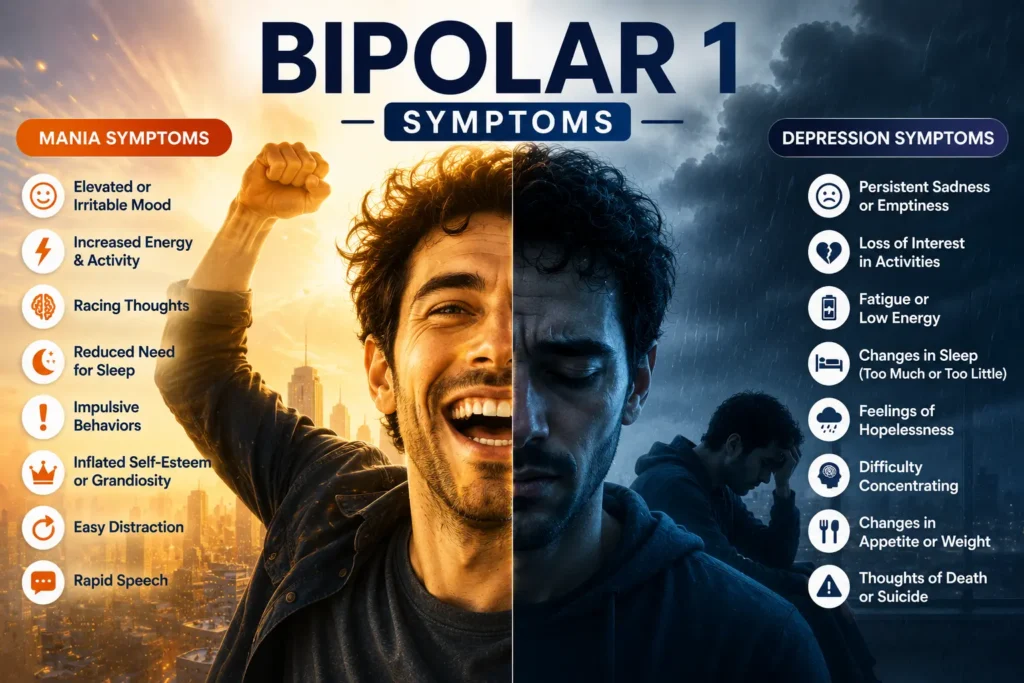
Bipolar 1 symptoms disorder is defined by at least one full manic episode — a period of abnormally high energy, racing thoughts, reduced need for sleep, and impulsive behavior that lasts a week or requires hospitalization. Most people with bipolar 1 also experience major depressive episodes, and some have mixed episodes where manic and depressive symptoms happen at the same time. The severity of the manic episode is what separates bipolar 1 from bipolar 2, where hypomania (a milder form) is the ceiling.
Table of Contents
Introduction
If you’ve searched for bipolar 1 symptoms, you’re probably trying to figure out whether what you or someone you love is going through fits the pattern. Maybe there was a week of barely sleeping, spending money without thinking twice, and talking a mile a minute — followed weeks later by a crash into exhaustion and hopelessness.
That swing, from one extreme to the other, is the hallmark of bipolar 1 disorder. It’s a lifelong mental health condition, but it’s also one of the more misunderstood diagnoses in psychiatry. People often confuse it with ordinary mood swings or with bipolar 2, when in reality the two conditions differ mainly in how intense the “up” episodes get.
This guide breaks down exactly what bipolar 1 symptoms look like during mania, depression, and mixed states, how clinicians recognize them, and which warning signs mean it’s time to get help immediately. For a broader introduction to the condition itself, see our guide on what bipolar disorder is and what bipolar 1 means specifically.
Key Takeaways
- A single manic episode lasting seven days (or requiring hospital care) is enough to diagnose bipolar 1.
- Depressive episodes are common in bipolar 1 but are not required for diagnosis, unlike bipolar 2.
- Symptoms fall into three episode types: manic, depressive, and mixed.
- Psychotic features (delusions or hallucinations) can occur during severe mania or depression in bipolar 1, something bipolar 2 does not include.
- Warning signs like reckless spending, no need for sleep, grandiosity, or suicidal thinking need prompt evaluation.
- The specific symptom pattern, not just the mood swing itself, is what a mental health professional uses to diagnose bipolar 1 — see our full bipolar 1 diagnosis guide for that process.
What Bipolar 1 Disorder Is (Briefly)
Bipolar 1 is one of several conditions on the bipolar spectrum, sitting alongside bipolar 2 and cyclothymia. What sets it apart is the presence of full mania rather than the milder hypomania seen in bipolar 2. For a side-by-side breakdown of every subtype, our guide to the types of bipolar disorder covers cyclothymia and other variants in more depth than we will here.
According to the American Psychiatric Association’s DSM-5, bipolar 1 is diagnosed based on the presence of at least one manic episode, regardless of whether depressive episodes have ever occurred. That single detail is the reason two people can both be told they have bipolar 1 while having very different day-to-day experiences.
The Three Types of Episodes in Bipolar 1
Bipolar 1 symptoms show up in distinct episodes rather than as a constant, steady mood. Understanding each type helps explain why the disorder can look so different from one person, or one year, to the next.
| Episode Type | Core Feature | Minimum Duration |
| Manic episode | Abnormally elevated, expansive, or irritable mood with high energy | 7 days, or any length if hospitalization is needed |
| Depressive episode | Persistent low mood or loss of interest/pleasure | 2 weeks |
| Mixed features | Manic and depressive symptoms occurring in the same episode | Varies |
Manic Episode Symptoms
Mania is the defining feature of bipolar 1. It’s more than just feeling “up” or energetic — it’s a noticeable, often disruptive shift from a person’s usual behavior that other people typically notice too.
Common symptoms during a manic episode include:
- Inflated self-esteem or grandiosity (feeling unusually powerful, talented, or important)
- Decreased need for sleep — feeling rested after just a few hours
- Talking more than usual, or feeling pressure to keep talking
- Racing thoughts or the sense that ideas are moving too fast to keep up with
- Being easily distracted by unimportant things
- A jump in goal-directed activity, whether at work, socially, or sexually
- Risky, impulsive behavior — reckless spending, sudden business decisions, unsafe driving, or impulsive sexual activity
For a manic episode to count toward a bipolar 1 diagnosis, these symptoms need to last at least a week and cause noticeable problems in daily functioning, or be severe enough that hospitalization is required. In severe cases, mania can include psychotic features such as delusions of special power or paranoid hallucinations.
Depressive Episode Symptoms
While not required for a bipolar 1 diagnosis, depressive episodes are common and, for many people, they last longer and are harder to live with than the manic episodes. Symptoms mirror those of major depressive disorder and can include:
- Persistent sadness, emptiness, or hopelessness
- Loss of interest in activities once enjoyed
- Significant weight or appetite changes
- Sleeping too much or too little
- Fatigue or loss of energy nearly every day
- Feelings of worthlessness or excessive guilt
- Difficulty concentrating or making decisions
- Recurrent thoughts of death or suicide
These symptoms typically need to last at least two weeks and represent a clear change from a person’s usual functioning.
Mixed Features
Some episodes don’t fit neatly into “manic” or “depressive.” A person can feel simultaneously wired and hopeless — racing thoughts and high energy alongside despair, guilt, or suicidal thinking. The DSM-5 recognizes this as a “with mixed features” specifier, and it tends to carry a higher risk of impulsive, self-destructive behavior than either pure mania or pure depression.
Bipolar 1 Symptoms at a Glance
| Symptom Category | Mania | Depression |
| Mood | Euphoric, expansive, or irritable | Sad, empty, hopeless |
| Energy | Increased, restless | Low, fatigued |
| Sleep | Little need for sleep | Oversleeping or insomnia |
| Speech/thoughts | Fast talking, racing thoughts | Slowed thinking, poor concentration |
| Self-view | Inflated confidence, grandiosity | Worthlessness, guilt |
| Behavior | Impulsive, risk-taking | Withdrawn, low motivation |
| Possible severe features | Delusions, hallucinations | Suicidal thoughts, psychotic depression |
How Bipolar 1 Symptoms Differ From Bipolar 2
This is one of the most common points of confusion. Both conditions include depressive episodes, but bipolar 2 never reaches full mania — it caps out at hypomania, a shorter and less disruptive version of an “up” episode. If you’re trying to work out which pattern fits your own experience, our detailed comparison of bipolar 1 vs 2 symptoms and this side-by-side chart lay it out visually. There’s also a dedicated breakdown of the core differences between bipolar 1 and 2 if you want the full picture beyond just symptoms.
A few quick distinctions worth knowing:
- Hypomania (bipolar 2) doesn’t usually require hospitalization; mania (bipolar 1) sometimes does.
- Psychotic features can occur in bipolar 1 but not in a hypomanic episode.
- Bipolar 2 requires at least one major depressive episode for diagnosis; bipolar 1 does not.
It’s also worth knowing that hypomania doesn’t naturally progress into full mania over time in every case — for more on that, see can bipolar 2 become bipolar 1. If cyclothymia is also on your radar, our guide comparing bipolar 1 vs 2 vs cyclothymia explains where that milder, chronic pattern fits in.
Do Symptoms Look Different in Men and Women?
Some research suggests men with bipolar 1 tend to experience manic episodes more prominently, while women may report more depressive episodes and mixed features over their lifetime, though individual experiences vary widely. We cover this in more depth, including how symptom timing and rapid cycling patterns differ, in our guide on bipolar 1 vs 2 in men and women.
Myths vs Facts About Bipolar 1 Symptoms
| Myth | Fact |
| “Bipolar just means moody or unpredictable.” | Bipolar 1 involves distinct, sustained episodes of mania and depression, not quick mood changes throughout a day. |
| “Everyone with bipolar 1 has hallucinations.” | Psychotic features happen in some, but not all, severe manic or depressive episodes. |
| “Bipolar 1 always includes depression.” | Depression is common but not required for a bipolar 1 diagnosis — one manic episode is enough. |
| “Mania feels good, so it’s not really a problem.” | Mania often leads to job loss, financial harm, damaged relationships, or hospitalization. |
| “Medication cures bipolar 1.” | There’s no cure, but treatment can effectively manage symptoms long-term. |
For a longer list of misconceptions, our dedicated page on bipolar disorder myths goes deeper than we can here.
Warning Signs That Need Attention
Certain symptoms signal that a manic or depressive episode is becoming dangerous rather than just uncomfortable. Watch for:
- Not sleeping for several days without feeling tired
- Spending sprees, risky investments, or giving away money impulsively
- Grandiose beliefs (believing you have special powers, connections, or destiny)
- Hallucinations or delusional thinking
- Extreme irritability or aggression
- Talk of death, suicide, or feeling like a burden to others
- Sudden withdrawal from everyone and everything
When to Get Emergency Help
If someone is expressing suicidal thoughts, talking about wanting to die, or showing signs of psychosis (such as hearing voices or acting on delusional beliefs), this is a mental health emergency.
- In the U.S., call or text 988 (Suicide & Crisis Lifeline) any time, day or night.
- If there’s immediate danger, call 911 or go to the nearest emergency room.
- Outside the U.S., contact local emergency services or a regional crisis line.
Don’t wait for a “worse” moment to reach out. Early intervention during a manic or depressive episode can prevent serious harm.
Causes and Risk Factors (Brief Overview)
Bipolar 1 symptoms arise from a mix of genetic, neurological, and environmental factors — it’s rarely caused by one single thing. Family history is one of the strongest known risk factors. We explore the biological and environmental contributors in full in our guide to bipolar disorder causes.
How Bipolar 1 Is Diagnosed (Brief Overview)
Diagnosis relies on a clinical interview, a detailed history of mood episodes, and DSM-5 criteria rather than a blood test or brain scan. A psychiatrist or psychologist will typically ask about episode duration, severity, and impact on functioning. If you want to understand what that evaluation process actually involves, read our full bipolar disorder diagnosis guide, or try our bipolar 1 vs 2 symptom self-check quiz as a starting point (not a substitute for a professional evaluation). There’s also a more targeted bipolar 1 vs 2 test and a diagnosis-specific comparison at bipolar 1 vs 2 diagnosis.
How Bipolar 1 Is Treated (Brief Overview)
Treatment usually combines mood-stabilizing medication with psychotherapy and lifestyle management. Because treatment plans are complex and highly individual, we’ve dedicated a full guide to it: bipolar disorder treatment, plus a comparison of bipolar 1 vs 2 treatment approaches if you’re trying to understand how care differs between the two.
Possible Complications
Left unmanaged, bipolar 1 symptoms can lead to job loss, relationship strain, financial hardship, substance use, or legal trouble from impulsive decisions made during mania. For a full breakdown, see our guide on bipolar disorder complications.
Outlook and Long-Term Prognosis
With consistent treatment, many people with bipolar 1 lead stable, productive lives, though episodes can recur over a lifetime. Our bipolar disorder prognosis guide covers what affects long-term outcomes in more detail, including how depressive symptom severity compares between bipolar 1 and 2 in our bipolar 1 vs 2 depression comparison.
How Common Are These Symptoms?
Bipolar 1 affects roughly 1% of adults in the U.S. at some point in their lives, according to National Institute of Mental Health estimates, with onset most commonly occurring in the late teens or early twenties. For more detailed prevalence data, see our bipolar disorder statistics page.
Frequently Asked Questions
What is the first sign of bipolar 1 disorder? Often it’s a noticeable drop in the need for sleep combined with a sudden burst of energy, confidence, or talkativeness that stands out from a person’s usual behavior.
Can you have bipolar 1 without depression? Yes. A bipolar 1 diagnosis only requires one manic episode; depressive episodes are common but not mandatory.
How long does a manic episode last? By DSM-5 criteria, at least seven days, or any duration if hospitalization becomes necessary. Untreated episodes can sometimes last longer.
Is bipolar 1 worse than bipolar 2? “Worse” depends on the person — bipolar 1 involves more intense highs, but bipolar 2 often involves more time spent in depression. Our guide on which is worse, bipolar 1 or 2 unpacks this comparison directly.
Can bipolar 1 symptoms appear suddenly? A manic episode can develop over just a few days, especially the first one, which is why it can catch people and their families off guard.
Do bipolar 1 symptoms get worse with age? Not necessarily, but untreated or poorly managed bipolar 1 can lead to more frequent or severe episodes over time, which is why early, consistent treatment matters.
Can children show bipolar 1 symptoms? Bipolar 1 can occur in adolescents, though diagnosis in children is complex and often requires a specialist familiar with pediatric mood disorders.
For more terminology explained simply, our bipolar disorder glossary is a useful reference, and our compiled bipolar 1 vs 2 FAQs page answers even more comparison-specific questions.
Summary
Bipolar 1 symptoms center on one defining feature: at least one full manic episode, marked by high energy, reduced need for sleep, grandiosity, and impulsive behavior. Depressive episodes often accompany it, and mixed features can blend both extremes together. Recognizing these patterns early, and knowing the warning signs that call for emergency help, makes a real difference in outcomes. If any of this sounds familiar, the next step is a conversation with a psychiatrist or licensed mental health professional — not a self-diagnosis. For a deeper look at the condition as a whole, start with our guide on bipolar 1.
This article is for educational purposes and is not a substitute for professional medical advice. If you or someone you know is in crisis, contact 988 (U.S.) or your local emergency services immediately.