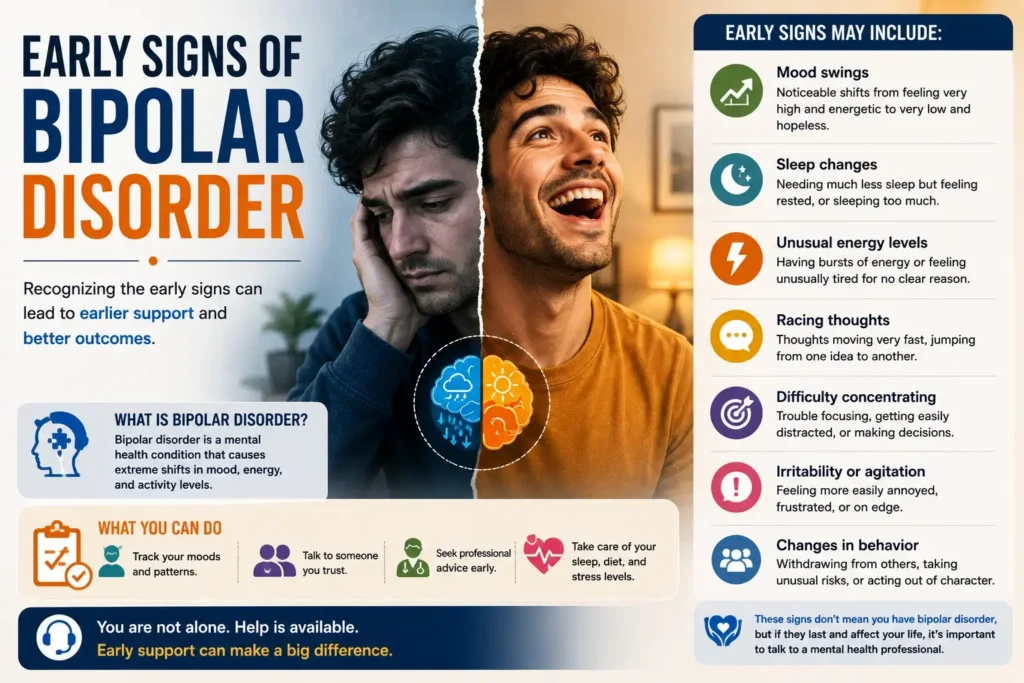
Early signs of bipolar disorder are usually subtler than a full manic or depressive episode. They often include noticeable shifts in sleep need, brief stretches of unusually high energy or irritability, uncharacteristic impulsiveness, or short periods of low mood and withdrawal — changes a person’s close family or friends may notice before the person does. These early or “first” signs don’t always meet full diagnostic criteria yet, which is exactly why they get dismissed as stress, personality, or a phase. For the complete clinical symptom picture once a pattern is established, see our full guide to bipolar disorder symptoms and bipolar symptoms.
Table of Contents
Introduction
Most people don’t get diagnosed with bipolar disorder the first time something feels off. They get diagnosed years later, often after several episodes, sometimes after a crisis. Research summarized by the National Institute of Mental Health and reflected in clinical literature points to a real gap between when symptoms first appear and when a proper diagnosis happens — and early signs are a big part of why.
This isn’t because early signs are invisible. It’s because they look like other things. A few nights of barely sleeping and feeling unstoppable can look like ambition. A stretch of irritability and short temper can look like stress. A dip into low energy and withdrawal can look like a rough patch. Individually, none of these ring an alarm bell. Together, over time, they can be the first thread of a bigger pattern.
This guide walks through what early bipolar signs actually look like — in the years, months, and weeks before a first full episode — how they differ across age groups, and what to do if you’re noticing this pattern in yourself or someone close to you. For the broader condition itself, see bipolar disorder and what bipolar disorder is.
Key Takeaways
- Early signs of bipolar disorder are often mild versions of the mood, sleep, and energy changes seen in full episodes.
- These signs frequently appear years before a formal diagnosis.
- Subtle hypomanic-like signs are especially easy to miss because they can feel productive or pleasant.
- Family history is one of the strongest predictors of who is likely to develop the condition.
- Early signs can look different in teenagers than in adults.
- Getting an evaluation early — rather than waiting for a full-blown episode — is linked to better long-term outcomes.
- A proper diagnosis still requires an assessment by a mental health professional.
Why Early Signs Are Easy to Miss
Bipolar disorder doesn’t usually announce itself with a dramatic first episode out of nowhere. More often, there’s a build-up — subtle shifts that don’t yet meet the duration or severity thresholds used in the DSM-5, the American Psychiatric Association’s diagnostic manual. A manic episode, for instance, requires symptoms lasting at least a week; hypomania requires at least four days. Early signs can show up as shorter, milder versions that never quite cross that line — at least not yet.
That’s what makes them tricky. They can be explained away: “I’ve just been stressed,” “I’m naturally a night owl,” “it’s just finals season.” Some early signs even feel good — extra confidence, extra energy, extra productivity — so there’s little reason to flag them as a problem. This is one reason Bipolar 2, which involves hypomania rather than full mania, tends to take even longer to diagnose than Bipolar 1.
Early Warning Signs: Mood and Emotional Changes
- Mood swings that feel more intense or last longer than what friends describe experiencing
- Irritability or a short fuse that seems disproportionate to the situation
- Sudden bursts of unusual optimism, confidence, or a feeling of being “on top of the world”
- Brief stretches of sadness, hopelessness, or tearfulness that come and go without an obvious trigger
- Mood that feels disconnected from what’s actually happening in someone’s life
Early Warning Signs: Sleep and Energy Changes
Sleep is often one of the earliest and most reliable signals. Watch for:
- Needing noticeably less sleep than usual while still feeling energetic
- Racing thoughts at night that make it hard to “switch off”
- Sudden bursts of restless or nervous energy
- Alternating with stretches of oversleeping and low motivation
Because sleep disruption can both signal and trigger mood episodes, it’s worth tracking closely. We cover this relationship in more depth in mania and sleep.
Early Warning Signs: Behavior and Judgment
- Uncharacteristic impulsiveness — unplanned purchases, sudden decisions, or impulsive social or romantic choices
- Talking faster than usual or jumping between topics
- Taking on far more projects or commitments than usual, then struggling to follow through
- Withdrawing from friends, family, or usual activities for no clear reason
- Increased use of alcohol or other substances, sometimes as an attempt to manage mood
Early Signs Table: Subtle vs Full Episode
| Symptom Area | Early / Subtle Sign | Full Episode Version |
| Sleep | Slightly less sleep, still functional | Days with almost no sleep, no fatigue |
| Mood | Mild irritability or brief euphoria | Sustained elevated or irritable mood, 4+ days |
| Energy | Bursts of restlessness | Constant, driven activity |
| Judgment | Occasional impulsive choice | Repeated risky decisions (spending, driving, sex) |
| Speech/Thought | Talking a bit faster | Rapid speech, racing thoughts, hard to interrupt |
| Low mood | Brief low patches, days | Persistent low mood, 2+ weeks, with other symptoms |
This table is a starting reference, not a diagnostic tool. A full breakdown of clinical criteria for each episode type is available in our bipolar disorder symptoms guide, and the difference between mild and severe “up” states is explained fully in mania vs hypomania.
Early Signs in Teenagers and Young Adults
Bipolar disorder often first appears in the late teens or early twenties. In younger people, early signs can look a bit different from the adult pattern:
- Increased irritability or explosive reactions, more than euphoria
- Sudden academic decline or difficulty concentrating
- Big changes in sleep patterns, including staying up much later than peers
- Risk-taking that goes beyond typical adolescent experimentation
- Periods of intense sadness or social withdrawal alternating with high energy
Diagnosing bipolar disorder in adolescents is more complex, since normal teenage mood variability can overlap with early symptoms. A specialist experienced in adolescent mental health is best positioned to tell the difference. For a look at how early presentation may connect to family patterns, see bipolar disorder causes and causes of mania.
Risk Factors That Make Early Signs More Significant
Not every mood swing warrants concern, but certain factors raise the likelihood that early signs reflect the start of bipolar disorder rather than ordinary stress:
- A first-degree relative (parent or sibling) with bipolar disorder or another mood disorder
- A prior episode of depression, especially one with unusual features like rapid onset or atypical symptoms
- Onset of mood symptoms during adolescence or early adulthood
- Significant sleep disruption preceding a mood shift
- A history of mood episodes triggered without a clear external cause
For the full picture of what increases risk, see our dedicated bipolar disorder causes article and our overview of types of bipolar disorder, since risk factors can vary slightly depending on which type eventually develops.
Myths vs Facts About Early Signs
| Myth | Fact |
| “If it’s not a full manic episode, it’s not bipolar-related.” | Early, milder signs can precede a first full episode by months or years. |
| “Feeling great and productive can’t be an early warning sign.” | Unusually elevated energy or confidence can be an early hypomanic-like sign, especially if it’s out of character. |
| “Bipolar disorder always starts with mania.” | It can start with a depressive episode, sometimes years before any elevated mood appears. |
| “Teenagers are just moody — it’s never a sign of anything.” | While normal teen mood swings are common, a distinct pattern of extreme, sustained shifts is worth having evaluated. |
A broader myth-busting resource is available at bipolar disorder myths.
When Early Signs Point to Bipolar 1 vs Bipolar 2
Early signs can hint at which type may be developing, though only a clinical evaluation can confirm this:
- Signs that include intense, days-long high-energy states with little need for sleep — sometimes with risky or reckless behavior — lean toward the pattern eventually seen in Bipolar 1.
- Signs that are milder, shorter, and don’t cause major disruption — a few good, highly energetic days followed by a crash — often resemble the Bipolar 2 pattern, since that diagnosis centers on hypomania rather than full mania.
We compare these patterns side by side in Bipolar 1 vs Bipolar 2, our Bipolar 1 vs 2 symptoms breakdown, and the visual Bipolar 1 vs 2 chart.
Warning Signs That Need Immediate Attention
Some signs should never wait for a scheduled appointment. Seek help right away if you notice:
- Any talk of suicide, self-harm, or feeling like a burden
- Signs of psychosis — hearing or seeing things others don’t, or strongly held false beliefs
- Extremely reckless behavior that puts someone’s safety at risk
- A combination of high energy and hopelessness at the same time (possible mixed features)
If you or someone you know is having thoughts of suicide, contact the 988 Suicide & Crisis Lifeline (call or text 988 in the US) or your local emergency number right away. This is a sensitive area — if you’re personally struggling, please reach out to a crisis line or a trusted professional rather than handling it alone.
What to Do If You Notice These Signs
- Track the pattern. Write down mood, sleep, and energy changes over a few weeks. Patterns are more informative than single incidents.
- Talk to someone you trust. A family member or close friend may have noticed things you haven’t.
- Book an evaluation. A primary care doctor can be a starting point, but a psychiatrist or psychologist is best equipped to assess mood disorder symptoms specifically.
- Be honest about family history. Mentioning a parent or sibling with bipolar disorder or depression gives your provider important context.
- Don’t wait for a crisis. Getting evaluated after noticing early signs — rather than after a severe episode — is associated with earlier, more effective treatment.
For what that evaluation actually involves, see our full bipolar disorder diagnosis guide. If you want a low-stakes starting point to organize your thoughts before an appointment, our Bipolar 1 vs 2 test and Bipolar 1 vs 2 quiz can help — though neither replaces a professional assessment.
Why Early Recognition Matters
Catching early signs isn’t about labeling every mood swing. It’s about giving someone the chance to get support before symptoms escalate into a full episode that disrupts work, relationships, or safety. Earlier treatment is generally linked to better symptom management and fewer complications over time — a connection we explore further in bipolar disorder complications and bipolar disorder prognosis.
Checklist: Should You Get Evaluated?
- [ ] Noticeable shifts in sleep need lasting several days, without an obvious cause
- [ ] Periods of unusual energy, confidence, or irritability that feel out of character
- [ ] Brief stretches of low mood or withdrawal, separate from the high-energy periods
- [ ] Impulsive decisions you or others have flagged as unusual for you
- [ ] A family history of bipolar disorder, depression, or other mood disorders
- [ ] Friends or family have commented that “something seems different” about your mood or energy
- [ ] These patterns have repeated more than once
If several of these apply, it’s reasonable to bring them up with a healthcare provider — not because they confirm a diagnosis, but because they’re worth discussing.
Frequently Asked Questions
What is usually the very first sign of bipolar disorder? There’s no single universal first sign, but sleep changes — needing less sleep while still feeling energetic — and noticeable shifts in mood or irritability are commonly among the earliest signs reported.
Can bipolar disorder start with depression instead of mania? Yes. Many people experience a depressive episode well before their first hypomanic or manic episode, which is one reason early bipolar disorder is sometimes initially diagnosed as unipolar depression.
How early can bipolar disorder show up? Symptoms can begin in the teenage years or early adulthood, though the pattern often isn’t recognized as bipolar disorder until later, after more episodes accumulate.
Are mild early signs the same as hypomania? Not necessarily. True hypomania meets specific duration and symptom criteria. Early signs may be milder or shorter versions that don’t yet meet that threshold, though they can still be worth monitoring.
Is it possible to have early signs and never develop full bipolar disorder? Yes. Not everyone with mood variability or occasional high-energy periods goes on to develop bipolar disorder. That’s exactly why a professional evaluation — rather than self-diagnosis — matters.
Can early signs run in families? Family history is one of the more consistently identified risk factors for bipolar disorder, so a relative’s diagnosis is a relevant detail to share with a provider, even if it doesn’t guarantee anything on its own.
Should I wait until symptoms get worse before seeking help? No. Seeking an evaluation when early signs appear — rather than waiting for a severe episode — is generally associated with earlier intervention and better long-term management.
Summary
Early signs of bipolar disorder rarely look like the dramatic episodes people picture. They tend to show up as subtler shifts in sleep, mood, energy, and judgment — changes that are easy to explain away until a pattern becomes clear. Paying attention to that pattern, especially alongside risk factors like family history, is the most useful thing you can do before things escalate. If this sounds familiar, the next right step isn’t self-diagnosis — it’s a conversation with a mental health professional who can look at the full picture.
For deeper reading, see our guides on bipolar disorder statistics, our bipolar disorder glossary for unfamiliar terms, or our comparison of Bipolar 1 vs 2 which is worse if you’re trying to understand severity differences between types.
This article is for educational purposes and is not a substitute for a professional diagnosis. If you are experiencing thoughts of suicide or self-harm, please contact the 988 Suicide & Crisis Lifeline (call or text 988) or your local emergency services immediately.