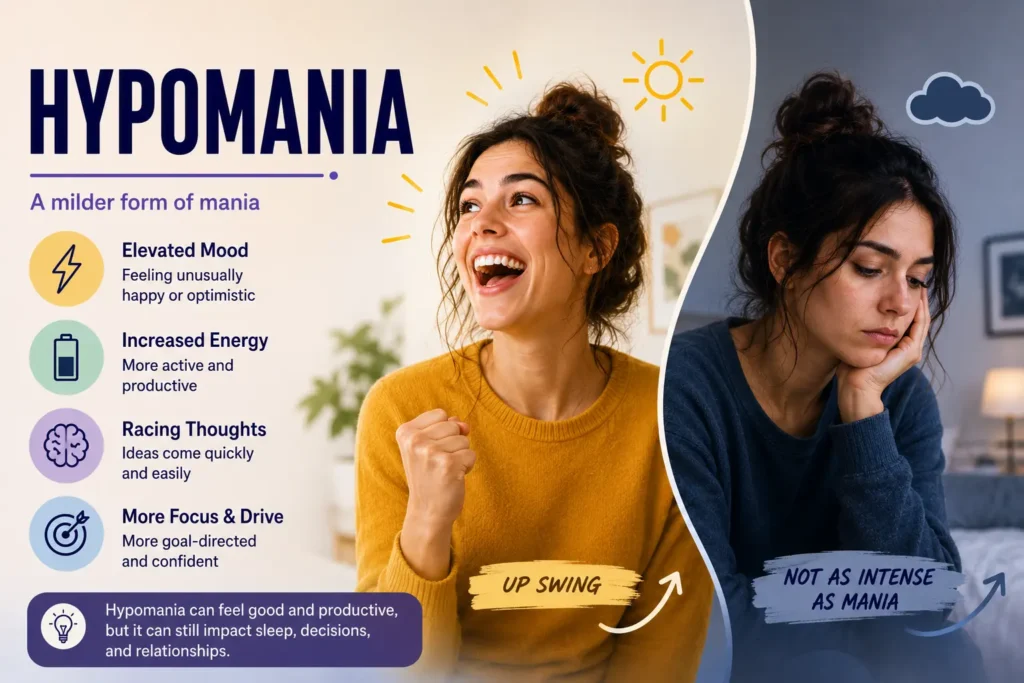
Hypomania is a distinct period of elevated, expansive, or irritable mood and increased energy that lasts at least four days — noticeably different from a person’s usual self, but not severe enough to cause major impairment, psychosis, or hospitalization. It’s the defining feature of bipolar 2 disorder and is often mistaken for simply having a good week, which is part of what makes it easy to miss. Unlike full mania, hypomania doesn’t include hallucinations or delusions, and people can usually still function at work and in relationships during an episode — though not without consequences. If these patterns sound familiar, or you’re noticing them alongside periods of depression, a mental health professional can help clarify what’s going on.
Table of Contents
Key Takeaways
- Hypomania is a milder, shorter version of mania that lasts at least four consecutive days.
- It’s the hallmark episode of bipolar 2 disorder, distinguishing it from bipolar 1.
- Symptoms include elevated mood, less need for sleep, rapid speech, and increased confidence — without psychosis.
- Because it can feel productive or even pleasant, hypomania is frequently missed or misread as a “good mood.”
- Left unaddressed, hypomania can still lead to impulsive decisions and often precedes or follows depressive episodes.
- Diagnosis relies on clinical history, not lab tests, and treatment usually combines medication with therapy.
What Is Hypomania?
Hypomania is a clinical term for a sustained shift in mood and energy that’s clearly different from a person’s baseline — but doesn’t spiral into the severe disruption seen in full mania. Under the DSM-5, a hypomanic episode requires an abnormally elevated, expansive, or irritable mood plus increased activity or energy, present most of the day, nearly every day, for at least four consecutive days.
The catch is that hypomania often doesn’t feel like a problem while it’s happening. People describe it as feeling unusually sharp, confident, sociable, or productive. That’s exactly why it’s under-recognized — it doesn’t look like illness from the inside, and sometimes not even from the outside.
Hypomania is the defining episode type in bipolar 2 disorder, which is why understanding it matters for accurate diagnosis. If you want the broader picture of how bipolar disorder is classified, our guide on types of bipolar disorder lays out how bipolar 1, bipolar 2, and cyclothymia relate to each other, and our bipolar 1 vs bipolar 2 comparison goes deeper into how these two conditions differ overall.
Hypomania vs. Mania
These two are related but clinically distinct, and the difference changes both diagnosis and treatment.
| Feature | Hypomania | Mania |
| Minimum duration | 4 days | 7 days (or any length if hospitalized) |
| Functional impairment | Noticeable but manageable | Severe — disrupts work, relationships, safety |
| Psychosis possible? | No | Yes |
| Hospitalization needed? | Rarely | Often |
| Associated diagnosis | Bipolar 2 | Bipolar 1 |
For a full breakdown of manic episodes specifically, see our dedicated mania guide and bipolar 1 manic episodes page. For a side-by-side visual comparison across both conditions, our bipolar 1 vs 2 chart and bipolar 1 vs 2 symptoms pages are useful next steps.
Symptoms of Hypomania
The DSM-5 requires at least three of the following symptoms (four if mood is only irritable) alongside the mood change, sustained for four or more days.
| Category | Symptom | What It Looks Like |
| Mood | Elevated or irritable mood | Unusually upbeat, confident, or easily agitated |
| Energy | Increased goal-directed activity | Tackling multiple tasks or projects with unusual drive |
| Sleep | Decreased need for sleep | Feeling rested on far less sleep than normal |
| Speech | Talkativeness | Speaking more, faster, or more animatedly than usual |
| Thought | Racing thoughts | Ideas moving quickly, jumping between topics |
| Self-view | Inflated self-esteem | Increased confidence, sometimes bordering on overconfidence |
| Attention | Distractibility | Trouble focusing on one thing at a time |
| Judgment | Increased risk-taking | Impulsive spending, decisions, or social behavior |
Unlike mania, hypomania never includes hallucinations or delusions. If psychotic symptoms are present, the episode is classified as mania, not hypomania — a key distinction covered in more detail in our mania article.
What a Hypomanic Episode Can Feel Like
Because hypomania is often subtle, it helps to see it in context:
- Someone takes on three new projects at work in one week and finishes all of them, feeling unstoppable.
- A person becomes the center of every conversation at a gathering, more talkative and confident than usual.
- Someone starts a home renovation, a new hobby, and a fitness plan all in the same week, sleeping four hours a night without feeling tired.
- A person makes a large purchase impulsively, feeling certain it’s the right call, and reconsiders it days later.
Family and friends often notice hypomania before the person does — this is one reason outside observations matter during diagnosis.
What Causes Hypomania?
Hypomania shares the same underlying drivers as mania, just expressed with less intensity. Research points to a mix of biological, genetic, and environmental factors.
| Contributing Factor | How It Plays a Role |
| Genetics | A family history of bipolar disorder raises risk substantially |
| Brain chemistry | Imbalances in neurotransmitters like dopamine and serotonin |
| Sleep disruption | Reduced or irregular sleep is a common trigger |
| Stress | Both negative and positive major life changes can trigger episodes |
| Substance use | Stimulants and alcohol can bring on or worsen symptoms |
| Antidepressant use | Can trigger hypomania in people with an underlying bipolar vulnerability |
| Seasonal changes | Some people notice a seasonal pattern to their episodes |
For the fuller explanation of the biology and risk factors behind bipolar disorder overall, our bipolar disorder causes and bipolar 2 causes guides go into more depth than is needed here.
Risk Factors
- A family history of bipolar disorder, particularly bipolar 2
- A personal history of depressive episodes
- Major disruptions to sleep schedule (travel, shift work, new parenthood)
- Starting an antidepressant without a mood stabilizer
- High-stress or high-stimulation life events
- Substance use, especially stimulants
How Hypomania Is Diagnosed
There’s no lab test for hypomania — diagnosis depends entirely on a clinical evaluation. A psychiatrist or psychologist typically looks at:
- Duration and pattern of mood changes, matched against DSM-5 criteria
- Whether symptoms represent a clear change from the person’s usual functioning
- Input from family or close friends, since people often don’t recognize their own hypomania
- A history of depressive episodes, since hypomania alone (without depression) doesn’t meet criteria for bipolar 2
- Ruling out other causes, including thyroid conditions, substance use, and medication effects
Because hypomania can feel good rather than distressing, people often don’t seek help until a depressive episode follows — which is part of why bipolar 2 is frequently diagnosed later than bipolar 1. Our bipolar disorder diagnosis and bipolar 2 diagnosis guides walk through what that evaluation process looks like in practice.
Hypomania vs. Other Conditions
| Condition | Key Difference From Hypomania |
| Normal good mood | Doesn’t involve reduced sleep need, racing thoughts, or impulsivity for days at a time |
| ADHD | Chronic and consistent, not episodic with a clear start and end |
| Anxiety | Restlessness driven by worry rather than elevated mood or confidence |
| Mania | More severe, longer-lasting, and can include psychosis |
| Cyclothymia | Involves numerous milder hypomanic and depressive symptoms over a longer timeframe without meeting full episode criteria — see our bipolar 1 vs 2 vs cyclothymia comparison |
Treatment for Hypomania
Hypomania is treatable, and effective management focuses on preventing escalation and reducing the depressive episodes that often follow.
Medications
| Medication Type | Examples (Class) | Purpose |
| Mood stabilizers | Lithium, lamotrigine | First-line treatment for long-term mood stability |
| Atypical antipsychotics | Quetiapine, lurasidone | Used in some cases, especially with mixed features |
| Antidepressant caution | SSRIs, SNRIs | Used carefully and typically alongside a mood stabilizer to avoid triggering hypomania |
Medication choices are individualized and should always involve a psychiatrist familiar with bipolar 2. Our bipolar disorder treatment and bipolar 2 treatment pages cover dosing considerations and treatment planning in full.
Therapy
- Cognitive behavioral therapy (CBT): Builds awareness of early mood shifts and challenges impulsive thinking patterns.
- Interpersonal and social rhythm therapy (IPSRT): Stabilizes daily routines and sleep, both strongly tied to episode frequency.
- Psychoeducation: Helps people and families recognize hypomania’s subtle signs before they escalate.
Lifestyle Tips
- Keep a consistent sleep and wake schedule, even on weekends
- Track mood daily to catch early shifts before they build momentum
- Limit alcohol and stimulant use
- Build a plan with a trusted person who can flag early signs objectively
- Avoid major decisions during a suspected episode until mood stabilizes
Warning Signs an Episode May Be Building
- Sleeping less without feeling tired
- Talking faster or more than usual
- Feeling unusually confident or “on top of the world”
- Starting several new projects or plans at once
- Increased impulsivity in spending or decision-making
- Friends or family commenting that you “seem different” lately
When to Seek Help Right Away
Hypomania itself is rarely a medical emergency, but seek prompt professional support if:
- Hypomanic symptoms escalate — worsening sleep loss, growing recklessness, or any signs of psychosis, which would indicate mania instead
- Impulsive decisions are causing serious financial, legal, or relational harm
- A depressive episode follows, especially with thoughts of self-harm
If you or someone you know is having thoughts of self-harm or suicide, contact emergency services immediately, or in the U.S., call or text 988 to reach the Suicide & Crisis Lifeline, available 24/7.
Myths vs. Facts About Hypomania
| Myth | Fact |
| Hypomania is just a good mood | It’s a distinct clinical episode with measurable changes in sleep, thought, and behavior |
| Hypomania isn’t serious since it doesn’t need hospitalization | It can still cause real harm and often precedes depressive episodes |
| Only bipolar 1 requires treatment | Bipolar 2, defined by hypomania and depression, also requires ongoing treatment |
| People always know when they’re hypomanic | Insight is often limited; family and friends notice it first |
| Hypomania feels bad | Many people describe it as pleasant, which is part of why it’s under-treated |
For more misconceptions addressed at the disorder level, see our bipolar disorder myths guide.
Complications of Untreated Hypomania
- Impulsive financial, legal, or relational decisions
- Increased risk of a depressive episode following the high
- Strained relationships from unpredictable mood shifts
- Delayed diagnosis of bipolar 2, since hypomania is easy to overlook
- Greater frequency of mood episodes over time without treatment
Our bipolar disorder complications guide covers these risks across bipolar disorder as a whole.
Outlook and Long-Term Management
With consistent treatment, people with bipolar 2 and recurring hypomania typically achieve good long-term stability. Because hypomania can be pleasant, staying engaged with treatment sometimes requires extra motivation — but consistent medication and routine substantially reduce both hypomanic and depressive episodes over time.
For a fuller look at what long-term outcomes tend to look like, see our bipolar disorder prognosis and bipolar 2 prognosis guides.
Frequently Asked Questions
What triggers a hypomanic episode? Common triggers include sleep disruption, high stress (positive or negative), substance use, and starting an antidepressant without a mood stabilizer.
How long does hypomania last? By clinical definition, a hypomanic episode lasts at least four consecutive days, though it can continue longer without treatment.
Is hypomania a good thing? It can feel pleasant or productive in the moment, but it’s part of a mood disorder and often carries hidden risks, including impulsive decisions and a higher chance of a depressive episode afterward.
Can hypomania turn into full mania? In bipolar 2, episodes are defined by hypomania rather than mania. If a person experiences a full manic episode, the diagnosis shifts to bipolar 1 — our can bipolar 2 become bipolar 1 guide explains this in detail.
Does hypomania always come with depression? For a bipolar 2 diagnosis, yes — it requires at least one hypomanic episode and at least one major depressive episode. Hypomania on its own doesn’t meet full diagnostic criteria for bipolar 2.
How is hypomania different from just having a lot of energy? Hypomania involves a cluster of changes together — reduced sleep need, rapid speech, racing thoughts, and increased impulsivity — sustained for days, not just a single burst of motivation or a good mood.
Can hypomania be treated without medication? Therapy and lifestyle strategies help manage symptoms and reduce frequency, but medication, particularly mood stabilizers, is typically part of an effective long-term treatment plan.
Summary
Hypomania is a distinct, sustained period of elevated mood, increased energy, and reduced need for sleep that lasts at least four days — milder than full mania, but still a meaningful clinical episode. It’s the defining feature of bipolar 2 disorder, and because it can feel pleasant or even productive, it’s frequently overlooked until a depressive episode follows. Hypomania responds well to treatment, particularly mood stabilizers combined with therapy and consistent daily routines. If these patterns sound familiar, a mental health professional can help clarify the diagnosis and build an effective treatment plan. To see how hypomania fits into the wider picture, explore our guides on bipolar 2, bipolar 2 hypomania, and bipolar 1 vs bipolar 2.
This article is for educational purposes and is not a substitute for professional medical advice. If you or someone you know is experiencing symptoms of hypomania, mania, or depression, please consult a qualified healthcare provider.