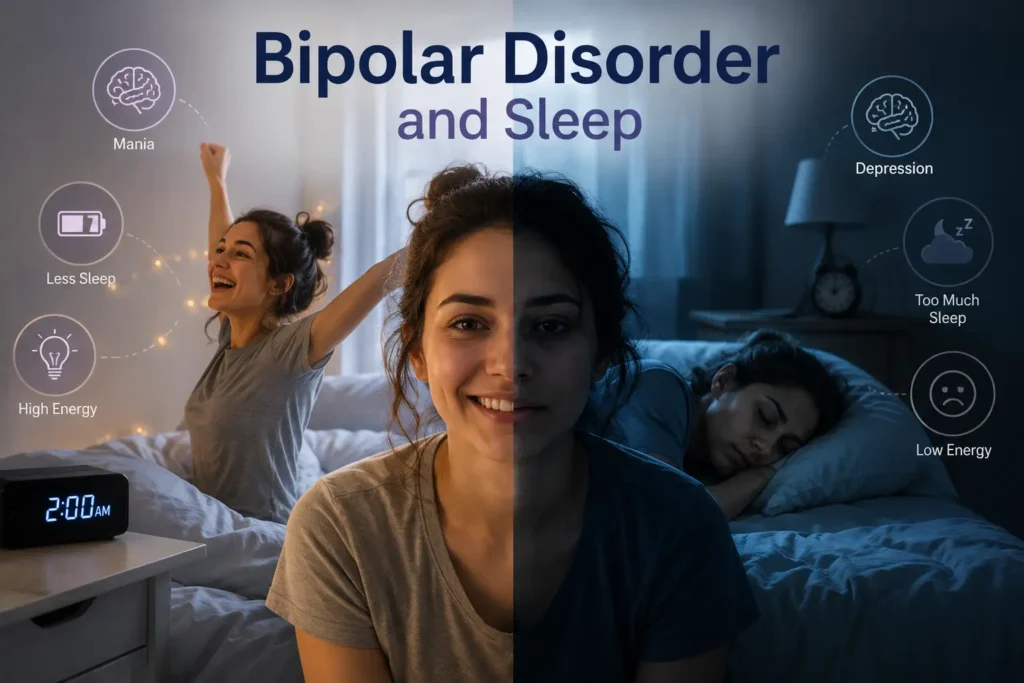
Sleep and bipolar disorder affect each other in both directions. A single night of lost sleep can trigger a manic or hypomanic episode, and mood episodes themselves — whether manic, hypomanic, or depressive — almost always change how a person sleeps. Sleep disruption isn’t just a symptom of bipolar disorder; research increasingly treats it as one of the underlying mechanisms that drives mood instability in the first place. That’s why sleep tracking, sleep hygiene, and circadian rhythm stabilization have become core parts of long-term bipolar management, alongside medication and therapy.
If you want the bigger clinical picture first, our guide to bipolar disorder covers the condition from the ground up.
Table of Contents
Key Takeaways
- Sleep problems can appear in every phase of bipolar disorder — mania, hypomania, depression, and even the stable periods in between.
- Losing sleep is one of the most reliable triggers for a manic or hypomanic episode, not just a side effect of one.
- People with bipolar disorder tend to have a naturally unstable internal body clock (circadian rhythm), which makes sleep more fragile to begin with.
- Different sleep patterns show up depending on the episode: reduced need for sleep in mania, oversleeping or insomnia in depression.
- Treatment usually combines medication, structured routines (like Interpersonal and Social Rhythm Therapy), and consistent sleep habits — not sleep hygiene alone.
- A sudden, unexplained drop in the need for sleep is a warning sign worth taking seriously, especially if it comes with racing thoughts or unusual energy.
Why Sleep and Bipolar Disorder Are So Closely Linked
Sleep isn’t a side issue in bipolar disorder — it sits close to the center of the condition. Researchers who study the biology of bipolar disorder have found that people with the condition often have a naturally less stable circadian rhythm, the internal 24-hour clock that governs when the body feels sleepy, alert, hungry, or ready to rest. This instability affects things like melatonin timing, body temperature rhythm, and the regularity of the sleep-wake cycle, even during periods when mood is stable.
That instability matters because circadian rhythm and mood regulation share overlapping brain circuitry. When one goes off track, the other tends to follow. This is part of why clinicians increasingly describe bipolar disorder as, in part, a circadian rhythm disorder rather than treating disrupted sleep as an incidental symptom.
For a full breakdown of the condition itself, including its causes and mechanisms, see our detailed guide on what is bipolar disorder and bipolar disorder causes.
The Two-Way Street
The relationship runs in both directions, and it helps to think of it as a loop rather than a one-way cause:
- Sleep disruption can trigger mood episodes. Losing even one night of sleep — through jet lag, shift work, stress, or a newborn in the house — can be enough to tip someone with bipolar disorder into mania or hypomania.
- Mood episodes disrupt sleep. Mania reduces the need for sleep. Depression often causes oversleeping or insomnia. Even mixed states scramble sleep architecture.
- Poor sleep worsens future episodes. Chronic sleep disruption is associated with more frequent relapses, longer recovery times, and reduced quality of life between episodes.
This loop is why sleep isn’t treated as an afterthought in bipolar care plans — it’s treated as a lever that can be used to help stabilize mood, or a risk factor that can destabilize it.
How Sleep Changes Across Different Bipolar Episodes
Sleep doesn’t look the same throughout bipolar disorder. It shifts depending on which phase someone is in. Recognizing these patterns helps separate ordinary tiredness from something that might need medical attention.
| Episode Type | Typical Sleep Pattern | What It Often Feels Like |
| Mania | Sharply reduced need for sleep (sometimes 2–4 hours a night) without feeling tired | Wired, energized, racing thoughts, feeling rested on almost no sleep |
| Hypomania | Reduced sleep need, less extreme than mania | More productive or social than usual, slightly restless at night |
| Bipolar depression | Oversleeping (hypersomnia) or insomnia | Struggling to get out of bed, or lying awake exhausted but unable to sleep |
| Mixed episode | Unpredictable — insomnia with agitation is common | Exhausted but too keyed up to rest |
| Euthymic (stable) phase | Often mildly irregular even without symptoms | Later bedtimes, more variable sleep timing than people without bipolar disorder |
If you’re trying to understand which phase you or someone else might be in, our guides on mania, hypomania, and mania vs. hypomania go into the distinguishing features in more depth. For a closer look at how sleep interacts specifically with manic episodes, see mania and sleep.
Common Sleep Problems in Bipolar Disorder
Not every sleep issue in bipolar disorder is episode-specific. Some patterns persist even during stable periods and deserve attention on their own.
Insomnia. Difficulty falling asleep, staying asleep, or waking too early is common across both bipolar depression and mixed states. Chronic insomnia is also one of the strongest known predictors of an upcoming mood episode.
Hypersomnia. Oversleeping, needing naps, and feeling unrefreshed after long sleep is a hallmark of bipolar depression for many people, though it’s less talked about than insomnia.
Delayed sleep phase. A tendency to fall asleep and wake up much later than is socially typical. This is more common in bipolar disorder than in the general population and can worsen mood stability by clashing with work, school, or family schedules.
Irregular sleep-wake timing. Rather than a fixed problem like insomnia, some people simply have a sleep schedule that shifts night to night. This variability itself, independent of total sleep amount, has been linked to mood symptom severity.
Nightmares and sleep talking/walking. These show up more frequently in bipolar disorder than in the general population, though they’re less discussed than insomnia or hypersomnia.
Obstructive sleep apnea. Breathing that repeatedly stops and starts during sleep is more common among people with bipolar disorder than would be expected by chance, and it can worsen daytime mood symptoms and fatigue independent of the bipolar disorder itself. This is one reason a sleep study is sometimes recommended alongside psychiatric evaluation.
Why Losing Sleep Is a Trigger, Not Just a Symptom
This is one of the most important — and most overlooked — parts of the sleep-bipolar relationship. In people prone to bipolar disorder, sleep deprivation doesn’t just make someone tired the next day. It can act as a direct trigger for mania or hypomania, sometimes within 24 to 48 hours.
This is why clinicians ask about recent sleep changes when someone reports new manic symptoms, and why protecting sleep is treated as a relapse-prevention strategy, not just a comfort measure. Situations that commonly disrupt sleep enough to act as triggers include:
- Jet lag or long-haul travel across time zones
- Shift work, especially rotating or overnight shifts
- New parenthood and infant care
- All-nighters for school or work deadlines
- Substance use, including caffeine, alcohol, and stimulants
- Acute stress or grief that interferes with falling asleep
For a broader look at what else can set off an episode, see our guide to mania triggers and causes of mania.
Building a Sleep Routine That Supports Mood Stability
General sleep hygiene advice — the kind aimed at the average insomniac — only goes partway for bipolar disorder. What tends to matter more is regularity: keeping bedtime, wake time, meals, and activity on a consistent daily schedule, because irregular timing itself appears to destabilize mood independent of total sleep hours.
Daily Habits That Support Stable Sleep
- Wake up at the same time every day, including weekends — this anchors the circadian rhythm more effectively than a fixed bedtime alone.
- Get natural light exposure soon after waking, which helps set the body’s internal clock.
- Keep a consistent wind-down routine in the hour before bed (dim lights, no screens, calming activity).
- Limit caffeine after early afternoon and be cautious with alcohol, which fragments sleep even if it initially feels sedating.
- Avoid major schedule shifts where possible — try to protect sleep timing around travel, deadlines, and irregular work shifts.
- Track sleep and mood together (a simple daily log works) so that changes in one can be caught before the other shifts too.
Dos and Don’ts at a Glance
| Do | Don’t |
| Keep a fixed wake-up time daily | Sleep in dramatically on weekends |
| Get morning sunlight exposure | Stay in dim, artificial light all day |
| Treat insomnia as an early warning sign | Dismiss a few short nights as “no big deal” |
| Talk to a prescriber before changing sleep medication | Self-medicate with over-the-counter sleep aids long-term |
| Build a consistent wind-down routine | Use screens in bed right before sleep |
| Involve a partner or family member in noticing sleep changes | Hide sleep changes from your care team |
This kind of structured routine is the foundation of Interpersonal and Social Rhythm Therapy (IPSRT), a form of psychotherapy developed specifically for bipolar disorder. IPSRT works by helping people stabilize daily routines — sleep, meals, activity, and social contact — on the theory that keeping these rhythms steady helps keep the internal circadian clock, and therefore mood, steadier too. Clinical studies have found IPSRT associated with improved circadian rhythm stability and better social functioning when used alongside standard treatment, and it’s most often introduced as an add-on to medication rather than a replacement for it.
For a wider view of talk-therapy options beyond IPSRT, see our guide to bipolar therapy and cognitive behavioral therapy for bipolar disorder.
How Bipolar Medications Affect Sleep
Medication plays a large role in stabilizing sleep in bipolar disorder, but the effect varies significantly by drug class and by individual. This is general information, not a substitute for guidance from your prescriber.
| Medication Type | Common Effect on Sleep |
| Lithium | Can help stabilize circadian rhythm over time; some people notice increased sleepiness initially |
| Quetiapine and other sedating antipsychotics | Often prescribed partly for their sedative effect, especially in depressive or mixed episodes |
| Lamotrigine | Generally less sedating; sleep effects are usually mild |
| Valproate | Can cause drowsiness, particularly when starting treatment |
| Antidepressants (used cautiously, if at all) | Effects vary; some can disrupt sleep or, in susceptible people, contribute to triggering mania |
Because sedation and insomnia both appear across different bipolar medications, changes in sleep after starting or adjusting a prescription are worth reporting to a healthcare provider rather than managing alone. For medication-specific detail, see our guides to bipolar medications, mood stabilizers for bipolar disorder, and lithium for bipolar disorder.
Myths vs. Facts About Bipolar Disorder and Sleep
| Myth | Fact |
| “Needing less sleep during mania means the person has more energy to burn.” | Reduced sleep need in mania is a symptom of the episode itself, not a sign of genuine vitality — it typically needs clinical attention. |
| “Catching up on sleep after a manic episode fixes the problem.” | Recovery sleep helps, but it doesn’t reverse the episode or prevent recurrence; ongoing routine and treatment matter more. |
| “Sleep problems in bipolar disorder are just insomnia.” | Sleep problems in bipolar disorder include insomnia, hypersomnia, delayed sleep phase, irregular timing, and sleep apnea — insomnia is only one pattern among several. |
| “Sleeping pills alone can manage bipolar-related sleep issues.” | Sleep medication may help short-term, but sustainable improvement usually requires addressing the underlying mood episode and circadian rhythm, often through a combination of medication and structured routine. |
| “Everyone with bipolar disorder has the same sleep pattern.” | Sleep patterns vary by episode type, individual, and even by bipolar subtype — see our comparison of bipolar 1 vs. bipolar 2 for how presentation differs. |
For a broader list of misconceptions about the condition, our guide to bipolar disorder myths covers more ground.
Warning Signs: When Sleep Changes Signal Something More
Occasional bad nights happen to everyone. In bipolar disorder, certain sleep changes are worth paying closer attention to because of how strongly they’re linked to oncoming episodes:
- A sudden, sustained drop in the need for sleep (feeling fully rested on 2–4 hours) without effort or intention
- Racing thoughts that keep you awake alongside a surge in energy, talkativeness, or impulsivity
- Weeks of oversleeping combined with low mood, low energy, or loss of interest in usual activities
- A rapidly shifting sleep schedule that keeps drifting later and later
- Sleep changes that appear right after a major disruption — travel, a new job schedule, a loss, or a stressful life event
None of these on their own confirm an episode, but a pattern like this is a reasonable cue to reach out to a psychiatrist, therapist, or primary care provider — sooner rather than later, since early intervention tends to shorten and soften episodes.
When to Seek Emergency Help
Most sleep-related mood changes develop over days, giving time to intervene. But some signs call for urgent care rather than a routine appointment:
- Thoughts of suicide or self-harm
- Behavior that puts the person or others at immediate risk (reckless driving, dangerous spending, aggression)
- Signs of psychosis — hallucinations, delusions, or extreme disorganized thinking — alongside little or no sleep
- A mood episode escalating rapidly over 24–48 hours with no signs of slowing
If any of these apply, contact a crisis line, go to an emergency department, or call emergency services. In the US, the 988 Suicide & Crisis Lifeline is available by call or text at any hour. This is a sensitive area, and if you’re personally going through something difficult right now, it’s worth reaching out to one of these resources directly rather than waiting it out alone.
How Sleep Fits Into Diagnosis and Ongoing Monitoring
Sleep pattern changes are part of the diagnostic picture for bipolar disorder. The DSM-5 criteria for a manic episode specifically include a “decreased need for sleep” as one of the defining symptoms — distinct from simply not getting enough sleep, since the person doesn’t feel tired despite sleeping far less than usual. Clinicians also use sleep history to help distinguish bipolar depression from unipolar depression, since the hypersomnia and evening-oriented sleep pattern seen in bipolar depression differs somewhat from typical major depressive episodes.
Beyond diagnosis, sleep tracking is often used as an ongoing monitoring tool. Because sleep changes frequently show up before mood changes become obvious to the person experiencing them or to people around them, many treatment plans include daily sleep logs or wearable sleep tracking as an early-warning system.
To understand how sleep symptoms fit into the wider diagnostic process, see our guides on bipolar disorder diagnosis and DSM-5 bipolar disorder.
Complications of Long-Term Sleep Disruption
Sleep problems that go unmanaged over years aren’t just uncomfortable — they’re associated with real downstream effects for people with bipolar disorder:
- More frequent mood episodes and shorter periods of stability between them
- Increased risk of cardiovascular disease, weight gain, and metabolic issues, particularly when sleep apnea goes undiagnosed
- Reduced cognitive function, including memory and concentration difficulties
- Greater strain on relationships, work, and daily functioning
- Higher relapse rates even when medication is otherwise well-managed
More detail on how untreated symptoms compound over time is covered in our guide to bipolar disorder complications and bipolar disorder prognosis.
Frequently Asked Questions
Does lack of sleep cause bipolar disorder? No. Sleep deprivation doesn’t cause bipolar disorder, which develops from a combination of genetic and biological factors — see our guide on bipolar disorder causes for the full picture. However, in someone who already has bipolar disorder, or is genetically vulnerable to it, sleep loss can trigger or worsen episodes.
Why do people with bipolar disorder need less sleep during mania? Reduced sleep need during mania is a core symptom of the episode, tied to changes in brain activity and circadian rhythm regulation rather than a genuine reduction in the body’s need for rest. The person typically doesn’t feel tired despite the shortened sleep, which distinguishes it from ordinary sleep restriction.
Can fixing sleep alone stop bipolar disorder? No. Sleep regulation is an important supportive strategy, but it isn’t a standalone treatment. Most effective management combines medication, therapy such as IPSRT or CBT, and consistent daily routines. See our overview of bipolar disorder treatment for the full framework.
Is oversleeping a sign of bipolar depression? It can be. Hypersomnia — sleeping much more than usual and still feeling exhausted — is a common feature of bipolar depression, though not everyone experiences it this way; some people have insomnia during depressive episodes instead.
How much sleep should someone with bipolar disorder get? There’s no single universal number, but most guidance points toward a consistent 7–9 hours nightly with a fixed wake time, since regularity appears to matter as much as total duration for mood stability.
Can melatonin or over-the-counter sleep aids help? Some people use melatonin under medical guidance, particularly to help correct a delayed sleep phase, but any sleep aid — including over-the-counter options — should be discussed with a prescriber first, since interactions with mood-stabilizing medications are possible.
Does bipolar disorder get worse with sleep deprivation over time? Chronic sleep disruption is associated with more frequent relapses and reduced quality of life between episodes, which is why long-term sleep management is treated as an ongoing priority rather than a one-time fix.
Should I track my sleep if I have bipolar disorder? Many clinicians recommend it. Because sleep changes often precede mood changes, a simple daily log or wearable tracker can help catch early warning signs before an episode fully develops.
Summary
Sleep and bipolar disorder are tied together in both directions — disrupted sleep can trigger episodes, and episodes disrupt sleep in return. The patterns differ by phase: reduced sleep need in mania, oversleeping or insomnia in depression, and often mild irregularity even during stable periods. Because of this close relationship, protecting a consistent sleep routine is treated as a genuine part of bipolar disorder management, alongside medication and therapy such as IPSRT. Sudden, unexplained changes in sleep — especially a dramatic drop in sleep need — are worth raising with a healthcare provider promptly, since early attention tends to soften what would otherwise become a fuller episode.
If you’re still working out the basics of the condition, start with our foundational guide to bipolar disorder, or explore bipolar disorder symptoms and types of bipolar disorder to see how sleep patterns vary across the spectrum.
This article is for educational purposes and isn’t a substitute for personalized medical advice. If you’re concerned about your sleep or mood, talk to a psychiatrist, therapist, or primary care provider.