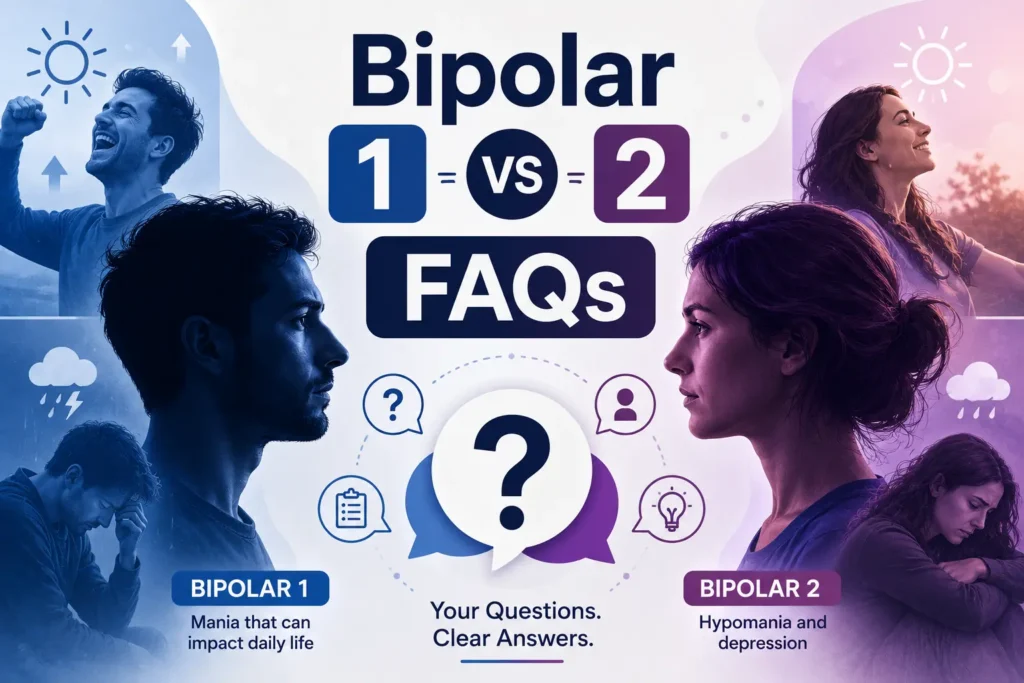
Bipolar 1 vs 2 FAQs: Bipolar I and Bipolar II are different diagnoses defined by the type of “high” episode a person experiences — full mania for Bipolar I, milder hypomania for Bipolar II. Below, we’ve answered the questions people search for most when trying to understand how the two compare, from basic definitions to diagnosis, treatment, and daily life. For the full comparison, start with our main Bipolar 1 vs Bipolar 2 guide — this page is built to answer the specific questions that guide leaves open.
Table of Contents
Key Takeaways
- Bipolar I requires at least one full manic episode; Bipolar II requires hypomania plus at least one major depressive episode.
- Neither type is simply a “milder” or “worse” version of the other — they differ in episode type, not on a single severity scale.
- Diagnosis relies on a clinical interview and DSM-5 criteria from the American Psychiatric Association, not a blood test or scan.
- Both types are treatable with a combination of medication and therapy, and outcomes are generally best with early, consistent care.
- Misdiagnosis is common for both types, especially when hypomania is mistaken for a good mood or mania is mistaken for a personality trait.
Understanding the Basics
What is the actual difference between Bipolar I and Bipolar II?
Bipolar I is defined by at least one manic episode lasting seven days or more, or one severe enough to require hospitalization. Bipolar II is defined by at least one hypomanic episode — a shorter, milder high — combined with at least one major depressive episode, without ever having had a full manic episode. If you’re new to these terms, our guide on what bipolar disorder is explains the broader condition before narrowing into these two subtypes.
Is Bipolar II just a milder form of Bipolar I?
No, and this is one of the most persistent misunderstandings about the condition. Bipolar II involves a different pattern, not a lighter dose of Bipolar I. People with Bipolar II often spend more total time in depressive episodes than people with Bipolar I, and that depression can be just as disabling. Our full Bipolar 1 vs 2 myths page addresses this and other common misconceptions in more depth.
What does mania actually feel like, and how is it different from hypomania?
Mania typically involves a dramatic increase in energy, reduced need for sleep, racing thoughts, and behavior that clearly disrupts daily life — sometimes including psychosis. Hypomania involves similar changes but at a lower intensity; the person may seem unusually productive, talkative, or confident, and family members often notice it before the person does, but it doesn’t require hospitalization or cause a major break from reality.
What is a mixed episode?
A mixed episode involves symptoms of depression and mania or hypomania happening at the same time or in rapid alternation — for example, feeling agitated and restless while also feeling hopeless. Mixed features can occur in both Bipolar I and Bipolar II and often make diagnosis more complicated because the presentation doesn’t fit a single, clean category.
Are there other types of bipolar disorder besides I and II?
Yes. Cyclothymic disorder involves numerous periods of hypomanic and depressive symptoms that don’t meet the full criteria for either a hypomanic or major depressive episode. There’s also “bipolar disorder not otherwise specified” for presentations that don’t fit neatly into any category. Our full overview of the types of bipolar disorder covers all of these, and our specific comparison of Bipolar 1 vs 2 vs cyclothymia breaks down exactly where cyclothymia fits.
Comparison at a Glance
| Question | Bipolar I | Bipolar II |
| Defining episode | Full mania | Hypomania |
| Depressive episodes required for diagnosis? | No | Yes |
| Can include psychosis? | Yes | Rarely |
| Hospitalization common? | More often | Less often |
| Time typically spent in depression | Significant, but variable | Often the dominant symptom |
| Commonly confused with | Schizophrenia, schizoaffective disorder | Major depressive disorder, borderline personality disorder |
For a more detailed side-by-side, visit our Bipolar 1 vs 2 chart and full Bipolar 1 vs Bipolar 2 differences guide. For the same information without clinical language, see our simple explanation of Bipolar 1 vs 2.
Symptom Questions
What are the main symptoms of Bipolar I?
Bipolar I centers on manic episodes — elevated or irritable mood, decreased need for sleep, grandiosity, racing thoughts, and impulsive or risky behavior — often alongside depressive episodes as well. For the complete symptom list recognized in clinical criteria, see bipolar disorder symptoms and the type-specific Bipolar 1 vs 2 symptoms comparison.
What are the main symptoms of Bipolar II?
Bipolar II centers on major depressive episodes — low mood, fatigue, loss of interest, and hopelessness — paired with hypomanic episodes that are noticeable but don’t cause major impairment. Because the depressive side is often more prominent and disruptive, many people with Bipolar II seek help during a depressive episode without realizing the hypomanic periods are clinically significant too.
How can I tell if I’ve had hypomania rather than just a good mood?
Hypomania usually involves a noticeable change from your usual self that lasts at least four consecutive days and is observable to other people — not just an internally pleasant mood. Signs include needing less sleep without feeling tired, talking faster or more than usual, taking on more projects than normal, and feeling unusually confident or irritable. A single good day doesn’t qualify; the pattern needs to be sustained and different from your baseline.
Do symptoms differ between men and women?
Yes, to some degree. Clinical research points to men being somewhat more likely to show classic manic symptoms and Bipolar I patterns, while women more often show depression-dominant symptoms, rapid cycling, and Bipolar II patterns. Our dedicated guide on Bipolar 1 vs 2 in men and women covers these differences in detail.
What causes Bipolar I and Bipolar II?
Neither type has a single known cause. Current research points to a combination of genetics, brain chemistry, and environmental stressors, with family history being the strongest known risk factor for both types. For a full explanation of contributing factors, see our guide to bipolar disorder causes.
Diagnosis Questions
How do doctors diagnose Bipolar I vs Bipolar II?
Diagnosis is based on a structured clinical interview, a detailed history of mood episodes, and criteria from the DSM-5. There’s no lab test or brain scan that confirms either diagnosis on its own — a clinician has to establish whether a full manic episode has ever occurred (Bipolar I) or whether only hypomania has occurred alongside major depression (Bipolar II). Our full guide to bipolar disorder diagnosis and the type-specific Bipolar 1 vs 2 diagnosis process explains what an evaluation actually involves.
Can an online test tell me if I have Bipolar I or II?
An online bipolar 1 vs 2 test or quiz can help you organize your symptoms and figure out whether a professional evaluation is worth pursuing, but it can’t replace one. Only a licensed clinician can make a formal diagnosis, since that requires ruling out other conditions and carefully assessing episode history.
Why is Bipolar II so often misdiagnosed as depression?
Hypomanic episodes are mild enough that people often don’t recognize them as a problem, or don’t mention them during an evaluation because they didn’t feel like “symptoms” at the time. Without that information, a clinician may only see the depressive side and diagnose major depressive disorder instead. This is one reason antidepressant treatment alone sometimes doesn’t work as expected for someone who actually has Bipolar II — the hypomanic side of the illness was never identified or addressed.
Can Bipolar I be mistaken for another condition?
Yes. Because manic episodes can include psychosis, Bipolar I is sometimes initially mistaken for schizophrenia or schizoaffective disorder, particularly if a clinician doesn’t have a full picture of the person’s mood history outside the psychotic episode. A thorough evaluation over time usually clarifies the distinction.
Does a diagnosis ever change from Bipolar II to Bipolar I?
It can, though it isn’t the typical course. If someone previously diagnosed with Bipolar II later experiences a full manic episode, the diagnosis is updated to Bipolar I, since a manic episode is the defining feature of that type. Our dedicated article on whether Bipolar 2 can become Bipolar 1 explains how often this happens and what to watch for.
Treatment Questions
Is treatment different for Bipolar I vs Bipolar II?
The overall approach is similar — mood-stabilizing medication combined with psychotherapy — but specifics can differ based on which type of episode a person is more prone to and how severe those episodes tend to be. A psychiatrist tailors medication choice and dosing to the individual rather than applying a fixed protocol based on type alone. See our full guides to bipolar disorder treatment and the type-specific Bipolar 1 vs 2 treatment approach for more detail.
Do people with Bipolar II need medication if their “highs” are mild?
Usually, yes. Even though hypomania itself may not be dangerous, the depressive episodes in Bipolar II can be severe, frequent, and long-lasting, which is typically what drives the need for ongoing treatment. Medication and therapy are generally used to stabilize mood across both the hypomanic and depressive sides of the illness, not just to control the more visible symptom.
Can therapy alone manage Bipolar I or Bipolar II without medication?
For most people, therapy alone isn’t considered sufficient for either type, particularly for Bipolar I, where manic episodes can escalate quickly and become dangerous without medication. Therapy plays an important role in managing triggers, routines, and coping strategies, but it’s typically used alongside medication rather than as a replacement for it. Any decision about medication should be made with a psychiatrist based on individual history and severity.
How is bipolar depression treated differently from regular depression?
Standard antidepressants are used cautiously in bipolar disorder because, in some cases, they can trigger a manic or hypomanic episode if used without a mood stabilizer alongside them. This is one of the most important reasons an accurate Bipolar I vs Bipolar II diagnosis matters before starting treatment. See our comparison of Bipolar 1 vs 2 depression for more on how depressive episodes present and get managed across the two types.
Severity, Outlook, and Daily Life
Which is worse, Bipolar I or Bipolar II?
Neither type is universally worse — they carry different risks. Bipolar I carries a higher risk of severe mania and psychosis, sometimes requiring hospitalization, while Bipolar II’s depressive episodes tend to be more frequent and persistent, and are sometimes underestimated because the “high” side looks mild by comparison. Our full breakdown of which type is worse walks through this comparison in more depth.
What complications can happen with untreated bipolar disorder?
Untreated or poorly managed bipolar disorder, of either type, is associated with a higher risk of relationship and job instability, substance use, and suicide risk compared with the general population. Consistent treatment substantially lowers these risks for most people. Our guide to bipolar disorder complications covers this in full.
What’s the long-term outlook for someone with Bipolar I or Bipolar II?
With consistent treatment, most people with either type achieve meaningful stability and are able to work, maintain relationships, and manage daily life effectively. Outlook depends more on how early the condition is diagnosed and how consistently it’s treated than on which type someone has. See our full bipolar disorder prognosis guide for more.
How common are Bipolar I and Bipolar II?
Both types occur at meaningful rates in the general population, and prevalence is roughly similar between men and women according to data referenced by the National Institute of Mental Health (NIMH). For the full numbers, including breakdowns by age group, see our dedicated bipolar disorder statistics page.
What terms should I know before reading more about bipolar disorder?
Terms like euthymia, rapid cycling, mixed features, and specifiers come up often in bipolar disorder literature and can be confusing without context. Our bipolar disorder glossary defines all the clinical terms used across this site in plain language.
Myths vs Facts Recap
| Myth | Fact |
| Bipolar II is Bipolar I but “less severe” | They’re separate diagnoses defined by different episode types |
| You can self-diagnose based on mood swings alone | Diagnosis requires a structured clinical evaluation, not symptom-matching |
| People with Bipolar II don’t need real treatment | Bipolar II often involves severe, long-lasting depressive episodes that require ongoing care |
| Bipolar disorder always looks like extreme highs and lows | Hypomania can be subtle enough that friends and family notice it before the person does |
| Once diagnosed, the type can never change | A diagnosis can shift from Bipolar II to Bipolar I if a full manic episode later occurs |
Checklist: Questions to Bring to Your Doctor
- Have I ever had a period of unusually high energy or reduced need for sleep lasting several days?
- How many depressive episodes have I had, and how long did each one last?
- Does anyone in my family have bipolar disorder, depression, or another mood disorder?
- Have I ever taken an antidepressant that seemed to make me feel “too good” or unusually energized?
- Am I currently using alcohol or other substances that could be affecting my mood?
- Are my symptoms affecting my job, relationships, or daily responsibilities?
Warning Signs That Need Immediate Attention
- Thoughts of suicide or not wanting to be alive
- A specific plan or any steps taken toward self-harm
- Psychosis — hearing or seeing things that aren’t there, or strongly believing things that aren’t true
- Manic behavior that puts personal safety at serious risk, such as dangerous spending, driving, or sexual behavior
- Depression severe enough to prevent basic self-care
Emergency Help
If you or someone you know is in immediate danger or considering suicide, call or text 988 (Suicide & Crisis Lifeline) in the United States, available 24/7. If there is immediate danger to life, call 911 or go to the nearest emergency room. Outside the U.S., contact your local emergency number, or find regional crisis resources through the WHO’s mental health directory.
Summary
Bipolar I and Bipolar II are separate diagnoses shaped by the type of high episode involved — full mania versus hypomania — not by a simple severity scale, and most of the confusion people have about the two comes down to a handful of recurring questions: how they’re diagnosed, whether one is worse than the other, why misdiagnosis happens, and what treatment actually looks like. If your own questions weren’t fully answered here, our related guides linked throughout this page go deeper into each specific topic. For anything involving your own symptoms or diagnosis, a licensed psychiatrist or mental health professional is the right person to talk to.
This article is for educational purposes and is not a substitute for professional medical advice, diagnosis, or treatment. Always consult a qualified healthcare provider with questions about a medical condition.