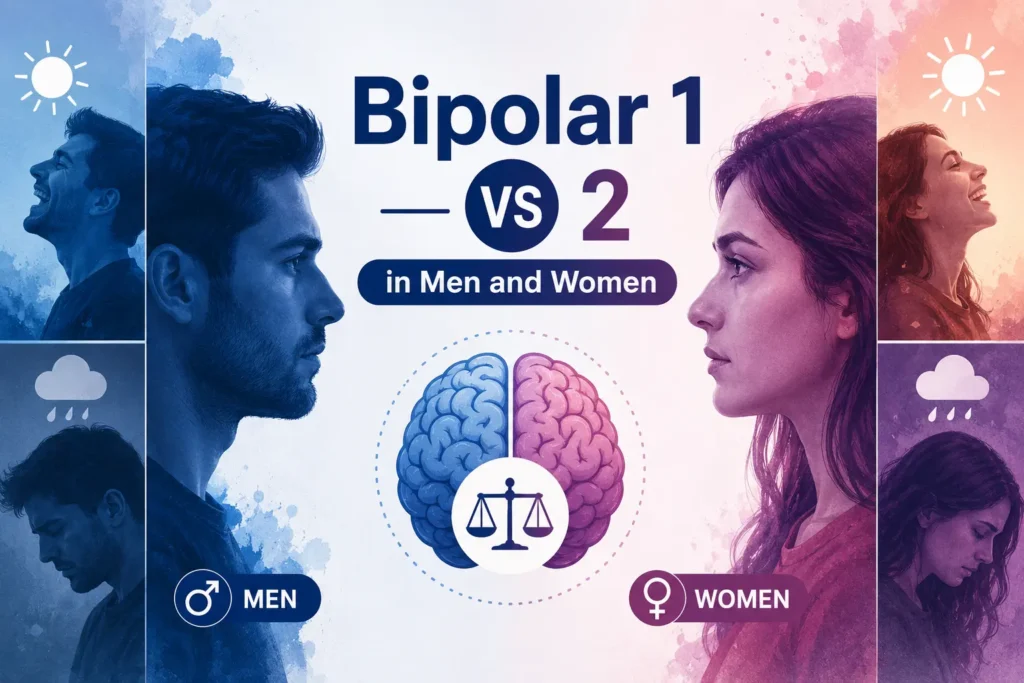
Bipolar 1 vs 2 in Men and Women: Bipolar I and Bipolar II are separate diagnoses, not two stages of the same illness. Bipolar I requires at least one full manic episode, while Bipolar II involves hypomania (a milder high) paired with major depressive episodes.
Gender doesn’t change which type someone can develop, but it does shape how the illness tends to show up. Research summarized by the National Institute of Mental Health (NIMH) shows men and women are diagnosed with bipolar disorder at nearly equal rates overall, yet men are somewhat more likely to be identified with Bipolar I and manic-predominant patterns, while women are more often diagnosed with Bipolar II, rapid cycling, and depression-heavy episodes. These patterns influence how each group gets diagnosed, misdiagnosed, and treated.
For the foundational difference between the two types before diving into gender patterns, see our full Bipolar 1 vs Bipolar 2 comparison.
Table of Contents
Key Takeaways
- Bipolar I and Bipolar II are defined by mood episode type, not severity alone or gender.
- Men are diagnosed with Bipolar I somewhat more often; women are diagnosed with Bipolar II somewhat more often, according to multiple clinical studies.
- Women with bipolar disorder report more depressive episodes, more mixed episodes, and higher rates of rapid cycling than men.
- Men are more likely to have co-occurring substance use disorders, which can mask or delay a bipolar diagnosis.
- Hormonal transitions (puberty, pregnancy, postpartum, perimenopause) can shift symptom patterns for women in ways that don’t apply to men.
- Misdiagnosis is common in both sexes but happens for different reasons — women are frequently misdiagnosed with depression or borderline personality disorder, men with anger or substance use problems.
- Neither type is universally “worse” — outcomes depend on episode severity, response to treatment, and support systems, not sex alone.
Introduction
Ask two people with bipolar disorder to describe their experience, and you’ll likely get two very different stories. Some of that difference comes down to which type of bipolar disorder they have — Bipolar I or Bipolar II. Some of it comes down to something researchers have paid less attention to until recently: whether the person is a man or a woman.
This guide focuses specifically on how Bipolar I and Bipolar II present differently across men and women — the symptom patterns, the diagnostic pitfalls, and the treatment considerations that actually change based on both variables together. If you’re looking for a broader introduction to bipolar disorder itself, our guide on what bipolar disorder is and what bipolar means is a good starting point before you continue here.
Bipolar I vs Bipolar II: The Core Difference (A Quick Refresher)
Before looking at gender, it helps to be clear on what actually separates these two diagnoses, since the distinction has nothing to do with which sex a person is.
Bipolar I disorder is defined by at least one manic episode lasting seven days or longer, or a manic episode severe enough to require hospitalization. Depressive episodes usually occur too, but they aren’t required for a Bipolar I diagnosis.
Bipolar II disorder requires at least one hypomanic episode (a shorter, less intense high that doesn’t cause major impairment) and at least one major depressive episode. A person with Bipolar II has never had a full manic episode — if they had, the diagnosis would shift to Bipolar I.
| Feature | Bipolar I | Bipolar II |
| Defining episode | Full mania (7+ days or hospitalization) | Hypomania (4+ days, milder) |
| Depressive episodes | Common but not required for diagnosis | Required for diagnosis |
| Psychosis possible | Yes, during mania or depression | Rare, usually not during hypomania |
| Functional impact of “high” episodes | Often severe, may need hospitalization | Noticeable to others but usually doesn’t stop daily function |
| Common misdiagnosis | Schizophrenia, other psychotic disorders | Major depression, borderline personality disorder |
For a deeper side-by-side of every diagnostic criterion, visit our Bipolar 1 vs 2 chart and the detailed Bipolar 1 vs Bipolar 2 differences breakdown. If you want the concept explained without clinical language, our simple explanation of Bipolar 1 vs 2 covers it in plain terms.
How Bipolar Symptoms Differ in Men
Men with bipolar disorder — of either type — tend to follow some recognizable patterns, though not every man will match them.
- Mania tends to look more classically “manic.” Men with Bipolar I are more often reported to show irritability, aggression, grandiosity, and risk-taking behavior during manic episodes, rather than euphoria alone.
- Substance use is more common alongside the disorder. Men with bipolar disorder have higher documented rates of co-occurring alcohol and substance use disorders, which frequently delays diagnosis because symptoms get attributed to substance use instead of a mood disorder.
- Fewer depressive episodes relative to women, though depression is still a major part of the illness for many men.
- Onset can appear more disruptive early on, often first showing up through conflict at work, legal trouble, or relationship breakdowns tied to manic behavior rather than a visible depressive episode.
- Men are somewhat less likely to seek treatment voluntarily, often coming to clinical attention after a crisis rather than a mood complaint.
For the full symptom checklist across both types, see bipolar disorder symptoms and the type-specific Bipolar 1 vs 2 symptoms comparison.
How Bipolar Symptoms Differ in Women
Women’s presentations tend to diverge in several consistent ways, based on findings referenced by organizations including the NIMH and reviewed in clinical literature on gender and bipolar disorder.
- Depression dominates the clinical picture more often. Women with bipolar disorder, particularly Bipolar II, report spending more total time in depressive episodes than in hypomanic ones.
- Rapid cycling is more frequent. Studies have found women are more likely than men to experience four or more mood episodes within a year, a pattern known as rapid cycling.
- Mixed episodes (features of depression and mania at once) are reported more often in women.
- Hormonal shifts can trigger or worsen episodes. Puberty, the menstrual cycle, pregnancy, the postpartum period, and perimenopause are all associated with symptom changes in women with bipolar disorder — a factor that has no direct male equivalent.
- Thyroid conditions and migraines occur more often as co-existing conditions, which can complicate diagnosis and treatment planning.
- Higher likelihood of a Bipolar II diagnosis specifically, according to several clinical samples, though Bipolar I still occurs in women at meaningful rates.
Gender Differences at a Glance
| Pattern | More Common in Men | More Common in Women |
| Diagnosis type | Bipolar I | Bipolar II |
| Dominant episode type | Mania | Depression |
| Rapid cycling | Less common | More common |
| Mixed episodes | Less common | More common |
| Substance use comorbidity | Higher | Lower |
| Anxiety comorbidity | Lower | Higher |
| Thyroid disorder comorbidity | Lower | Higher |
| Hormonal symptom triggers | Not applicable | Menstrual cycle, pregnancy, postpartum, perimenopause |
| Typical path to diagnosis | Crisis, legal or work conflict | Ongoing depression, missed hypomania |
These are population-level tendencies drawn from clinical research, not rules. Plenty of men experience rapid cycling and depression-dominant Bipolar II, and plenty of women experience classic Bipolar I mania. If you’re unsure which pattern fits your own experience, an online bipolar 1 vs 2 test or quiz can help you organize your symptoms before a clinical evaluation — but neither replaces a formal diagnosis.
Why Misdiagnosis Happens Differently by Gender
Misdiagnosis is one of the most consequential problems in bipolar care, and it doesn’t happen the same way for men and women.
In women, hypomanic episodes are frequently overlooked entirely — by the patient, family members, and sometimes clinicians — because a mild energy boost doesn’t look like a problem the way a depressive episode does. This leads to a common pattern: a woman is treated for recurrent major depression for years, sometimes with antidepressants alone, before a clinician recognizes the hypomanic episodes and corrects the diagnosis to Bipolar II. Women are also more frequently misdiagnosed with borderline personality disorder, since mood instability and mixed features can resemble that condition on the surface.
In men, manic symptoms like irritability, impulsivity, and risk-taking are more likely to be attributed to substance use, personality traits, or antisocial behavior rather than recognized as a mood episode. This means men often aren’t evaluated for bipolar disorder until a manic episode becomes severe enough to cause a hospitalization, an arrest, or a major life disruption.
Both patterns point to the same underlying issue: hypomania and irritable mania are harder to recognize than classic depression or classic euphoric mania, and clinicians without training in gender-specific presentations can miss them. This is one reason a structured, criteria-based evaluation matters more than symptom impressions alone — our guide to bipolar disorder diagnosis and the type-specific Bipolar 1 vs 2 diagnosis process walks through what a thorough evaluation actually involves.
Causes and Risk Factors
The underlying causes of Bipolar I and Bipolar II are not fully understood, but current research points to a combination of genetics, brain chemistry, and environmental stress rather than any single cause tied to gender. Family history remains the strongest known risk factor for both types. Sex differences appear to influence when and how symptoms show up rather than whether someone develops the disorder in the first place. For a full breakdown of genetic, environmental, and neurological contributors, see our dedicated guide to bipolar disorder causes.
Diagnosis: What a Clinical Evaluation Actually Looks At
A proper bipolar diagnosis relies on a structured clinical interview, a detailed mood history, and criteria from the DSM-5, the diagnostic manual published by the American Psychiatric Association. There is no blood test or brain scan that confirms Bipolar I or II on its own.
Clinicians look for:
- Whether a full manic episode has ever occurred (points to Bipolar I).
- Whether hypomania alone, paired with major depression, has occurred (points to Bipolar II).
- Duration, severity, and functional impact of episodes.
- Family history of mood disorders.
- Any co-occurring conditions — anxiety, substance use, thyroid problems — that could be contributing to or masking symptoms.
Because women are more likely to first present with depression and men are more likely to first present with disruptive behavior or substance use, clinicians increasingly screen for hypomania history specifically in patients being treated for recurrent depression, and screen for mood symptoms specifically in patients presenting with substance use or behavioral crises. For the general types of bipolar disorder recognized in the DSM-5, including cyclothymia and other specifiers, see our overview of the types of bipolar disorder.
Treatment Considerations by Gender
Treatment for Bipolar I and Bipolar II typically combines mood-stabilizing medication with psychotherapy, and the overall approach doesn’t fundamentally change based on sex. However, several practical considerations do differ.
| Consideration | Notes for Men | Notes for Women |
| Medication and pregnancy | Not applicable | Some mood stabilizers, including valproate, carry pregnancy-related risks and require careful planning with an OB and psychiatrist |
| Substance use treatment | Often needs to be addressed alongside bipolar treatment | Less frequently a co-occurring factor, though not absent |
| Hormonal monitoring | Not applicable | Symptom tracking around menstrual cycle, postpartum period, and perimenopause can guide treatment timing |
| Engagement with therapy | May need more encouragement to start, given lower voluntary treatment-seeking rates | Often engages earlier due to depression-driven help-seeking |
| Weight and metabolic monitoring | Relevant for both sexes on certain antipsychotics and mood stabilizers | Relevant for both sexes; some women report more concern about weight-related side effects |
Medication choice, dosing, and monitoring should always be individualized by a psychiatrist, particularly for women who are pregnant, breastfeeding, or planning a pregnancy. This article does not provide medication recommendations — for a full overview of treatment approaches, see our guides to bipolar disorder treatment and the type-specific Bipolar 1 vs 2 treatment approach.
Bipolar Depression: A Closer Look
Depression is often the more disabling and longer-lasting part of bipolar disorder for both men and women, but especially for women and for anyone with Bipolar II, where depressive episodes are part of the diagnostic definition. Depressive episodes in bipolar disorder can look similar to major depressive disorder on the surface — low energy, hopelessness, loss of interest — which is exactly why a missed hypomanic history so often leads to a mislabeled diagnosis. For a focused comparison of how depression shows up differently across Bipolar I and Bipolar II, see Bipolar 1 vs 2 depression.
Bipolar I vs II: Which One Is “Worse”?
This is one of the most common questions people ask, and there isn’t a single correct answer. Bipolar I carries a higher risk of manic episodes severe enough to require hospitalization and, in some cases, psychosis. Bipolar II is often underestimated because hypomania looks mild, but the depressive episodes in Bipolar II can be just as long, recurrent, and disabling as those in Bipolar I — sometimes more so, since Bipolar II depression tends to be more persistent. Severity in either type also depends heavily on how early it’s diagnosed, how consistently it’s treated, and what support systems a person has. Our full analysis of which type is worse goes into this comparison in more depth.
Can Bipolar II Turn Into Bipolar I?
A related question worth addressing directly: does Bipolar II ever progress into Bipolar I? For a small subset of people, a first full manic episode does eventually occur after years of a Bipolar II pattern, which would technically change the diagnosis. This isn’t the typical course, though, and most people with Bipolar II do not go on to develop Bipolar I. Our dedicated article on whether Bipolar 2 can become Bipolar 1 covers what’s known about this pattern and what warning signs to watch for.
It’s also worth knowing where cyclothymia fits into this picture, since it’s often confused with both types. Cyclothymic disorder involves numerous periods of hypomanic and depressive symptoms that don’t meet the full criteria for hypomania or major depression. See our comparison of Bipolar 1 vs 2 vs cyclothymia for the full distinction.
Myths vs Facts
| Myth | Fact |
| Bipolar II is just a “milder” version of Bipolar I | They are distinct diagnoses defined by different episode types, not a severity scale |
| Only women get Bipolar II and only men get Bipolar I | Both types occur in both sexes; research shows tendencies, not exclusivity |
| Mood swings that change quickly always mean bipolar disorder | Rapid mood changes can stem from many causes, including personality factors, other mental health conditions, or medical issues |
| Bipolar disorder always includes visible mania | Bipolar II never involves full mania — only hypomania, which can be easy to miss |
| Once diagnosed, the type never changes | In rare cases, the diagnosis is revised if a full manic episode later occurs |
For a complete breakdown of common misconceptions, see our full bipolar disorder myths guide.
Complications and Prognosis
Untreated or poorly managed bipolar disorder, of either type, is linked to a higher risk of relationship strain, job instability, substance use, and — importantly — suicide risk, which is elevated in both Bipolar I and Bipolar II compared to the general population. Women with bipolar disorder show somewhat higher rates of co-occurring anxiety disorders, while men show higher rates of co-occurring substance use disorders, both of which can worsen overall outcomes if left unaddressed. With consistent treatment, most people with either type achieve meaningful symptom stability. For the full list of possible complications and long-term outlook, see our guides to bipolar disorder complications and bipolar disorder prognosis.
Bipolar Disorder Statistics: Men vs Women
According to the NIMH, past-year prevalence of bipolar disorder among U.S. adults is nearly identical between sexes — around 2.9% for men and 2.8% for women — which confirms that bipolar disorder itself is not more common in one sex than the other. What differs is the distribution across subtypes and episode patterns described throughout this guide. For a complete statistical breakdown, including prevalence by age and country, visit our dedicated bipolar disorder statistics page.
Checklist: Signs Worth Bringing to a Doctor
- Periods of unusually high energy, reduced need for sleep, or racing thoughts, even if brief
- Episodes of depression that come and go rather than staying constant
- Family history of bipolar disorder or severe depression
- Mood changes that clearly affect work, relationships, or daily functioning
- Times when your mood or energy has been “up” without a clear outside reason
- Any history of substance use that started around the same time as mood changes
- For women: mood shifts that reliably track with the menstrual cycle, pregnancy, or postpartum period
Warning Signs That Need Immediate Attention
Certain symptoms should never wait for a routine appointment:
- Talking about wanting to die or not wanting to be alive
- Making a plan or taking steps toward suicide
- Psychosis (hearing or seeing things that aren’t there, or holding beliefs that are clearly untrue)
- Behavior during mania that puts personal safety at serious risk (dangerous driving, unsafe spending, unsafe sexual behavior)
- Severe depression that includes an inability to care for basic needs
Emergency Help
If you or someone you know is in immediate danger or considering suicide, call or text 988 (Suicide & Crisis Lifeline) in the United States, available 24/7. If there is immediate danger to life, call 911 or go to the nearest emergency room. Outside the U.S., contact your local emergency number or a crisis line in your country, such as the WHO’s mental health resources directory of regional services.
Frequently Asked Questions
Are men or women more likely to have Bipolar I? Multiple clinical studies suggest men are somewhat more likely to be diagnosed with Bipolar I, while women are somewhat more likely to be diagnosed with Bipolar II — though both types occur in both sexes and overall bipolar prevalence is nearly equal between men and women.
Why do women get diagnosed with depression before bipolar disorder more often? Because hypomanic episodes are milder and easier to overlook than depressive episodes, women are frequently treated for recurrent depression for years before a clinician identifies a hypomanic history and revises the diagnosis to Bipolar II.
Do hormones affect bipolar symptoms in women? Yes. Puberty, the menstrual cycle, pregnancy, the postpartum period, and perimenopause are all associated with symptom shifts in women with bipolar disorder, which is why tracking mood alongside hormonal changes can help guide treatment.
Is Bipolar I more dangerous than Bipolar II? Bipolar I carries a higher risk of severe manic episodes and psychosis, but Bipolar II’s depressive episodes tend to be more frequent and longer-lasting, so overall disability can be comparable between the two types.
Can a man have Bipolar II? Yes. While women are diagnosed with Bipolar II somewhat more often in clinical samples, Bipolar II occurs in men as well, and it can be just as easily missed due to substance use or irritability being mistaken for something else.
Does bipolar disorder look different in men versus women during mania? Men more often show irritability, aggression, and risk-taking during manic or hypomanic episodes, while women’s manic and hypomanic episodes are more often accompanied by mixed depressive features.
Should treatment be different for men and women with bipolar disorder? The core treatment approach — mood stabilizers, therapy, and lifestyle management — is similar for both sexes, but factors like pregnancy planning, hormonal cycles, and co-occurring substance use can shift specific treatment decisions.
Summary
Bipolar I and Bipolar II are distinguished by the type of “high” episode a person experiences — full mania versus hypomania — not by gender. Still, clinical research consistently shows that men and women tend to experience and get diagnosed with bipolar disorder along somewhat different lines: men more often toward Bipolar I, mania-predominant patterns, and substance use complications; women more often toward Bipolar II, depression-predominant patterns, rapid cycling, and hormonally-linked symptom shifts. Recognizing these tendencies can help both patients and clinicians catch the right diagnosis sooner, which matters because earlier, accurate treatment is one of the strongest predictors of long-term stability for either type. If any of the symptom patterns described here sound familiar, a licensed psychiatrist or mental health professional is the right next step for a full evaluation — for definitions of any clinical terms used throughout this guide, see our bipolar disorder glossary.
This article is for educational purposes and is not a substitute for professional medical advice, diagnosis, or treatment. Always consult a qualified healthcare provider with questions about a medical condition.