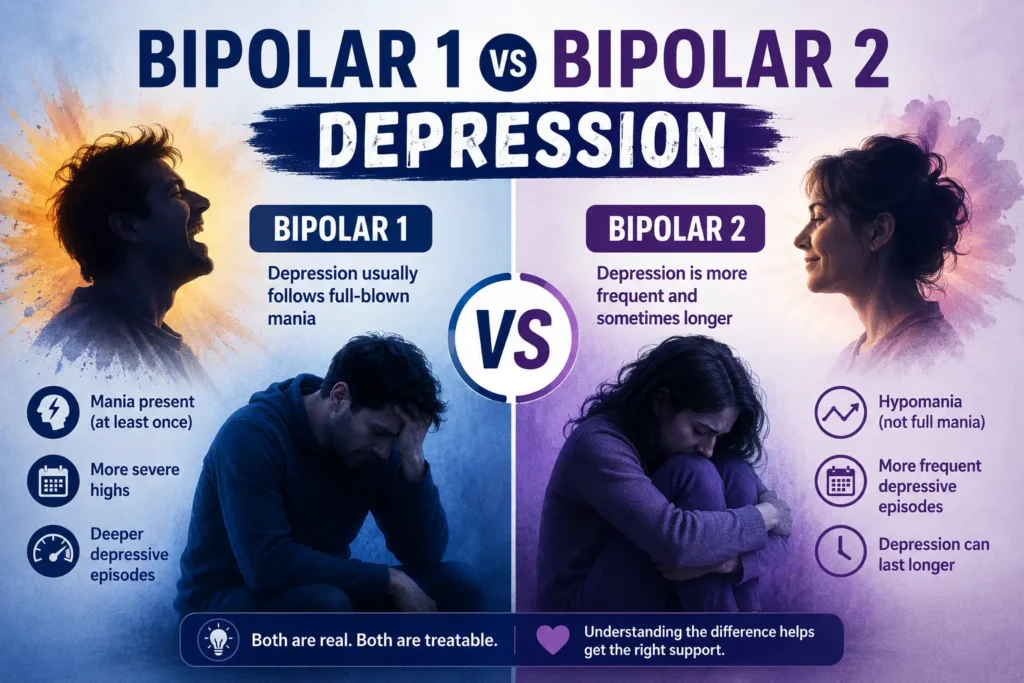
Bipolar 1 vs Bipolar 2 Depression: Depression looks similar on the surface in bipolar 1 and bipolar 2, but research shows real differences in how often it shows up and how long it sticks around. People with bipolar 2 tend to spend considerably more of their time in a depressive state than people with bipolar 1, and their depressive episodes are often more frequent and longer-lasting. In one well-known long-term study, people with bipolar 1 were symptomatic with depression roughly a third of the time they were followed, compared to roughly half the time for people with bipolar 2. Manic or hypomanic symptoms, by contrast, made up only a small fraction of the time in both groups. In short: bipolar 1 is defined by its most extreme “up” episode, but for many people living with either diagnosis, it’s depression that dominates day-to-day life and drives the disability.
If you haven’t already, it helps to start with our broader bipolar 1 vs bipolar 2 comparison before diving into this depression-specific breakdown.
Table of Contents
Key Takeaways
- Bipolar 1 and bipolar 2 share the same clinical definition of a major depressive episode, but the lived experience of depression differs between the two.
- People with bipolar 2 typically experience depression more frequently and for a greater share of their overall time than people with bipolar 1.
- Bipolar 2 depression is more often misdiagnosed as standalone (unipolar) depression, since hypomanic episodes are easy to miss or dismiss.
- Depressive episodes in bipolar 2 are more likely to include “atypical” features, such as oversleeping and increased appetite, than classic depression.
- Suicide risk tied to depressive episodes is a serious concern in both diagnoses, and some research points to an even higher risk in bipolar 2.
- Treatment for bipolar depression differs meaningfully from treatment for standalone depression, particularly around antidepressant use.
Understanding the Two Diagnoses Before Comparing Their Depression
Bipolar 1 and bipolar 2 are separated by the intensity of their “up” episodes, not their “down” ones. For a full explanation of what defines each diagnosis, see our guide on what bipolar disorder is and our page on bipolar disorder more broadly.
Briefly:
- Bipolar 1 requires at least one manic episode. Depressive episodes are common but not required for the diagnosis.
- Bipolar 2 requires at least one hypomanic episode plus at least one major depressive episode. A full manic episode never occurs — if it does, the diagnosis changes to bipolar 1.
For the mechanics of mania versus hypomania specifically, our bipolar 1 vs 2 differences page and bipolar 1 vs 2 symptoms comparison cover that ground in detail, so this article focuses specifically on the depressive side of both conditions.
What a Major Depressive Episode Looks Like
Both diagnoses use the same clinical definition for a major depressive episode: at least two weeks of intensely low mood or loss of interest in activities, along with several additional symptoms such as fatigue, sleep or appetite changes, feelings of worthlessness or guilt, trouble concentrating, restlessness or slowed movement, and recurring thoughts of death or suicide. For the complete symptom picture across both diagnoses, see our page on bipolar disorder symptoms.
The diagnostic checklist for depression is identical whether someone has bipolar 1, bipolar 2, or no history of mania or hypomania at all. That’s exactly why the distinction matters so much clinically — the depression can look the same on paper while the right treatment approach is very different underneath.
How Depression Differs Between Bipolar 1 and Bipolar 2
Frequency and Time Spent Depressed
This is the most striking, well-documented difference between the two conditions. Long-term studies that track patients for years, rather than just during a single episode, consistently find that people with bipolar 2 spend more of their overall time in a depressive state than people with bipolar 1 do.
| Measure | Bipolar 1 | Bipolar 2 |
| Approximate share of follow-up time spent with depressive symptoms | Around one-third | Around half |
| Approximate share of follow-up time spent with manic/hypomanic symptoms | Roughly one-tenth | A small fraction, often under 2% |
| Which mood state dominates the overall course | More balanced, though still depression-heavy | Depression clearly dominates |
These figures come from long-term naturalistic follow-up studies of bipolar patients — not from a single symptom checklist, but from tracking real people’s mood states week by week over years. The takeaway is consistent across multiple studies: even though mania is what defines bipolar 1 on paper, it’s depression that eats up most of the calendar for both groups, and especially for people with bipolar 2.
Duration and Recurrence
Depressive episodes in bipolar 2 also tend to last longer and recur more often than in bipolar 1. This contributes to a more chronic feeling course of illness, where people may go longer stretches without fully returning to their usual baseline mood between episodes.
Severity and Impact
It’s a common misconception that bipolar 2 is the “lighter” diagnosis simply because it doesn’t involve full mania. In reality, the depressive episodes associated with bipolar 2 are frequently just as severe, or more disabling in day-to-day terms, than those in bipolar 1. Some research even points to a higher risk of suicidal thinking and behavior associated with bipolar 2’s depressive episodes, likely tied to how often and how long people experience them. For more on this comparison overall, see our page on which is worse, bipolar 1 or bipolar 2.
Symptom Presentation: Atypical Depression Features
One notable pattern in bipolar 2 depression is a higher rate of “atypical” depressive features — meaning symptoms that run opposite to the classic picture of depression. Instead of insomnia and appetite loss, atypical depression involves oversleeping, increased appetite, a heavy or leaden feeling in the limbs, and heightened sensitivity to rejection. These atypical features show up more frequently in bipolar 2 depression than in standalone major depressive disorder, which is one clue clinicians use when trying to distinguish the two.
Why Bipolar 2 Depression Is So Often Misdiagnosed as Regular Depression
This is one of the most important practical points in the entire bipolar 1 vs bipolar 2 conversation, and it’s specific to depression.
Because hypomania in bipolar 2 doesn’t look “sick” — it can feel like a burst of energy, confidence, or productivity — people rarely bring it up to a doctor unprompted. What they do bring up is the depression, since that’s the part that disrupts their life. If a clinician only asks about depressive symptoms and doesn’t specifically screen for a history of hypomania, bipolar 2 can be missed entirely and treated as standalone major depressive disorder instead.
This misdiagnosis matters because standalone depression and bipolar depression are not managed the same way, which we’ll cover in the treatment section below. For a full explanation of how clinicians distinguish between the two conditions accurately, see our guides on bipolar disorder diagnosis and bipolar 1 vs 2 diagnosis. If you’re trying to get a general sense of your own symptom pattern before an appointment, our bipolar 1 vs 2 test and bipolar 1 vs 2 quiz are educational tools, not diagnostic replacements.
Risk Factors That Shape How Depression Shows Up
Several factors influence how severe, frequent, or long-lasting bipolar depression becomes, in both diagnoses:
| Risk Factor | Why It Matters |
| Younger age of illness onset | Linked to more frequent depressive recurrence over time |
| Poor sleep quality | A well-documented trigger for both depressive and manic/hypomanic episodes |
| Rapid cycling (frequent episode shifts) | Associated with faster return of depressive symptoms |
| Substance use | Can worsen depressive symptoms and complicate treatment |
| Lack of consistent treatment | Associated with more time spent symptomatic overall |
| Co-occurring anxiety disorders | Common alongside bipolar depression and can intensify its impact |
For a broader look at what contributes to bipolar disorder overall, see our dedicated page on bipolar disorder causes.
How Bipolar Depression Is Diagnosed
Diagnosing depression itself is fairly straightforward using the standard criteria described above. The harder part — and the part that truly separates bipolar 1 depression, bipolar 2 depression, and standalone depression — is figuring out whether a manic or hypomanic episode has ever occurred in the person’s history.
A thorough evaluation typically includes:
- A detailed history of every past mood episode, not just the current depressive one
- Specific screening questions about hypomanic or manic symptoms, since people often don’t volunteer this information
- Input from family members or close contacts who may have noticed mood changes the person didn’t recognize in themselves
- Ruling out other causes of low mood, including medical conditions, medication side effects, and substance use
For the complete diagnostic picture across both conditions, see our pages on bipolar disorder diagnosis and types of bipolar disorder.
Treatment Differences for Bipolar 1 vs Bipolar 2 Depression
Bipolar depression is not treated the same way as standalone depression, and there are some meaningful differences between how bipolar 1 and bipolar 2 depression are approached as well.
| Treatment Area | Bipolar 1 Depression | Bipolar 2 Depression |
| Mood stabilizers | Central to treatment, often the foundation before addressing depression directly | Commonly used, though sometimes at different dosing strategies |
| Antidepressants alone | Generally avoided, due to the risk of triggering mania | Used more cautiously and typically only alongside a mood stabilizer, due to the risk of triggering hypomania |
| Antipsychotic medication | Frequently used, particularly for depressive episodes with psychotic features | Used selectively, depending on severity |
| Psychotherapy | Strongly recommended alongside medication | Strongly recommended, especially given how much of the illness course involves depression |
| Monitoring frequency | Regular follow-up, often more frequent after a manic episode | Regular follow-up, particularly important given how often depression recurs |
The reason antidepressants are used with caution in both conditions comes down to the same underlying risk: introduced without a mood stabilizer, they can trigger a switch into hypomania or mania. This is one of the clearest reasons an accurate diagnosis matters so much, since standalone depression is often treated with antidepressants alone. For a full breakdown of treatment approaches, see our pages on bipolar disorder treatment and bipolar 1 vs 2 treatment.
Myths vs Facts About Bipolar Depression
| Myth | Fact |
| “Bipolar 2 depression is milder because bipolar 2 is the milder diagnosis.” | Bipolar 2 depression is often more frequent, longer-lasting, and more disabling in daily life than bipolar 1 depression. |
| “If someone doesn’t seem manic, their depression can’t be bipolar.” | Hypomania is easy to miss or mistake for a good mood, which is exactly why bipolar 2 depression is so often misdiagnosed. |
| “Antidepressants work the same for bipolar depression as they do for regular depression.” | Antidepressants carry a risk of triggering hypomania or mania in bipolar disorder and are generally used alongside a mood stabilizer, not alone. |
| “Depression isn’t a big part of bipolar 1, since it’s defined by mania.” | People with bipolar 1 still spend a substantial share of their time dealing with depressive symptoms, not just manic ones. |
| “Bipolar depression looks exactly like standalone depression.” | Bipolar depression, especially in bipolar 2, more often includes atypical features like oversleeping and increased appetite. |
For more common misconceptions across bipolar disorder generally, see our bipolar disorder myths page.
Warning Signs and Emergency Help
Because depressive episodes in both diagnoses carry a real risk of suicidal thinking, it’s worth knowing which signs call for urgent attention rather than a routine follow-up appointment:
- Persistent or recurring thoughts of death or suicide
- A specific plan or means for self-harm
- Giving away possessions or saying goodbye in ways that feel final
- Complete withdrawal from work, relationships, or basic self-care
- Sudden calm after a period of severe depression, which can sometimes signal a decision has been made
If you or someone you know is showing these signs, treat it as an emergency. In the U.S., the 988 Suicide & Crisis Lifeline is available by call or text, any time, day or night. If there’s immediate danger, call 911 or go to the nearest emergency room.
This is a sensitive topic, and if you’re navigating these feelings yourself, please know that support is available and reaching out is worth it, even when it doesn’t feel that way in the moment.
Prognosis and Complications
With consistent treatment, both bipolar 1 and bipolar 2 depression can improve significantly, and many people achieve long stretches of stability. That said, a few realities are worth knowing:
- Depressive symptoms, even at a lower, “background” intensity that doesn’t meet full episode criteria, are common between major episodes in both diagnoses and can still affect quality of life.
- Episode length can vary considerably from one depressive period to the next, even within the same person, so past episodes don’t reliably predict how long future ones will last.
- Ongoing psychiatric care and consistent treatment adherence are strongly associated with better long-term stability.
For a fuller picture of long-term outcomes, see our dedicated pages on bipolar disorder prognosis and bipolar disorder complications.
A Practical Checklist for Tracking Bipolar Depression
Whether you have bipolar 1 or bipolar 2, keeping track of depressive symptoms over time can make a real difference in how quickly patterns are caught and addressed:
- [ ] Log mood, sleep, and energy daily, even briefly
- [ ] Note the specific symptoms present, not just “good day” or “bad day”
- [ ] Track how long each depressive period lasts, not just when it starts
- [ ] Flag any hypomanic-feeling periods too, even ones that felt good at the time
- [ ] Share your log with your psychiatrist at each appointment
- [ ] Bring up any thoughts of self-harm immediately, rather than waiting for a scheduled visit
Frequently Asked Questions
Is depression worse in bipolar 1 or bipolar 2? By most measures of frequency and total time spent depressed, bipolar 2 depression tends to be more persistent and disabling day-to-day, even though bipolar 1 is considered the more severe diagnosis overall due to its manic episodes.
Why does bipolar 2 get misdiagnosed as regular depression so often? Because hypomania often feels productive or pleasant rather than distressing, people frequently don’t mention it to a doctor, so only the depressive symptoms get evaluated and treated.
Can antidepressants make bipolar depression worse? Antidepressants used without a mood stabilizer carry a risk of triggering a switch into hypomania or mania in people with bipolar disorder, which is why they’re typically prescribed cautiously and alongside other medications.
How long do bipolar depressive episodes usually last? Duration varies significantly, both between individuals and within the same person over time. Some episodes last weeks, others last months, and past episode length doesn’t reliably predict how long the next one will be.
Does bipolar 2 depression look different from bipolar 1 depression? The formal diagnostic criteria are identical, but bipolar 2 depression more frequently includes atypical features like oversleeping and increased appetite, and tends to occur more often and last longer.
Is suicide risk higher in bipolar 1 or bipolar 2? Both carry meaningful suicide risk tied to depressive episodes. Some research points to an even higher risk of suicidal thoughts and behavior in bipolar 2, likely related to how much time is spent in a depressive state.
Should I track my mood if I have bipolar depression? Yes. Mood tracking helps both you and your psychiatrist spot patterns, catch early warning signs, and adjust treatment more precisely than relying on memory alone.
Summary
Bipolar 1 and bipolar 2 share the same clinical definition of depression, but the way it actually plays out differs in meaningful ways. People with bipolar 2 typically spend more time depressed, experience more frequent and longer episodes, and are more prone to being misdiagnosed with standalone depression because their hypomanic episodes go unnoticed. Neither version of bipolar depression is something to manage without professional support, and neither is “the mild one” just because it isn’t defined by full mania.
If what you’ve read here resonates with your own experience, the next step is a conversation with a psychiatrist who can look at your complete mood history, not just your current symptoms. For more background on the broader condition, explore our guides on types of bipolar disorder, bipolar disorder statistics, and, if bipolar 2 depression is part of your history, our article on whether bipolar 2 can become bipolar 1. If a term here was unfamiliar, our glossary can help, and our bipolar 1 vs 2 vs cyclothymia guide places this comparison within the full bipolar spectrum.
This article is for educational purposes and isn’t a substitute for a diagnosis or treatment plan from a licensed mental health professional. If you’re concerned about symptoms in yourself or someone else, please consult a psychiatrist or other qualified healthcare provider.