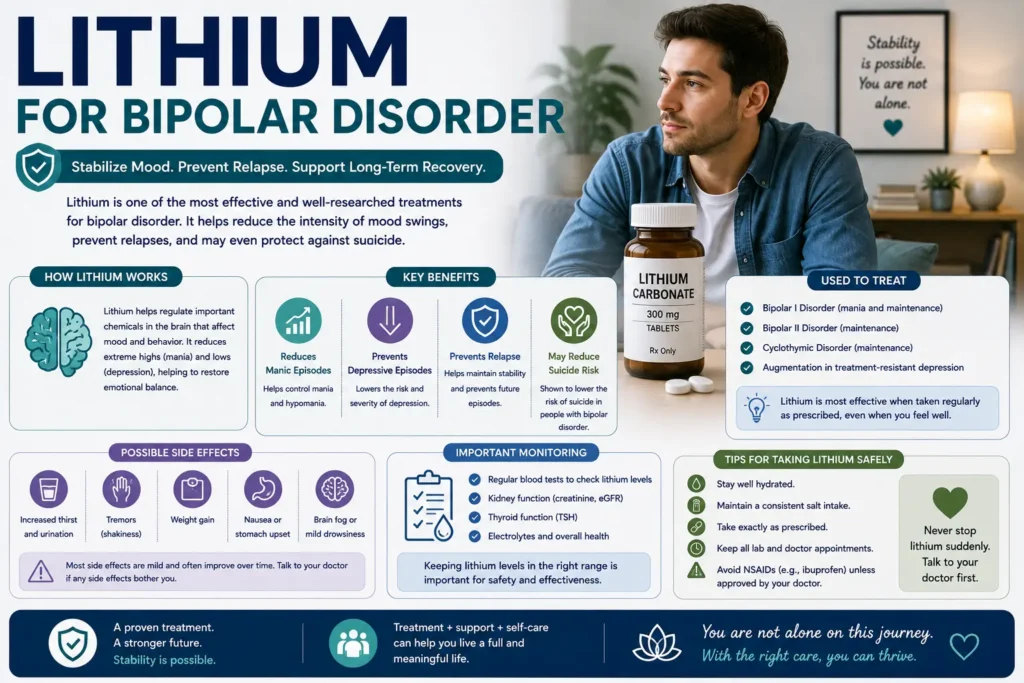
Lithium for Bipolar Disorder: Lithium is the oldest and most extensively studied medication for bipolar disorder. It helps prevent both manic and depressive episodes and is the only bipolar medication specifically linked to a reduced long-term risk of suicide. Because it has a narrow gap between an effective dose and one that causes side effects, lithium treatment involves regular blood tests — this is standard, expected care rather than a warning sign.
Table of Contents
Introduction
Lithium has been used to treat bipolar disorder since the mid-20th century, which makes it unusual in psychiatry: most medications in active use today are far newer. That long history isn’t a downside — it means lithium has more real-world outcome data behind it than almost any other bipolar treatment.
Still, lithium raises specific questions that other medications don’t, mostly around monitoring, toxicity, and long-term organ effects. This guide covers exactly what to know if lithium has been recommended, prescribed, or is simply on the table as an option.
For how lithium fits alongside other treatment types, see our guides to mood stabilizers for bipolar disorder and bipolar medications. If you’re earlier in the process, bipolar disorder diagnosis is a good starting point.
Key Takeaways
- Lithium is a first-line mood stabilizer for many people with Bipolar 1, effective against both manic and depressive episodes.
- It’s the only bipolar medication specifically associated with a reduced long-term risk of suicide.
- Lithium requires regular blood tests because the effective dose range sits close to the range that can cause side effects.
- Toxicity is uncommon with proper monitoring but is a medical emergency when it happens — knowing the warning signs matters.
- Lithium isn’t right for everyone; kidney function, thyroid health, and pregnancy plans all factor into the decision.
What Is Lithium and How Does It Work?
Lithium is a naturally occurring element, not a synthetic compound like most psychiatric medications. In bipolar disorder, it’s thought to stabilize mood by influencing signaling pathways inside brain cells, though the exact mechanism is still an area of ongoing research. What’s well established, rather than theoretical, is its clinical effect: consistently reducing the frequency and severity of both manic and depressive episodes over time.
This dual-direction effect is what makes lithium a true mood stabilizer, distinct from medications that only address one mood state. Our mood stabilizers for bipolar disorder guide explains how this category works more broadly.
Who Is Lithium Typically Prescribed For?
Lithium is most often considered for:
- People with Bipolar 1, particularly with a history of classic (non-mixed) manic episodes
- People whose primary concern is reducing suicide risk alongside mood stability
- People starting long-term maintenance treatment after a first major episode
- People who haven’t responded adequately to other mood stabilizers
It’s used somewhat differently in Bipolar 2, where depression tends to dominate the illness course — lithium can still help, but other options like lamotrigine are sometimes favored for depression-heavy presentations. A psychiatrist weighs episode history, kidney and thyroid health, and other individual factors before recommending it.
What to Expect When Starting Lithium
Timeline
| Phase | What Typically Happens |
| First 1–2 weeks | Initial dose started low; early side effects (mild tremor, thirst, nausea) may appear and often ease |
| 1–3 weeks | Early mood-stabilizing effects may begin |
| Several months | Full stabilizing effect builds; dose fine-tuned based on blood levels and response |
Baseline Testing Before Starting
Before starting lithium, most psychiatrists order baseline tests, since lithium is processed by the kidneys and can affect thyroid function over time:
- Kidney function tests
- Thyroid function tests
- Sometimes a baseline ECG, depending on age and heart health history
This baseline isn’t a barrier to treatment — it’s what allows changes to be tracked accurately later.
Blood Level Monitoring: Why It Matters
Lithium has a narrow therapeutic window — the difference between a dose that’s effective and one that starts causing side effects is relatively small. Regular blood tests measure the lithium level in the bloodstream to keep dosing in that effective, safe range.
| Monitoring Type | Typical Frequency | Purpose |
| Lithium blood level | More frequent when starting or adjusting dose; less frequent once stable | Confirm dose is in the effective, safe range |
| Kidney function | Periodically during long-term treatment | Lithium is cleared by the kidneys |
| Thyroid function | Periodically during long-term treatment | Lithium can affect thyroid hormone levels over time |
This is standard, ongoing care for anyone on long-term lithium — not a sign that something has gone wrong.
Common Side Effects vs. Signs of Toxicity
This is one of the most important distinctions to understand with lithium.
| Common, Usually Manageable Side Effects | Signs of Possible Lithium Toxicity (Seek Urgent Care) |
| Mild hand tremor | Severe, worsening tremor |
| Increased thirst or urination | Confusion or disorientation |
| Mild nausea | Persistent vomiting or diarrhea |
| Slight weight gain | Slurred speech |
| Feeling mildly “foggy” early on | Loss of coordination or severe drowsiness |
Toxicity risk goes up with dehydration, certain illnesses (especially ones causing vomiting or diarrhea), some other medications, and dose changes made without medical guidance. If toxicity symptoms appear, this is a medical emergency — seek urgent care immediately rather than waiting to see if it passes.
Factors That Can Affect Lithium Levels
Certain situations can raise lithium levels unexpectedly, even without a dose change:
- Dehydration (including from heat, illness, or reduced fluid intake)
- Vomiting or diarrhea
- Some other medications, including certain blood pressure medications and NSAIDs
- Significant changes in salt intake
Anyone on lithium should tell every prescriber and pharmacist involved in their care that they’re taking it, so interactions can be checked before new medications are added.
Lithium and Pregnancy
Lithium requires individualized planning during pregnancy — it carries specific considerations that need to be weighed against the risks of untreated bipolar disorder, which are also significant. This is a decision made jointly with a psychiatrist and an OB-GYN, ideally discussed before conception when possible, rather than decided independently. Never stop or adjust lithium during pregnancy without direct medical guidance.
Lithium vs. Other Mood Stabilizers
| Factor | Lithium | Valproate | Lamotrigine |
| Strongest for | Both mania and depression prevention; suicide risk reduction | Acute mania, mixed episodes | Depression prevention |
| Blood monitoring | Yes, routine | Yes, routine | Not routinely |
| Onset for acute mania | Slower than antipsychotics | Faster | Not used for acute mania |
| Pregnancy considerations | Requires individualized planning | Generally avoided | Often considered relatively better-studied, still individualized |
A full breakdown of these options is available in our mood stabilizers for bipolar disorder guide.
Myths vs. Facts About Lithium
| Myth | Fact |
| “Lithium is an old, outdated drug.” | It remains a first-line treatment in major psychiatric guidelines, largely due to its strong long-term evidence base. |
| “Lithium is basically a sedative.” | It stabilizes mood through a distinct mechanism, not by simply sedating the person. |
| “Once you’re stable, you can lower your own dose.” | Dose changes should always go through a psychiatrist, since lithium’s safety margin is narrow. |
| “Lithium damages your kidneys immediately.” | Kidney effects, when they occur, typically relate to long-term use and are one reason for periodic monitoring — not an inevitable, immediate outcome. |
See our broader bipolar disorder myths guide for more.
Checklist: Taking Lithium Safely
- Take lithium at consistent times and stay consistent with fluid and salt intake
- Attend all scheduled blood tests, even when feeling well
- Tell every doctor, dentist, and pharmacist that you’re taking lithium
- Stay especially cautious about hydration during illness, hot weather, or exercise
- Never adjust the dose without medical guidance
- Contact your prescriber promptly about new medications, including over-the-counter drugs
- Raise pregnancy plans with your psychiatrist as early as possible
Warning Signs and Emergency Help
Seek urgent medical attention for any signs of lithium toxicity:
- Severe or worsening tremor
- Confusion or disorientation
- Persistent vomiting or diarrhea
- Slurred speech or loss of coordination
These symptoms warrant immediate medical attention, not a wait-and-see approach. If there’s any risk to safety more broadly — including thoughts of suicide or self-harm — seek emergency care immediately or contact the 988 Suicide & Crisis Lifeline (in the U.S.), available 24/7 by call or text.
Frequently Asked Questions
How long do people typically stay on lithium? For many people with Bipolar 1, lithium is a long-term or lifelong treatment, since relapse risk after stopping remains high even after long periods of stability. Any decision to stop is made gradually and under medical supervision.
Does lithium cause weight gain? Weight changes are a possible side effect for some people, though they vary individually. This is worth discussing directly with a prescriber if it becomes a concern, since it can sometimes be managed.
Can lithium be taken with other bipolar medications? Yes — lithium is often combined with an antipsychotic during an acute manic episode, or with other medications for treatment-resistant symptoms. Combinations are managed carefully by a psychiatrist.
What happens if a dose of lithium is missed? Guidance varies by individual dosing schedule, so this is best clarified directly with a prescriber or pharmacist rather than guessed at — doubling up without guidance isn’t advisable given lithium’s narrow safety margin.
Is lithium safe for long-term use? With regular monitoring of kidney and thyroid function, many people take lithium safely for years or decades. The monitoring exists specifically to catch and manage any changes early.
Summary
Lithium remains one of the most effective and well-studied treatments for bipolar disorder, with a track record few other psychiatric medications can match — including its unique link to reduced long-term suicide risk. Its narrow safety margin means regular blood testing is part of standard care, not a red flag, and understanding the difference between common side effects and true toxicity is essential for anyone taking it. Working closely with a psychiatrist, staying consistent with monitoring, and never adjusting the dose independently are what make long-term lithium treatment both effective and safe.
For a broader look at how lithium compares to other options, visit our mood stabilizers for bipolar disorder and bipolar medications guides.
This article is for educational purposes only and isn’t a substitute for personalized medical advice. Always consult a licensed psychiatrist or healthcare provider before starting, stopping, or adjusting any medication.