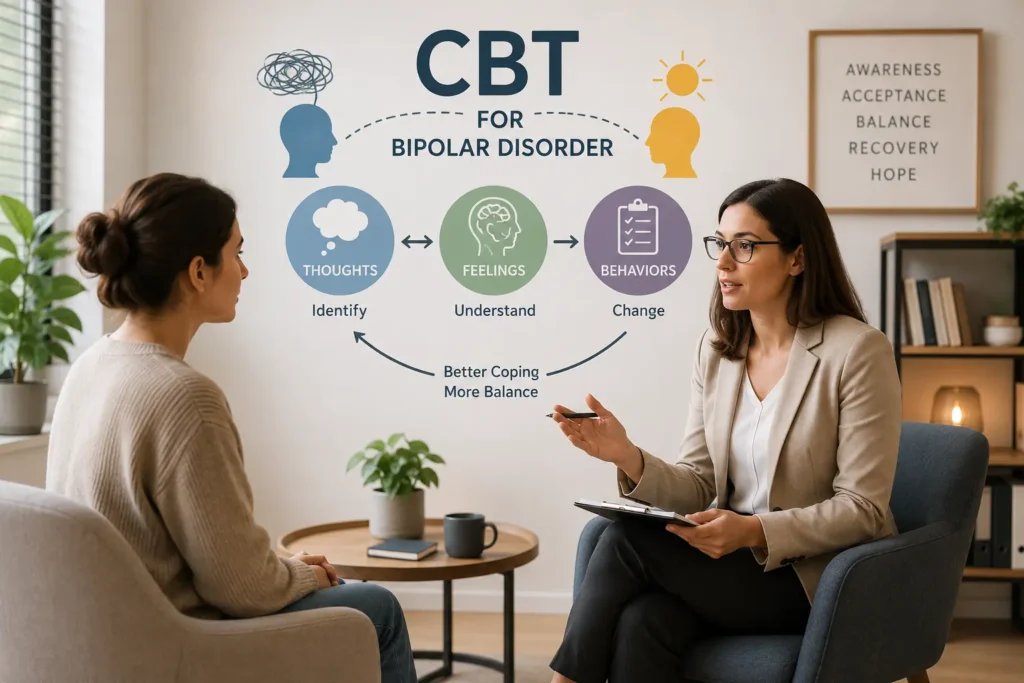
Cognitive behavioral therapy (CBT) for bipolar disorder is a structured, skills-based talk therapy that helps people recognize the thought patterns and behaviors that trigger mood episodes, and replace them with healthier coping strategies. It’s not a replacement for medication, but research shows it works well alongside mood stabilizers to reduce depressive symptoms, shorten relapses, and improve day-to-day functioning. A typical course runs 12 to 20 sessions and focuses on things like mood monitoring, sleep regulation, and catching early warning signs before an episode takes hold.
If you’re newer to the topic, our guide on what bipolar disorder is is a good place to start before diving into treatment details.
Table of Contents
Key Takeaways
- CBT is an evidence-based add-on treatment for bipolar disorder, not a stand-alone cure.
- It works best when combined with medication management, not instead of it.
- Core techniques include cognitive restructuring, behavioral activation, sleep and routine stabilization, and relapse-prevention planning.
- Studies show CBT is most effective for reducing bipolar depression and preventing relapse, with a smaller effect on manic symptoms.
- A licensed psychologist, psychiatrist, or clinical social worker trained in CBT typically delivers this therapy.
- It’s different from other bipolar-specific therapies like interpersonal and social rhythm therapy (IPSRT) or family-focused therapy (FFT), though they share some overlapping goals.
What Is Cognitive Behavioral Therapy for Bipolar Disorder?
Cognitive behavioral therapy is a form of psychotherapy built on a simple idea: the way we think shapes the way we feel and act. For someone managing bipolar disorder, that connection matters a lot. Distorted thinking — like assuming a low mood means a depressive episode is “unstoppable,” or believing a burst of energy means nothing is wrong — can quietly fuel a mood swing before the person even realizes what’s happening.
CBT for bipolar disorder adapts the standard CBT model to address the specific patterns that come with this condition. Instead of only working on general negative thinking (as CBT does for depression or anxiety), a bipolar-focused CBT program also targets:
- Recognizing personal early warning signs of mania or depression
- Correcting unhelpful beliefs about the illness itself (for example, “I don’t need my medication if I feel fine”)
- Building consistent daily routines, since irregular sleep and activity levels are known mood triggers
- Developing a written relapse-prevention plan
This isn’t a generic “think positive” approach. It’s a structured, skills-based process with homework, self-monitoring tools, and measurable goals — closer to physical therapy for the mind than a typical vent-and-listen counseling session.
For background on the different mood episodes CBT is designed to help manage, see our guides on bipolar disorder symptoms and mania.
Why CBT Is Used for Bipolar Disorder
Medication is the foundation of bipolar treatment — mood stabilizers, antipsychotics, and sometimes antidepressants manage the underlying biology of the condition. But medication alone doesn’t address everything. People still have to cope with:
- Stress and life events that can trigger episodes
- Medication non-adherence (skipping doses, especially during hypomania when someone feels “fine”)
- Sleep disruption
- Shame, stigma, or grief connected to the diagnosis
- Damaged relationships or job instability from past episodes
CBT fills these gaps. According to a large NIMH-funded trial, the Systematic Treatment Enhancement Program for Bipolar Disorder (STEP-BD), <cite index=”9-1″>intensive psychosocial treatments — including cognitive behavioral therapy, family-focused therapy, and interpersonal and social rhythm therapy — used alongside medication were more effective than brief psychoeducation alone at helping people recover from bipolar depression.</cite> That’s a meaningful finding: therapy isn’t a “nice extra,” it’s a measurable part of an effective treatment plan.
A more recent meta-analysis of randomized controlled trials found that <cite index=”10-1″>CBT produced a greater reduction in relapse rate specifically among people with bipolar I disorder</cite>, and that <cite index=”10-1″>longer sessions — 90 minutes or more — were associated with stronger improvements in both depressive symptoms and mania severity</cite>. In plain terms: CBT seems to work better when it’s given enough time and consistency, not squeezed into short check-ins.
It’s worth setting realistic expectations, though. Findings across studies aren’t uniform. <cite index=”3-1″>Reviews of the evidence describe CBT as effective for reducing symptoms of depression and mania and improving emotion regulation, particularly with longer-term treatment</cite>, while some meta-analyses report a smaller overall effect on core symptoms specifically, with more consistent benefits for functioning, relapse prevention, and reducing anxiety and insomnia. CBT is a genuine, evidence-supported tool — just not a guaranteed fix for every symptom.
For a full breakdown of how CBT fits alongside other options, visit our bipolar disorder treatment guide.
Core Techniques Used in CBT for Bipolar Disorder
| Technique | What It Involves | What It Targets |
| Mood monitoring | Daily tracking of mood, sleep, energy, and medication use | Early detection of mood shifts |
| Cognitive restructuring | Identifying and challenging distorted thoughts | Depressive or manic thinking patterns |
| Behavioral activation | Scheduling meaningful, achievable activities | Depressive withdrawal and low motivation |
| Sleep and routine stabilization | Setting consistent sleep/wake times and daily structure | Circadian triggers for mood episodes |
| Relapse-prevention planning | Building a written action plan for warning signs | Preventing full-blown manic or depressive episodes |
| Psychoeducation | Learning about the condition and treatment rationale | Medication adherence, stigma, insight |
| Problem-solving skills training | Structured approach to resolving stressors | Life stress that can trigger episodes |
Each technique is taught, then practiced as homework between sessions. This is one of the biggest differences between CBT and more open-ended talk therapy — progress is tracked, and skills are meant to be used independently once therapy ends.
What a Typical CBT Session Looks Like
A standard course of CBT for bipolar disorder usually spans 12 to 20 sessions, though this varies by therapist and clinical need. Sessions are typically broken into three general phases:
1. Assessment and Psychoeducation (Sessions 1–4)
The therapist gathers a mood history, discusses the diagnosis, and explains the CBT model. This phase often overlaps with reviewing bipolar disorder causes and personal triggers, so the person understands why certain patterns keep repeating.
2. Skill-Building (Sessions 5–14)
This is the core of treatment. Sessions focus on cognitive restructuring, routine stabilization, and identifying the specific early warning signs unique to that person — a change in sleep, sudden irritability, or racing thoughts, for example.
3. Relapse Prevention and Maintenance (Final Sessions)
The therapist and client build a detailed, written plan for what to do if warning signs appear, and sessions taper off to reinforce independent use of the skills learned.
Sessions are usually 45–90 minutes and may be weekly, tapering to biweekly or monthly as symptoms stabilize.
CBT vs. Other Therapies for Bipolar Disorder
CBT isn’t the only structured therapy used for bipolar disorder. Here’s how it compares to the other most-studied options.
| Therapy | Main Focus | Best For |
| Cognitive Behavioral Therapy (CBT) | Thought patterns, behavior change, relapse prevention | Depressive symptoms, medication adherence, overall coping |
| Interpersonal and Social Rhythm Therapy (IPSRT) | Stabilizing daily routines and sleep-wake cycles | People with strong routine or sleep disruption |
| Family-Focused Therapy (FFT) | Communication and problem-solving within the family | People whose relapses are tied to family stress |
| Psychoeducation (group or individual) | Understanding the illness and treatment | Newly diagnosed individuals, medication adherence |
| Dialectical Behavior Therapy (DBT) | Emotion regulation, distress tolerance | People with intense mood reactivity or self-harm risk |
These approaches aren’t mutually exclusive. Many treatment plans combine CBT with medication and, in some cases, elements of another therapy. A psychiatrist or therapist can help determine the right combination based on symptom patterns — something covered in more depth in our bipolar disorder diagnosis guide.
How Effective Is CBT for Bipolar Disorder?
Research on CBT for bipolar disorder is generally positive but nuanced — and it’s worth understanding both sides.
What the evidence supports:
- Reduced depressive symptoms, especially with longer or more intensive sessions
- Lower relapse rates, particularly in bipolar I disorder
- Improved psychosocial functioning (work, relationships, daily activities)
- Better medication adherence
- Reduced anxiety symptoms and improved sleep
Where the evidence is more mixed:
- Effects on manic symptoms specifically tend to be smaller and less consistent than effects on depression
- Some meta-analyses report only a modest overall effect size on core symptoms across all studies
- Results vary based on session length, therapist training, and how long treatment lasts
This mixed picture doesn’t mean CBT “doesn’t work” — it means it works best as one part of a broader treatment plan that includes medication, monitoring, and often family or lifestyle support. Anyone comparing therapy options should also look at our overview of bipolar disorder prognosis, since long-term outcomes depend on more than any single treatment.
Who Benefits Most From CBT
CBT tends to work best for people who:
- Are already on a stable medication regimen and want additional support
- Struggle more with depressive episodes than manic ones
- Have some insight into their condition and are willing to do between-session homework
- Want practical, structured tools rather than open-ended talk therapy
- Are working through medication ambivalence or adherence issues
It may be less of a fit — or need to be paired with other supports — for someone in the middle of an acute manic or mixed episode, since CBT requires a level of concentration and reflection that’s harder to access during acute mania. In those cases, stabilization typically comes first through medication and psychiatric care, with therapy introduced or resumed once the person is more stable.
Myths vs. Facts About CBT for Bipolar Disorder
| Myth | Fact |
| CBT can replace medication | CBT is an add-on treatment; research consistently shows better outcomes when it’s combined with medication, not used alone |
| CBT only helps with negative thinking | Bipolar-specific CBT also addresses sleep, routine, medication adherence, and relapse prevention |
| Therapy works the same for everyone | Response varies by bipolar subtype, session length, and consistency of attendance |
| One course of CBT “cures” bipolar disorder | Bipolar disorder is a chronic condition; CBT builds long-term coping skills but isn’t a cure |
| CBT is only useful during a crisis | CBT is typically most effective when started during a stable period, not during an acute episode |
For more myths worth knowing before starting treatment, see our dedicated page on bipolar disorder myths.
What to Expect When Starting CBT
Getting started with CBT for bipolar disorder generally follows a predictable path:
- Initial evaluation — A psychiatrist or therapist reviews your mood history, current medications, and treatment goals.
- Finding the right therapist — Look for someone trained specifically in CBT, ideally with experience treating bipolar disorder (not just depression or anxiety).
- Setting a baseline — Early sessions establish a mood-tracking routine so progress can be measured over time.
- Committing to homework — Between-session exercises are a core part of CBT; skipping them slows progress.
- Reviewing progress regularly — Most therapists reassess goals every few weeks and adjust the focus as needed.
Checklist: Is CBT Right for You?
- [ ] I’m currently stable enough to engage in structured, goal-oriented sessions
- [ ] I’m open to completing homework and tracking my mood between sessions
- [ ] I want practical coping tools, not just a space to talk
- [ ] I’m working with a psychiatrist or prescriber for medication management
- [ ] I’d like support with sleep, routine, or catching early warning signs
- [ ] I’m willing to commit to a course of therapy (typically several months)
If most of these apply to you, it’s worth raising CBT with your treatment team.
Warning Signs CBT Alone Isn’t Enough
CBT is a valuable tool, but it isn’t designed to manage every situation. Seek immediate psychiatric or medical care — not just a therapy appointment — if you or someone you know experiences:
- Thoughts of suicide or self-harm
- Signs of psychosis (hallucinations, delusions, disorganized thinking)
- A rapidly escalating manic episode with reckless or dangerous behavior
- Inability to care for basic needs (eating, sleeping, safety)
Emergency Help
If you or someone you know is in crisis or considering suicide, call or text 988 (Suicide & Crisis Lifeline) in the United States, available 24/7. If there’s immediate danger, call 911 or go to the nearest emergency room. This article is educational and does not replace emergency care or a personal treatment plan from a licensed provider.
Frequently Asked Questions
Does CBT work for bipolar disorder? Research supports CBT as an effective add-on treatment, particularly for reducing depressive symptoms, lowering relapse rates, and improving daily functioning. Its effect on manic symptoms specifically is smaller and less consistent across studies.
How long does CBT for bipolar disorder take? Most courses run 12 to 20 sessions over several months, though this can vary based on individual needs and how the person responds to treatment.
Can CBT replace bipolar medication? No. CBT is used alongside medication, not instead of it. Studies consistently show better outcomes when therapy and pharmacological treatment are combined.
What’s the difference between CBT and IPSRT for bipolar disorder? CBT focuses primarily on thought patterns and behavior change, while IPSRT centers on stabilizing daily routines and sleep-wake cycles. Both are evidence-based and sometimes used together.
Who provides CBT for bipolar disorder? Licensed psychologists, clinical social workers, or psychiatrists trained specifically in CBT techniques provide this therapy. Look for someone with experience treating bipolar disorder, not just general anxiety or depression.
Is CBT covered by insurance? Many insurance plans cover CBT when provided by a licensed mental health professional, though coverage details vary. Check with your insurance provider and prospective therapist about costs and coverage before starting.
Can CBT help during a manic episode? CBT is generally more effective when started during a stable period rather than an acute manic episode, since it requires sustained focus and reflection. During acute mania, medical stabilization typically comes first.
How is CBT different from regular talk therapy? CBT is structured, goal-oriented, and includes homework between sessions, whereas general talk therapy is often more open-ended and exploratory.
Summary
Cognitive behavioral therapy for bipolar disorder is a structured, evidence-supported therapy that helps people manage the thought patterns, routines, and early warning signs connected to mood episodes. It works best as part of a broader treatment plan that includes medication management and, ideally, support from a psychiatric provider. While it’s not a cure and its effect on manic symptoms is more modest than its effect on depression, CBT gives people practical tools to reduce relapse, improve daily functioning, and stay more consistent with treatment over the long term.
If you’re exploring treatment options further, our guides on bipolar disorder treatment and living with bipolar 1 or living with bipolar 2 offer a broader look at what ongoing care can look like.
This article is for educational purposes and is not a substitute for professional medical advice. Speak with a licensed psychiatrist or therapist to determine the right treatment plan for your situation.