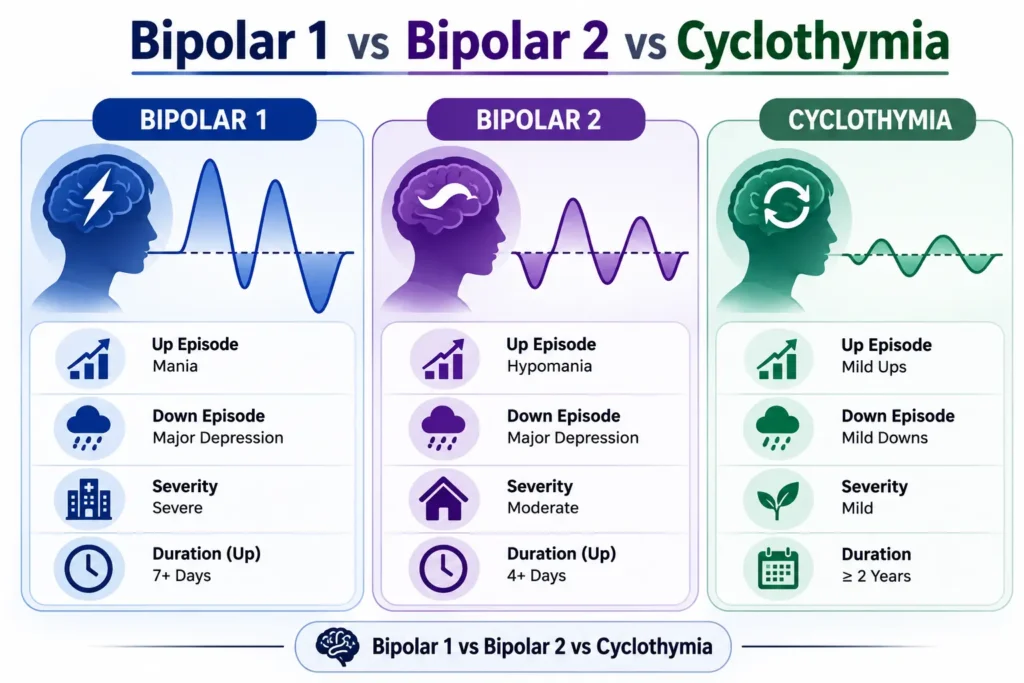
Bipolar 1, bipolar 2, and cyclothymic disorder are three related but distinct diagnoses on the bipolar spectrum, and the difference between them mostly comes down to how severe and how long the “high” episodes last. Bipolar 1 involves at least one full manic episode severe enough to disrupt daily life, sometimes with psychosis. Bipolar 2 involves hypomania (a milder high) plus major depression, without ever reaching full mania. Cyclothymic disorder is the mildest of the three: a long-term pattern of mild mood swings that never rise to the level of a full hypomanic or depressive episode, but persist for at least two years in adults. All three are real, diagnosable conditions — none is “more fake” or “less serious” than the others, even though cyclothymia is often misunderstood as not being a true form of bipolar disorder.
For a closer look at how bipolar 1 and bipolar 2 specifically compare, see our detailed bipolar 1 vs bipolar 2 guide.
Table of Contents
Key Takeaways
- All three diagnoses fall under the umbrella term bipolar disorder, and all involve shifts between elevated and low mood states.
- The core difference is episode severity and duration, not simply “how bad” someone’s life looks day to day.
- Bipolar 1 requires mania; bipolar 2 requires hypomania plus depression; cyclothymia requires neither to reach full-episode intensity, but the pattern must persist for years.
- Cyclothymia can, in some people, develop into bipolar 1 or bipolar 2 over time, which is one reason ongoing monitoring matters.
- Diagnosis depends on a detailed history, not a single conversation or online quiz.
- Effective treatment exists for all three, though it’s tailored to each condition’s pattern.
Where All Three Fit on the Bipolar Spectrum
Bipolar disorder isn’t one single condition — it’s a category that includes three primary diagnoses: bipolar I, bipolar II, and cyclothymic disorder, according to the American Psychiatric Association. Each represents a different pattern of mood episodes, and understanding where they overlap and where they diverge is the fastest way to make sense of a confusing diagnostic landscape.
If you’re brand new to this topic, it helps to start with our foundational guide on what bipolar disorder is before diving into how the three subtypes differ.
Think of the spectrum less like three separate boxes and more like a continuum of intensity:
- Cyclothymia sits at the milder end — chronic, low-grade mood instability.
- Bipolar 2 sits in the middle — clear hypomanic and depressive episodes, but never full mania.
- Bipolar 1 sits at the most severe end — at least one full manic episode, which can include psychosis.
Depressive episodes can appear in all three, though the way they’re counted differs by diagnosis, which we’ll break down section by section.
The Core Difference: Mania, Hypomania, and Sub-Threshold Mood Swings
This is the single most useful concept for understanding all three diagnoses, so it’s worth explaining clearly before anything else.
Mania is a period of at least one week (or any length if hospitalization is required) where a person is abnormally elevated, expansive, or irritable, with a noticeable increase in energy, and at least three additional symptoms such as decreased need for sleep, rapid speech, racing thoughts, distractibility, or risky, impulsive behavior. Mania is severe enough to disrupt work, relationships, or safety, and can involve psychotic features like delusions or hallucinations.
Hypomania is a shorter, milder version — at least four consecutive days of similar symptoms, but without the severe functional breakdown, hospitalization, or psychosis that defines mania.
Cyclothymic mood swings don’t meet the full symptom count or duration required for either a hypomanic or a major depressive episode. Instead, they’re a chronic pattern of “up and down” periods that are noticeable but fall short of a full clinical episode.
| Feature | Mania (Bipolar 1) | Hypomania (Bipolar 2) | Cyclothymic Mood Swings |
| Minimum duration | 7 days (or any length requiring hospitalization) | 4 consecutive days | Symptoms present at least half the time over 2+ years, never absent more than 2 months |
| Meets full episode criteria? | Yes | Yes (hypomanic episode) | No — falls short of a full episode |
| Psychosis possible? | Yes | No | No |
| Typical impact on daily function | Severe disruption, often requires hospital care | Noticeable, but daily functioning usually continues | Mild to moderate; often mistaken for personality or mood variability |
| Depressive episodes required for diagnosis? | Not required (though common) | Yes, at least one major depressive episode | No full depressive episodes — sub-threshold low moods instead |
For a full breakdown of these symptom categories, see our dedicated pages on bipolar disorder symptoms and the more specific bipolar 1 vs 2 symptoms comparison.
Bipolar 1 Disorder: The Defining Feature Is Full Mania
Bipolar 1 is diagnosed when a person has experienced at least one manic episode. Depressive or hypomanic episodes often occur too, but they aren’t required for the diagnosis — mania alone is enough.
People with bipolar 1 commonly also live with other conditions such as anxiety disorders, substance use disorders, or ADHD, and the risk of suicide is meaningfully higher in this group than in the general population, which is one reason ongoing psychiatric care matters so much.
Because mania can involve a serious loss of judgment, psychosis, or safety risks, bipolar 1 often requires more intensive treatment, including hospitalization during acute episodes. For a complete look at how this diagnosis is confirmed, visit our page on bipolar disorder diagnosis and our bipolar 1 vs 2 diagnosis comparison.
Bipolar 2 Disorder: Hypomania Plus Depression, Without Full Mania
Bipolar 2 requires at least one hypomanic episode and at least one major depressive episode — but never a full manic episode. If a manic episode ever occurs, the diagnosis changes to bipolar 1, regardless of how many hypomanic episodes came before it.
People with bipolar 2 often return to their usual level of functioning between episodes, and many first seek treatment because of depression rather than hypomania, since hypomanic periods can feel productive or even pleasant rather than distressing.
This diagnosis is frequently underestimated in severity. Bipolar 2 is not a “lighter version” of bipolar 1 — the depressive episodes can be just as disabling, and in some studies, people with bipolar 2 spend more total time in depressive states than people with bipolar 1 do. For the full picture, see our bipolar 1 vs bipolar 2 differences page, and if you’re wondering whether bipolar 2 can shift into bipolar 1 over time, our dedicated article on whether bipolar 2 can become bipolar 1 covers that question in depth.
Cyclothymic Disorder: The Chronic, Milder Pattern
Cyclothymic disorder — often shortened to “cyclothymia” — is a milder, more chronic form of bipolar disorder. Instead of distinct manic, hypomanic, or major depressive episodes, a person experiences frequent mood swings between hypomanic and depressive symptoms that never reach the intensity or duration needed for a full episode.
According to the American Psychiatric Association, cyclothymic disorder is diagnosed when someone has experienced numerous periods of hypomanic and depressive symptoms for at least two years (one year in children and teens), and during that time, the symptoms have been present for at least half the time and have never been absent for more than two months at a stretch.
Why Cyclothymia Is Often Missed or Misunderstood
Cyclothymia tends to fly under the radar for a few reasons:
- The mood swings can look like “just having an intense personality” rather than a clinical condition.
- Because no single episode is severe, people often don’t seek help until the cumulative pattern starts affecting relationships or work.
- It’s frequently confused with mood instability caused by other conditions, such as borderline personality disorder or ADHD, which require a different diagnostic approach.
Despite being milder in any single moment, cyclothymia is a chronic condition, and living with constant, low-grade mood instability for years can be genuinely exhausting, even without a single “big” episode ever occurring.
Can Cyclothymia Turn Into Bipolar 1 or Bipolar 2?
Yes, this is a recognized possibility. Because cyclothymia already involves a pattern of hypomanic-like and depressive-like symptoms, some people go on to develop a full hypomanic, manic, or major depressive episode later in life, at which point the diagnosis would be updated to bipolar 2 or bipolar 1 accordingly. This is part of why ongoing follow-up with a psychiatrist matters even when symptoms feel manageable.
Side-by-Side Comparison: Bipolar 1 vs Bipolar 2 vs Cyclothymia
| Category | Bipolar 1 | Bipolar 2 | Cyclothymic Disorder |
| Defining episode | At least one manic episode | Hypomanic + major depressive episode(s) | Chronic sub-threshold mood swings |
| Minimum episode duration | 7 days (mania) | 4 days (hypomania), 2 weeks (depression) | 2+ years overall pattern (1+ year in youth) |
| Psychosis possible | Yes | No | No |
| Hospitalization common | Yes, during manic episodes | Less common, mainly during severe depression | Rare |
| Depression required for diagnosis | No (though often present) | Yes | No full depressive episodes required |
| Functioning between episodes | Often returns to baseline | Frequently returns to baseline | Mood instability is more constant |
| Typical age of onset | Mid-20s on average | Often similar to bipolar 1 | Often earlier, sometimes adolescence |
| Can progress to a more severe diagnosis | N/A (most severe category) | Can convert to bipolar 1 | Can convert to bipolar 1 or bipolar 2 |
For an easy visual reference, our bipolar 1 vs 2 chart covers bipolar 1 and 2 in more depth, while the table above extends that comparison to include cyclothymia.
Causes and Risk Factors Across All Three
The exact cause of any bipolar spectrum disorder isn’t fully understood, but research points to a mix of biological and environmental contributors shared across bipolar 1, bipolar 2, and cyclothymia:
- Genetics: bipolar disorder runs strongly in families. Between 80 and 90 percent of people with a bipolar diagnosis have a relative with bipolar disorder or depression, according to the American Psychiatric Association.
- Brain chemistry and structure: differences in neurotransmitter signaling and brain excitability are believed to play a role.
- Environmental triggers: stress, major sleep disruption, and substance use can trigger mood episodes in people who are already vulnerable.
- Age of onset: the average age of onset for bipolar disorder is the mid-20s, though cyclothymia is sometimes recognized earlier, including in adolescence.
For a more complete look at underlying causes, see our dedicated guide on bipolar disorder causes.
How Each Diagnosis Is Confirmed
There’s no blood test or brain scan that diagnoses any of the three conditions. Instead, a psychiatrist or qualified mental health professional relies on:
- A detailed clinical interview covering the full history of mood episodes, not just current symptoms
- Information from family members or close contacts, since insight into one’s own hypomanic or manic behavior can be limited
- Ruling out other causes, including substance use, medical conditions, and other psychiatric diagnoses that can mimic mood instability
- Comparing the pattern, duration, and severity of symptoms against DSM-5 criteria for each specific diagnosis
Because the line between cyclothymia and bipolar 2, or between bipolar 2 and bipolar 1, depends on whether a full episode has ever occurred, an accurate diagnosis often takes time and more than one appointment. For a full explanation of this process, see our guides on bipolar disorder diagnosis and bipolar 1 vs 2 diagnosis. If you want a general sense of where your symptoms might fall before an appointment, our bipolar 1 vs 2 test and bipolar 1 vs 2 quiz are educational tools, not diagnostic substitutes.
Treatment Approaches Compared
Treatment overlaps across all three diagnoses but is adjusted based on severity and episode pattern.
| Treatment Area | Bipolar 1 | Bipolar 2 | Cyclothymic Disorder |
| Mood stabilizers | Central to treatment, often lithium or anticonvulsants | Commonly used | Sometimes used, often at lower intensity |
| Antipsychotic medication | Frequently used, especially with psychosis | Used selectively | Uncommon unless symptoms intensify |
| Antidepressants | Used cautiously; risk of triggering mania | Used cautiously and briefly; risk of triggering hypomania | Used with caution; monitored closely |
| Psychotherapy | Strongly recommended alongside medication | Strongly recommended alongside medication | Often a primary tool, especially for coping skills |
| Mood tracking / journaling | Helpful adjunct | Helpful adjunct | Frequently recommended as a core strategy |
| Hospitalization | Common during severe manic episodes | Less common | Rare |
Across all three conditions, medication is generally considered the cornerstone of treatment, with psychotherapy playing a strong supporting role in helping people understand their illness and stay consistent with treatment. For the full picture, visit our dedicated pages on bipolar disorder treatment and bipolar 1 vs 2 treatment.
Myths vs Facts
| Myth | Fact |
| “Cyclothymia isn’t a real diagnosis, just a personality trait.” | Cyclothymic disorder is a formally recognized DSM-5 diagnosis with specific criteria, not an informal label. |
| “Bipolar 2 is a milder, less serious version of bipolar 1.” | Bipolar 2 is a distinct diagnosis. Depressive episodes in bipolar 2 can be just as severe and long-lasting as those in bipolar 1. |
| “If you’ve never been hospitalized, you can’t have bipolar 1.” | Hospitalization is common but isn’t required for a diagnosis — the manic episode itself, and its severity, is what matters. |
| “Cyclothymia always progresses to full bipolar disorder.” | Some people with cyclothymia go on to develop bipolar 1 or 2, but this isn’t universal or guaranteed. |
| “You can self-diagnose which one you have based on symptoms alone.” | Distinguishing between the three requires a detailed clinical history and professional evaluation, since the differences hinge on episode duration and severity criteria that are easy to misjudge. |
For more common misconceptions, see our full bipolar disorder myths page.
Warning Signs and When to Seek Help
Regardless of which of the three conditions someone has or suspects they have, certain signs call for prompt professional attention:
- Sleep dropping to a few hours a night, or stopping altogether, without corresponding tiredness
- Grandiose or unrealistic beliefs about one’s abilities, wealth, or importance
- Reckless spending, impulsive sexual behavior, or other high-risk decisions that are out of character
- Hearing, seeing, or believing things that aren’t there
- Persistent thoughts of death or suicide
- Mood swings severe enough to seriously disrupt work, school, or relationships
Emergency Help
If psychosis, thoughts of suicide or self-harm, or behavior that puts someone at immediate risk appears, this is an emergency, not something to monitor from home. In the U.S., the 988 Suicide & Crisis Lifeline is available by call or text at any hour. If there’s immediate danger, call 911 or go to the nearest emergency room.
Complications and Long-Term Outlook
Left untreated, all three conditions can worsen quality of life over time, though the specific risks differ:
- Bipolar 1 carries the highest risk of hospitalization, psychosis, and safety-related complications during manic episodes.
- Bipolar 2 carries a substantial risk from depressive episodes, which can be prolonged and are sometimes underestimated because hypomania doesn’t look “sick” from the outside.
- Cyclothymia’s main risk is chronic instability that erodes relationships, work performance, or self-esteem over years, along with the possibility of progressing to a more severe diagnosis.
With consistent treatment, people across all three diagnoses can and do lead stable, productive lives. For more on long-term trajectories, see our pages on bipolar disorder prognosis and bipolar disorder complications.
Frequently Asked Questions
What’s the main difference between bipolar 1, bipolar 2, and cyclothymia? Bipolar 1 requires at least one full manic episode. Bipolar 2 requires hypomania plus major depression, without ever reaching full mania. Cyclothymia involves chronic mild mood swings that never reach the severity or duration of a full episode.
Is cyclothymia a type of bipolar disorder? Yes. The American Psychiatric Association classifies cyclothymic disorder as one of the three primary bipolar spectrum diagnoses, alongside bipolar 1 and bipolar 2.
Which is more serious: bipolar 1, bipolar 2, or cyclothymia? Severity isn’t only about which category sounds more intense. Bipolar 1 involves the most severe individual episodes, but bipolar 2’s depressive episodes and cyclothymia’s chronic instability both carry real, serious impact on quality of life.
Can cyclothymia turn into bipolar 1 or bipolar 2? Yes, this has been documented in some individuals over time, which is one reason ongoing psychiatric follow-up matters even when cyclothymia feels manageable.
Do all three conditions require medication? Medication, especially mood stabilizers, is typically central to treating bipolar 1 and bipolar 2. Cyclothymia is sometimes managed with psychotherapy alone, though medication may be added if symptoms intensify.
How is cyclothymia different from just having an intense or moody personality? Cyclothymia involves a specific clinical pattern: mood swings present for at least half of a two-year period, with no symptom-free stretch longer than two months. This chronic, near-constant pattern is what separates it from ordinary personality-based mood variation.
Can someone be misdiagnosed between these three conditions? Yes, this is common, especially between cyclothymia and bipolar 2, or between bipolar 2 and bipolar 1, since the distinctions depend on subtle differences in episode duration and severity that require a detailed history to assess accurately.
Summary
Bipolar 1, bipolar 2, and cyclothymic disorder all sit on the same diagnostic spectrum, but they aren’t interchangeable labels for the same experience. Bipolar 1 is defined by full mania, bipolar 2 by hypomania paired with major depression, and cyclothymia by a chronic pattern of milder mood swings that never reach full-episode intensity. None of the three is inherently “worse” in every sense — each carries its own risks, and each responds well to the right combination of treatment and consistent care.
If you recognize a pattern from this article in yourself or someone you care about, the next step isn’t to self-diagnose — it’s to bring what you’ve noticed to a psychiatrist or licensed mental health professional who can evaluate the full picture. For more background on where these three diagnoses fit within the broader condition, see our guides on types of bipolar disorder, bipolar disorder statistics, and our glossary for definitions of any terms covered here.
This article is for educational purposes and isn’t a substitute for a diagnosis or treatment plan from a licensed mental health professional. If you’re concerned about symptoms in yourself or someone else, please consult a psychiatrist or other qualified healthcare provider.