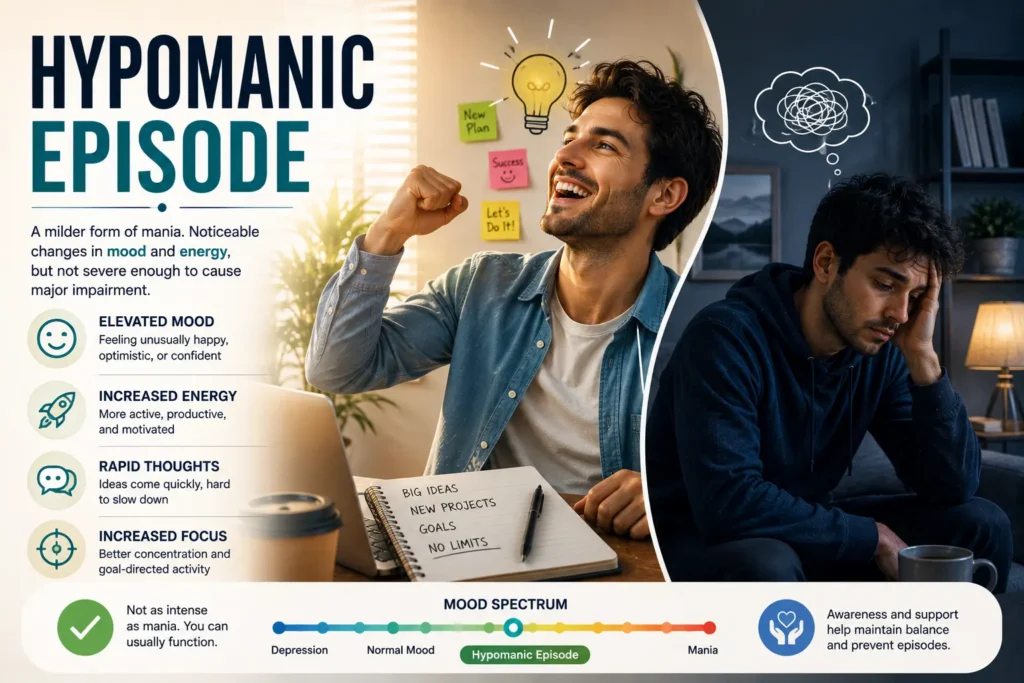
A hypomanic episode is a distinct period of elevated, expansive, or irritable mood and unusually high energy that lasts at least four consecutive days. It’s less severe than a manic episode — it doesn’t cause major disruption to daily life or require hospitalization — but it’s still a noticeable change that others usually pick up on. Hypomania is the defining feature of bipolar 2 disorder.
Table of Contents
Key Takeaways
- A hypomanic episode involves elevated mood and energy lasting at least four days in a row.
- Unlike mania, hypomania doesn’t include psychosis and doesn’t severely impair daily functioning.
- Hypomania is a core diagnostic feature of bipolar 2 disorder, not bipolar 1.
- Because it can feel productive or pleasant, hypomania is often missed or mistaken for simply “having a good week.”
- Left unrecognized, hypomanic episodes can still lead to poor decisions and often precede depressive episodes.
- Diagnosis requires a clinical evaluation; treatment usually combines mood stabilizers, therapy, and routine-building.
What Is a Hypomanic Episode?
A hypomanic episode is a real, measurable shift in mood and energy — not just a burst of enthusiasm or a productive streak. The word “hypo” means “below” or “less than,” so hypomania sits just under full-blown mania in terms of intensity.
According to the DSM-5, a hypomanic episode requires a distinct period of abnormally and persistently elevated, expansive, or irritable mood along with increased activity or energy, present most of the day, nearly every day, for at least four consecutive days. The mood change has to be different enough from the person’s usual self that other people notice it too.
What makes hypomania tricky to identify is that it often doesn’t feel like a problem. People in a hypomanic state may feel unusually confident, sociable, and energetic — which is part of why it’s frequently missed, both by the person experiencing it and by the people around them. To understand where hypomania fits within the broader condition, see our guides on what bipolar disorder is and the types of bipolar disorder.
Symptoms of a Hypomanic Episode
Hypomania touches mood, energy, thinking, and behavior — just to a lesser degree than mania.
| Category | Common Signs |
| Mood | Elevated, upbeat, or irritable mood |
| Energy | Increased activity, restlessness, feeling unusually driven |
| Sleep | Reduced need for sleep without feeling tired the next day |
| Speech | Talking more than usual, feeling chatty or “on” |
| Thinking | Sharper focus, racing or crowded thoughts, heightened creativity |
| Confidence | Increased self-esteem, feeling unusually capable |
| Behavior | Taking on new projects, being more social, mild impulsivity |
Unlike mania, hypomania does not involve delusions, hallucinations, or symptoms severe enough to require hospitalization. For a wider view of how these symptoms compare across mood states, see our full breakdown of bipolar disorder symptoms.
Why Hypomania Can Be Hard to Notice
Many people describe hypomania as feeling like their “best self” — more productive, more social, more creative. That’s exactly why it’s often missed in diagnosis. The mood shift is real, but because it doesn’t create an obvious crisis, people rarely think to mention it to a doctor unless they’re specifically asked.
Hypomanic Episode vs. Manic Episode vs. Normal Good Mood
This is one of the most searched comparisons, and for good reason — the differences matter for diagnosis and treatment.
| Feature | Normal Good Mood | Hypomanic Episode | Manic Episode |
| Duration | Hours to a day | At least 4 consecutive days | At least 7 days (or any length if hospitalized) |
| Impact on daily functioning | None | Noticeable, but manageable | Significant impairment |
| Sleep | Normal | Reduced, but not exhausting | Often minimal or absent |
| Judgment | Intact | Mildly affected | Frequently impaired |
| Psychosis | Never | Never | Possible |
| Hospitalization | No | No | Sometimes required |
For a full side-by-side comparison, read our dedicated guide on mania vs. hypomania. If you’re trying to figure out which condition someone’s symptoms point to, our bipolar 1 vs bipolar 2 comparison and bipolar 1 vs 2 chart can help clarify further, and our bipolar 1 vs 2 quiz is a useful starting point for self-reflection ahead of a professional evaluation.
What Causes a Hypomanic Episode?
Like other mood episodes, hypomania isn’t caused by one single factor. It usually results from a combination of biological vulnerability and environmental triggers.
| Contributing Factor | How It Plays a Role |
| Genetics | Family history of bipolar disorder raises risk significantly |
| Brain chemistry | Irregular activity involving neurotransmitters like dopamine |
| Sleep disruption | Losing sleep is one of the most common triggers for hypomania |
| Stress or major change | Both negative and positive life events can act as triggers |
| Substance use | Stimulants or alcohol can bring on or worsen symptoms |
| Antidepressant use | In some people with bipolar disorder, antidepressants alone can trigger hypomania |
| Seasonal shifts | Some people notice a seasonal pattern, often in spring |
For a deeper dive into biological and environmental causes across bipolar disorder generally, see bipolar disorder causes.
Risk Factors
- Family history of bipolar disorder
- A prior depressive or hypomanic episode
- Disrupted sleep patterns
- History of substance use
- Postpartum period, in some individuals
How Is a Hypomanic Episode Diagnosed?
There’s no lab test for hypomania — diagnosis relies on a clinical interview and history. A psychiatrist or qualified mental health professional will typically:
- Ask about mood, energy, and behavior changes lasting four or more days
- Check whether the changes were noticeable to others, not just the individual
- Rule out other explanations, including thyroid conditions, medications, or substance use
- Review whether depressive episodes have also occurred, since hypomania combined with depression points toward bipolar 2 disorder
- Compare the pattern against DSM-5 criteria for hypomanic episodes
Because people often don’t recognize hypomania as a symptom, input from family members or close friends is valuable during evaluation. For the full diagnostic process, see bipolar disorder diagnosis and, more specifically, bipolar 1 vs 2 diagnosis and bipolar 2 diagnosis.
How Long Does a Hypomanic Episode Last?
By definition, hypomania lasts at least four consecutive days, though episodes can extend for weeks in some cases. Compared to mania, hypomanic episodes are shorter and less intense, and they typically resolve without hospitalization.
| Phase | What Typically Happens |
| Onset | Subtle rise in energy, mood, and sociability |
| Peak | Increased productivity, confidence, and reduced need for sleep |
| Plateau | Symptoms remain steady, sometimes for days or weeks |
| Resolution | Mood gradually returns to baseline, sometimes followed by a depressive episode |
Hypomania and Bipolar 2 Disorder
Hypomanic episodes are the defining mood feature of bipolar 2 disorder, which also includes at least one major depressive episode. This is different from bipolar 1, which requires a full manic episode.
Because hypomania feels less disruptive than mania, bipolar 2 is sometimes underdiagnosed — people are more likely to seek help during depressive episodes and not mention the “up” periods at all. If you want to understand this diagnostic distinction in depth, our guides on bipolar 2, bipolar 2 symptoms, and bipolar 2 hypomania go further into this specific relationship.
Complications of Unrecognized Hypomania
Even though hypomania doesn’t require hospitalization, ignoring it isn’t harmless. Possible consequences include:
- Impulsive decisions around spending, relationships, or work commitments
- Strained relationships due to increased irritability or overcommitment
- Missed or delayed diagnosis of bipolar 2 disorder
- Higher risk of a depressive episode following the hypomanic period
- Reduced effectiveness of treatment if hypomania goes unreported to a clinician
For a broader look at how unmanaged mood episodes affect long-term health, see bipolar disorder complications.
Treatment for Hypomanic Episodes
Treatment focuses on stabilizing mood and preventing the cycle between hypomania and depression. This overview covers the basics — for full detail, see our complete guide on bipolar disorder treatment and, specifically, bipolar 2 treatment.
Common Treatment Approaches
| Approach | Purpose |
| Mood stabilizers | Reduce frequency and intensity of hypomanic episodes |
| Atypical antipsychotics | Sometimes used depending on symptom severity |
| Psychotherapy (e.g., CBT) | Builds coping skills and helps identify early warning signs |
| Sleep regulation | Protects against one of the most common triggers |
| Regular monitoring | Mood tracking helps catch early signs before escalation |
A psychiatrist should always guide medication choices, since treatment plans depend on individual history, especially if antidepressants are involved, given their potential to trigger hypomania in people with bipolar disorder.
Lifestyle Strategies That Help
- Keeping consistent sleep and wake times
- Limiting alcohol and recreational drug use
- Tracking mood patterns to catch early warning signs
- Reducing major decisions during an active episode
- Building a support system that can offer honest feedback
Warning Signs That Hypomania May Be Escalating
Hypomania can sometimes progress into full mania. Watch for:
- Increasingly reckless or impulsive behavior
- Growing irritability or agitation
- Any signs of unusual beliefs, paranoia, or perceptual changes
- Sleep dropping to little or none for multiple nights
- Family or friends expressing serious concern about behavior changes
If symptoms intensify to the point of psychosis, severe agitation, or safety concerns, this may indicate a shift toward a full manic episode, which requires more urgent care.
When to Seek Help
Hypomania on its own isn’t typically a medical emergency, but it’s still worth professional attention — especially because it often signals bipolar 2 disorder and tends to precede depressive episodes. Reach out to a mental health professional if:
- The pattern of elevated mood and energy repeats over time
- Family or friends have noticed a consistent shift in behavior
- Sleep, spending, or relationships are being affected
- Hypomanic periods are followed by depressive episodes
If symptoms escalate rapidly, involve safety risks, or include any loss of touch with reality, treat this as urgent and seek immediate care. In the US, the 988 Suicide & Crisis Lifeline is available 24/7 by call or text for any mental health crisis, not only suicidal thoughts.
Myths vs. Facts About Hypomanic Episodes
| Myth | Fact |
| Hypomania is just a good mood | It’s a distinct, diagnosable symptom involving a measurable change in energy and behavior |
| Hypomania is harmless | It can still lead to poor decisions and often precedes depressive episodes |
| Only people with bipolar 1 experience mood episodes like this | Hypomania is specifically tied to bipolar 2, not bipolar 1 |
| If someone seems fine, hypomania doesn’t need treatment | Recognizing and managing hypomania helps prevent escalation and mood cycling |
| Hypomania always turns into mania | Hypomania and mania are diagnostically distinct; hypomania doesn’t always progress to mania |
For more common misunderstandings across bipolar disorder generally, see bipolar disorder myths.
Prognosis and Long-Term Outlook
With consistent treatment, most people with hypomanic episodes manage their symptoms effectively and reduce how often episodes occur. Recognizing early warning signs, sticking to a treatment plan, and maintaining stable routines all improve long-term outcomes. For more on what to expect over time, see bipolar disorder prognosis and bipolar 2 prognosis.
Frequently Asked Questions
Is hypomania a mental illness on its own? No. Hypomania is a symptom, not a standalone diagnosis. It’s most often associated with bipolar 2 disorder.
Can hypomania turn into a manic episode? It’s possible, though not automatic. If someone’s hypomanic symptoms intensify, extend beyond a week, or begin to include psychosis or major impairment, it may indicate a manic episode rather than hypomania.
How long does a hypomanic episode last? By clinical definition, at least four consecutive days, though some episodes last longer.
What’s the main difference between hypomania and mania? Duration, severity, and impact. Mania lasts longer, causes major life disruption, can include psychosis, and sometimes requires hospitalization — hypomania does none of these. See our full mania vs. hypomania comparison.
Can antidepressants cause hypomania? In people with an underlying bipolar disorder, antidepressants can sometimes trigger a hypomanic episode. This is one reason accurate diagnosis matters before starting treatment.
Does everyone with bipolar 2 experience hypomania the same way? No. Symptoms, intensity, and triggers vary by person. Some notice mostly increased energy and confidence, while others notice more irritability or restlessness.
Should I see a doctor if I think I’ve had a hypomanic episode? Yes. Even though hypomania isn’t a medical emergency, a professional evaluation can clarify what’s happening and guide appropriate treatment, especially since hypomania often precedes depressive episodes.
Summary
A hypomanic episode is a genuine, diagnosable shift in mood and energy lasting at least four days — noticeable, but not as disruptive or severe as a full manic episode. It’s the defining feature of bipolar 2 disorder and, despite sometimes feeling positive or productive, deserves professional attention. With proper diagnosis, treatment, and routine-building, most people manage hypomanic episodes effectively over the long term. If you notice a pattern of elevated mood and energy in yourself or someone close to you, consider reaching out to a mental health professional for an evaluation.
This article is for educational purposes and is not a substitute for professional medical advice. If you or someone you know may be experiencing a hypomanic or manic episode, please consult a qualified healthcare provider.