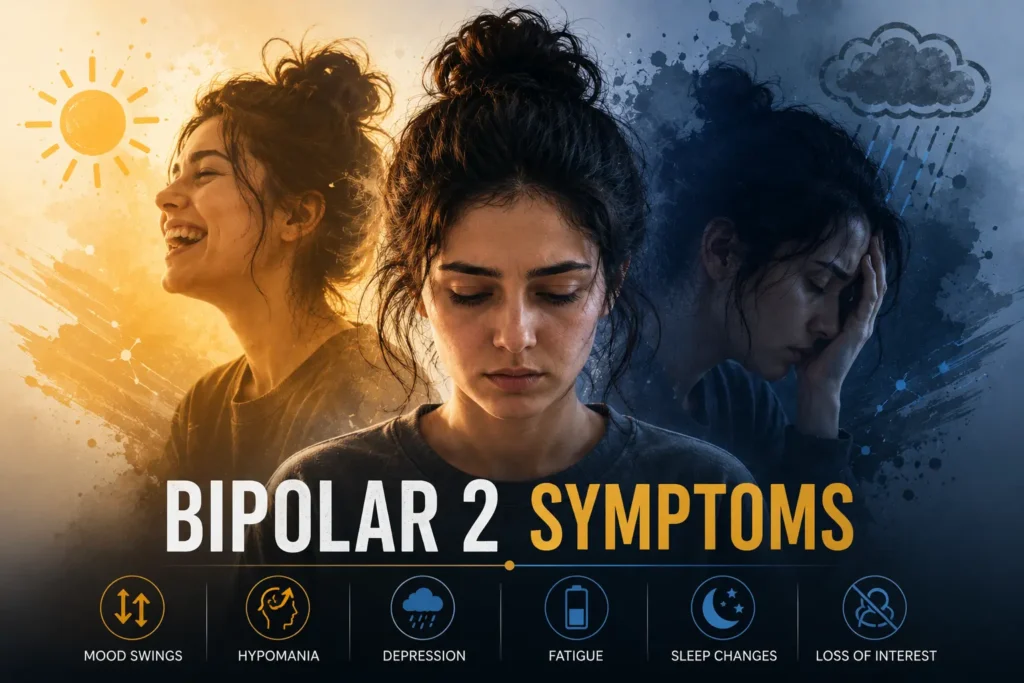
Bipolar 2 symptoms fall into two categories: hypomanic symptoms (elevated mood, high energy, less need for sleep, racing thoughts) and major depressive symptoms (persistent low mood, fatigue, loss of interest, feelings of worthlessness). What sets bipolar 2 apart is that the “up” episodes never reach full mania — they stay at the hypomanic level — while the depressive episodes tend to be longer, more frequent, and often the reason people first seek help.
Table of Contents
Key Takeaways
- Bipolar 2 involves two distinct symptom patterns: hypomania and major depression, and both must be present at some point for a diagnosis.
- Hypomanic symptoms are often mistaken for a good mood, high productivity, or personality rather than a mood episode.
- Depressive symptoms usually dominate the overall course of the illness and are what most people notice first.
- Symptom duration matters: hypomania must last at least four days, and depression at least two weeks, to meet clinical criteria.
- Recognizing the pattern — not just isolated symptoms — is what separates bipolar 2 from ordinary mood changes.
Introduction
Most people who search “bipolar 2 symptoms” aren’t looking for a textbook definition. They’re trying to figure out if what they — or someone they care about — are going through fits a pattern they’ve noticed: stretches of exhausting sadness, occasionally interrupted by short bursts of unusual energy, confidence, or restlessness.
That pattern is exactly what bipolar 2 looks like in real life. It rarely announces itself the way people expect. There’s no dramatic manic episode, no hospitalization from mania. Instead, the symptoms tend to be quieter, easier to explain away, and easier to miss — which is exactly why understanding them clearly matters. This guide breaks down the specific symptoms of bipolar 2, grouped by episode type, along with the warning signs that call for immediate professional attention.
For a full overview of the condition itself, including causes, diagnosis, and treatment, see our complete guide to bipolar 2 disorder. This article focuses specifically on what the symptoms look like and how to recognize them.
The Two Symptom Patterns in Bipolar 2
To meet diagnostic criteria under the DSM-5 (the American Psychiatric Association’s diagnostic manual), a person with bipolar 2 must have experienced:
- At least one hypomanic episode — lasting a minimum of four consecutive days
- At least one major depressive episode — lasting a minimum of two weeks
Both patterns need to show up at some point, though not necessarily close together. Some people go months or years between episodes. Others cycle more rapidly. What matters for a diagnosis isn’t how often symptoms occur, but whether they’ve occurred at all, and whether they meet the duration and severity thresholds. For the general symptom picture across all forms of the condition, see bipolar disorder symptoms.
Hypomanic Symptoms of Bipolar 2
Hypomania is the trickiest part of bipolar 2 to recognize, because it often doesn’t feel like a problem while it’s happening. People describe it as finally having energy, feeling unusually confident, or being unstoppably productive. The symptoms below need to represent a clear change from a person’s normal baseline — not just an unusually good day.
| Symptom | What It Looks Like Day-to-Day |
| Elevated, expansive, or irritable mood | Feeling unusually upbeat or, alternatively, unusually short-tempered and easily agitated |
| Increased energy and activity | Starting new projects, cleaning the entire house at 1 a.m., taking on more than usual without feeling tired |
| Decreased need for sleep | Feeling fully rested after 3–4 hours, without fatigue the next day |
| Rapid or pressured speech | Talking faster than usual, jumping between topics, hard for others to interrupt |
| Racing thoughts | Ideas moving quickly, difficulty slowing down mentally |
| Increased distractibility | Trouble focusing on one task before jumping to the next |
| Inflated self-esteem or confidence | Feeling unusually capable, sometimes overestimating one’s abilities |
| Increased goal-directed activity | Suddenly diving into work, hobbies, or social plans with unusual intensity |
| Impulsive or risky behavior | Overspending, impulsive decisions, increased risk-taking without weighing consequences |
For hypomania to count toward a diagnosis, these changes need to be noticeable to others, represent a clear shift from the person’s usual functioning, and last at least four days in a row. Unlike full mania, hypomania generally doesn’t involve psychosis or require hospitalization — it’s disruptive, but the person can typically still function.
How Hypomania Differs From Just Feeling Good
This is the single most common source of missed diagnoses. A genuinely good mood is usually tied to something — good news, a completed goal, a vacation — and it fades naturally. Hypomania tends to appear without a clear trigger, lasts longer than the situation would explain, and comes with a cluster of the symptoms above happening together, not just an improved mood on its own.
Depressive Symptoms of Bipolar 2
The depressive episodes in bipolar 2 look clinically similar to major depressive disorder, which is a major reason bipolar 2 so often gets misdiagnosed as regular depression, especially if a clinician never asks about past hypomanic episodes.
| Symptom | What It Looks Like Day-to-Day |
| Persistent sad, empty, or hopeless mood | Present most of the day, nearly every day, for at least two weeks |
| Loss of interest or pleasure | Withdrawing from hobbies, relationships, or activities once enjoyed |
| Fatigue or loss of energy | Feeling drained even after adequate rest |
| Changes in sleep | Insomnia, or sleeping significantly more than usual |
| Changes in appetite or weight | Noticeable weight loss or gain without trying |
| Difficulty concentrating or deciding | Trouble focusing at work, indecisiveness over small choices |
| Feelings of worthlessness or excessive guilt | Harsh self-criticism disproportionate to the situation |
| Psychomotor changes | Noticeably slowed movements/speech, or restlessness and agitation |
| Recurrent thoughts of death or suicide | Requires immediate professional attention |
Depressive episodes in bipolar 2 tend to be longer and more frequent than the hypomanic episodes, and they’re usually what pushes someone to seek help in the first place. This is one of the clearest patterns separating bipolar 2 from bipolar 1 symptoms, where the manic episodes are typically what bring someone into treatment.
Symptom Timeline: How Long Episodes Typically Last
| Episode Type | Minimum Duration for Diagnosis | Typical Real-World Pattern |
| Hypomanic episode | 4 consecutive days | Can range from several days to a few weeks |
| Major depressive episode | 2 consecutive weeks | Often lasts weeks to months without treatment |
| Mixed features (both present together) | Varies | Depressive symptoms with some hypomanic features simultaneously |
Some people also experience mixed features — depressive symptoms alongside a few hypomanic ones (like racing thoughts combined with low mood) at the same time. This mixed presentation can be especially distressing and is worth flagging clearly to a clinician, since it doesn’t always fit neatly into either category.
Bipolar 2 Symptoms vs. Bipolar 1 Symptoms
Because these two conditions get confused constantly, it helps to see the core symptom difference in one place.
| Feature | Bipolar 2 | Bipolar 1 |
| Elevated mood episode | Hypomania (milder, no psychosis) | Full mania (can include psychosis) |
| Hospitalization from elevated mood | Rarely needed | Often needed during severe mania |
| Depressive episodes | Usually more frequent and longer | Present, but pattern can vary |
| Functional impairment during “up” episodes | Present but manageable | Can be severe |
| Diagnosis often follows | A depressive episode | A manic episode |
This is a symptom-level snapshot only. For the full clinical comparison — including causes, treatment approaches, and diagnostic criteria — see our complete bipolar 1 vs bipolar 2 guide, our detailed bipolar 1 vs 2 symptoms breakdown, and the visual bipolar 1 vs 2 chart.
Symptom Checklist: Could This Be Bipolar 2?
This checklist is a starting point for organizing your observations before talking to a professional — it isn’t a diagnostic tool.
- Have you had a period of at least four days with noticeably less need for sleep, elevated or irritable mood, and increased energy?
- Did people around you notice a clear change during that time?
- Have you also had a period of at least two weeks with low mood, loss of interest, and low energy?
- Do the “up” periods feel different from your normal personality, not just a good mood?
- Have these patterns repeated more than once over time?
If you answered yes to most of these, the next step is a full evaluation — not a self-diagnosis. Our bipolar 1 vs 2 test and bipolar 1 vs 2 quiz can help you put your observations into words before that appointment.
Myths vs. Facts About Bipolar 2 Symptoms
| Myth | Fact |
| “If you’re not manic, it’s not really bipolar.” | Bipolar 2 is a distinct, clinically recognized diagnosis defined by hypomania, not full mania. |
| “Hypomania always feels good, so it can’t be a symptom.” | Hypomania can involve irritability, poor judgment, and impulsive decisions, not just a pleasant high. |
| “Depression is a separate problem from bipolar 2.” | The depressive episodes are a core, defining part of bipolar 2, not a separate condition layered on top. |
| “You’d definitely notice your own hypomania.” | Many people don’t recognize hypomania in themselves and only learn about it from others or in hindsight. |
| “Bipolar 2 symptoms look the same in everyone.” | Symptom intensity, frequency, and pattern vary significantly between individuals. |
For a broader set of misconceptions across all bipolar diagnoses, see bipolar disorder myths.
Warning Signs That Need Immediate Attention
Some symptoms go beyond a routine mood episode and require urgent action:
- Thoughts of suicide or self-harm
- A specific plan or intent to hurt yourself or someone else
- Severe hopelessness paired with reckless or dangerous behavior
- Inability to meet basic needs (eating, hygiene, safety) during an episode
- Symptoms of psychosis, such as hallucinations or delusions (this would point toward bipolar 1 rather than bipolar 2, and needs urgent evaluation either way)
If you or someone you know is showing these signs, call or text 988 (the Suicide & Crisis Lifeline in the U.S.) or go to the nearest emergency room immediately. Don’t wait for a scheduled appointment when safety is a concern.
What to Do If You Recognize These Symptoms
Noticing these patterns in yourself or someone else is the first step, not the last. From here:
- Track your mood. Write down mood, sleep, and energy patterns over a few weeks — this becomes valuable information for a clinician.
- Book an evaluation. A psychiatrist or psychologist can assess your full history, not just current symptoms. Learn what that process involves in our guide to bipolar disorder diagnosis and our bipolar 2–specific breakdown of bipolar 1 vs 2 diagnosis.
- Be honest about past “up” periods, even ones that felt good at the time — this is often the missing piece in an accurate diagnosis.
- Ask about treatment options. Effective management usually combines medication and therapy; see our full guide to bipolar disorder treatment and the bipolar 2–specific approach in bipolar 1 vs 2 treatment.
Frequently Asked Questions
What are the first signs of bipolar 2? Early signs often include a noticeable shift in sleep needs, energy, and mood — either an unusual high with less need for sleep, or a persistent low mood and loss of interest that lasts more than two weeks.
What does bipolar 2 hypomania feel like? Many describe it as feeling unusually confident, energetic, and mentally quick — sometimes pleasant, sometimes irritable — but it’s a clear departure from their normal baseline and is often noticed by people around them before they notice it themselves.
Can you have bipolar 2 with depression only, and no noticeable highs? No — a diagnosis requires at least one documented hypomanic episode at some point, even if it wasn’t recognized as a symptom when it happened. This is why clinicians ask detailed questions about past mood history.
How long do bipolar 2 mood episodes last? Hypomanic episodes must last at least four consecutive days, and major depressive episodes at least two weeks, to meet diagnostic criteria. In practice, depressive episodes are often much longer.
What’s the difference between bipolar 2 symptoms and regular mood swings? Regular mood swings are usually shorter, tied to specific triggers, and don’t involve the sustained cluster of symptoms (like decreased need for sleep or persistent low mood) required for a bipolar 2 diagnosis.
Can bipolar 2 symptoms change over time? Yes. Episode frequency and intensity can shift throughout life, which is part of why ongoing follow-up with a mental health professional matters, even during stable periods.
Are bipolar 2 symptoms the same in men and women? There are some documented differences in presentation and episode patterns between men and women. For a detailed comparison, see bipolar 1 vs 2 in men and women.
Summary
Bipolar 2 symptoms show up in two distinct patterns: hypomania, which is easy to mistake for a good mood or high productivity, and major depression, which tends to be longer, more frequent, and usually the reason people first seek help. Recognizing both patterns — not just one — is what separates bipolar 2 from everyday mood changes or standard depression. If these symptoms sound familiar, the most useful next step is a full evaluation with a qualified mental health professional. For the complete picture, including causes, diagnosis, and treatment, visit our full guide to bipolar 2 disorder.
This article is for educational purposes and is not a substitute for professional medical advice. Always consult a qualified healthcare provider for diagnosis and treatment.