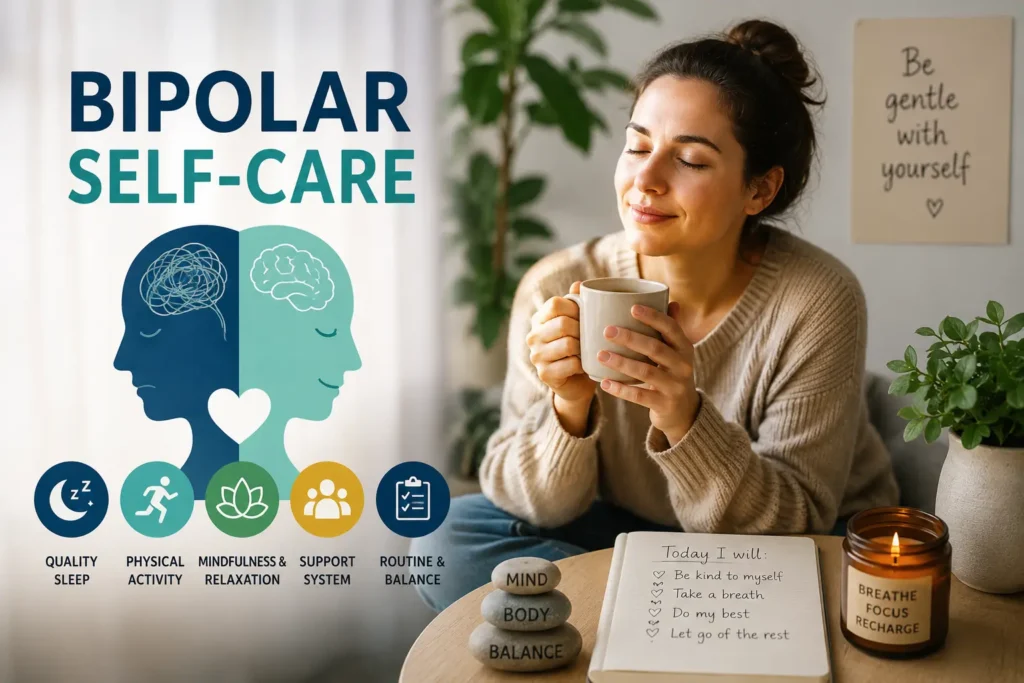
Bipolar self-care means building daily habits — steady sleep, mood tracking, stress management, medication adherence, and a strong support network — that work alongside professional treatment to reduce the frequency and severity of mood episodes. Self-care doesn’t replace therapy or medication; it’s the daily scaffolding that makes treatment work better. The goal isn’t a “perfect” routine, it’s consistency you can actually sustain.
Table of Contents
Introduction
If you’re living with bipolar disorder, you’ve probably already noticed something: the days you feel most stable are rarely random. They’re usually the days you slept enough, ate on some kind of schedule, and didn’t let stress pile up unchecked. That’s not a coincidence — it’s the whole idea behind self-care for bipolar disorder.
Self-care in this context isn’t bubble baths and scented candles. It’s a structured, sometimes unglamorous set of habits that help regulate your internal clock, your stress response, and your early-warning system for mood changes. Research consistently links irregular routines to mood instability in bipolar disorder, which is why so much of what follows centers on rhythm — sleep rhythm, meal rhythm, activity rhythm.
This guide walks through what actually works, based on guidance from organizations like the National Institute of Mental Health (NIMH), the American Psychiatric Association, and the NHS, plus the practical, lived-experience side of managing symptoms day to day. If you’re newer to the diagnosis, it may help to first read about what bipolar disorder is and the different types of bipolar disorder, since self-care strategies can shift slightly depending on whether you’re managing bipolar 1 or bipolar 2.
Key Takeaways
- Self-care supports treatment — it does not replace medication or therapy.
- Sleep regularity is one of the single most protective factors against mood episodes.
- Mood tracking helps you and your care team catch early warning signs before a full episode develops.
- Stress, substance use, and disrupted routines are the three most common episode triggers.
- A written relapse prevention plan, created while you’re stable, is one of the most effective self-care tools available.
- Self-care is not a substitute for emergency help — some warning signs need immediate medical attention.
Why Self-Care Matters So Much in Bipolar Disorder
Bipolar disorder affects the brain’s mood-regulation and circadian (internal body clock) systems. That’s why the same lifestyle factors that seem like “generic wellness advice” for other people — sleep, routine, stress reduction — actually carry clinical weight here. The causes of bipolar disorder involve a mix of genetics, brain chemistry, and environmental triggers, and self-care mainly works on that third piece: the environmental and behavioral triggers you have some control over.
This matters because bipolar disorder is a long-term condition. Understanding the likely prognosis of bipolar disorder can be reassuring here — many people achieve long stretches of stability, and self-care habits are one of the biggest levers you have in getting there. It also helps to know what can go wrong without adequate management; the complications of bipolar disorder — from relationship strain to hospitalization — are largely tied to unmanaged mood episodes, not the diagnosis itself.
The Core Pillars of Bipolar Self-Care
Most effective self-management approaches fall into a handful of categories. Think of these less as a checklist and more as levers — you don’t need to max out every one, but neglecting several at once is usually when trouble starts.
1. Sleep Regularity
Sleep is arguably the single most researched self-care factor in bipolar disorder. Losing even one night of sleep can trigger a manic episode in some people, and chronic sleep disruption is strongly linked to depressive episodes as well.
Practical steps:
- Go to bed and wake up at the same time every day, including weekends.
- Avoid major schedule shifts (travel, all-nighters, shift work) without a plan to buffer the change.
- Watch for early insomnia or a reduced need for sleep — this is a well-documented early sign of an emerging manic episode. Understanding mania and sleep can help you recognize this pattern early.
- If you struggle with sleep chronically, mention it to your prescriber — some medications affect sleep, and dose timing can sometimes be adjusted.
2. Mood and Symptom Tracking
Mood charting is one of the most consistently recommended self-management tools by clinicians. The idea is simple: rate your mood, sleep, energy, and any symptoms daily, so patterns become visible over weeks and months instead of staying invisible day to day.
What to track:
| What to Track | Why It Matters |
| Mood (low to high scale) | Reveals cycling patterns over time |
| Sleep hours and quality | Sleep loss often precedes mood shifts |
| Energy level | Rising energy can signal early hypomania/mania |
| Irritability or anxiety | Often an early depressive or mixed-state marker |
| Medication taken (yes/no) | Flags missed doses that may explain instability |
| Major stressors or events | Connects triggers to mood changes |
Bring this log to appointments. It gives your care team objective data instead of relying on memory, which is notoriously unreliable during mood episodes.
3. Medication Adherence
Self-care and medication aren’t competing strategies — adherence is a self-care habit. Missed doses are one of the most common causes of relapse. If side effects are the issue, that’s worth raising directly with your prescriber rather than stopping on your own; a browse through bipolar medication side effects can help you frame that conversation. If you’re weighing whether to stop a medication for any reason, read about stopping bipolar medication safely first — abrupt discontinuation carries real risks.
Simple adherence tools:
- Pill organizers sorted by day and time
- Phone reminders tied to an existing habit (e.g., “after brushing teeth”)
- A visible tracking chart, checked off daily
- Refilling prescriptions before you run out, not the day of
4. Stress Management
Stress doesn’t cause bipolar disorder, but it’s one of the most reliable episode triggers once the condition is present. Effective stress management isn’t about eliminating stress — that’s unrealistic — it’s about building a buffer.
Approaches with evidence behind them include:
- Structured relaxation practices — breathing exercises, progressive muscle relaxation, or mindfulness-based stress reduction.
- Regular, moderate exercise — linked to improved mood stability, though intense exercise late at night can disrupt sleep, so timing matters.
- Boundaries around overcommitment — saying no to added obligations during periods of high stress or early symptom changes.
- Scheduled downtime — treating rest as a non-negotiable part of your calendar, not something you get to “if there’s time.”
5. Nutrition and Substance Use
There’s no specific “bipolar diet,” but two things are well established: irregular eating patterns can disrupt the same circadian rhythms that regulate mood, and alcohol or recreational drug use significantly raises the risk of mood episodes and interacts poorly with many medications. If substance use is a factor for you, it’s worth discussing openly with your care team — it changes how treatment should be approached.
6. Routine and Structure
Interpersonal and Social Rhythm Therapy (IPSRT), a therapy approach specifically designed for bipolar disorder, is built entirely around this idea: keeping wake time, meals, activity, and social contact on a consistent daily schedule helps stabilize mood. You don’t need formal therapy to borrow the core principle — a loosely consistent daily structure is protective on its own. For a deeper look at therapy options built around this idea, see therapy for bipolar disorder.
7. Support Systems
Isolation tends to worsen both depressive and manic symptoms — depression by removing accountability and connection, mania by removing the “reality checks” that friends and family often provide. A support system might include a therapist, psychiatrist, trusted friends or family, or a peer support group. If you’re supporting a partner or family member instead of managing this yourself, how to help someone with bipolar disorder is a useful next read, as is our guide on bipolar disorder and relationships.
Building a Personal Relapse Prevention Plan
One of the most practical things you can do — ideally while you’re stable, not mid-crisis — is write down a relapse prevention plan. This typically includes:
- Your personal early warning signs for both mania/hypomania and depression (these are often different for each person).
- Known triggers — situations, seasons, or events that have preceded past episodes.
- A response plan — who to call, what to adjust, and when to contact your prescriber if symptoms appear.
- Emergency contacts, including your psychiatrist, therapist, and a trusted family member or friend.
- A list of what has helped before, and what hasn’t.
For a more detailed walkthrough, see our dedicated guide on bipolar relapse prevention. This kind of plan is also one of the most effective tools for reducing the need for hospitalization for bipolar disorder, because it catches shifts before they escalate.
Self-Care During a Manic or Hypomanic Episode
Early-stage mania and hypomania can feel productive or even pleasant, which is part of what makes it risky — insight is often reduced. Helpful self-care steps at this stage include:
- Sticking rigidly to a sleep schedule, even if you don’t feel tired
- Avoiding major financial or life decisions until the episode passes
- Reducing stimulating input — caffeine, loud environments, high-stimulation activities
- Letting a trusted person know what’s happening, since they may notice changes before you do
Learning to recognize your own mania symptoms or hypomania symptoms ahead of time makes this stage far easier to manage.
Self-Care During a Depressive Episode
Depressive episodes in bipolar disorder often call for smaller, more achievable goals rather than an ambitious self-care overhaul. Useful approaches include:
- Breaking tasks into very small steps (e.g., “get out of bed,” not “clean the whole house”)
- Maintaining at least minimal social contact, even briefly
- Keeping consistent light exposure — morning light in particular can help regulate mood-related rhythms
- Avoiding alcohol, which worsens depressive symptoms despite short-term relief
If depressive symptoms are new to you, our guide to bipolar depression symptoms can help you identify what you’re experiencing.
Myths vs. Facts About Bipolar Self-Care
| Myth | Fact |
| “Self-care can replace medication.” | Self-care supports treatment; it doesn’t substitute for medication or therapy in most cases. |
| “If I feel fine, I can skip my routine.” | Feeling stable is often the result of the routine, not a sign it’s no longer needed. |
| “Mood tracking is only useful for severe cases.” | Tracking is useful at every stage — it’s how mild patterns get caught before they become severe. |
| “Exercise alone can manage bipolar disorder.” | Exercise helps, but isn’t sufficient on its own without medical treatment. |
| “Self-care means avoiding all stress.” | The goal is managing and buffering stress, not eliminating it — that’s not realistic. |
For a broader list of misconceptions, see our full guide on bipolar disorder myths.
A Simple Weekly Self-Care Checklist
- [ ] Same wake-up time, 7 days a week (±30 minutes)
- [ ] Mood/sleep log filled in daily
- [ ] Medications taken as prescribed, no missed doses
- [ ] At least 3 meals or snacks eaten on a consistent schedule
- [ ] Some form of movement or exercise, most days
- [ ] One check-in with a support person during the week
- [ ] Limited or no alcohol/recreational substance use
- [ ] A few minutes of stress-reduction practice (breathing, mindfulness, etc.)
Warning Signs That Need Professional Attention
Self-care is not a substitute for professional care when symptoms escalate. Contact your psychiatrist or therapist if you notice:
- A significantly reduced need for sleep over several nights
- Racing thoughts, rapid speech, or impulsive risk-taking
- Symptoms of psychosis — psychosis in mania is a medical priority, not something to self-manage
- Persistent low mood, hopelessness, or loss of interest lasting more than two weeks
- Any thoughts of self-harm or suicide
Emergency Help
If you or someone you know is in immediate danger, or is having thoughts of suicide or self-harm, please seek help right away:
- In the US, call or text 988 (Suicide & Crisis Lifeline), available 24/7
- In the UK, call 111 or the Samaritans at 116 123
- If there is immediate danger to life, call your local emergency number (911, 999, 112, etc.)
Self-care strategies are meant to support daily stability — they are not designed to manage a crisis, and reaching out for professional or emergency support in that moment is the right call, not a failure of self-management.
Frequently Asked Questions
What is the best self-care routine for bipolar disorder? There’s no single “best” routine — the most effective one is whichever combination of consistent sleep, mood tracking, medication adherence, and stress management you can realistically sustain long-term.
Can bipolar disorder be managed without medication through self-care alone? For most people, no. Self-care works alongside medication and therapy rather than replacing them. Speak with your prescriber before making any changes to treatment; our guide on bipolar treatment without medication covers this question in more depth.
How do I know if my self-care routine is working? A working routine usually shows up as fewer or milder mood episodes over time, more predictable sleep, and fewer missed medication doses — mood tracking data is the clearest way to see this objectively.
Does exercise help with bipolar disorder? Regular, moderate exercise is associated with improved mood stability, but intense exercise late at night can disrupt sleep and should be timed carefully.
What triggers bipolar mood episodes the most? Sleep disruption, high stress, substance use, and missed medication are among the most commonly reported triggers, though triggers for mania can be quite individual.
Is self-care different for bipolar 1 vs. bipolar 2? The core principles are the same, but the intensity of monitoring can differ — see our comparison of bipolar 1 vs bipolar 2 for how symptom severity affects day-to-day management.
How can family members support someone’s bipolar self-care? Family members can help by learning the person’s early warning signs, encouraging routine without controlling it, and knowing the relapse prevention plan in advance — see how to help someone with bipolar disorder for specifics.
Summary
Bipolar self-care isn’t a cure, and it isn’t optional wellness advice — it’s a practical, evidence-informed layer of daily management that works alongside medication and therapy. Regular sleep, honest mood tracking, medication adherence, stress buffering, and a support network are the pillars that show up again and again in clinical guidance from organizations like NIMH, the APA, and the NHS. None of it needs to be perfect. It needs to be consistent enough that patterns become visible, and early warning signs get caught before they become full episodes. If you haven’t already, working with your care team to build a written relapse prevention plan is one of the highest-value steps you can take next.
This article is for educational purposes and is not a substitute for personalized medical advice. Please consult a qualified healthcare professional for diagnosis and treatment decisions.