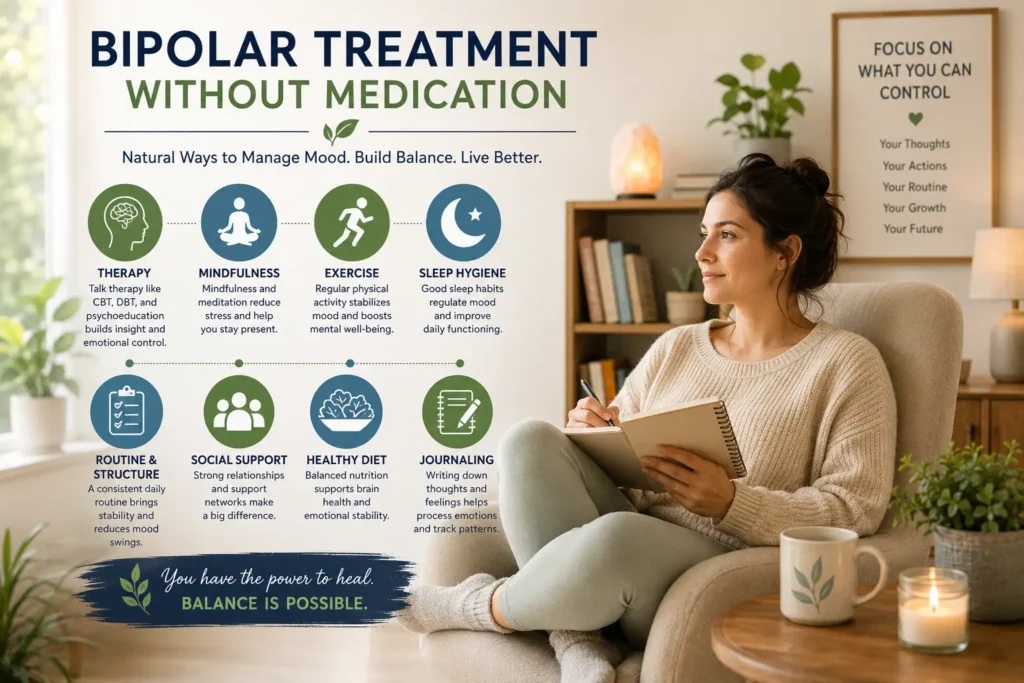
Bipolar Treatment Without Medication: There’s no natural treatment or therapy proven to replace medication for bipolar disorder. Mood stabilizers, antipsychotics, and other prescribed medications remain the foundation of treatment because they directly target the biological processes behind manic and depressive episodes. That said, several non-drug approaches—including structured therapy, sleep and routine stabilization, exercise, and select supplements like omega-3 fatty acids—have research support as add-ons to medication, not substitutes for it. If you’re looking to manage bipolar disorder with fewer medication side effects or want to strengthen your treatment plan beyond a prescription, this guide covers what actually has evidence behind it, and what doesn’t.
For background on the condition itself before exploring treatment options, see our guide on what bipolar disorder is.
Table of Contents
Key Takeaways
- No supplement, therapy, or lifestyle change has been shown to safely replace medication for bipolar disorder.
- Some non-drug approaches — psychotherapy, sleep regulation, exercise, and omega-3 fatty acids — have real evidence as complementary treatments used alongside medication.
- A few popular “natural” options, including St. John’s wort and SAMe, carry a documented risk of triggering mania and should not be used without medical supervision.
- Stopping bipolar medication without a doctor’s guidance is one of the most common triggers for relapse and hospitalization.
- The right question usually isn’t “medication or no medication” — it’s “what can I add to my treatment plan to support the medication I’m already on.”
- People considering coming off medication should always talk to a psychiatrist first, ideally with a structured tapering plan in place.
Why This Question Comes Up So Often
Searching for “bipolar treatment without medication” usually comes from one of a few places: frustration with side effects, concern about long-term medication use, a preference for natural approaches, or simply wanting to understand all the options before starting or continuing a prescription. All of these are reasonable things to want clarity on.
But it’s worth being direct about something upfront: bipolar disorder is a biologically-based mood disorder, and unmedicated bipolar disorder tends to follow an unpredictable and often more severe course. That doesn’t mean medication is the only thing that matters — therapy, lifestyle, and support systems all play a real role. It means the honest answer to “can I manage bipolar disorder without medication” is nuanced, not a simple yes.
This article breaks down what actually has evidence behind it, so you can have an informed conversation with your care team — not to talk you out of asking the question. For a fuller look at how medication and other treatments fit together, see our complete guide to bipolar disorder treatment.
Why Medication Is Still Considered the Foundation of Treatment
Bipolar disorder involves shifts in mood, energy, and activity levels that are driven by changes in brain chemistry and function — not simply stress or mindset. Medications like mood stabilizers (lithium, valproate, lamotrigine) and certain antipsychotics work directly on those underlying processes to prevent and shorten manic, hypomanic, and depressive episodes.
Research consistently shows that <cite index=”25-1″>conventional treatments such as lithium, valproate, and lamotrigine, along with second-generation antipsychotics like quetiapine, play a central role in managing bipolar disorder</cite>, even though side effects and adherence challenges are real and valid concerns for many people.
This is why most non-drug approaches discussed below are studied — and recommended — as adjunctive treatments: things used in combination with medication, not instead of it. A review specifically focused on complementary approaches for mood disorders concluded that <cite index=”22-1″>better-quality studies are still needed before complementary interventions can be broadly recommended, and that patients should be informed of the potential risks associated with these approaches</cite> in the meantime.
If you’re weighing medication concerns specifically, it may help to understand your diagnosis in more depth first — see our guides on bipolar disorder causes and bipolar disorder diagnosis.
Non-Drug Approaches With the Strongest Evidence
These approaches have meaningful research support as additions to a medication-based treatment plan.
| Approach | What It Involves | Evidence Level |
| Structured psychotherapy (CBT, IPSRT, DBT, family-focused therapy) | Skills-based therapy targeting thought patterns, routines, or emotional regulation | Strong — supported by multiple randomized controlled trials |
| Sleep and routine stabilization | Consistent sleep/wake times, regular daily structure | Strong — disrupted sleep is a well-established trigger for mood episodes |
| Omega-3 fatty acids | Fish oil or algae-based EPA/DHA supplementation | Moderate — <cite index=”22-1″>Level 1 evidence exists for adjunctive omega-3s specifically in bipolar depression</cite>, though effects on mania are not established |
| Exercise | Regular aerobic activity | Moderate — supported mainly for depressive symptoms, less evidence for mania |
| Light exposure management | Regulating exposure to bright light and blue light, especially around sleep | Emerging — some support for regulating both depressive and manic symptoms through circadian rhythm stabilization |
| Psychoeducation | Structured learning about the condition, triggers, and treatment | Strong — improves treatment adherence and relapse recognition |
Structured therapy has the most consistent evidence of any non-drug approach. Our dedicated guides on cognitive behavioral therapy for bipolar disorder and dialectical behavior therapy for bipolar disorder go into detail on how each of these works.
Supplements and “Natural” Options: What the Research Actually Shows
This is where a lot of misinformation circulates, so it’s worth being precise.
| Supplement/Approach | What the Evidence Shows | Key Caution |
| Omega-3 fatty acids (fish oil) | Some support for reducing depressive symptoms; <cite index=”21-1″>manic symptoms are not affected, and higher doses appear to be needed in treatment-resistant bipolar depression</cite> | Generally well-tolerated, but not a stand-alone treatment |
| St. John’s wort | Evidence supports use for mild-to-moderate unipolar depression | <cite index=”23-1″>Carries a documented risk of inducing mania</cite> and interacts with many medications — not recommended without medical guidance |
| SAMe (S-adenosylmethionine) | Some evidence for depressive symptoms in general populations | <cite index=”23-1″>Also carries a potential risk of triggering mania</cite> |
| Inositol, choline, N-acetylcysteine | <cite index=”21-1″>Described as effective adjuncts in some bipolar studies</cite>, primarily for depressive symptoms | Data are limited; should be used only under medical supervision |
| Acupuncture | <cite index=”27-1″>One study found favorable but not statistically significant effects on both mania and depression</cite> | Evidence is too limited to recommend as primary treatment |
| Yoga, aromatherapy, massage therapy | <cite index=”22-1″>Data on these approaches in bipolar disorder are almost entirely lacking</cite> | May support general wellbeing but shouldn’t be relied on for mood stabilization |
The pattern here matters: even the “natural” options with real research behind them are studied as additions to medication, and a couple of the most popular ones — St. John’s wort and SAMe — are specifically flagged for their potential to trigger manic episodes. That’s a meaningful risk, not a minor footnote.
Lifestyle Habits That Genuinely Support Mood Stability
Beyond formal therapy and supplements, day-to-day habits play a documented role in reducing episode frequency and severity.
Sleep Consistency
Irregular sleep is one of the most well-established triggers for both manic and depressive episodes. Going to bed and waking up at consistent times — even on weekends — helps stabilize the internal body clock that influences mood regulation.
Routine and Structure
Predictable daily patterns around meals, activity, and work reduce the kind of circadian disruption that can trigger mood episodes. This is the core principle behind interpersonal and social rhythm therapy.
Regular Physical Activity
Aerobic exercise has research support for easing depressive symptoms, alongside broader physical health benefits. It’s not a treatment for mania and shouldn’t be relied on during an active manic episode, when excessive activity can sometimes worsen symptoms.
Substance Use Reduction
Alcohol and recreational drug use can interfere with medication effectiveness and directly trigger mood episodes. Reducing or eliminating use is consistently recommended across treatment guidelines.
Stress Management
Chronic stress is a known trigger for both poles of bipolar disorder. Structured approaches — not just “relaxing more” — such as mindfulness practice taught in DBT, tend to have more consistent evidence than informal stress-reduction techniques.
For a broader look at what can set off an episode, see our guide on mania triggers.
Comparing Approaches: Medication vs. Therapy vs. Lifestyle Support
| Treatment Type | Primary Role | Can It Work Alone? |
| Medication (mood stabilizers, antipsychotics) | Directly regulates the biological processes behind mood episodes | Most effective option studied as a stand-alone treatment, though many people benefit from combining it with therapy |
| Psychotherapy (CBT, DBT, IPSRT, FFT) | Builds coping skills, routine stability, and relapse-prevention strategies | Not established as a stand-alone treatment for bipolar disorder |
| Supplements (omega-3, inositol, etc.) | Supports mood regulation, primarily for depressive symptoms | Not established as a stand-alone treatment; some carry manic-risk warnings |
| Lifestyle habits (sleep, exercise, routine) | Reduces triggers and supports overall stability | Helpful as a foundation, but not sufficient alone for most people |
This table reflects a consistent theme in the research: these approaches work best layered together, with medication as the base rather than one option chosen to the exclusion of the others.
Myths vs. Facts About Treating Bipolar Disorder Without Medication
| Myth | Fact |
| Natural supplements can replace mood stabilizers | No supplement has been shown to match the effectiveness of prescribed mood stabilizers or antipsychotics for preventing bipolar episodes |
| If therapy is working, medication isn’t necessary anymore | Therapy and medication address different aspects of the condition; most research shows better outcomes when they’re combined, not one replacing the other |
| “Natural” automatically means safer | Some natural products, including St. John’s wort and SAMe, carry a specific risk of triggering manic episodes |
| Stopping medication gradually on your own is safe if done slowly | Any medication changes should be guided by a psychiatrist, since even gradual, unsupervised tapering is linked to higher relapse risk |
| Lifestyle changes alone can prevent all future episodes | Lifestyle habits reduce risk and support stability but don’t eliminate the biological basis of the condition |
For more misconceptions worth clearing up, visit our page on bipolar disorder myths.
If You’re Considering Reducing or Stopping Medication
This is a legitimate conversation to have — but it’s one to have with your prescriber, not around them. Here’s a general framework for approaching it safely.
- Start the conversation early, before you’ve already decided to stop. Bring your specific concerns — side effects, long-term worries, quality-of-life impact — directly to your psychiatrist.
- Ask about dose adjustments before full discontinuation. Sometimes side effects can be managed by changing the dose, timing, or specific medication rather than stopping altogether.
- Discuss a monitored tapering plan, if reduction is appropriate. Abrupt discontinuation is strongly linked to relapse, especially with mood stabilizers like lithium.
- Increase therapy and monitoring during any transition period. More frequent check-ins with your treatment team and closer symptom tracking can catch early warning signs before they escalate.
- Build a relapse-prevention plan in advance, including specific early warning signs and who to contact if they appear.
For a deeper look at what unmanaged episodes can lead to, see our guide on bipolar disorder complications.
Checklist: Building a Safer, More Complete Treatment Plan
- [ ] I’ve discussed my medication concerns directly with my prescriber, rather than making changes on my own
- [ ] I’m using or considering a structured therapy (CBT, DBT, IPSRT, or FFT) alongside medication
- [ ] I have a consistent sleep and daily routine
- [ ] I’ve talked to my doctor before starting any supplement, including “natural” ones
- [ ] I have a written relapse-prevention plan with specific early warning signs
- [ ] I know who to contact if I notice symptoms escalating
Warning Signs You Shouldn’t Manage Without Medical Support
Certain signs call for prompt medical attention rather than a lifestyle or supplement-based approach:
- Escalating manic symptoms — racing thoughts, little need for sleep, impulsive or risky behavior
- Worsening depressive symptoms that interfere with daily functioning
- Psychotic symptoms, such as hallucinations or delusions
- Thoughts of self-harm or suicide
- Sudden or unplanned discontinuation of medication, especially lithium
Emergency Help
If you or someone you know is in crisis or having thoughts of suicide, call or text 988 (Suicide & Crisis Lifeline) in the United States, available 24/7. If there is immediate danger, call 911 or go to the nearest emergency room. Never stop or adjust bipolar medication without medical guidance — doing so, even gradually, is one of the most common causes of relapse and hospitalization.
Frequently Asked Questions
Can bipolar disorder be treated without medication? There’s no natural treatment or therapy proven to replace medication for bipolar disorder. Some non-drug approaches have real evidence as additions to medication, but medication remains the most established treatment for preventing manic and depressive episodes.
What natural remedies help with bipolar disorder? Omega-3 fatty acids have the strongest evidence among natural options, mainly for depressive symptoms, but only as an addition to medical treatment. Other supplements, like St. John’s wort and SAMe, carry a risk of triggering mania and should not be used without medical supervision.
Can therapy alone manage bipolar disorder? Psychotherapy is an important part of treatment and has strong evidence as a complement to medication, but it isn’t established as a stand-alone treatment for bipolar disorder.
Is it safe to stop bipolar medication if I feel stable? Feeling stable is often a sign the medication is working, not a sign it’s safe to stop. Discontinuing medication — even gradually and without a doctor’s guidance — is strongly associated with relapse.
Does exercise help with bipolar disorder? Regular aerobic exercise has evidence supporting improvement in depressive symptoms and general wellbeing. It hasn’t been shown to prevent manic episodes and isn’t a substitute for medication.
What lifestyle changes help the most with bipolar disorder? Consistent sleep schedules, regular daily routines, reduced alcohol and substance use, and structured stress management have the most consistent research support.
Are there risks to using supplements for bipolar disorder? Yes. Several popular options, including St. John’s wort and SAMe, have a documented risk of triggering manic episodes, and many supplements can interact with prescribed medications. Always consult a doctor before adding any supplement.
How do I know if I need medication for bipolar disorder? This is a decision for a psychiatrist based on your specific symptoms, episode history, and risk factors. If you haven’t been formally diagnosed yet, see our guide on how bipolar disorder is diagnosed.
Summary
Managing bipolar disorder without medication isn’t currently supported as a safe, stand-alone approach by the available evidence. What the research does support is a layered plan: medication as the foundation, paired with structured therapy, consistent routines, and — where appropriate and medically supervised — select supplements like omega-3 fatty acids. If medication side effects or concerns are driving the search for alternatives, that’s a conversation worth having directly with a psychiatrist, who can adjust the plan safely rather than leaving it to trial and error.
To understand how all these pieces typically fit together, visit our complete guide to bipolar disorder treatment or learn more about the types of bipolar disorder this guidance applies to.
This article is for educational purposes and is not a substitute for professional medical advice. Never start, stop, or adjust bipolar medication without guidance from a licensed psychiatrist or prescriber.