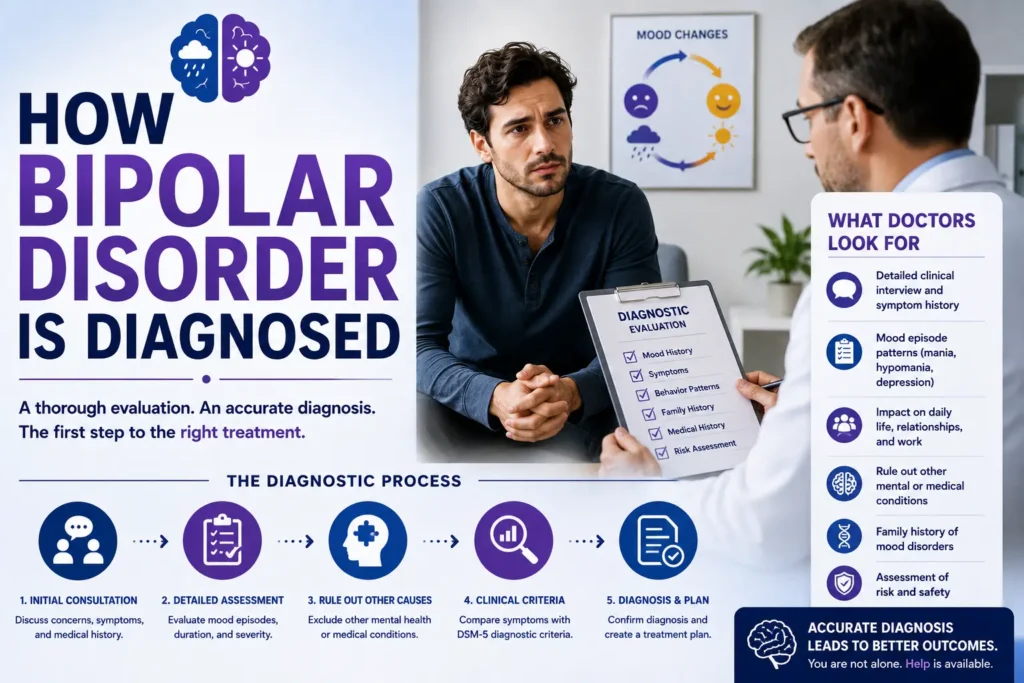
How Bipolar Disorder Is Diagnosed: There’s no blood test or scan that confirms bipolar disorder. Instead, a psychiatrist or psychologist diagnoses it through a structured clinical evaluation—reviewing your current symptoms, your full mood history, family history, and ruling out other causes—then matching what they find against the criteria in the DSM-5. The process usually involves more than one appointment, sometimes input from people close to you, and occasionally physical tests to rule out other conditions first.
Table of Contents
Key Takeaways
- Diagnosis is based on a clinical interview and history, not a single test.
- Clinicians use the DSM-5 criteria to confirm episode type, length, and severity.
- Physical exams and lab work are used to rule out other causes, not to diagnose bipolar disorder itself.
- Mood tracking before your appointment can make the process faster and more accurate.
- A correct diagnosis often takes time, especially since bipolar disorder is frequently mistaken for other conditions at first.
Why Diagnosing Bipolar Disorder Is Different From Diagnosing Other Conditions
Many physical illnesses have a clear test — a scan, a blood panel, a culture. Bipolar disorder doesn’t work that way. It’s identified through patterns of thought, mood, energy, and behavior over time, which means the accuracy of a diagnosis depends heavily on a thorough history and an experienced clinician. For general background on the condition itself, see bipolar disorder and what bipolar disorder is.
This is also why self-diagnosis isn’t reliable. If you’re trying to figure out whether your own experiences fit the pattern before seeking help, our guide on how to know if you have bipolar is a useful starting point — but it’s not a substitute for what’s described here.
Step 1: Recognizing There’s a Problem Worth Evaluating
Diagnosis typically starts one of two ways: someone notices a pattern of mood episodes in themselves or a loved one, or a doctor treating something else — often depression — starts asking questions that point toward bipolar disorder. This second path is common. A large share of people with bipolar disorder are first treated for unipolar depression because they sought help during a low period and didn’t mention or recognize a past hypomanic or manic episode.
The behaviors and symptoms clinicians are trained to listen for are covered in depth in bipolar disorder symptoms and early signs of bipolar disorder.
Step 2: Choosing Who to See
You can start with a primary care doctor, but a full diagnosis is generally made by a psychiatrist or a licensed psychologist trained in mood disorders.
| Provider | What they typically do |
| Primary care doctor | Initial screening, rules out physical causes, refers you onward |
| Psychiatrist | Conducts full psychiatric evaluation, can diagnose and prescribe medication |
| Psychologist | Conducts full evaluation and structured testing, refers for medication if needed |
| Therapist / counselor (non-prescribing) | May flag symptoms and refer you to a psychiatrist or psychologist for formal diagnosis |
If you’re unsure where to begin, a referral from your regular doctor is a reasonable first move.
Step 3: The Physical Exam and Lab Work
Before settling on a psychiatric diagnosis, clinicians usually rule out physical explanations for mood symptoms. This can include:
- A general physical exam
- Thyroid function tests (an overactive or underactive thyroid can mimic mood episodes)
- Blood tests to check for other medical causes
- A review of current medications and substance use, since some drugs and medications can trigger manic- or depressive-like symptoms
This step doesn’t diagnose bipolar disorder — it clears the ground so the psychiatric evaluation isn’t confused by an unrelated medical issue.
Step 4: The Psychiatric Evaluation
This is the core of the diagnostic process. A typical psychiatric evaluation for bipolar disorder includes:
- A detailed symptom interview — what you’re experiencing now, when it started, and how it affects daily life.
- A full mood history — the clinician will ask about past periods of unusually high energy or elevated mood, not just depression, since these episodes are easy to overlook or misremember as “just a good phase.”
- Sleep and behavior patterns — reduced need for sleep, changes in speech pace, impulsivity, and risk-taking are all relevant.
- Family history — a first-degree relative with bipolar disorder or another mood disorder raises the likelihood of the diagnosis.
- Functional impact — how these mood changes affect work, relationships, and daily responsibilities.
- Screening for other conditions — including anxiety disorders, ADHD, borderline personality disorder, and substance use disorders, which can overlap with or mimic bipolar symptoms.
Clinicians may also use structured questionnaires such as the Mood Disorder Questionnaire (MDQ) to help organize this information, though these tools support the interview rather than replace it.
Step 5: Getting Input From Family or Close Friends
Because people experiencing mania or hypomania don’t always recognize the episode as unusual while it’s happening, clinicians often ask permission to speak with a spouse, parent, or close friend. This person can describe changes in behavior, sleep, and speech that the patient may not have noticed or recalled accurately. This step is optional and only happens with the patient’s consent, but it can significantly improve diagnostic accuracy.
Step 6: Applying DSM-5 Criteria
Once the clinician has a complete picture, they compare it against the criteria set out in the DSM-5 (Diagnostic and Statistical Manual of Mental Disorders, 5th edition), published by the American Psychiatric Association. In general terms, this means confirming:
- Whether the person has had a manic episode (required for Bipolar 1) lasting at least seven days, or any duration if hospitalization was needed
- Whether the person has had a hypomanic episode lasting at least four days, combined with at least one major depressive episode (the pattern for Bipolar 2)
- Whether symptoms are better explained by another condition, medication, or substance use
- Whether the episode caused noticeable impairment in daily functioning (for mania) or was simply noticeable to others (for hypomania)
This is also the stage where the specific type is determined. Our guides to types of bipolar disorder and Bipolar 1 vs. Bipolar 2 explain how these categories differ and why getting the type right matters for treatment.
Diagnostic Criteria at a Glance
| Diagnosis | Key Requirement |
| Bipolar 1 | At least one manic episode (depressive episodes common but not required) |
| Bipolar 2 | At least one hypomanic episode + at least one major depressive episode, no full manic episode |
| Cyclothymia | Numerous hypomanic and depressive symptoms over 2+ years that don’t meet full episode criteria |
| Other/unspecified bipolar disorder | Symptoms don’t fit neatly into the above categories but still cause impairment |
For a deeper explanation of the process specific to each type, see Bipolar 1 diagnosis and Bipolar 2 diagnosis, or the side-by-side Bipolar 1 vs. 2 diagnosis comparison.
Conditions Often Confused With Bipolar Disorder
Misdiagnosis is common, partly because several conditions share overlapping symptoms. Clinicians are specifically trained to distinguish bipolar disorder from:
- Major depressive disorder — especially if a past hypomanic episode was missed
- ADHD — overlapping impulsivity and distractibility, particularly in teens and children
- Borderline personality disorder — mood instability that shifts faster and is often tied to interpersonal triggers rather than sustained episodes
- Anxiety disorders — racing thoughts and restlessness can resemble hypomania
- Substance-induced mood changes — stimulants, certain medications, or withdrawal can produce manic- or depressive-like symptoms
This is one reason the evaluation takes time rather than happening in a single 15-minute visit.
How Long Does Diagnosis Usually Take?
There’s no fixed timeline, and it varies by individual. Some people are diagnosed within one or two appointments if the history is clear-cut. Others — particularly those who were first treated for depression alone — may not receive an accurate bipolar diagnosis for years, since a past hypomanic episode has to surface in conversation before a clinician can factor it in. This is part of why keeping a mood record, described below, can shorten the process.
What You Can Do Before Your Appointment
| Do | Don’t |
| Track your mood, sleep, and energy daily for a few weeks if possible | Wait for a “perfect” case before booking an appointment |
| Write down past episodes, even ones that felt positive at the time | Only mention the depressive episodes and leave out the highs |
| List current medications and substances used | Assume a single appointment will give you the full answer |
| Bring a family member if you’re comfortable, or note family history | Diagnose yourself and stop seeking a professional opinion |
| Be specific about how symptoms affect daily functioning | Downplay symptoms out of embarrassment |
A structured bipolar screening or bipolar test can also help you organize your thoughts before the appointment, and tools like the bipolar quiz are designed to mirror some of the questions a clinician will ask.
Myths vs. Facts About Bipolar Diagnosis
| Myth | Fact |
| “A blood test can confirm bipolar disorder.” | No lab test diagnoses bipolar disorder; blood work only rules out other causes. |
| “One appointment is enough for an accurate diagnosis.” | Many diagnoses require multiple visits and a detailed history. |
| “If you’re not manic right now, you can’t be diagnosed.” | Diagnosis is based on history, not just current presentation. |
| “Online quizzes can diagnose you.” | They can flag a pattern worth discussing, but a licensed clinician makes the diagnosis. |
| “Bipolar disorder always looks the same in every person.” | Presentation varies by type, age, and sex — see our guide to bipolar disorder myths for more. |
Warning Signs That Warrant Prompt Evaluation
Some symptoms should prompt faster action rather than waiting for a routine appointment:
- Days without sleep and no sense of tiredness
- Impulsive spending, sexual behavior, or driving that’s clearly out of character
- Hearing or seeing things that aren’t there
- Persistent hopelessness lasting more than two weeks
- Any thoughts of self-harm or suicide
Emergency Help
If you or someone you know is having thoughts of suicide or self-harm, treat it as a medical emergency. In the US, call or text 988 (Suicide & Crisis Lifeline). In the UK, call 111 or the Samaritans at 116 123. Elsewhere, contact your local emergency number or nearest emergency department. You do not need a formal diagnosis to reach out for help.
After Diagnosis: What Comes Next
Once a diagnosis is confirmed, the clinician will typically discuss treatment options, which usually combine medication, therapy, and lifestyle strategies. This is covered fully in our guide to bipolar disorder treatment. It’s also worth understanding what an accurate diagnosis means for the road ahead — see bipolar disorder prognosis and bipolar disorder complications if left untreated.
Frequently Asked Questions
Can bipolar disorder be diagnosed with a blood test or brain scan? No. These tests can rule out other medical causes, like thyroid problems, but bipolar disorder itself is diagnosed through clinical evaluation.
Do I need to be in a manic or depressive episode to be diagnosed? No. Diagnosis is based on your full history, not just your current state. A clinician can diagnose bipolar disorder even during a stable period if past episodes meet the criteria.
Why do so many people get misdiagnosed with depression first? Because people are more likely to seek help during a depressive episode and may not mention — or recognize — a past hypomanic or manic period as significant.
How accurate are online bipolar tests? They can be a useful screening step to help you organize your thoughts, but they aren’t diagnostic. Only a licensed clinician can confirm a diagnosis.
Can a diagnosis change over time? Yes. It’s possible for a diagnosis to shift — for example, from Bipolar 2 to Bipolar 1 — if a full manic episode occurs later. Our article on whether Bipolar 2 can become Bipolar 1 covers this in detail.
Is a psychiatric evaluation covered by insurance? Coverage varies by provider and location. It’s worth checking directly with your insurance plan or clinic before your appointment.
What should I bring to my first appointment? A list of current symptoms, medications, family mental health history, and — if possible — a record of your mood, sleep, and energy over the past few weeks.
Summary
Diagnosing bipolar disorder is a structured process, not a single test. It combines a detailed psychiatric evaluation, a full mood history, input from those close to you where appropriate, and careful comparison against DSM-5 criteria — all while ruling out other conditions that can look similar. It can take time, especially if past hypomanic or manic episodes weren’t recognized earlier. If you suspect you or someone you care about may have bipolar disorder, the most reliable next step is a full evaluation with a psychiatrist or psychologist, using resources like the American Psychiatric Association, NIMH, or your national health service to help you find the right provider.