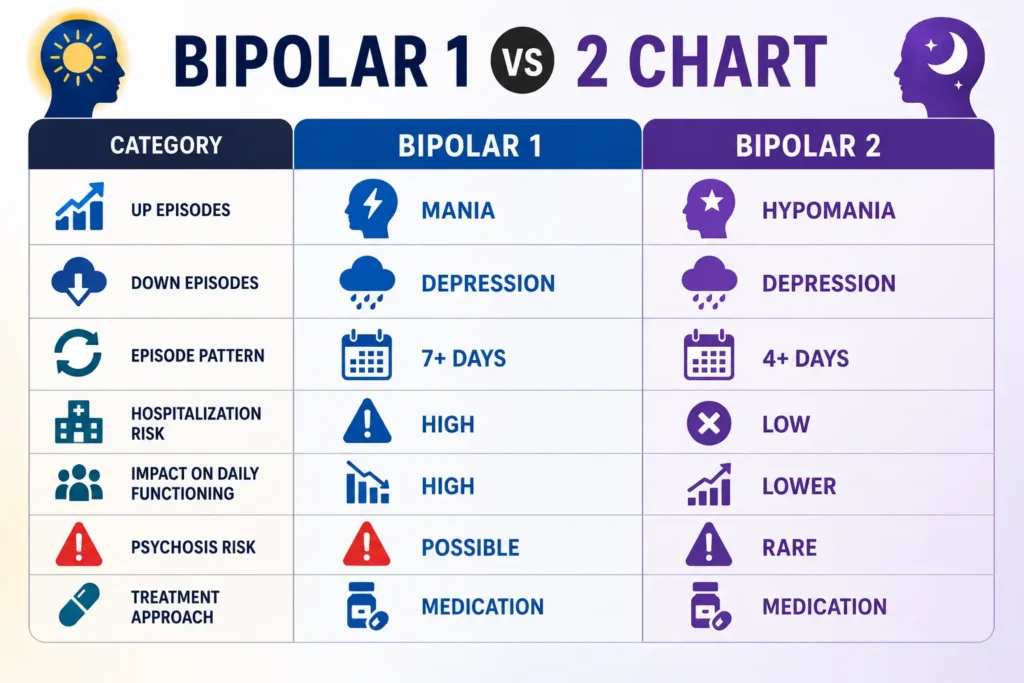
Bipolar 1 and bipolar 2 disorder are both mood disorders that cause extreme shifts between elevated and depressed states, but the difference comes down to severity. Bipolar 1 involves at least one full manic episode severe enough to disrupt daily life or require hospitalization, while bipolar 2 involves hypomania, a milder form of elevated mood, paired with more frequent and often longer depressive episodes. The Bipolar 1 vs 2 Chart and sections below break down every major difference in plain language, so you can see exactly how the two conditions compare and what that means for diagnosis and treatment.
Table of Contents
Key Takeaways
- Bipolar 1 requires a manic episode; bipolar 2 requires hypomania plus at least one major depressive episode.
- Mania in bipolar 1 can include psychosis; hypomania in bipolar 2 never does.
- People with bipolar 2 typically spend more total time depressed than those with bipolar 1.
- Both conditions fall under the broader category of bipolar disorder, and neither one is “more serious” than the other overall — they’re just different in shape.
- Diagnosis depends on a clinical evaluation, not a symptom checklist you fill out at home.
- Treatment overlaps heavily but antidepressant use is approached more cautiously in bipolar 1 because of the risk of triggering mania.
What Is Bipolar Disorder, in Simple Terms?
Bipolar disorder is a brain-based condition that affects mood, energy, and the ability to function. People with bipolar disorder cycle between emotional highs and lows that go beyond normal ups and downs. These aren’t just “mood swings” in the everyday sense — the episodes are distinct, they last for days to weeks at a time, and they change how a person thinks, sleeps, and behaves.
The American Psychiatric Association’s Diagnostic and Statistical Manual (DSM-5) recognizes several types of bipolar disorder, and bipolar 1 and bipolar 2 are the two most commonly discussed. If you’re looking for a broader introduction to the condition itself, our guide on what bipolar disorder is covers the basics in more depth, and our overview of the types of bipolar disorder walks through how cyclothymia and other variants fit into the picture.
For this article, we’re focusing specifically on how bipolar 1 and bipolar 2 compare to each other — not explaining bipolar disorder from scratch.
Bipolar 1 vs Bipolar 2: The Comparison Chart
This chart is the fastest way to see how the two conditions differ across the categories that matter most for diagnosis and daily life.
| Feature | Bipolar 1 Disorder | Bipolar 2 Disorder |
| Defining episode | At least one full manic episode | At least one hypomanic episode + one major depressive episode |
| Episode severity | Mania is severe, often disabling | Hypomania is milder, doesn’t disable daily functioning |
| Minimum episode length | Mania lasts 7+ days (or any length if hospitalized) | Hypomania lasts at least 4 consecutive days |
| Psychosis possible? | Yes, mania can include delusions or hallucinations | No, hypomania does not include psychosis |
| Hospitalization | Often required during manic episodes | Rarely required unless depression becomes severe |
| Depressive episodes required for diagnosis | Not required (though usually present) | Required for diagnosis |
| Time spent depressed | Significant, but often less than bipolar 2 | Typically more frequent and longer depressive periods |
| Risk of misdiagnosis | Lower, since mania is more visibly disruptive | Higher, often mistaken for major depression |
| Functional impact during “up” episode | Can seriously impair work, relationships, judgment | Often feels productive or energized rather than impairing |
| Typical first noticeable episode | Manic or mixed episode | Depressive episode |
Keep in mind this chart is an educational summary, not a diagnostic tool. Only a licensed mental health professional can determine which type of bipolar disorder someone has.
Mania vs Hypomania: The Real Dividing Line
The single biggest difference between bipolar 1 and bipolar 2 is the intensity of the “up” episode — mania versus hypomania. Understanding this distinction clears up most of the confusion around the two diagnoses.
What Mania Looks Like (Bipolar 1)
Mania is a distinct period of abnormally elevated, expansive, or irritable mood combined with unusually high energy. According to diagnostic criteria referenced by the DSM-5, a manic episode must last at least one week (or any duration if hospitalization is needed) and include at least three additional symptoms, such as:
- Decreased need for sleep without feeling tired
- Racing thoughts or rapid speech
- Grandiosity or inflated self-esteem
- Impulsive or risky behavior (spending, driving, sexual behavior)
- Distractibility
- Increased goal-directed activity or agitation
In severe cases, mania can include psychotic features like delusions or hallucinations, and it frequently disrupts work, relationships, and personal safety enough to require hospitalization.
What Hypomania Looks Like (Bipolar 2)
Hypomania shares the same symptom list as mania, but the intensity and impact are different. Hypomanic episodes last at least four consecutive days and are noticeable to others as a change in functioning, but they don’t cause severe impairment, don’t require hospitalization, and never include psychosis.
Many people describe hypomania as feeling unusually confident, productive, or “switched on.” That’s part of why bipolar 2 is so often missed — the hypomanic period doesn’t look like a crisis. It can even feel good, at least at first, which is one reason people don’t always seek help during that phase.
For a full breakdown of symptoms specific to each condition, see our dedicated guide on bipolar 1 vs 2 symptoms.
Depression in Bipolar 1 vs Bipolar 2
It’s a common myth that bipolar 2 is the “milder” version of bipolar disorder overall. In reality, the depressive episodes in bipolar 2 are often more frequent, longer-lasting, and harder to treat than those in bipolar 1. Research summarized by clinical sources, including work published through the National Institutes of Health, has found that people with bipolar 2 tend to spend a greater proportion of their time in a depressive state compared to those with bipolar 1.
This matters clinically because depression, not mania or hypomania, is usually what brings people with bipolar 2 into treatment in the first place — and it’s also what gets misdiagnosed as major depressive disorder when the hypomanic episodes go unreported or unnoticed.
Bipolar 1 vs 2: Diagnostic Criteria Compared
Diagnosis for both conditions follows the DSM-5 criteria used by psychiatrists and clinical psychologists. Here’s how the formal requirements differ.
| Diagnostic Requirement | Bipolar 1 | Bipolar 2 |
| Manic episode | Required (at least 1) | Not present |
| Hypomanic episode | Not required, but may occur | Required (at least 1) |
| Major depressive episode | Not required for diagnosis | Required (at least 1) |
| Episode must significantly impair functioning | Yes, for the manic episode | Not necessarily for hypomania; often applies to the depressive episode |
| Rule out other causes | Substance use, medical conditions, other psychiatric disorders | Same |
Diagnosis isn’t based on a single conversation or questionnaire. Clinicians typically look at a person’s full history of mood episodes, sometimes going back years, and rule out other explanations such as thyroid conditions, substance use, or other psychiatric disorders. Our guide on bipolar disorder diagnosis explains the full evaluation process in detail, including the tools clinicians use and what to expect at an appointment.
Why Bipolar 2 Is So Often Misdiagnosed
Misdiagnosis is one of the most consequential issues in bipolar 2, and it’s worth explaining why it happens so often:
- Hypomania rarely feels like a problem. People often remember the depressive episodes vividly but forget or downplay the hypomanic ones, since those periods can feel like a return to “normal” energy rather than something unusual.
- Depression is the presenting symptom. Since depressive episodes are what typically drive someone to seek help, bipolar 2 is frequently misdiagnosed as major depressive disorder, especially in a single appointment without a full mood history.
- Antidepressant-only treatment can backfire. When bipolar 2 is mistaken for unipolar depression, prescribing antidepressants without a mood stabilizer can sometimes trigger hypomanic episodes or rapid mood cycling.
This is why a thorough clinical history — including questions about energy, sleep, and behavior during “up” periods — is essential for an accurate diagnosis.
Causes and Risk Factors: Do They Differ Between Types?
The underlying causes of bipolar 1 and bipolar 2 are not fully understood, but research points to a combination of genetic, neurological, and environmental factors that apply broadly across both types. Family history is one of the strongest known risk factors — having a close relative with bipolar disorder significantly increases risk, according to information from the National Institute of Mental Health.
There isn’t strong evidence that bipolar 1 and bipolar 2 have entirely separate causes. Instead, they’re generally understood as different expressions of overlapping underlying vulnerability. For a full discussion of genetic, biological, and environmental risk factors, visit our detailed guide on bipolar disorder causes.
Treatment: How Bipolar 1 and Bipolar 2 Are Managed Differently
Treatment for both conditions typically combines medication and therapy, but there are meaningful differences in approach.
| Treatment Area | Bipolar 1 | Bipolar 2 |
| Mood stabilizers | First-line treatment, often essential | Also commonly used |
| Antipsychotic medication | Frequently used, especially during acute mania | Used less often, mainly for severe depressive episodes |
| Antidepressants | Used cautiously, almost always with a mood stabilizer | Used more often, but still with caution due to hypomania risk |
| Hospitalization | More common during manic episodes | Uncommon, except during severe depression or suicidality |
| Psychotherapy | Strongly recommended (CBT, family-focused therapy) | Strongly recommended, often central to managing depression |
| Lifestyle management | Sleep and routine stability are critical | Sleep and routine stability are equally critical |
Mood stabilizers such as lithium remain a cornerstone treatment for both types, according to guidance referenced by organizations like the Mayo Clinic and the NHS. The key difference is caution around antidepressants: because hypomania can be triggered or worsened by antidepressant use, clinicians usually pair them with a mood stabilizer, particularly in bipolar 1, where the risk of provoking a full manic episode is highest.
For a complete breakdown of medications, therapy types, and treatment planning, see our full guide on bipolar disorder treatment.
Myths vs Facts: Bipolar 1 and Bipolar 2
| Myth | Fact |
| “Bipolar 2 is just a milder version of bipolar 1.” | Bipolar 2 involves less severe highs, but often more time spent in depression. Neither type is uniformly “milder.” |
| “You can self-diagnose using a comparison chart.” | Charts like this one are educational only. Diagnosis requires a clinical evaluation. |
| “Hypomania is always a good feeling.” | Hypomania can feel energizing at first, but it can also involve irritability, poor judgment, and risky decisions. |
| “People with bipolar 1 are always in a manic state.” | Most people with bipolar 1 spend far more time stable or depressed than manic. |
| “Bipolar 2 doesn’t need medication.” | Bipolar 2 is a serious condition that typically requires ongoing treatment, just like bipolar 1. |
For a broader list of misconceptions, see our full bipolar disorder myths guide.
Complications and Prognosis: A Brief Overview
Left untreated, both bipolar 1 and bipolar 2 can lead to serious complications, including relationship strain, job loss, financial problems from impulsive decisions during elevated episodes, and an increased risk of substance use. Depressive episodes in either type also carry a real risk of suicidal thinking, which is why ongoing treatment and a solid support system matter regardless of type.
With consistent treatment, both conditions can be managed effectively, and many people lead stable, fulfilling lives. Prognosis depends more on factors like treatment adherence, early diagnosis, and support systems than on which type someone has. For a deeper look at long-term outlook, visit our guide on bipolar disorder prognosis, and for more on potential complications, see our article on bipolar disorder complications.
How Common Are Bipolar 1 and Bipolar 2?
Both types are relatively uncommon compared to conditions like major depressive disorder, but they affect millions of people worldwide. For detailed prevalence data and demographic breakdowns, see our full page on bipolar disorder statistics, which draws on data from organizations including the World Health Organization and the National Institute of Mental Health.
Warning Signs That Need Immediate Attention
Regardless of bipolar type, certain warning signs call for urgent professional help rather than waiting for a routine appointment:
- Thoughts of suicide or self-harm
- Severe agitation or inability to sleep for multiple days
- Psychotic symptoms, such as hallucinations or delusions
- Reckless behavior that puts the person or others at risk
- A sudden, dramatic shift in mood or behavior
Getting Emergency Help
If you or someone you know is in crisis or having thoughts of suicide, reach out for immediate support:
- 988 Suicide & Crisis Lifeline (US): call or text 988
- Emergency services: call 911 (US) or your local emergency number
- If you’re outside the US, search for your country’s crisis line or go to the nearest emergency department
You don’t need a confirmed diagnosis to ask for help. If something feels seriously wrong, treat it as urgent.
Frequently Asked Questions
Is bipolar 2 worse than bipolar 1? Neither is objectively worse. Bipolar 1 involves more severe manic episodes, sometimes with psychosis, while bipolar 2 often involves more frequent and longer depressive episodes. Severity depends on the individual, not just the diagnostic type.
Can bipolar 2 turn into bipolar 1? It’s uncommon, but not impossible, for someone diagnosed with bipolar 2 to later experience a full manic episode, which would change the diagnosis to bipolar 1. This is why ongoing monitoring by a mental health professional matters.
What’s the main difference between mania and hypomania? Severity and impact. Mania is more intense, lasts longer, can include psychosis, and often disrupts daily functioning enough to require hospitalization. Hypomania is milder, shorter in required duration, and doesn’t involve psychosis or hospitalization.
Does bipolar 2 require a manic episode to be diagnosed? No. Bipolar 2 is defined by at least one hypomanic episode and at least one major depressive episode — a full manic episode is not part of the diagnosis.
Can someone have symptoms of both bipolar 1 and bipolar 2? A person is diagnosed with one type based on their most severe elevated episode. If a full manic episode ever occurs, the diagnosis is bipolar 1, even if hypomanic and depressive episodes also occur.
Is a comparison chart enough to diagnose bipolar disorder? No. Charts and checklists are educational tools only. An accurate diagnosis requires a full clinical evaluation by a psychiatrist or psychologist, including a detailed history of mood episodes.
Which type is more common? Estimates vary by study and population, but both types are considered relatively rare compared to major depressive disorder. For specific prevalence figures, see our bipolar disorder statistics page.
Summary
Bipolar 1 and bipolar 2 both involve significant mood episodes, but they differ in a specific, clinically defined way: bipolar 1 requires a full manic episode, while bipolar 2 requires hypomania plus a major depressive episode. Bipolar 1 tends to involve more intense, sometimes hospitalization-requiring highs, while bipolar 2 often carries a heavier depressive burden over time. Neither type is simply a “lesser” version of the other, and both require an accurate diagnosis and consistent treatment to manage well.
If you recognize symptoms in yourself or someone you care about, the most useful next step isn’t matching them to a chart — it’s talking to a psychiatrist or licensed mental health professional who can evaluate the full picture. For a broader starting point, visit our main guide on bipolar 1 vs bipolar 2.
This article is for educational purposes and is not a substitute for professional medical advice, diagnosis, or treatment. Always consult a qualified healthcare provider with questions about a medical condition.