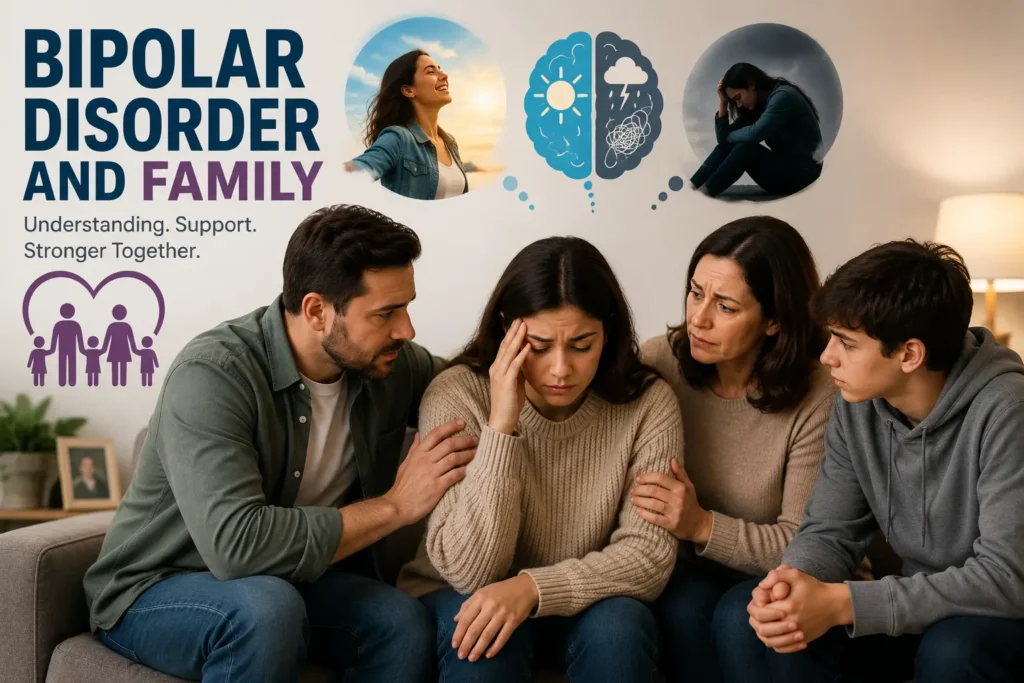
Bipolar disorder doesn’t just affect the person diagnosed — it reshapes daily life for everyone close to them. Mood episodes can disrupt routines, finances, communication, and trust, and family members often carry emotional strain that goes unaddressed. The good news: with education, boundaries, a crisis plan, and the right professional support, families can stay connected and even grow stronger. This guide covers exactly how bipolar disorder shows up in family life and what actually helps.
Table of Contents
Key Takeaways
- Bipolar disorder affects an estimated 2.8% of U.S. adults in a given year, and about 4.4% of adults experience it at some point in their lives, so most families will encounter it in some form, directly or through extended relatives.
- More than two-thirds of people with bipolar disorder have at least one close relative with the condition or with major depression, meaning the disorder often runs through a family system, not just one individual.
- Family reactions during manic and depressive episodes can unintentionally make symptoms worse or better — this is well documented in research on “expressed emotion.”
- Family-focused therapy, psychoeducation, and clear crisis planning are among the most effective supports alongside medical treatment.
- Caregiver burnout is common and deserves its own attention, not just the ill family member’s.
What Bipolar Disorder Looks Like From the Family’s Side
Clinically, bipolar disorder is a mood disorder marked by shifts between manic or hypomanic episodes and depressive episodes. If you want the full clinical picture — symptoms, subtypes, and diagnostic criteria — read our complete guide to bipolar disorder and what bipolar disorder actually is.
But for a spouse, parent, sibling, or child living alongside someone with bipolar disorder, the experience isn’t a checklist of symptoms. It’s:
- Waking up unsure which version of your loved one you’ll see today
- Explaining, again, why a family event got cancelled
- Watching a bank account drain during a manic spending spree
- Sitting with someone who won’t get out of bed for days
- Wondering how much of their behavior is “them” and how much is the illness
None of this makes the person with bipolar disorder a bad partner, parent, or child. It means the family is living with a chronic, cyclical medical condition — similar in impact to how a family adapts around any relapsing illness, but with an added layer most physical illnesses don’t carry: mood and behavior are the symptoms.
How Manic and Depressive Episodes Affect Family Life Differently
Families often describe two very different versions of the same person, and each version creates its own kind of strain.
During Manic or Hypomanic Episodes
- Impulsive decisions — large purchases, sudden trips, risky business ideas, or quitting a job without warning
- Irritability and conflict — a low tolerance for disagreement, sometimes escalating into arguments
- Reduced need for sleep — which can disrupt the whole household’s routine
- Grandiosity or unrealistic plans — that are hard to gently redirect without triggering conflict
- Risky behavior — including reckless driving, substance use, or sexual risk-taking
For a full breakdown of what mania looks like clinically, see our dedicated guide on mania and manic episodes.
During Depressive Episodes
- Withdrawal — from conversations, responsibilities, and physical affection
- Loss of function — missed work, unpaid bills, undone chores
- Irritability that looks like anger — but is often exhaustion and hopelessness
- Reduced parenting or partner capacity — which other family members quietly absorb
- Passive or active suicidal thoughts — which family members are often the first to notice
Because these two states are so different, families sometimes feel like they’re managing two relationships in one. Understanding the difference between manic and depressive presentations — and where hypomania fits in — is covered in more depth in mania vs. hypomania.
Why Bipolar Disorder Puts Strain on Every Type of Family Relationship
Partners and Spouses
Romantic relationships often absorb the most direct impact — shared finances, shared parenting, shared reputation. Spouses may feel they’re “married to the illness” during episodes and married to their actual partner in between. This inconsistency is genuinely disorienting and is one of the top reasons couples seek outside support. Our guide on bipolar disorder and relationships and bipolar disorder and marriage covers relationship-specific strategies in more depth.
Parents of a Child or Teen With Bipolar Disorder
Parents often carry guilt (wondering if they caused it), grief (mourning the “before” version of their child), and exhaustion from advocating with schools, doctors, and insurance. Recognizing symptoms early matters here — see bipolar symptoms in children and bipolar symptoms in teenagers for age-specific signs.
Adult Children of a Parent With Bipolar Disorder
Growing up with an unpredictable parent can shape a child’s sense of safety and self-worth well into adulthood, even when the parent is stable and treated. Many adult children describe becoming “the responsible one” too early.
Siblings
Siblings sometimes feel overlooked, since so much family attention goes toward the person with the diagnosis. Sibling resentment isn’t a character flaw — it’s a predictable response to an imbalanced caregiving load.
The Research Behind Family Impact: Expressed Emotion
One of the most consistent findings in bipolar disorder research involves something psychologists call expressed emotion (EE) — the level of criticism, hostility, or emotional over-involvement in a family environment.
Families with high expressed emotion (frequent criticism or over-involvement) are associated with higher relapse rates in the person with bipolar disorder, while calmer, more supportive home environments are linked to better outcomes. This doesn’t mean families cause bipolar disorder — the condition has a strong genetic and neurobiological basis, explained fully in bipolar disorder causes. It means the emotional climate at home can influence how well someone recovers between episodes, which is precisely why family-focused treatment approaches exist and are backed by clinical evidence.
Bipolar Disorder Runs in Families: The Genetic Reality
Family impact isn’t only emotional — it’s also biological. The lifetime risk of developing bipolar disorder is 5% to 10% for someone with a first-degree relative who has the condition, roughly seven times higher than the general population, and 80–90% of people with bipolar disorder have a relative with bipolar disorder or depression.
This is one reason bipolar disorder often appears across generations or between siblings, and why family history is a key part of diagnosis. For a deeper look at genetic and environmental risk factors, visit our guide to bipolar disorder causes. It’s also worth understanding how subtypes differ within a family — one relative may have Bipolar 1 while another has Bipolar 2; our Bipolar 1 vs Bipolar 2 comparison explains the practical differences.
How Family Involvement Affects Treatment and Recovery
Family isn’t just affected by bipolar disorder — family can be part of what helps someone get well and stay well. Involvement typically helps with:
| Area | How Family Involvement Helps |
| Early warning signs | Family often notices mood shifts before the person does |
| Medication adherence | Gentle reminders and routine support improve consistency |
| Crisis response | A pre-agreed plan reduces panic and delay during emergencies |
| Sleep and routine | Family can help protect stable sleep/wake schedules, a major relapse trigger |
| Treatment engagement | Support getting to and staying in therapy or psychiatric appointments |
For details on the treatment options family members should understand, see our full guide on bipolar disorder treatment, including bipolar therapy and bipolar medications.
Family-Focused Therapy Approaches
Several evidence-based therapy models specifically involve family members as part of treatment, rather than treating the diagnosis in isolation:
- Family-Focused Therapy (FFT) — combines psychoeducation, communication skills training, and problem-solving skills for the whole family unit; it has research support specifically for reducing relapse in bipolar disorder.
- Psychoeducation programs — structured sessions that teach families what bipolar disorder is, what triggers episodes, and how to respond.
- Couples or family counseling — general therapy adapted to address relationship strain caused by the illness.
These approaches work alongside, not instead of, individual treatment. Learn more about therapy modalities in our guides to cognitive behavioral therapy for bipolar disorder and dialectical behavior therapy for bipolar disorder.
Practical Ways to Support a Family Member With Bipolar Disorder
1. Learn the Person’s Early Warning Signs
Every person’s pattern is different — some people talk faster before mania, others stop sleeping first. Track these patterns together during stable periods, not during a crisis.
2. Separate the Illness From the Person
It helps to mentally distinguish “this is the depression talking” or “this is the mania talking” from your loved one’s actual character. This isn’t about excusing harmful behavior — it’s about responding strategically instead of personally.
3. Build a Crisis Plan While Everyone Is Stable
A written plan should include:
- Warning signs specific to that person
- Who to call (psychiatrist, therapist, trusted family member)
- Medication information and pharmacy contact
- Preferred hospital, if hospitalization becomes necessary
- What has helped — and what has made things worse — in past episodes
See hospitalization for bipolar disorder for guidance on what that process typically involves.
4. Set Boundaries Without Guilt
Support doesn’t mean unlimited access to your time, money, or emotional bandwidth. Boundaries might sound like: “I love you and I’m not going to lend money during a manic episode” or “I need us to talk about this when we’re both calm.”
5. Encourage Treatment Without Policing It
Gentle encouragement toward appointments and medication works better long-term than ultimatums, which tend to increase secrecy. For situations involving medication hesitancy, our guide on stopping bipolar medication explains the risks worth discussing together.
6. Take Care of Your Own Mental Health
Caregiver stress is real and well documented in chronic illness research generally. Family members benefit from their own therapy, support groups, or simply protected time away from caregiving duties.
Dos and Don’ts for Family Members
| Do | Don’t |
| Learn about bipolar disorder from credible medical sources | Rely on stigma-driven assumptions or media portrayals |
| Respond calmly during mood episodes | Match irritability with irritability |
| Encourage consistent sleep and routine | Enable major decisions made during mania (large purchases, quitting jobs) without discussion |
| Ask directly about suicidal thoughts if concerned | Avoid the topic out of fear of “putting ideas in their head” |
| Set clear, kind boundaries | Sacrifice your own wellbeing indefinitely |
| Involve professionals during a crisis | Try to manage a severe episode alone |
Myths vs Facts About Bipolar Disorder and Family
| Myth | Fact |
| Bad parenting or family conflict causes bipolar disorder | Bipolar disorder has a strong genetic and neurobiological basis; family environment can influence course and relapse, not cause the underlying condition |
| People with bipolar disorder can’t have healthy families | Many people with bipolar disorder build stable, loving families, especially with consistent treatment and support |
| It’s the family’s job to “fix” the person | Families support recovery; licensed professionals treat the condition |
| Kids will “definitely” inherit it if a parent has it | Genetics raise risk but don’t guarantee the condition will develop |
| Once stable, ongoing support isn’t needed | Bipolar disorder is a lifelong, relapsing condition that benefits from continued support even in stable periods |
For a broader myth-busting resource, see bipolar disorder myths.
Warning Signs Families Should Never Ignore
Contact a mental health professional or crisis service if you notice:
- Talk of suicide, self-harm, or feeling like a burden
- Giving away possessions or saying goodbye
- Psychotic symptoms — hearing voices, extreme paranoia, delusions (see psychosis in mania)
- Not sleeping for multiple consecutive days
- Reckless behavior that puts safety at risk
- Complete withdrawal from food, hygiene, or communication for days
Emergency Help
If someone is in immediate danger of harming themselves or others, call 911 (US) or go to the nearest emergency room.
988 Suicide & Crisis Lifeline (US): Call or text 988, available 24/7.
If you’re a family member reading this in the middle of a crisis, please use the resources above now — the rest of this article will be here afterward. If you personally are struggling with your own mental health while supporting a loved one, please also consider reaching out to a therapist or counselor for your own support; you don’t have to carry this alone.
Frequently Asked Questions
Does bipolar disorder get worse over time without family support? Family support isn’t a substitute for treatment, but a stressful or high-conflict home environment is associated with higher relapse rates, while calmer environments are linked to better outcomes. Combined with proper treatment, supportive family involvement generally improves long-term stability.
Is bipolar disorder hereditary within families? Yes, to a significant degree. People with a first-degree relative who has bipolar disorder face a 5–10% lifetime risk of developing it themselves, about seven times the general population risk. Learn more in our bipolar disorder causes guide.
How do I talk to my kids about a parent’s bipolar disorder? Use age-appropriate, honest language: it’s a medical condition that affects mood, it’s not their fault, and the parent is getting help. Avoiding the topic entirely often increases a child’s anxiety more than a simple, honest explanation would.
Should family members go to therapy appointments with the person? Sometimes, and only with the person’s consent. Family-focused therapy and some psychoeducation programs are specifically designed to include loved ones; ask the treating psychiatrist or therapist whether it’s appropriate in your situation.
What’s the difference between supporting someone and enabling them? Support helps someone access treatment, stability, and safety. Enabling shields someone from the natural consequences of harmful choices (e.g., repeatedly covering manic spending). A therapist can help families tell the difference in specific situations.
Can a family member get someone hospitalized against their will? In most regions, involuntary hospitalization requires meeting a legal threshold, typically danger to self or others, or inability to care for oneself, and is determined by a medical or legal authority, not a family member alone. Local laws vary, so check with a local crisis service for specifics. See hospitalization for bipolar disorder for more.
Is it normal to feel resentment toward a family member with bipolar disorder? Yes. Resentment, grief, and frustration are common and understandable responses to chronic caregiving stress. These feelings don’t cancel out love, and they’re worth discussing with a therapist or support group rather than suppressing.
How can extended family (grandparents, aunts, uncles) help? Learning the basics of the condition, avoiding blame or judgment, offering practical help (childcare, errands) during episodes, and respecting the immediate family’s boundaries all make a meaningful difference.
Summary
Bipolar disorder affects the whole family system — moods, finances, trust, routines, and relationships all shift with the illness’s cycles. Genetics mean it often touches more than one family member, and the emotional climate at home can meaningfully influence how well a loved one recovers between episodes. The most effective path forward combines professional treatment for the person with bipolar disorder, education and involvement from family, clear boundaries, a solid crisis plan, and ongoing support for caregivers themselves. For the full picture of diagnosis, treatment, and long-term outlook, explore our guides on bipolar disorder diagnosis, bipolar disorder treatment, and bipolar disorder prognosis.
This article is for educational purposes and does not replace personalized medical advice. If you or a family member are experiencing a mental health crisis, contact a healthcare professional or crisis service immediately.