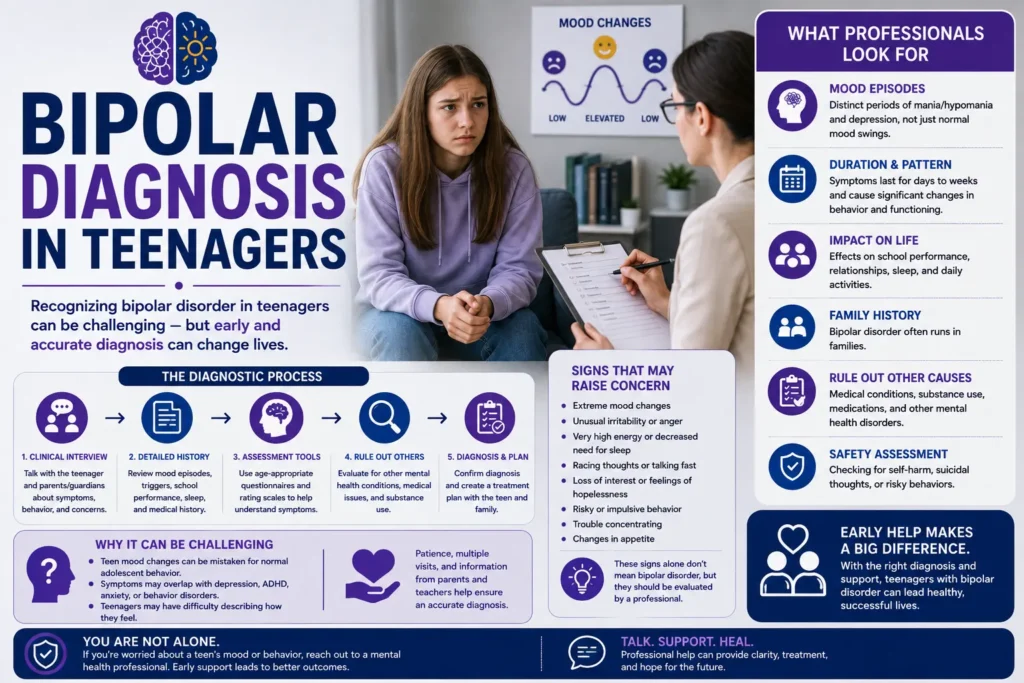
A bipolar diagnosis in teenagers is made by a psychiatrist or psychologist through clinical interviews, mood history tracking, and DSM-5 criteria — not a blood test or brain scan. Diagnosis typically requires evidence of at least one manic or hypomanic episode, alongside careful screening to rule out ADHD, depression, and other conditions that mimic bipolar symptoms in adolescence.
Table of Contents
Key Takeaways
- Bipolar disorder in teens is diagnosed clinically, based on mood episode history, not lab tests.
- Diagnosis usually involves a child/adolescent psychiatrist, a structured interview, and input from parents, teachers, or caregivers.
- Teen mania often looks like irritability and explosive outbursts rather than classic euphoria.
- Bipolar disorder is frequently misdiagnosed as ADHD, depression, or conduct disorder in adolescents.
- An accurate diagnosis usually takes weeks to months of observation, not a single appointment.
- If a teen shows signs of self-harm or suicidal thinking, that’s an emergency — don’t wait for a diagnosis to get help.
Why Diagnosing Bipolar Disorder in Teens Is Different From Adults
Bipolar disorder doesn’t look the same at 15 as it does at 35. In adults, mania often shows up as the “classic” picture — grandiosity, euphoria, racing thoughts, and reckless spending. In teenagers, that same underlying condition frequently presents as irritability, rage outbursts, and rapid, unpredictable mood shifts within the same day.
This difference matters because it’s the main reason bipolar diagnosis in adults and adolescent diagnosis follow the same DSM-5 rulebook but look completely different in practice. A clinician evaluating a teenager has to separate genuine mood episodes from normal adolescent turbulence, hormonal shifts, and the emotional intensity that comes with puberty — which is exactly why teen evaluations tend to take longer and involve more people than adult ones.
Add to that the overlap with other common adolescent conditions — ADHD, anxiety, depression, and trauma responses can all produce mood swings and irritability — and you can see why bipolar disorder in teens is one of the more challenging diagnoses in adolescent psychiatry.
Early Warning Signs Parents and Teens Notice First
Before a formal evaluation ever happens, most families notice a pattern of behavior that feels “off” compared to typical teenage moodiness. For a full breakdown of what these look like day to day, see our guide to bipolar symptoms in teenagers and early signs of bipolar disorder. In short, the signs that typically prompt a first evaluation include:
- Sudden bursts of high energy with little need for sleep
- Explosive anger that seems disproportionate to the situation
- Rapid talking, racing thoughts, or jumping between topics
- Periods of deep sadness, hopelessness, or withdrawal that follow the “up” periods
- Risky decisions — reckless driving, unsafe sexual behavior, substance use
- Grandiose thinking, like believing they’re destined for extraordinary success
- Sharp drops in school performance or sudden conflict with friends and family
One or two of these on their own usually don’t point to bipolar disorder. What clinicians look for is a pattern — a distinct shift in mood and energy that lasts for days, represents a clear change from the teen’s usual baseline, and disrupts daily functioning.
Symptoms Clinicians Look for During Evaluation
| Symptom Category | What It Looks Like in Teens | Typical Duration |
| Elevated or irritable mood | Euphoria, giddiness, or explosive anger out of proportion to the trigger | At least 4 days (hypomania) or 7 days (mania) |
| Decreased need for sleep | Feels rested after 3–4 hours, not just staying up late | Persists through the episode |
| Rapid or pressured speech | Talking fast, hard to interrupt, jumping topics | Present during high-energy periods |
| Racing thoughts | Reports “brain won’t slow down” | Present during high-energy periods |
| Increased goal-directed activity | Starting multiple projects, hyper-focus on hobbies or social plans | Days at a time |
| Risky behavior | Reckless driving, unsafe sex, spending sprees, substance experimentation | Variable |
| Depressive episodes | Withdrawal, hopelessness, fatigue, loss of interest, sleep/appetite changes | At least 2 weeks |
For the complete clinical picture across both mood poles, see bipolar disorder symptoms.
The DSM-5 Criteria Used to Diagnose Bipolar Disorder in Teens
Doctors in the U.S. rely on the American Psychiatric Association’s DSM-5 to diagnose bipolar disorder in anyone, including adolescents. There is no separate “teen version” of the criteria — the same standards apply, but clinicians interpret them with extra attention to developmental context. We break the full criteria down in detail in our DSM-5 bipolar disorder guide. The essentials:
- A manic episode requires a distinct period of abnormally elevated, expansive, or irritable mood and increased energy lasting at least one week (or any length if hospitalization is needed), along with at least three additional symptoms (four if the mood is only irritable) such as decreased need for sleep, grandiosity, pressured speech, racing thoughts, distractibility, increased goal-directed activity, or risky behavior.
- A hypomanic episode follows the same symptom list but lasts at least four days and doesn’t cause severe impairment or require hospitalization.
- A major depressive episode involves at least two weeks of depressed mood or loss of interest, plus symptoms like sleep and appetite changes, fatigue, feelings of worthlessness, or difficulty concentrating.
Which combination of episodes a teen has experienced determines the specific diagnosis. That distinction is covered fully in our guide to types of bipolar disorder and our detailed bipolar 1 vs bipolar 2 comparison — worth reading once a diagnosis is confirmed, since treatment can differ between subtypes.
How the Diagnostic Process Actually Works
Getting a bipolar diagnosis is rarely a one-visit event. It’s a process that plays out over several appointments. Here’s what families can generally expect, based on how child and adolescent psychiatrists typically approach an evaluation:
- Initial screening. A pediatrician, school counselor, or therapist notices concerning patterns and refers the teen to a specialist. This is also where bipolar screening tools often come in.
- Comprehensive psychiatric evaluation. A child and adolescent psychiatrist or psychologist conducts a structured clinical interview, often using tools like the Kiddie Schedule for Affective Disorders and Schizophrenia (K-SADS) to systematically assess mood episodes.
- Collateral information gathering. Because teens don’t always recognize or report their own symptoms accurately, clinicians typically interview parents, and sometimes request input from teachers or other caregivers who see the teen in different settings.
- Mood charting over time. Many clinicians ask families to track mood, sleep, and behavior daily for several weeks. This timeline helps distinguish a genuine episode from a single bad day.
- Medical workup. Bloodwork or a physical exam may be ordered — not to diagnose bipolar disorder itself, but to rule out thyroid problems, substance use, or other medical causes of mood symptoms.
- Differential diagnosis. The clinician systematically compares the teen’s symptom pattern against other conditions that can look similar (see the comparison table below).
- Diagnosis and treatment planning. Once the pattern fits DSM-5 criteria, the clinician explains the diagnosis to the family and outlines next steps.
For a broader look at how this compares across age groups, see how bipolar disorder is diagnosed and who can diagnose bipolar disorder.
Who Can Diagnose Bipolar Disorder in a Teenager?
Not every provider is equipped to make this call. In most cases, an accurate diagnosis comes from:
- Child and adolescent psychiatrists — medical doctors specializing in youth mental health, able to diagnose and prescribe medication
- Clinical psychologists trained in adolescent mood disorders, who can diagnose but not prescribe
- Developmental-behavioral pediatricians, in some cases, working alongside a psychiatric specialist
A pediatrician or general practitioner can raise initial concerns and refer out, but a formal bipolar diagnosis in a teenager should come from a specialist with training in adolescent mood disorders — general practitioners typically aren’t equipped to make this determination on their own.
Bipolar Disorder vs. Other Conditions: Why Teens Get Misdiagnosed
This is where teen diagnosis gets genuinely difficult. Several conditions common in adolescence share overlapping symptoms with bipolar disorder, and misdiagnosis is common enough that we cover it in depth in our guide to bipolar misdiagnosis.
| Condition | Overlapping Symptoms | Key Differences From Bipolar Disorder |
| ADHD | Impulsivity, distractibility, high energy | ADHD symptoms are chronic and consistent, not episodic; no distinct mood “episodes” with a clear start and end |
| Major depression | Sadness, withdrawal, low energy | No history of manic or hypomanic episodes |
| Disruptive mood dysregulation disorder (DMDD) | Chronic irritability, frequent outbursts | Irritability is persistent between outbursts, not episodic like mania |
| Anxiety disorders | Restlessness, racing thoughts, irritability | No elevated mood, grandiosity, or decreased need for sleep |
| Conduct disorder | Risky or defiant behavior | Behavior is more consistently oppositional, not tied to a distinct mood shift |
| Substance use | Mood swings, erratic behavior, risk-taking | Symptoms track closely with substance use and often resolve with abstinence |
A skilled clinician distinguishes these by focusing on episodicity — whether the mood and energy changes come in distinct, time-limited episodes that represent a real shift from the teen’s baseline, rather than a constant personality trait or a reaction to a specific trigger.
Risk Factors That Raise the Chances of a Bipolar Diagnosis
Bipolar disorder tends to run in families, and certain factors increase the likelihood a teen’s symptoms will turn out to be bipolar disorder rather than something else. We cover the full picture in bipolar disorder causes, but the most relevant risk factors for adolescents include:
- A parent or sibling with bipolar disorder
- A family history of major depression
- Early-onset depression that seems to “flip” into high-energy episodes
- High levels of childhood stress or trauma
- Sleep disruption patterns that predate other symptoms
None of these guarantee a diagnosis on their own — they simply raise clinical suspicion enough to warrant a closer look.
Screening Tools Used for Teen Bipolar Disorder
Screening questionnaires don’t diagnose bipolar disorder by themselves, but they help clinicians decide whether a full evaluation is warranted. Commonly used tools in adolescent settings include:
- Mood Disorder Questionnaire (MDQ) — a brief self-report screener adapted for use with teens and their parents
- Young Mania Rating Scale (YMRS) — used to rate the severity of manic symptoms once a concern is raised
- General Behavior Inventory (GBI) — a longer, more detailed mood-tracking questionnaire
- K-SADS structured interview — the gold-standard diagnostic interview used by specialists
If you’re curious how self-assessment tools compare to a full clinical workup, our bipolar test and bipolar quiz pages explain what these screeners can and can’t tell you. A positive screen is a reason to seek a full evaluation — it is never a diagnosis on its own.
What to Expect at the First Appointment: A Checklist for Parents
Walking into a psychiatric evaluation can feel intimidating. Bringing organized information helps the clinician move faster toward an accurate answer. Consider preparing:
- [ ] A written timeline of mood episodes, including approximate start and end dates
- [ ] Notes on sleep patterns during both “up” and “down” periods
- [ ] Examples of specific behaviors, not just general descriptions (“stayed up until 4 a.m. redecorating her room three nights in a row”)
- [ ] Any family history of bipolar disorder, depression, or other mental illness
- [ ] A list of current medications and supplements
- [ ] School reports or teacher observations, if relevant
- [ ] Any history of self-harm, substance use, or risky behavior
Myths vs. Facts About Diagnosing Bipolar Disorder in Teens
| Myth | Fact |
| Mood swings mean a teen has bipolar disorder | Normal adolescent mood swings are usually reactive and short-lived; bipolar episodes are longer, more extreme, and less tied to obvious triggers |
| A single outburst is enough to diagnose bipolar disorder | Diagnosis requires a documented pattern of episodes meeting DSM-5 duration and symptom criteria |
| Only adults get “real” bipolar disorder | Bipolar disorder can and does emerge in adolescence, sometimes even earlier |
| A blood test can confirm bipolar disorder | There is no lab test for bipolar disorder — diagnosis is entirely clinical |
| Bipolar disorder in teens always looks like extreme happiness | Irritability and anger are often more prominent than euphoria in adolescent mania |
| A diagnosis can be made in one visit | Most reliable diagnoses come after weeks or months of observation and mood tracking |
For a wider list of misconceptions across all age groups, see bipolar disorder myths.
Warning Signs That Need Immediate Attention
Some symptoms go beyond “needs an evaluation” and move into “needs help right now.” Contact a doctor, crisis line, or emergency services immediately if a teen shows:
- Talk of suicide, self-harm, or feeling like a burden to others
- Signs of psychosis — hearing voices, believing things that aren’t true
- Extreme, uncontrollable agitation or aggression
- Behavior that puts their safety or others’ safety at risk
If a teen is in crisis, don’t wait for a scheduled appointment. In the U.S., call or text 988 to reach the Suicide & Crisis Lifeline, available 24/7. You can also text HOME to 741741 to reach the Crisis Text Line. If there is immediate danger, call 911 or go to the nearest emergency room.
After Diagnosis: What Comes Next
A confirmed diagnosis is the starting point for a treatment plan, not the end of the story. Most adolescent bipolar treatment plans combine medication management with structured therapy, and we cover both in detail in our guides to bipolar disorder treatment and bipolar disorder complications if left unmanaged. Families understandably want to know what the road ahead looks like — our bipolar disorder prognosis guide walks through long-term outlook and what factors improve it, including early diagnosis itself.
It’s also worth understanding the terminology that comes up throughout this process. Our bipolar disorder glossary explains clinical terms like mania, hypomania, euthymia, and mixed features in plain language, and our mania vs. hypomania comparison clarifies one of the most commonly confused distinctions in a new diagnosis.
How Common Is Bipolar Disorder in Teenagers?
According to nationally representative interview data cited by the National Institute of Mental Health (NIMH), an estimated 2.9% of U.S. adolescents ages 13 to 18 have had bipolar disorder at some point in their lives, with 2.6% experiencing severe impairment from it. That makes it far less common than anxiety or depression in teens, but common enough that it shouldn’t be dismissed as rare. For more context on how these numbers compare across age groups and bipolar subtypes, see bipolar disorder statistics.
Frequently Asked Questions
Can a bipolar diagnosis in teenagers change over time? Yes. Some teens are first diagnosed with depression and later develop a manic or hypomanic episode that shifts the diagnosis to bipolar disorder. This is one reason clinicians reassess periodically rather than treating an early diagnosis as permanent.
At what age can bipolar disorder first be diagnosed? Bipolar disorder can technically be diagnosed at any age once DSM-5 criteria are met, though it’s most commonly first identified in the mid-to-late teens or early twenties. Diagnosis in younger children is far more controversial and typically requires an especially experienced specialist.
Is bipolar disorder in teenagers the same as being “moody”? No. Ordinary teenage moodiness is usually short-lived, tied to specific events, and doesn’t come with the sustained changes in sleep, energy, and functioning that define a manic or depressive episode.
Do teenagers with bipolar disorder need to see a psychiatrist specifically? A formal diagnosis and medication management should involve a psychiatrist, ideally one specializing in child and adolescent mental health. Therapists and psychologists play an important complementary role but generally cannot prescribe medication.
Can school counselors diagnose bipolar disorder? No. School counselors can flag concerning patterns and recommend an evaluation, but a diagnosis requires a licensed mental health professional trained in psychiatric assessment.
How long does it take to get a bipolar diagnosis for a teenager? It varies, but a reliable diagnosis often takes several appointments over weeks or months, especially if symptoms are being tracked over time to confirm a genuine pattern rather than a single episode.
Is it possible for a teen to be misdiagnosed with bipolar disorder? Yes, this happens in both directions — some teens are misdiagnosed with bipolar disorder when they actually have ADHD, DMDD, or another condition, while others go undiagnosed for years because symptoms are attributed to normal teenage behavior.
Does a bipolar diagnosis in a teenager mean they’ll have it for life? Bipolar disorder is generally considered a lifelong condition, but that doesn’t mean unmanaged symptoms are inevitable. With consistent treatment, many people — including those diagnosed as teens — go on to live stable, fulfilling lives.
Summary
A bipolar diagnosis in teenagers is a clinical judgment, built from a careful history of mood episodes, input from family, structured screening tools, and DSM-5 criteria — not a single test or a single conversation. Because teen mania often shows up as irritability rather than obvious euphoria, and because so many other conditions can mimic it, getting the diagnosis right usually takes time, patience, and the right specialist. If you’re concerned about a teen in your life, the first step isn’t a diagnosis — it’s an evaluation from a child and adolescent psychiatrist or psychologist who can start building that picture properly.
This article is for educational purposes and isn’t a substitute for a professional psychiatric evaluation. If you’re concerned about a teenager’s mental health, consult a qualified healthcare provider.