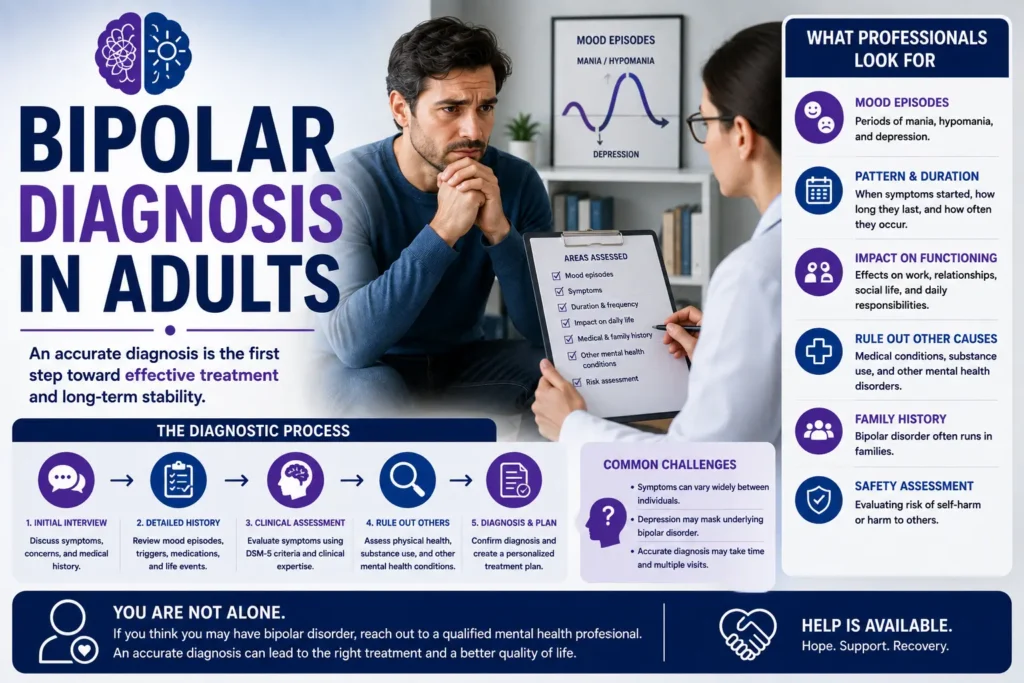
Bipolar Diagnosis in Adults: Bipolar disorder in adults is diagnosed the same way it is at any age—through a full clinical evaluation of mood history, not a single test—but adulthood brings specific complications. Careers, marriages, parenting, physical health conditions, and years of built-up coping habits can all mask or mimic symptoms, which is a major reason adult diagnosis is so often delayed. Understanding what makes the adult presentation distinct can help you recognize it sooner and get an accurate evaluation.
Table of Contents
Key Takeaways
- The core diagnostic process for adults is the same one used at any age: a full clinical evaluation against DSM-5 criteria, not a single test.
- Adults often have years of undiagnosed episodes behind them, sometimes explained away as personality, stress, or burnout.
- Physical health conditions and medications become more relevant with age and need to be ruled out as part of the evaluation.
- Life responsibilities — work, marriage, parenting — can both mask symptoms and make the consequences of missed episodes more serious.
- First-time bipolar diagnosis after age 40 or 50 warrants closer medical rule-out steps, since new-onset mood symptoms later in life have a wider range of possible causes.
Why Adult Diagnosis Looks Different From Diagnosis at Other Ages
The clinical criteria for bipolar disorder don’t change with age — the same DSM-5 requirements for mania, hypomania, and depression apply across the lifespan. What changes is the context. For general background on the condition, see bipolar disorder and what bipolar disorder is. For the diagnostic process itself, our guide to how bipolar disorder is diagnosed explains the steps in detail — this article focuses on the factors that specifically shape diagnosis once someone reaches adulthood.
Adults tend to arrive at an evaluation with more history to untangle: past relationships, jobs lost or changed, years of self-medicating with alcohol or other substances, and a personal narrative that has often already assigned a different explanation to the pattern — “I’m just intense,” “I burn out easily,” “I’ve always been like this.”
Why Bipolar Disorder Is So Often Missed for Years in Adults
Symptoms Get Absorbed Into “Personality”
By adulthood, many people have built an identity around their mood pattern without recognizing it as one. High-energy, high-output periods get labeled as ambition or a strong work ethic. Low periods get labeled as being a private person, an introvert, or someone who needs a lot of downtime. This is different from how early signs of bipolar disorder may present in adolescence, when parents or teachers are more likely to notice a change from a shorter baseline.
Careers Can Both Hide and Reward Symptoms
Certain high-achievement, high-stimulation careers can inadvertently reward hypomanic traits — long hours, big ideas, minimal sleep — which makes the “up” phase look like strength rather than a symptom. The depressive phase, by contrast, tends to get treated as burnout or “just needing a vacation.”
Relationships and Family Life Add Complexity
A spouse, partner, or close friend often notices the pattern before the person experiencing it does, but broaching it can feel sensitive. Parenting responsibilities can also delay someone from seeking help, since taking time for a full evaluation and treatment can feel like a luxury they can’t afford.
Substance Use Complicates the Picture
Years of using alcohol or other substances to manage mood swings — intentionally or not — can obscure the underlying pattern and needs to be assessed separately during a full evaluation.
Physical Health Conditions Increase With Age
As people get older, general medical conditions become more common and more relevant to a mood workup — thyroid disorders, certain neurological conditions, and interactions between multiple medications can all produce symptoms that resemble mood episodes.
What an Adult Diagnostic Evaluation Typically Involves
The overall structure mirrors the process described in our full bipolar disorder diagnosis guide, but for adults it typically places extra weight on:
| Area of Focus | Why It Matters More in Adults |
| Full life-stage history | Years of episodes may need to be reconstructed across jobs, relationships, and major transitions |
| Substance use history | More years of potential self-medication or masking |
| Medication and health history | Higher likelihood of other conditions or medications affecting mood |
| Occupational and relationship impact | Consequences of missed episodes (job loss, relationship strain, debt) tend to be more concrete and easier to date |
| Family and genetic history | Adults may know more about relatives’ diagnoses than they did earlier in life |
A psychiatrist or psychologist conducting this evaluation will ask about the same core features covered in bipolar disorder symptoms — but will spend more time reconstructing a multi-year timeline than would typically be needed for a younger patient with a shorter history.
New-Onset Bipolar Symptoms Later in Life
Bipolar disorder most often first appears in the late teens to twenties, but symptoms can also emerge — or first come to clinical attention — later in adulthood. When mood symptoms genuinely appear for the first time after age 40 or 50, clinicians typically broaden the medical rule-out process, since new-onset mood changes at this stage have a wider range of possible causes, including:
- Neurological conditions
- Vascular changes affecting the brain
- Certain medications (including some prescribed for other health conditions)
- Thyroid and other endocrine conditions
- In older adults, early signs of a broader cognitive or neurological process, which needs distinguishing from mood illness
This doesn’t mean late-onset bipolar disorder isn’t real or valid — it is a recognized presentation — but it’s one reason a more thorough physical workup is standard when symptoms are genuinely new later in life, rather than a recognition of an existing lifelong pattern.
Bipolar 1 vs. Bipolar 2 in Adulthood
By adulthood, many people have had enough time for the full symptom pattern to reveal itself, which is part of why age can factor into which type is ultimately diagnosed. Someone who has only ever experienced hypomania and depression may be diagnosed with Bipolar 2, while a first full manic episode — even later in life — would point toward Bipolar 1. Our detailed comparison in Bipolar 1 vs. Bipolar 2 explains these categories fully, and it’s worth noting that a diagnosis can shift over time — see can Bipolar 2 become Bipolar 1 for more on that.
How Adult Presentation Can Differ Between Men and Women
Some symptom patterns show general tendencies that differ by sex, though individual presentation varies widely. Our dedicated guides on bipolar symptoms in men and bipolar symptoms in women go into this in more depth, including how hormonal factors can play a role for women across different life stages.
Conditions Commonly Confused With Bipolar Disorder in Adults
| Condition | Why It’s Confused With Bipolar Disorder in Adults |
| Major depressive disorder | Adults often first seek help during a depressive episode, without mentioning past highs |
| Anxiety disorders | Racing thoughts, poor sleep, and restlessness overlap with hypomanic symptoms |
| Substance use disorders | Years of alcohol or drug use can mimic or mask underlying mood episodes |
| Thyroid or other endocrine conditions | Physical illness can produce mood symptoms that resemble a psychiatric episode |
| Perimenopause and menopause-related mood changes | Hormonal shifts can produce mood symptoms that overlap with hypomania or depression |
| Personality patterns (e.g., borderline traits) | Faster, trigger-driven mood shifts can resemble — but differ from — sustained bipolar episodes |
For a full breakdown of how bipolar disorder gets mistaken for other conditions, see our guide to bipolar misdiagnosis.
A Practical Checklist Before Your Appointment
- Write out a rough timeline of mood episodes across your adult life, even ones you didn’t recognize as symptoms at the time
- Note any periods of significantly reduced sleep without feeling tired
- List major life consequences tied to mood changes — job changes, financial decisions, relationship strain
- Include your history of alcohol or substance use honestly
- Bring a list of current medications and health conditions
- Consider asking a spouse, partner, or close friend for their observations, since they may recall episodes you don’t
Tools like the bipolar screening or bipolar quiz can help you organize your answers ahead of time, and our article on who can diagnose bipolar disorder explains which type of provider is the right fit for this kind of evaluation.
Myths vs. Facts About Adult Bipolar Diagnosis
| Myth | Fact |
| “If I’ve made it this far without a diagnosis, I probably don’t have it.” | Many adults go undiagnosed for years, especially if symptoms were absorbed into personality or work habits. |
| “Bipolar disorder always starts in the teens or twenties.” | It usually does, but new presentations later in life happen and are evaluated with additional medical rule-outs. |
| “A successful career means it can’t be bipolar disorder.” | High-functioning periods, including hypomania, can coexist with real impairment during depressive or manic episodes. |
| “I’ve just always been intense — that’s not a diagnosis.” | A consistent pattern of distinct mood episodes, not just an intense personality, is what a clinician looks for. |
| “Getting diagnosed as an adult means starting over.” | An adult diagnosis actually benefits from more history and self-awareness than earlier diagnosis often allows. |
Warning Signs That Need Prompt Attention
- Days without sleep and no sense of tiredness
- Impulsive spending, risky sexual behavior, or reckless driving that’s out of character
- Hearing or seeing things others don’t
- Hopelessness lasting more than two weeks
- Any thoughts of self-harm or suicide
Emergency Help
If you or someone you know is having thoughts of suicide or self-harm, treat it as a medical emergency. In the US, call or text 988 (Suicide & Crisis Lifeline). In the UK, call 111 or the Samaritans at 116 123. Elsewhere, contact your local emergency number or nearest emergency department. You don’t need a formal diagnosis to reach out for support.
What Happens After an Adult Diagnosis
Once diagnosed, treatment typically combines medication, therapy, and practical lifestyle adjustments that fit an adult’s existing responsibilities — work schedules, caregiving, financial pressures. Our full guide to bipolar disorder treatment covers this in depth, and bipolar disorder prognosis explains what accurate, ongoing treatment can mean for long-term outcomes. It’s also worth understanding the risks of leaving adult-onset or long-undiagnosed bipolar disorder untreated — see bipolar disorder complications.
Frequently Asked Questions
Can bipolar disorder be diagnosed for the first time in your 40s or 50s? Yes, though clinicians typically broaden the medical workup in these cases to rule out other causes of new-onset mood symptoms, since the range of possible explanations widens with age.
Why do so many adults go undiagnosed for years? Symptoms often get absorbed into personality, work habits, or explained away as stress and burnout, especially if depressive episodes are the only ones ever discussed with a doctor.
Does having a career and family rule out bipolar disorder? No. Many people with bipolar disorder function well in careers and relationships, particularly during hypomanic or stable periods, while still experiencing real impairment during mood episodes.
Is adult bipolar diagnosis different from diagnosis in teenagers? The clinical criteria are the same, but adults typically bring a longer, more complex history that needs to be reconstructed, along with more physical health factors to consider.
Can menopause be mistaken for bipolar disorder, or vice versa? Hormonal changes during perimenopause and menopause can produce mood symptoms that overlap with hypomania or depression, which is one reason a thorough evaluation matters rather than assuming either explanation automatically.
Should I mention past alcohol or substance use during my evaluation? Yes. Being honest about this history helps your clinician distinguish genuine mood episodes from substance-related symptoms, which directly affects diagnostic accuracy.
Can a diagnosis change later in adulthood? Yes. A diagnosis can be refined over time — for example, if a first full manic episode occurs after an earlier Bipolar 2 diagnosis.
Summary
Bipolar disorder in adults is diagnosed using the same clinical criteria used at any age, but adulthood adds layers that can delay recognition — careers that reward hypomanic traits, relationships and parenting responsibilities, years of substance use, and an accumulating list of physical health factors that need to be ruled out. Recognizing these patterns, rather than writing them off as personality or burnout, is often the first step toward an accurate diagnosis. A thorough evaluation with a psychiatrist or psychologist experienced in mood disorders remains the most reliable way to get clarity, regardless of how many years the pattern has gone unnamed.