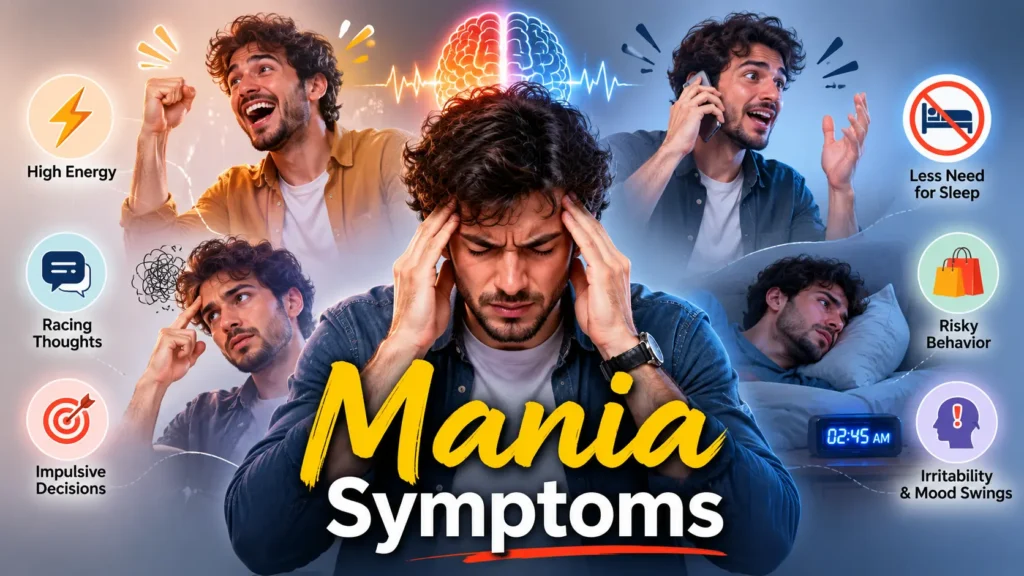
Mania symptoms include an abnormally elevated, expansive, or irritable mood along with increased energy, lasting at least one week, according to the American Psychiatric Association’s DSM-5 criteria. Alongside the mood change, mania typically involves several of the following: a reduced need for sleep, rapid or pressured speech, racing thoughts, inflated self-esteem or grandiosity, distractibility, increased goal-directed activity, and risky, impulsive behavior. Mania is the defining feature of Bipolar 1, though manic-type symptoms can occasionally have other causes too. For the milder, shorter version of this symptom pattern, see hypomania symptoms, and for the broader symptom picture across all mood episodes, see bipolar disorder symptoms.
Table of Contents
Introduction
Mania is one of the most misrepresented mental health terms in everyday language. People casually say they’re “manic” about a hobby or had a “manic Monday,” which flattens what mania clinically means: a distinct, sustained episode involving elevated or irritable mood, high energy, and a cluster of specific symptoms that meaningfully disrupt daily functioning.
Recognizing actual mania — not the casual use of the word — matters, because it’s a defining feature of Bipolar 1 disorder and, in severe cases, can involve psychosis or require hospitalization. This guide breaks down every core symptom of mania in plain language, with real-world examples of what each one can look like, so you can tell the difference between everyday high energy and a genuine manic episode. For background on the broader condition, see bipolar disorder and what bipolar disorder is.
Key Takeaways
- Mania is a distinct episode of elevated, expansive, or irritable mood plus increased energy, lasting at least one week (or any duration requiring hospitalization).
- Diagnosis requires the mood change plus at least three additional symptoms (four if the mood is only irritable), per DSM-5 criteria.
- Severity ranges from mild to severe, with the most serious cases involving psychosis.
- Mania is the hallmark of Bipolar 1, but manic-type symptoms occasionally have other causes, including substances or medical conditions.
- Reduced need for sleep is one of the most consistent and earliest-noticed symptoms.
- Warning signs like psychosis or dangerously reckless behavior require immediate professional attention.
What Counts as Mania, Clinically
To be diagnosed as a manic episode under DSM-5 criteria, a person needs a distinct period of abnormally and persistently elevated, expansive, or irritable mood, along with abnormally and persistently increased goal-directed activity or energy, lasting most of the day, nearly every day, for at least one week (or any duration if hospitalization is necessary). Alongside that mood and energy change, at least three additional symptoms from the list below must be present (or four, if the mood is irritable rather than elevated/expansive), and the symptoms must be severe enough to cause marked impairment in functioning, require hospitalization, or include psychotic features.
That’s a lot of clinical language for a simple point: mania isn’t just “feeling really good” or “having a productive week.” It’s a sustained, disruptive shift that stands out clearly from a person’s normal baseline.
The Core Symptoms of Mania
1. Inflated Self-Esteem or Grandiosity
This ranges from unusually high confidence to a genuinely unrealistic sense of importance, talent, or ability. In real life, this might look like someone suddenly believing they’re destined for extraordinary success, that they have special insight others lack, or that normal rules and risks don’t apply to them the way they do to everyone else.
2. Decreased Need for Sleep
Not just difficulty sleeping — a person in a manic episode may sleep two or three hours and wake up feeling fully rested and energetic, with no sense of fatigue. This is one of the most consistent and earliest-noticed symptoms of mania. It’s explored in more depth in our dedicated guide to mania and sleep.
3. Increased Talkativeness or Pressured Speech
Talking more than usual, feeling an internal pressure to keep talking, speaking faster than normal, or being hard to interrupt. In practice, this can look like dominating conversations, jumping quickly between topics, or family and friends noting that “you can’t get a word in.”
4. Racing Thoughts or Flight of Ideas
A sense that thoughts are moving faster than they can be expressed, or that ideas are jumping rapidly from one to another, sometimes connected only loosely. People sometimes describe this as their mind feeling like it’s “running ahead” of them.
5. Distractibility
Attention pulled easily and repeatedly toward irrelevant or unimportant stimuli — a sound outside, an unrelated thought, a passing comment — making it difficult to stay focused on a task or conversation.
6. Increase in Goal-Directed Activity
A noticeable rise in activity aimed at a goal — socially, at work, sexually, or in personal projects. This can look like suddenly launching multiple new projects, reorganizing the entire house at 2 a.m., or throwing oneself into work or a hobby with unusual intensity.
7. Psychomotor Agitation
Physical restlessness that goes beyond simple fidgeting — pacing, hand-wringing, or an inability to sit still, often paired with the internal sense of racing energy described above.
8. Excessive Involvement in Risky Activities
This is often the most visibly disruptive symptom. Examples include impulsive spending sprees, risky business or financial decisions, impulsive sexual behavior, reckless driving, or substance use that’s out of character for the person. Because judgment is impaired during mania, these decisions often don’t register as risky to the person experiencing them in the moment.
Symptom Table: Mania at a Glance
| Symptom | What It Can Look Like |
| Elevated or irritable mood | Euphoric, expansive, or unusually short-tempered, sustained for days |
| Grandiosity | Inflated confidence or belief in special talents/importance |
| Decreased need for sleep | Fully rested after 2–3 hours of sleep |
| Pressured speech | Talking fast, hard to interrupt, dominating conversation |
| Racing thoughts | Ideas jumping quickly, mind feels “ahead” of speech |
| Distractibility | Attention pulled by irrelevant stimuli |
| Increased activity | Multiple new projects, intense focus on goals |
| Psychomotor agitation | Pacing, restlessness, inability to sit still |
| Risky behavior | Impulsive spending, reckless driving, risky sexual decisions |
Severity Levels of Mania
Mania isn’t all-or-nothing — clinicians often describe severity along a spectrum:
- Mild mania: Symptoms are present and noticeable but cause relatively limited disruption to functioning.
- Moderate mania: Symptoms clearly impair work, relationships, or daily responsibilities.
- Severe mania: Symptoms cause major impairment, may require hospitalization for safety, and can include psychotic features such as delusions or hallucinations.
Milder, shorter versions of these same symptoms that don’t reach the severity or duration threshold for mania are classified as hypomania instead — a distinction covered fully in mania vs hypomania and hypomania symptoms.
Psychotic Features in Severe Mania
In its most severe form, mania can include psychosis — a loss of contact with shared reality. This might involve:
- Delusions (firmly held false beliefs, such as having special powers or a special mission)
- Hallucinations (seeing, hearing, or sensing things that aren’t there)
- Disorganized thinking or speech
Psychotic features during mania represent a medical emergency and require immediate professional treatment. We cover this specific presentation in detail in psychosis in mania and Bipolar 1 with psychotic features.
What Triggers a Manic Episode
Mania can be triggered by a range of factors, including sleep deprivation, high-stress life events, certain substances, and in some cases, antidepressant medication in someone with an underlying bipolar diagnosis. Since this deserves its own deep dive, see our dedicated guide to mania triggers and causes of mania.
Is It Always Bipolar Disorder? Other Causes of Manic Symptoms
While mania is most closely associated with Bipolar 1 disorder, manic-type symptoms can occasionally stem from other sources, and part of a proper evaluation involves ruling these out:
- Substance-induced mania — symptoms triggered by stimulants, certain recreational drugs, or, less commonly, prescription medications
- Mania due to another medical condition — some neurological or endocrine conditions can produce manic-like symptoms
- Antidepressant-induced switch — antidepressant treatment can occasionally trigger a manic episode in someone with an underlying bipolar vulnerability
A clinician will typically consider these possibilities during evaluation, since the underlying cause affects treatment. For the full diagnostic process, see bipolar disorder diagnosis.
Myths vs Facts About Mania
| Myth | Fact |
| “Mania just means being really happy or energetic.” | Clinical mania involves a specific cluster of symptoms lasting at least a week and causing real disruption, not simply a good mood. |
| “People in mania know they’re not acting like themselves.” | Insight is often reduced during mania, so the person may not recognize the behavior as unusual or risky in the moment. |
| “Mania always looks euphoric.” | Mania can present as irritability and agitation rather than euphoria, especially in some individuals and in younger people. |
| “Mania resolves on its own without treatment.” | While episodes are time-limited, professional treatment significantly shortens duration and reduces risk during the episode. |
For a broader collection of misconceptions, see bipolar disorder myths.
Warning Signs That Need Immediate Attention
Certain features of mania require urgent professional attention rather than waiting:
- Signs of psychosis — hallucinations or delusions
- Extremely reckless behavior that puts safety at serious risk (dangerous driving, major financial risk, unsafe sexual behavior)
- Combination of high energy and hopelessness at the same time (possible mixed features)
- Aggressive or threatening behavior toward others
- Complete inability to sleep for multiple consecutive nights
If you or someone you know is experiencing severe manic symptoms, especially with psychosis or safety concerns, seek emergency medical care right away. If there are also thoughts of suicide or self-harm involved, contact the 988 Suicide & Crisis Lifeline (call or text 988 in the US) or your local emergency number immediately.
Diagnosis: How Mania Is Confirmed
There’s no lab test for mania. Diagnosis relies on a clinical interview covering symptom duration, severity, and functional impact, using DSM-5 criteria as the reference standard used by Mayo Clinic and Cleveland Clinic. Input from family members is often valuable, since insight can be limited during an active manic episode. For the complete diagnostic process, see bipolar disorder diagnosis, and for how this fits within the broader Bipolar 1 diagnostic picture, see our dedicated guide.
Treatment for Mania (Brief)
Mania is typically treated with mood stabilizers or antipsychotic medications, sometimes requiring hospitalization for safety during severe episodes, followed by psychotherapy and ongoing management once the acute episode resolves. Since treatment deserves its own deep dive, see our full guide to mania treatment and the broader bipolar disorder treatment overview.
Dos and Don’ts for Supporting Someone Experiencing Mania
| Do | Don’t |
| Stay calm and speak in a steady, non-confrontational tone | Argue or try to reason someone out of grandiose beliefs |
| Help limit access to major financial decisions if possible | Hand over credit cards or large sums of money during an active episode |
| Encourage contact with their treatment provider | Wait and assume it will resolve without professional input |
| Prioritize safety over convincing them they’re “wrong” | Leave someone alone if there are signs of psychosis or danger |
| Document specific behaviors and changes you’ve noticed | Rely on vague descriptions like “acting weird” when seeking help |
Complications of Untreated Mania
Untreated manic episodes are associated with financial, legal, relationship, and safety consequences due to impaired judgment during the episode, along with increased risk of recurrence. For the full picture, see bipolar disorder complications.
Checklist: Recognizing Mania
- [ ] Elevated, expansive, or irritable mood lasting most of the day for a week or more
- [ ] Noticeably reduced need for sleep without fatigue
- [ ] Talking faster or more than usual
- [ ] Racing thoughts or ideas that feel hard to keep up with
- [ ] Increased confidence, grandiosity, or inflated self-importance
- [ ] Increased activity, new projects, or intense goal pursuit
- [ ] Impulsive or risky decisions out of character for the person
- [ ] Noticeable disruption to work, relationships, or daily responsibilities
If several of these apply and have lasted close to a week or more, it’s worth seeking a professional evaluation.
Frequently Asked Questions
What is the very first sign of a manic episode? Reduced need for sleep is one of the earliest and most consistently reported first signs, sometimes appearing before other symptoms become obvious.
Can someone have mania without feeling happy? Yes. Mania can present as intense irritability and agitation instead of euphoria, and this pattern is common in some individuals.
How long does a manic episode usually last? By DSM-5 criteria, symptoms must persist for at least one week (or any duration if hospitalization is required) to be classified as a full manic episode.
Is mania always part of bipolar disorder? Mania is most closely associated with Bipolar 1 disorder, but manic-type symptoms can occasionally result from substances, certain medical conditions, or antidepressant treatment, which is why proper evaluation matters.
What’s the difference between mania and hypomania? Hypomania involves the same core symptoms but is shorter (at least four days rather than a week), less severe, and doesn’t cause the same level of impairment, hospitalization, or psychosis that full mania can.
Can mania go away without treatment? Manic episodes are time-limited, but professional treatment significantly shortens their duration and reduces the risk of harmful decisions or complications during the episode.
Does everyone with mania experience psychosis? No — psychosis occurs only in more severe manic episodes. Many people experience mania without any psychotic features.
Summary
Mania involves a specific, sustained cluster of symptoms — elevated or irritable mood, decreased need for sleep, racing thoughts, grandiosity, increased activity, and risky behavior — lasting at least a week and clearly disrupting daily life. It’s more than just an energetic mood, and in its most severe form, it can include psychosis and require hospitalization. Recognizing the full symptom pattern, rather than a single behavior in isolation, is the key to getting an accurate evaluation and timely treatment.
For related reading, see our guides on manic episodes, manic depression, and hypermania if you’re researching related terminology, or our broader bipolar symptoms guide for the full picture across all mood episodes.
This article is for educational purposes and is not a substitute for a professional diagnosis. If you are experiencing thoughts of suicide or self-harm, please contact the 988 Suicide & Crisis Lifeline (call or text 988) or your local emergency services immediately.