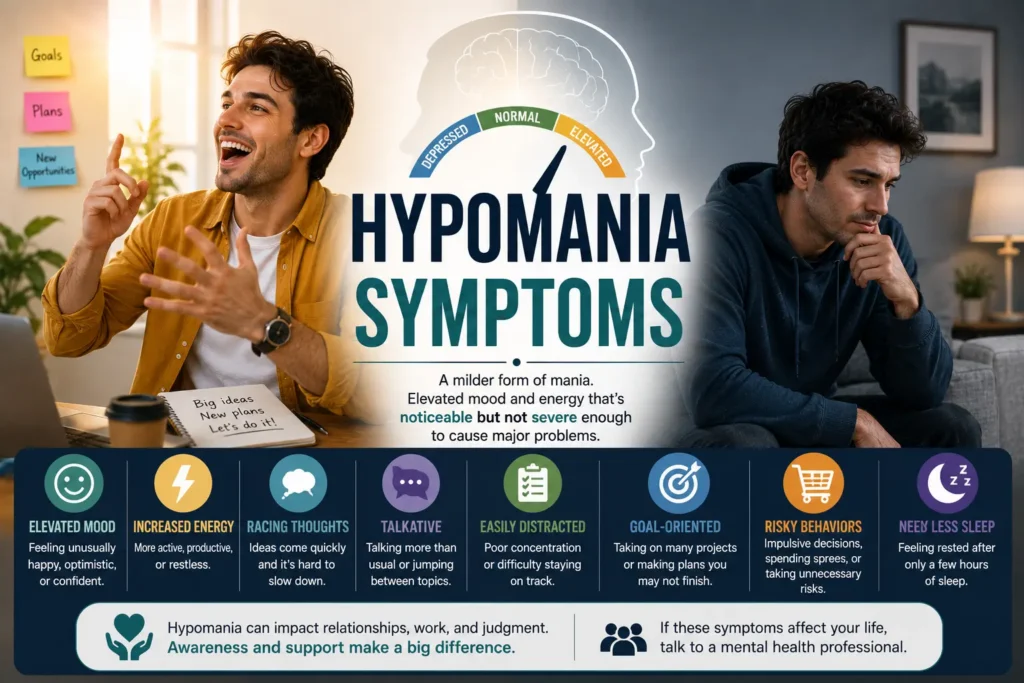
Hypomania symptoms include a noticeably elevated, expansive, or irritable mood combined with increased energy, lasting at least four consecutive days. Common signs are reduced need for sleep, increased talkativeness, heightened confidence, racing thoughts, and impulsivity — without the severe impairment or psychosis seen in full mania. These symptoms define a hypomanic episode and are most often associated with bipolar 2 disorder.
Table of Contents
Key Takeaways
- Hypomania symptoms affect mood, energy, thinking, and behavior, but stay milder than mania.
- Symptoms must last most of the day for at least four consecutive days to meet clinical criteria.
- Hypomania doesn’t cause major disruption to daily functioning and never includes psychosis.
- Because it can feel pleasant or productive, hypomania is frequently underreported and underdiagnosed.
- Hypomania symptoms are a defining feature of bipolar 2 disorder, distinct from the full mania seen in bipolar 1.
- Recognizing the pattern early helps prevent complications and supports more accurate diagnosis.
What Counts as a Hypomania Symptom?
Hypomania symptoms form a recognizable pattern, not just a single mood shift. According to the DSM-5, hypomania requires a distinct period of abnormally and persistently elevated, expansive, or irritable mood along with increased energy or activity, present most of the day, nearly every day, for at least four consecutive days.
The mood and behavior change has to be clear enough that other people notice it — not just a subtle internal shift. This is one reason hypomania often goes unreported: it doesn’t usually create the kind of crisis that prompts someone to seek help right away.
For background on how hypomania fits within the wider condition, see our guides on what bipolar disorder is and types of bipolar disorder. If you want the full clinical picture of hypomania as a diagnosis — including duration, causes, and treatment — visit our complete hypomanic episode guide. This article focuses specifically on what the symptoms look like and how to recognize them.
Core Symptoms of Hypomania
| Category | What It Looks Like |
| Mood | Elevated, upbeat, or irritable mood |
| Energy | Increased drive, restlessness, feeling unusually energized |
| Sleep | Reduced need for sleep without feeling tired the next day |
| Speech | Talking more than usual, feeling unusually chatty |
| Thought patterns | Quick, active thinking; occasionally racing thoughts |
| Confidence | Increased self-esteem, feeling capable or “on top of things” |
| Attention | Mild distractibility |
| Judgment | Slightly impulsive decisions, though generally manageable |
| Goal-directed activity | Increased productivity, new projects, heightened social activity |
For a wider view of symptoms across all bipolar mood states, see bipolar disorder symptoms.
Emotional Symptoms of Hypomania
- Elevated mood — feeling unusually upbeat, optimistic, or “high” without an obvious cause
- Irritability — some people experience hypomania as edginess or impatience rather than euphoria
- Increased sociability — wanting to talk to more people, make more plans, or connect more than usual
- Heightened confidence — feeling unusually sure of decisions, abilities, or plans
Not everyone experiences hypomania the same way. Some lean toward euphoric, expansive mood, while others notice mostly irritability and restlessness.
Cognitive and Speech-Related Symptoms
- Faster thinking — ideas coming quickly, sometimes feeling sharper or more creative than usual
- Increased talkativeness — speaking more than normal, sometimes without fully noticing it
- Mild racing thoughts — thoughts moving quickly, though usually still followable, unlike the flight of ideas seen in mania
- Distractibility — attention shifting more easily than usual, though not to the point of disrupting basic functioning
These cognitive shifts are part of why hypomania can feel like a “good” period — sharper focus and increased energy often feel productive in the moment.
Behavioral Symptoms of Hypomania
| Behavior | Example |
| Increased productivity | Taking on new projects, working longer hours |
| Mild impulsivity | Slightly riskier spending or decision-making |
| Increased socializing | More calls, messages, or plans than usual |
| Reduced need for sleep | Functioning well on less sleep without exhaustion |
| Heightened activity | Restlessness, fidgeting, or constant motion |
| Increased confidence in decisions | Making choices more quickly than usual |
Unlike full mania, these behaviors typically stay within a range that doesn’t seriously disrupt work, relationships, or safety — though they’re still a meaningful shift from someone’s baseline.
What Hypomania Symptoms Do NOT Include
This distinction matters, because it’s what separates hypomania from mania:
- No hallucinations or delusions
- No need for hospitalization
- No severe impairment in work, relationships, or daily responsibilities
- Symptoms generally stay noticeable but manageable, rather than escalating into crisis
If any of the above are present, the presentation likely points to a full manic episode rather than hypomania.
Hypomania Symptoms vs. Mania Symptoms
| Symptom Area | Hypomania | Mania |
| Duration | At least 4 consecutive days | At least 7 days (or any length if hospitalized) |
| Mood intensity | Noticeable, but controlled | Intense, often overwhelming |
| Sleep | Reduced, but not exhausting | Minimal or none |
| Judgment | Mildly affected | Significantly impaired |
| Daily functioning | Largely intact | Substantially disrupted |
| Psychosis | Never present | Possible |
| Typical association | Bipolar 2 | Bipolar 1 |
For a full side-by-side breakdown, see our guide on mania vs. hypomania. If you’re comparing the broader diagnostic picture, bipolar 1 vs bipolar 2 and the bipolar 1 vs 2 quiz can help clarify which pattern fits.
Why Hypomania Symptoms Are Easy to Miss
Hypomania often doesn’t feel like a problem while it’s happening. People commonly describe it as:
- Feeling more capable and “on” than usual
- A stretch of high productivity or creativity
- A mood that feels good, not distressing
Because of this, hypomania symptoms are frequently left out of conversations with doctors — people are far more likely to seek help during a depressive episode and simply not mention the “up” periods. This is a major reason bipolar 2 disorder can go undiagnosed or misdiagnosed as depression alone. For more on this pattern, see bipolar 2 hypomania and bipolar 2 depression.
Hypomania Symptoms Checklist
This checklist can help you recognize a pattern worth discussing with a professional — it isn’t a diagnostic tool on its own.
- [ ] Elevated, expansive, or irritable mood most of the day
- [ ] Reduced need for sleep without feeling tired
- [ ] Talking more than usual
- [ ] Increased energy or restlessness
- [ ] Heightened self-confidence
- [ ] Mildly impulsive decisions
- [ ] Increased goal-directed activity or social activity
- [ ] Symptoms noticeable to others, not just yourself
- [ ] Pattern lasting at least four consecutive days
- [ ] No hallucinations, delusions, or severe impairment
If several of these apply and the pattern has repeated over time, it’s worth bringing up with a mental health professional, especially if depressive episodes have also occurred. See bipolar disorder diagnosis for what that evaluation typically involves.
What Triggers These Symptoms?
Hypomania symptoms are influenced by genetics, brain chemistry, sleep disruption, stress, and sometimes medications like antidepressants. Since causes deserve deeper coverage on their own, our guide on bipolar disorder causes explains this in full.
When Hypomania Symptoms Need Professional Attention
Hypomania on its own usually isn’t an emergency, but it’s still worth addressing, especially if:
- The pattern repeats over weeks or months
- Family or friends have pointed out a consistent behavior shift
- Hypomanic periods are followed by depressive episodes
- Sleep, spending, or relationships are starting to be affected
Seek urgent help if symptoms escalate to include:
- Hallucinations, delusions, or disorganized thinking
- Extremely reckless or dangerous behavior
- No sleep for multiple consecutive nights with rising agitation
- Any thoughts of self-harm
These signs suggest the episode may be shifting from hypomania toward full mania, which needs more immediate care. If you or someone you know is in crisis, contact emergency services, or in the US, call or text 988 to reach the Suicide & Crisis Lifeline, available 24/7.
Myths vs. Facts About Hypomania Symptoms
| Myth | Fact |
| Hypomania symptoms are just a great mood | They’re a distinct, clinically recognized pattern involving measurable changes in energy and behavior |
| If it doesn’t disrupt life, it’s not worth mentioning to a doctor | Reporting hypomania symptoms helps ensure accurate diagnosis, especially for bipolar 2 |
| Hypomania symptoms always include euphoria | Irritability and restlessness are just as common as euphoric mood |
| Hypomania symptoms are identical to mania, just “less” | They differ in duration, severity, and the presence of psychosis, not just intensity |
| Only people who feel “manic” have hypomania | Some people only notice subtle changes like sleeping less or feeling unusually driven |
For more common misconceptions across bipolar disorder generally, see bipolar disorder myths.
How Hypomania Symptoms Are Diagnosed and Treated
Diagnosis and treatment are covered in full in our guides on bipolar disorder diagnosis, bipolar disorder treatment, and bipolar 2 treatment. In short, a clinician evaluates the pattern of symptoms against DSM-5 criteria, often alongside a history of depressive episodes, and treatment usually combines mood stabilizers, therapy, and consistent sleep habits.
Frequently Asked Questions
What are the earliest signs of hypomania? Common early signs include sleeping less without feeling tired, increased talkativeness, rising energy, and a subtle boost in confidence.
How long do hypomania symptoms need to last for a diagnosis? Clinically, symptoms need to be present most of the day, nearly every day, for at least four consecutive days.
Can hypomania symptoms feel positive? Yes, and that’s part of what makes them easy to miss. Many people describe hypomania as feeling more energetic, social, or productive than usual.
What’s the difference between hypomania symptoms and bipolar 2 symptoms? Hypomania symptoms are one part of bipolar 2, which also includes depressive episodes. Hypomania alone doesn’t confirm a bipolar 2 diagnosis — see bipolar 2 symptoms for the full picture.
Do hypomania symptoms always progress to mania? No. Hypomania and mania are diagnostically distinct, and hypomania doesn’t automatically escalate. That said, worsening symptoms should be evaluated promptly.
Can irritability alone signal hypomania? It can be part of the picture, but hypomania requires a cluster of symptoms — elevated mood or irritability alongside increased energy, reduced sleep, and other changes — lasting several days.
Should I track my hypomania symptoms? Yes. Mood tracking can help identify patterns over time and gives your clinician more accurate information than relying on memory alone.
Summary
Hypomania symptoms involve a genuine, noticeable shift in mood and energy — elevated or irritable mood, reduced need for sleep, increased talkativeness, and heightened confidence — lasting at least four consecutive days. Unlike mania, hypomania doesn’t include psychosis or seriously disrupt daily life, which is exactly why it’s so often missed or underreported. Recognizing this pattern matters, especially since it’s a defining feature of bipolar 2 disorder. If you notice this pattern repeating in yourself or someone close to you, a mental health professional can help clarify what’s happening and guide the right next steps.
This article is for educational purposes and is not a substitute for professional medical advice. If you or someone you know is experiencing symptoms of hypomania, please consult a qualified healthcare provider.