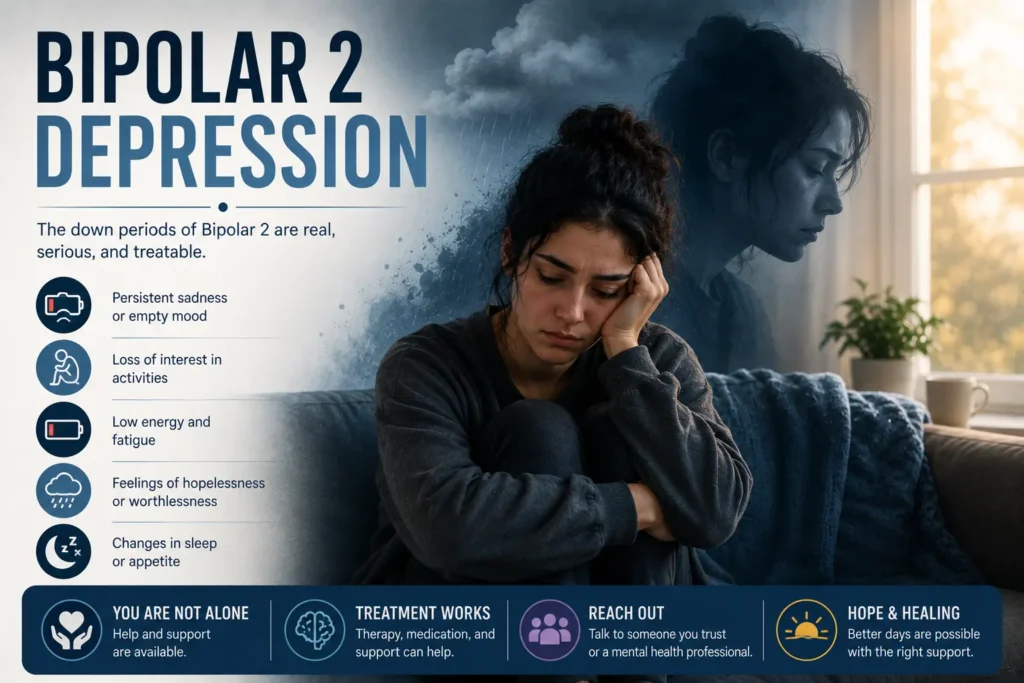
Bipolar 2 depression refers to the depressive episodes experienced by someone with bipolar 2 disorder. Clinically, these episodes look the same as major depressive disorder — at least five symptoms, including low mood or loss of interest, lasting two weeks or more — but they occur alongside a history of hypomania rather than on their own. That distinction matters enormously, because treating bipolar depression the same way you’d treat standalone depression can backfire, sometimes triggering hypomania or worsening the overall course of the illness. If you’re not yet sure which type of bipolar disorder you’re dealing with, our bipolar 1 vs bipolar 2 guide is the best place to start.
Table of Contents
Key Takeaways
- Bipolar 2 depression meets the same diagnostic criteria as major depressive disorder, but it’s part of a bipolar illness, not a standalone one.
- People with bipolar 2 typically spend far more time depressed than hypomanic — depression is usually the dominant, most disruptive part of the illness.
- Because depression is what usually brings people to treatment, bipolar 2 is frequently misdiagnosed as ordinary depression, sometimes for years.
- Standard antidepressants used alone can be risky in bipolar 2, since they may trigger a hypomanic episode in some people.
- Effective treatment usually combines mood stabilizers or specific atypical antipsychotics with structured therapy, not antidepressants alone.
What Is Bipolar 2 Depression?
Bipolar 2 depression is the depressive half of bipolar 2 disorder, a condition defined by at least one major depressive episode plus at least one hypomanic episode, with no history of full mania. If you haven’t read up on the hypomanic side of the illness yet, our guide to bipolar 2 hypomania covers that half in detail.
Here’s the part that surprises a lot of people: the DSM-5 diagnostic criteria for a major depressive episode are identical whether someone has bipolar disorder or straightforward major depressive disorder. There’s no separate symptom checklist for “bipolar depression.” What makes it bipolar is the presence of hypomania somewhere in the person’s history — not a different flavor of sadness.
That said, in practice, bipolar depression often behaves differently. Research consistently shows that people with bipolar 2 spend considerably more time in depressive episodes than in hypomanic ones over the course of their illness. Depression, not hypomania, is usually what damages quality of life, and it’s usually what eventually brings someone into a doctor’s office. For a broader look at how these mood states fit together, see our page on what is bipolar disorder.
Symptoms of a Bipolar 2 Depressive Episode
To meet DSM-5 criteria for a major depressive episode, a person needs at least five of the following symptoms nearly every day for at least two weeks, representing a change from previous functioning, and including at least one of the first two:
| Symptom | What it can look like |
| Depressed mood most of the day | Persistent sadness, emptiness, or hopelessness |
| Loss of interest or pleasure (anhedonia) | Activities that used to feel enjoyable no longer do |
| Significant weight or appetite change | Noticeable weight loss/gain not tied to dieting |
| Sleep disturbance | Insomnia or sleeping far more than usual |
| Psychomotor agitation or slowing | Visibly restless, or noticeably slowed movement/speech |
| Fatigue or loss of energy | Feeling drained even after rest |
| Feelings of worthlessness or excessive guilt | Harsh self-criticism disproportionate to the situation |
| Difficulty concentrating or making decisions | Trouble focusing at work, indecisiveness over small choices |
| Recurrent thoughts of death or suicide | Passive thoughts of not wanting to exist, or active suicidal thinking |
For the fuller symptom picture across both mood poles of the condition, our page on bipolar disorder symptoms is a useful companion. If you want to compare how bipolar 2 depression specifically differs from bipolar 1 depressive episodes, our dedicated bipolar 1 vs 2 depression page covers that comparison directly.
Features That Are More Common in Bipolar Depression
While the core symptom list is shared with unipolar depression, clinicians and researchers have noted that bipolar depressive episodes more often include:
- Oversleeping (hypersomnia) rather than insomnia
- Increased appetite and weight gain rather than loss
- A heavier, “leaden” fatigue rather than general low energy
- Earlier age of onset compared to unipolar depression
- A family history of bipolar disorder
- Mixed features — some hypomanic symptoms (racing thoughts, irritability, restlessness) occurring alongside the depression at the same time
None of these features alone confirm bipolar depression, but their presence is often what prompts a clinician to look more closely at a person’s mood history before settling on a diagnosis.
Bipolar 2 Depression vs. Major Depressive Disorder (Unipolar Depression)
This is one of the most important distinctions in the entire condition, and it’s frequently under-explained. The two look almost identical in the moment, which is exactly why misdiagnosis happens so often.
| Feature | Bipolar 2 Depression | Unipolar (Major) Depression |
| Diagnostic symptoms | Same DSM-5 criteria | Same DSM-5 criteria |
| History of hypomania | Present (required for diagnosis) | Absent |
| Typical age of onset | Often earlier, sometimes teens or early 20s | Can occur at any age |
| Family history | More often includes bipolar disorder | More often includes unipolar depression |
| Sleep/appetite pattern | Hypersomnia and increased appetite more common | Insomnia and decreased appetite more common |
| Response to antidepressants alone | Can trigger hypomania in some people | Generally used as first-line treatment |
| First-line medication | Mood stabilizers or specific atypical antipsychotics | Antidepressants |
| Course over time | Recurrent episodes with a hypomanic component | Depressive episodes only |
Because the depressive symptoms themselves don’t reveal which condition someone has, a full mood history — asking specifically about past hypomanic periods, not just current sadness — is the only reliable way to tell them apart. This is one of the main reasons bipolar 2 diagnosis is so often delayed.
Why Bipolar 2 Depression Gets Misdiagnosed So Often
Several factors make bipolar 2 depression easy to miss:
- People rarely report hypomania on their own. Hypomania can feel productive or even pleasant, so patients often don’t mention it — they show up describing depression, not “the good weeks.”
- Depression dominates the timeline. Since people with bipolar 2 spend far more time depressed than hypomanic, doctors see mostly depressive symptoms during visits.
- Standard depression screenings don’t ask about hypomania. Many routine questionnaires focus entirely on depressive symptoms and skip mood elevation history altogether.
- Hypomania is subtle compared to mania. Without the dramatic, unmistakable presentation of full mania, hypomanic periods are easy for both patients and clinicians to overlook in a brief appointment.
Getting this right matters because treatment approaches diverge significantly once bipolar 2 is correctly identified. Our detailed guide to bipolar disorder diagnosis and bipolar 1 vs 2 diagnosis walks through how clinicians approach this distinction. If you want a starting point for self-reflection ahead of a professional evaluation, our bipolar 1 vs 2 test and bipolar 1 vs 2 quiz can help frame that conversation — though neither replaces a clinical assessment.
Causes and Risk Factors
Bipolar 2 depression doesn’t have one single cause. Like bipolar disorder overall, it’s understood to arise from a mix of genetic, biological, and environmental factors.
| Category | Contributing factors |
| Genetics | Having a first-degree relative with bipolar disorder is one of the strongest known risk factors |
| Neurobiology | Differences in brain circuits and neurotransmitter regulation involved in mood control |
| Sleep disruption | Irregular sleep patterns are linked to both triggering and worsening depressive episodes |
| Stressful life events | Major stress, loss, or prolonged conflict can precede an episode |
| Substance use | Alcohol and drug use can both trigger episodes and complicate recovery |
| Hormonal changes | Postpartum periods and other major hormonal shifts can be triggers in vulnerable individuals |
| Untreated hypomania | Episodes that go unaddressed are associated with a higher chance of depressive relapse |
For a deeper dive into the research behind these risk factors, our page on bipolar disorder causes covers the genetic and neurobiological evidence in more depth.
How Bipolar 2 Depression Is Diagnosed
There’s no lab test that identifies bipolar depression specifically. Diagnosis depends on a thorough clinical evaluation, and typically includes:
- A complete mood history, covering not just the current depressive episode but any past periods of unusually elevated mood or energy, however brief.
- Screening for hypomanic symptoms using structured questions, since patients often won’t volunteer this information unprompted.
- Input from family members or partners, when appropriate, who may have noticed hypomanic periods the patient didn’t recognize as unusual.
- Ruling out other causes, including thyroid conditions, medication effects, and substance use, which can all produce depressive symptoms.
- Applying DSM-5 criteria for both a major depressive episode and a prior hypomanic episode, since both are required for a bipolar 2 diagnosis.
Our full breakdown of the bipolar 1 vs 2 chart and general types of bipolar disorder can help clarify where bipolar 2 fits among related conditions like bipolar 1 and cyclothymia.
Myths vs. Facts About Bipolar 2 Depression
| Myth | Fact |
| “Bipolar depression is the same as regular depression, just call it something else.” | It meets the same symptom criteria, but the underlying illness course, risks, and treatment approach differ meaningfully. |
| “If antidepressants haven’t worked, nothing will.” | Many people respond well once treatment is adjusted to address the bipolar component, not just the depressive symptoms. |
| “Bipolar 2 is a ‘lighter’ version of bipolar 1, so its depression must be milder too.” | Depressive episodes in bipolar 2 are often just as severe, and sometimes more frequent, than in bipolar 1. |
| “You can tell it’s bipolar depression just by how the sadness feels.” | The depressive symptoms themselves usually look identical to unipolar depression — the difference lies in mood history, not the depression itself. |
| “Once you’re diagnosed, hypomania is the main thing to manage.” | For most people with bipolar 2, depression takes up far more time and causes more day-to-day impairment than hypomania. |
For a broader set of misconceptions across the wider condition, see our page on bipolar disorder myths.
Complications of Untreated Bipolar 2 Depression
Depressive episodes that go unaddressed, or are treated incorrectly, are linked to a range of serious consequences:
- Increased risk of suicidal thinking and behavior — bipolar disorder carries meaningfully elevated suicide risk compared to the general population
- Greater difficulty maintaining work, school, or family responsibilities during episodes
- Higher likelihood of substance use as a coping mechanism
- Strain on relationships from prolonged withdrawal or low functioning
- A more difficult overall illness course when antidepressants are used without a mood stabilizer and inadvertently trigger hypomanic switching
Our page on bipolar disorder complications covers these risks across the full condition in more depth. If you or someone you know is having thoughts of suicide, this is a medical emergency — see the Emergency Help section below.
Treatment for Bipolar 2 Depression
Treating bipolar 2 depression requires a different strategy than treating unipolar depression, because the goal is managing the whole illness — preventing both future depressive and hypomanic episodes — not just lifting the current low mood.
Medications
| Medication type | Role in bipolar 2 depression |
| Mood stabilizers (e.g., lithium, lamotrigine) | Often foundational for reducing depressive relapse and stabilizing mood overall |
| Atypical antipsychotics (e.g., quetiapine, lurasidone) | Several are specifically approved for treating bipolar depression |
| Antidepressants | Used cautiously and typically only alongside a mood stabilizer, due to hypomania-switching risk when used alone |
Medication choice depends heavily on episode history, other health conditions, and prior response to treatment, which is why this decision should always be made with a psychiatrist rather than self-adjusted. Our guide to bipolar 1 vs 2 treatment and the broader bipolar disorder treatment overview go further into how these medications are typically combined.
Therapy
Several therapy approaches have a strong evidence base for bipolar depression:
- Cognitive behavioral therapy (CBT) — addressing depressive thought patterns and behavioral withdrawal
- Interpersonal and social rhythm therapy (IPSRT) — stabilizing daily routines and sleep, both closely linked to mood stability
- Psychoeducation — learning to recognize personal early warning signs of an oncoming depressive or hypomanic episode
- Family-focused therapy — helping loved ones understand the illness and respond in supportive, non-escalating ways
Lifestyle Strategies That Support Recovery
- Keeping a consistent sleep-wake schedule, since sleep disruption is a well-documented trigger for mood episodes
- Tracking mood daily to catch early signs of a shift before it deepens
- Limiting alcohol, which can worsen depressive symptoms and interfere with medication
- Staying connected to a support system, even when withdrawal feels like the easier option
- Building a written relapse plan with a trusted person, so early warning signs don’t go unnoticed
A Quick Self-Check: Could This Be Bipolar Depression?
This isn’t a diagnostic tool, but these questions can help frame a conversation with a clinician:
- Have you ever had a period of several days where you felt unusually energetic, confident, or needed much less sleep than normal — even if it felt good at the time?
- Has anyone close to you ever commented that you seemed “unusually up” or “not quite yourself” in an energized way?
- Have antidepressants ever made you feel unusually wired, agitated, or elevated rather than simply “better”?
- Does depression tend to come in distinct episodes, followed by stretches where your mood and energy feel notably different?
Answering “yes” to any of these doesn’t confirm bipolar 2, but it’s worth raising directly with a psychiatrist, since standard depression screenings often don’t ask about this.
Warning Signs to Watch For
- Persistent low mood or loss of interest lasting two weeks or more
- Sleeping far more than usual and still feeling exhausted
- Withdrawing from people or activities that used to matter
- Increasing hopelessness or a sense that things won’t improve
- Any thoughts of self-harm or suicide, even passing ones
When to Seek Emergency Help
Depression in bipolar 2 disorder can become a medical emergency. Seek immediate help if you or someone you know experiences:
- Thoughts of suicide or a plan to harm oneself
- A sudden inability to function or care for basic needs
- Statements suggesting someone no longer wants to be alive
- A rapid, severe worsening of mood that feels unmanageable
If you or someone else is in crisis, call or text 988 (Suicide & Crisis Lifeline) in the U.S., or contact local emergency services immediately. This is a sensitive topic, and if you’re personally experiencing these feelings, please reach out to a mental health professional or crisis line — you don’t have to manage this alone.
Prognosis and Long-Term Outlook
With consistent, correctly targeted treatment, many people with bipolar 2 disorder achieve real stability and go long stretches between depressive episodes. The outlook tends to be better when the bipolar component is recognized early, rather than treated for years as standalone depression. Ongoing therapy, medication adherence, and routine check-ins with a psychiatrist are all associated with better long-term outcomes. Our page on bipolar disorder prognosis covers the broader factors that shape long-term course.
Frequently Asked Questions
Is bipolar 2 depression worse than bipolar 1 depression? Neither is uniformly “worse.” Research suggests people with bipolar 2 often experience depression that is at least as frequent and impairing as in bipolar 1, even though bipolar 2 lacks full manic episodes. Our bipolar 1 vs 2 which is worse page explores this comparison in more depth.
Can antidepressants alone treat bipolar 2 depression? Generally, antidepressants aren’t used alone in bipolar disorder because they can trigger hypomania in some individuals. They’re typically combined with a mood stabilizer, and this decision should always involve a psychiatrist.
How long do bipolar 2 depressive episodes usually last? By DSM-5 criteria, a major depressive episode lasts at least two weeks, but individual episodes vary widely in length, and some last months without treatment.
Does bipolar 2 depression ever go away completely? Many people experience extended periods of stability between episodes, especially with consistent treatment, though bipolar disorder is generally understood as a long-term condition that’s managed rather than “cured.”
Why does it take so long for some people to get diagnosed with bipolar 2? Because depression dominates the illness and hypomania is easy to overlook, many people are treated for standalone depression for years before a clinician identifies the hypomanic history that points to bipolar 2.
Is there a genetic test for bipolar 2 depression? No. Diagnosis relies on clinical evaluation and mood history, not genetic or lab testing, though genetics are understood to play a significant role in risk.
How is bipolar 2 depression different from cyclothymia? Cyclothymia involves numerous periods of depressive and hypomanic symptoms that don’t meet full episode criteria, over at least two years. Our bipolar 1 vs 2 vs cyclothymia comparison explains the distinction in detail.
Summary
Bipolar 2 depression looks, symptom for symptom, like ordinary major depression — but it sits within a different illness, one that also includes a history of hypomania and responds best to a different treatment approach. Recognizing that difference is often the missing piece for people who’ve tried standard depression treatment without lasting success. If any of this resonates with your own experience, a full evaluation with a psychiatrist — one that asks specifically about past hypomanic periods, not just current symptoms — is the most reliable next step.
This article is for educational purposes and is not a substitute for professional medical advice. If you have concerns about your mental health, please consult a qualified healthcare provider.