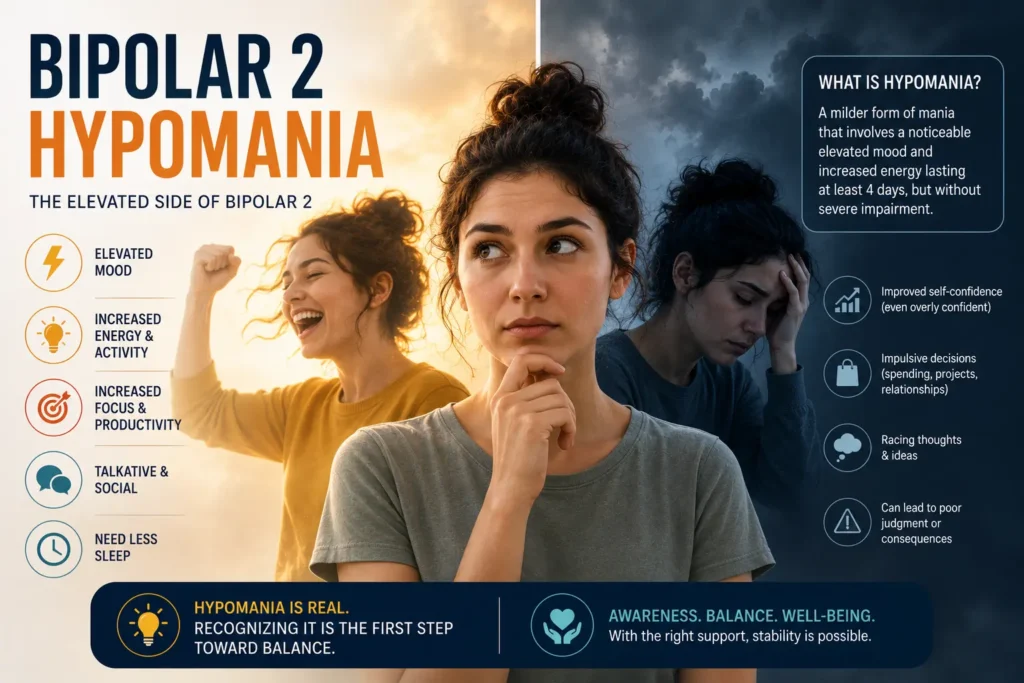
Hypomania in bipolar 2 disorder is a distinct period of unusually elevated, expansive, or irritable mood combined with higher-than-normal energy, lasting at least four days in a row. Unlike full mania, it doesn’t cause psychosis or require hospitalization, but it’s noticeable enough that people close to you can tell something’s different. A bipolar 2 diagnosis requires at least one hypomanic episode plus at least one major depressive episode, with no history of full-blown mania. If you’re trying to understand how hypomania fits into the bigger picture, our guide to bipolar 1 vs bipolar 2 breaks down the full comparison.
Table of Contents
Key Takeaways
- Hypomania is a real, diagnosable mood state — not just “having a good week.”
- It must last at least 4 consecutive days and include at least 3–4 specific symptoms (per DSM-5).
- Hypomania does not include psychosis and rarely requires hospitalization; if either happens, the diagnosis shifts toward bipolar 1.
- Many people with bipolar 2 don’t recognize their hypomanic episodes until a clinician points them out — the depression is what usually brings people to treatment.
- Left unaddressed, hypomania can still damage relationships, finances, and job stability, and often precedes a depressive crash.
What Is Hypomania in Bipolar 2 Disorder?
Hypomania comes from the Greek prefix “hypo,” meaning “under” or “below.” It’s mania’s quieter, less destructive sibling — elevated mood and energy that stay under the threshold of full mania. The person functions, often impressively so, but not like their usual self.
The American Psychiatric Association’s DSM-5 defines a hypomanic episode as a distinct period of abnormally and persistently elevated, expansive, or irritable mood and abnormally and persistently increased activity or energy, lasting at least four consecutive days and present most of the day, nearly every day.
That’s the technical definition. In practice, hypomania often looks like someone who suddenly has boundless energy, needs less sleep, talks faster, starts three new projects, and feels unusually confident — all without the reality-detachment or severe impairment seen in mania. For a broader look at how this fits within the diagnosis itself, see our guide on what is bipolar disorder.
Hypomania is one of the two core mood poles that define bipolar 2 disorder. Without at least one documented hypomanic episode, a bipolar 2 diagnosis isn’t possible — it’s the feature that separates bipolar 2 from major depressive disorder alone.
Hypomania vs. Mania: Where’s the Line?
This is one of the most searched questions about bipolar disorder, and for good reason — the distinction changes the entire diagnosis and treatment plan.
| Feature | Hypomania (Bipolar 2) | Mania (Bipolar 1) |
| Minimum duration | 4 consecutive days | 7 consecutive days (or any length if hospitalized) |
| Psychosis (delusions, hallucinations) | Never present | Can occur |
| Hospitalization needed | Rarely | Often, to ensure safety |
| Impact on functioning | Noticeable change, but daily life continues | Severe disruption to work, relationships, safety |
| Insight into the episode | Often partial or full insight | Frequently absent |
| Mood | Elevated, expansive, or irritable | Elevated, expansive, or irritable, more intense |
| Sleep | Reduced need for sleep, still functional | Sometimes days without sleep |
| Diagnosis it points to | Bipolar 2 disorder | Bipolar 1 disorder |
The core difference isn’t just intensity — it’s consequence. Mania creates a level of impairment or danger that hypomania doesn’t. Someone in a hypomanic episode might go on a spending spree that worries their partner; someone in a manic episode might max out multiple credit cards, believe they have a special mission, or need police intervention.
For a deeper side-by-side breakdown, our bipolar 1 vs 2 symptoms and bipolar 1 vs 2 chart pages cover this comparison in full detail.
Symptoms of a Hypomanic Episode
To meet DSM-5 criteria, a person needs the mood change (elevated, expansive, or irritable) plus increased energy or activity, along with at least three of the following symptoms (four if the mood is only irritable):
| Symptom | What it can look like day-to-day |
| Inflated self-esteem or grandiosity | Feeling unusually confident, capable, or “on top of the world” |
| Decreased need for sleep | Feeling fully rested after 3–4 hours of sleep |
| More talkative than usual | Speaking faster, louder, or dominating conversations |
| Racing thoughts | Ideas coming faster than they can be expressed |
| Distractibility | Attention pulled easily by irrelevant things |
| Increase in goal-directed activity | Starting multiple projects, socializing more, working late into the night |
| Risky or pleasurable activity | Impulsive spending, rash decisions, increased sexual activity, risky driving |
A useful way to think about it: hypomania often feels good, at least at first. That’s part of what makes it tricky — people frequently don’t want it to end, and many don’t seek help until it tips into depression or someone else notices the pattern. For the full symptom picture across both mood poles, our page on bipolar disorder symptoms is a helpful companion read.
What Hypomania Feels Like From the Inside
People who’ve experienced it often describe:
- A sense of clarity or heightened creativity
- Feeling unusually productive or “unstoppable”
- Irritability when others can’t keep up with their pace or ideas
- A subtle awareness that something is “off,” even while enjoying the state
- Difficulty slowing down mentally, even when physically tired
What Others Notice From the Outside
Family, partners, or coworkers often notice before the person does:
- Uncharacteristic talkativeness or interrupting
- Sudden ambitious plans or spending
- Shorter fuse or increased irritability
- Less sleep with no apparent tiredness
- A shift in tone that “doesn’t feel like them”
Causes and Risk Factors
No single cause explains hypomania. Research points to a combination of genetic, biological, and environmental contributors, consistent with what’s understood about bipolar disorder more broadly.
| Category | Contributing factors |
| Genetics | Having a first-degree relative with bipolar disorder significantly raises risk |
| Brain chemistry | Dysregulation in neurotransmitter systems and mood-regulating brain circuits |
| Sleep disruption | Missed sleep or major schedule changes (shift work, jet lag, newborn care) can trigger episodes |
| Stress | Major life events, both negative and positive (a promotion, a move, a new relationship) |
| Substance use | Stimulants, alcohol, or recreational drugs can precipitate or mimic hypomanic symptoms |
| Antidepressant use | In some people with an undiagnosed bipolar vulnerability, antidepressants alone can trigger hypomania |
| Postpartum period | Hormonal shifts after childbirth can trigger mood episodes in vulnerable individuals |
If you want the full picture of what’s understood about bipolar disorder’s origins, our detailed page on bipolar disorder causes goes further into the genetic and neurobiological research.
How Hypomania Is Diagnosed
There’s no blood test or brain scan that confirms hypomania. Diagnosis relies on a thorough clinical evaluation, usually by a psychiatrist or psychologist, and typically includes:
- A detailed mood history — looking for past periods of elevated mood, not just current depression, since people often present during a depressive episode and don’t mention hypomania unless specifically asked.
- Input from family or close contacts, when possible, since hypomania often comes with limited self-awareness.
- Ruling out other explanations — thyroid problems, substance use, medication side effects, or other psychiatric conditions that can mimic hypomanic symptoms.
- Applying DSM-5 criteria for both a hypomanic episode and a major depressive episode, since bipolar 2 requires both.
Because hypomania can feel pleasant and productive, it’s frequently missed or misdiagnosed as major depressive disorder, especially when a person only reports the depressive episodes to their doctor. This is one of the most common reasons bipolar 2 diagnosis gets delayed by years. Our full walkthrough of the bipolar disorder diagnosis process and the bipolar 1 vs 2 diagnosis differences covers this gap in more depth. If you’re wondering whether your own experiences fit the pattern, our bipolar 1 vs 2 test and bipolar 1 vs 2 quiz are useful starting points for a conversation with a clinician — not a substitute for one.
Bipolar 2 Hypomania vs. Just Having a Good Day
A common point of confusion: how do you tell hypomania apart from ordinary good moods, high motivation, or a caffeine-fueled productive streak?
| Ordinary good mood | Hypomanic episode |
| Matches something that happened (good news, a win) | Can appear with no clear trigger |
| Fades naturally within hours to a day | Persists for 4+ days, most of the day |
| Sleep and appetite stay roughly normal | Sleep need drops noticeably, without fatigue |
| Behavior stays consistent with your usual self | Behavior shifts noticeably — faster speech, more risk-taking |
| Doesn’t usually alarm people close to you | Often prompts a “are you okay?” or “you seem different” from others |
If the elevated state is proportional to a real event and passes quickly, it’s probably not hypomania. If it lingers for days, appears disconnected from circumstances, and changes how you’re functioning, that’s worth discussing with a professional.
Myths vs. Facts About Hypomania
| Myth | Fact |
| “Hypomania isn’t a real problem since it feels good.” | It can still lead to poor decisions, strained relationships, and often precedes a depressive crash. |
| “If you’re not manic, you don’t have bipolar disorder.” | Bipolar 2 is a distinct, legitimate diagnosis — not a “milder version” that doesn’t count. |
| “Hypomania always looks obviously different from normal behavior.” | It can be subtle, especially to the person experiencing it; friends and family often notice first. |
| “Only extroverted or high-energy people get hypomanic.” | Hypomania can occur in anyone, regardless of baseline personality. |
| “Antidepressants are always safe to take for bipolar depression.” | In bipolar disorder, antidepressants are typically used cautiously and often alongside a mood stabilizer, since they can trigger hypomania in some people. |
For more common misconceptions across the wider condition, see our page on bipolar disorder myths.
Complications of Untreated Hypomania
Because hypomania doesn’t always feel like a “problem” while it’s happening, it’s tempting to let it run its course. Over time, though, repeated untreated episodes are associated with:
- Strained personal and professional relationships
- Financial consequences from impulsive spending decisions
- Increased risk of the illness progressing to more severe or more frequent episodes
- A higher likelihood of the depressive phase that typically follows being more severe
- Greater difficulty maintaining consistent treatment, since people may (understandably) miss the “up” periods
Our page on bipolar disorder complications covers the broader long-term picture, including how repeated untreated episodes can affect overall course and prognosis.
Treatment for Bipolar 2 Hypomania
Treatment for hypomania sits within the broader treatment plan for bipolar 2 disorder — it’s rarely treated as an isolated event, since the goal is preventing future episodes (both hypomanic and depressive), not just managing one.
Medication
| Medication type | Role in bipolar 2 treatment |
| Mood stabilizers (e.g., lithium, lamotrigine) | First-line for preventing mood episode recurrence |
| Atypical antipsychotics (e.g., quetiapine, lurasidone) | Often used for both hypomanic and depressive episodes |
| Antidepressants | Used cautiously, typically combined with a mood stabilizer, due to hypomania-triggering risk |
Medication decisions should always be made with a psychiatrist, since the right combination depends on episode history, other health conditions, and how a person has responded to treatment in the past. Our dedicated guide to bipolar 1 vs 2 treatment and general bipolar disorder treatment overview go into more detail on how these are chosen.
Therapy
Several evidence-based therapy approaches are commonly used alongside medication:
- Psychoeducation — learning to recognize personal early warning signs of an episode
- Cognitive behavioral therapy (CBT) — addressing thought patterns tied to mood shifts
- Interpersonal and social rhythm therapy (IPSRT) — stabilizing daily routines and sleep, which are closely tied to mood episodes
- Family-focused therapy — helping loved ones recognize signs and respond supportively
Lifestyle Strategies That Support Stability
- Keeping a consistent sleep schedule, since sleep disruption is one of the most common hypomania triggers
- Tracking mood daily to spot patterns before they escalate
- Limiting alcohol and recreational substance use
- Building a relapse plan with a trusted person who can flag early changes
- Managing stress through regular routines rather than major, sudden life disruptions where possible
Warning Signs an Episode May Be Starting
Recognizing early hypomania signs can make a real difference in preventing escalation. Common early indicators include:
- Sleeping noticeably less without feeling tired
- Talking faster or jumping between topics more than usual
- A sudden surge of new plans, projects, or ideas
- Increased irritability with people who “aren’t keeping up”
- Spending or social impulses that feel out of character
When to Seek Emergency Help
Hypomania itself is rarely a medical emergency, but it’s important to know when a situation has moved beyond hypomania into territory that needs urgent attention. Seek immediate help if you or someone you know experiences:
- Beliefs that seem disconnected from reality (delusions or hallucinations)
- Behavior that puts personal safety at serious risk
- Thoughts of suicide or self-harm, which can also occur during the depressive phase of bipolar 2
- A rapid escalation that no longer resembles the person’s baseline hypomanic pattern
If you or someone else is in crisis or having thoughts of suicide, call or text 988 (Suicide & Crisis Lifeline) in the U.S., or contact local emergency services immediately.
Prognosis and Long-Term Outlook
With consistent treatment, many people with bipolar 2 disorder manage their condition effectively and maintain stable, fulfilling lives. Ongoing care — medication adherence, therapy, and routine monitoring — is strongly associated with fewer and less severe episodes over time. Missed treatment or unaddressed triggers, on the other hand, are linked to more frequent recurrences. For the fuller picture on what affects long-term outcomes, our page on bipolar disorder prognosis covers this in depth.
Frequently Asked Questions
Is hypomania always followed by depression? Not always, but in bipolar 2 disorder, depressive episodes are common and often more frequent and longer-lasting than hypomanic ones over the course of the illness.
Can hypomania turn into full mania? By definition, someone with a bipolar 2 diagnosis hasn’t had a full manic episode. If a manic episode ever occurs, the diagnosis changes to bipolar 1. Our page on can bipolar 2 become bipolar 1 explains this in detail.
How long does a hypomanic episode usually last? The DSM-5 minimum is four consecutive days, but individual episodes vary in length and intensity from person to person.
Can someone with hypomania function normally at work? Often yes — that’s part of what distinguishes it from mania. Many people are highly productive during hypomania, which is exactly why it can go unnoticed or even feel like a “good phase” until the pattern becomes clear.
Is hypomania dangerous? It’s generally less dangerous than mania, but impulsive decisions during hypomania (financial, relational, or otherwise) can still have lasting consequences.
Does hypomania look different in men and women? Some research suggests differences in presentation and diagnosis timing between men and women with bipolar 2, though individual experiences vary widely. Our page on bipolar 1 vs 2 in men and women explores this further.
How is bipolar 2 hypomania different from cyclothymia? Cyclothymia involves numerous periods of hypomanic and depressive symptoms that don’t meet full episode criteria, over at least two years. Our comparison of bipolar 1 vs 2 vs cyclothymia lays out the distinctions clearly.
Can lifestyle changes alone manage hypomania without medication? Lifestyle strategies help support stability, but they’re typically used alongside — not instead of — medication and therapy for a bipolar 2 diagnosis. This should always be discussed with a treating clinician.
Summary
Hypomania is the defining “up” phase of bipolar 2 disorder — a period of elevated mood and energy that’s noticeable, sometimes even enjoyable, but distinct from the more severe and disruptive experience of full mania. Recognizing it for what it is, rather than dismissing it as a good mood or ignoring it because it doesn’t feel harmful in the moment, is often the first step toward an accurate diagnosis and effective, lasting treatment. If any of this sounds familiar, a conversation with a psychiatrist or psychologist is the most reliable way to get clarity — self-assessment can point you in the right direction, but it isn’t a substitute for professional evaluation.
This article is for educational purposes and is not a substitute for professional medical advice. If you have concerns about your mental health, please consult a qualified healthcare provider.