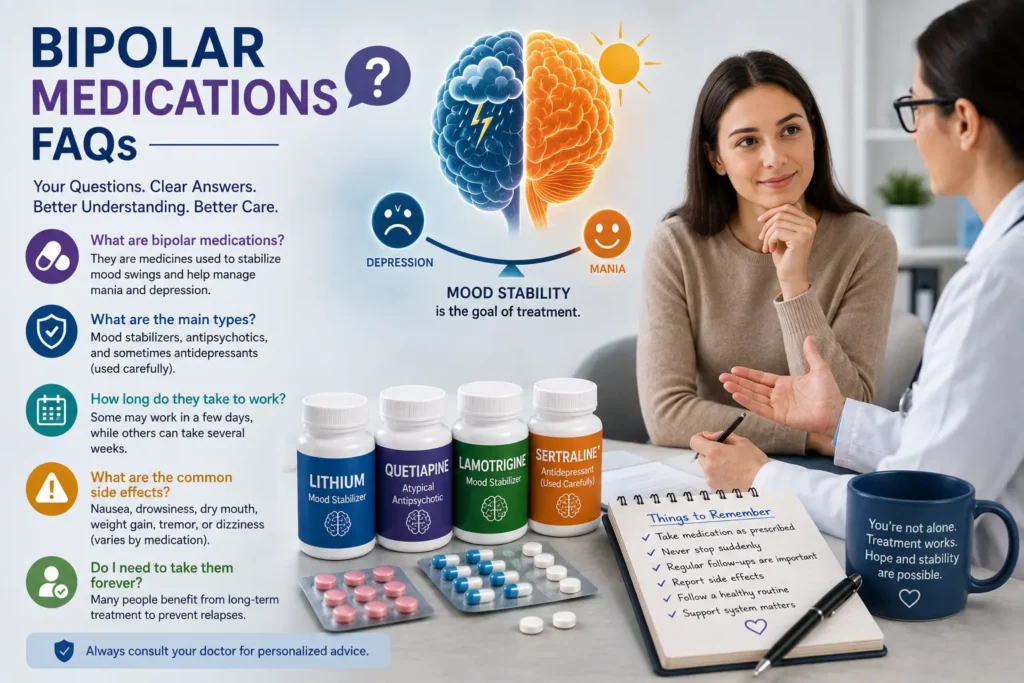
Bipolar Medications FAQs fall into a few main categories — mood stabilizers, atypical antipsychotics, and (occasionally, cautiously) antidepressants — and most people end up on a combination rather than a single drug. Common questions center on how these medications work, how long they take to show results, what side effects to expect, whether they’re needed for life, and how to handle pregnancy or stopping treatment safely. Below are direct, evidence-based answers to the questions people search for most, organized by theme, with links to full guides on each topic.
Table of Contents
Introduction
If you’re newly diagnosed with bipolar disorder, or you’re supporting someone who is, medication questions tend to pile up fast: What am I actually taking? Why this drug and not another? How long until it works? Is this forever? Most general bipolar articles answer one or two of these and leave the rest for you to piece together across a dozen tabs.
This guide brings the most common bipolar medication questions into one place, answered directly, with links to deeper guides on any topic that deserves more than a paragraph. It’s organized so you can jump to the section relevant to you, whether you’re just starting treatment, adjusting a plan that isn’t working, or thinking ahead to a major life change like pregnancy.
This article is educational and doesn’t replace individualized advice from your psychiatrist or prescriber. Bipolar disorder and its treatment vary enough between people that general answers are a starting point, not a substitute for your own care team.
Key Takeaways
- Bipolar disorder is treated with mood stabilizers, atypical antipsychotics, and sometimes antidepressants used cautiously alongside a mood stabilizer.
- Most people are treated with a combination of medications, not a single drug.
- Different medications target different phases: mania, depression, and long-term maintenance each have their own evidence-based options.
- Side effects and monitoring needs vary significantly by drug class — there’s no universal experience.
- Long-term maintenance treatment is standard for most people with bipolar disorder, since it’s a recurring, lifelong condition.
- Any change to medication — starting, stopping, or adjusting — is safest when planned with a prescriber rather than made independently.
Basics: How Bipolar Medications Work
What types of medication are used for bipolar disorder? Three main categories: mood stabilizers (like lithium, valproate, and lamotrigine), atypical antipsychotics (like quetiapine and olanzapine), and, less commonly and usually as an add-on, antidepressants. Each targets the condition differently — some address mania, some depression, some both, and some are used mainly for long-term relapse prevention. See bipolar medications for the full overview.
Why do I need medication instead of just therapy? Bipolar disorder involves significant shifts in brain chemistry and mood regulation that therapy alone typically can’t fully address, particularly during manic or severe depressive episodes. Medication and therapy are generally considered complementary, not competing, approaches — see bipolar therapy for how they work together.
Is medication for bipolar disorder lifelong? For most people, yes — bipolar disorder is a recurring, chronic condition, and ongoing maintenance treatment is standard practice for preventing future episodes, not just managing current ones. Some people do explore stopping under specific, supervised circumstances; see stopping bipolar medication for what that involves.
What’s the difference between a mood stabilizer and an antipsychotic for bipolar disorder? Mood stabilizers are designed specifically to prevent both manic and depressive extremes over time. Atypical antipsychotics were originally developed for other conditions but are also effective for bipolar mania and, in several cases, bipolar depression. Many treatment plans use one of each. See mood stabilizers for bipolar disorder and antipsychotics for bipolar disorder for more detail.
Choosing and Starting Medication
How do doctors decide which bipolar medication to prescribe? By weighing which phase needs treatment (mania, depression, or maintenance), your bipolar subtype, previous medication response, other health conditions, and personal factors like pregnancy plans. There’s no single “best” medication for everyone — see best medication for bipolar disorder for how this decision actually gets made.
How long does it take for bipolar medication to work? This varies by drug and by which symptoms are being treated. Antipsychotics used for acute mania can show effects within days to a couple of weeks, while mood stabilizers, especially for depression or long-term prevention, often take longer to reach their full effect. Ask your prescriber for a realistic timeline specific to your medication.
Will I need blood tests while taking bipolar medication? For some medications, yes. Lithium and valproate both require periodic blood tests to monitor drug levels and organ function; lamotrigine doesn’t require blood level monitoring but does require watching closely for rash, especially when starting treatment. See bipolar medication side effects for a full breakdown by drug class.
Can I take more than one bipolar medication at the same time? Yes — combination therapy is standard, not unusual, particularly during acute mood episodes or when a single medication doesn’t fully control symptoms. Two or three medications working together is common in real-world treatment plans.
What’s Bipolar 1 vs. Bipolar 2 medication like — is it different? There’s overlap, but not complete overlap. Treatment evidence is more extensive for Bipolar I, since it involves full manic episodes, while Bipolar II treatment often leans more on medications with strong depression evidence. See Bipolar 1 vs. Bipolar 2, Bipolar 1 treatment, and Bipolar 2 treatment for more.
Side Effects and Monitoring
What are the most common bipolar medication side effects? It depends heavily on the drug class. Nausea, drowsiness, and tremor are common early on with several medications; weight gain and metabolic changes are more specifically linked to certain antipsychotics and, in some patients, lithium and valproate. A full class-by-class breakdown is in bipolar medication side effects.
Do side effects go away over time? Many early side effects — nausea, dizziness, drowsiness — tend to ease as the body adjusts, often within a few weeks. Others, like metabolic or organ-function changes, build gradually and are managed through ongoing monitoring rather than something that simply resolves.
Which bipolar medication causes the least weight gain? This varies by individual and by specific drug rather than having one universal answer. Weight-related risk differs meaningfully even within the antipsychotic class, so this is worth discussing directly with your prescriber rather than assuming all options carry equal risk.
Is it normal to feel “flat” or less like myself on bipolar medication? Some people describe this, particularly early in treatment or at higher doses, and it’s worth raising directly with your prescriber rather than assuming it’s an unavoidable trade-off — dose adjustments or a different medication can sometimes address it. This is different from a medication simply working as intended, which is why an open conversation matters.
What’s the difference between a normal side effect and a medical emergency? Mild, stable symptoms like slight nausea or fatigue in the first couple of weeks are usually fine to mention at your next appointment. A spreading rash, confusion, severe tremor, yellowing skin, or new suicidal thoughts need same-day attention. See the warning signs section below and the full detail in bipolar medication side effects.
Specific Medications
What is lithium used for, and why is it still prescribed so often? Lithium is one of the longest-studied and most effective medications for bipolar disorder, particularly for long-term relapse prevention, and it’s associated with reduced suicide risk. It requires regular blood monitoring due to a narrow safe dosing range. See lithium for bipolar disorder.
What is valproate used for? Valproate is a mood stabilizer primarily used for manic and mixed episodes. It requires monitoring of liver function and blood counts and carries significant risk during pregnancy, which limits its use in people who could become pregnant. See valproate for bipolar disorder.
What is lamotrigine used for? Lamotrigine is mainly used for preventing depressive episodes and has a comparatively mild general side effect profile, with one notable exception: a rare but serious rash risk, which is why doses are increased slowly. See lamotrigine for bipolar disorder.
What are quetiapine and olanzapine used for? Both are atypical antipsychotics used for bipolar disorder, and both have evidence supporting use in mania, depression, and maintenance — a combination not every bipolar medication has. Their main long-term concern is metabolic: weight gain, blood sugar, and cholesterol changes. See quetiapine and olanzapine.
Can antidepressants be used for bipolar disorder? Yes, but cautiously, and almost never alone. Antidepressant monotherapy is generally avoided in bipolar disorder because of the risk of triggering a switch into mania or hypomania. When used, they’re typically combined with a mood stabilizer and closely monitored. See antidepressants for bipolar disorder for the full picture.
Comparison at a Glance
| Question | Short Answer | Full Guide |
| What’s the best overall option? | Depends on the episode type and individual factors | Best medication for bipolar disorder |
| What side effects should I expect? | Varies significantly by drug class | Bipolar medication side effects |
| Can I stop taking it? | Sometimes, but never abruptly and always with medical guidance | Stopping bipolar medication |
| Is it safe during pregnancy? | Risk varies by medication; some are preferred, others generally avoided | Bipolar medication during pregnancy |
| Are antidepressants an option? | Only combined with a mood stabilizer, with caution | Antidepressants for bipolar disorder |
Pregnancy, Life Changes, and Long-Term Planning
Is it safe to take bipolar medication while pregnant? Some medications carry more established risk than others — valproate carries the highest risk and is generally avoided, while lamotrigine and lithium each have their own, comparatively better-understood trade-offs. Stopping medication isn’t automatically the lower-risk choice either, since untreated bipolar disorder during pregnancy carries real risks of its own. See bipolar medication during pregnancy for the full breakdown.
What happens if I stop taking my medication? Stopping, especially abruptly, is associated with a meaningfully higher risk of relapse than gradual, medically supervised tapering. This is one of the most consistent findings in bipolar treatment research. See stopping bipolar medication for what the evidence shows and how to approach it safely if a change is appropriate.
Can I drink alcohol while taking bipolar medication? Alcohol can interact with several bipolar medications and worsen certain side effects, including sedation and, for some drugs, liver strain. This is worth discussing directly with your prescriber based on your specific medication rather than assuming it’s fine across the board.
Will I ever be able to come off medication completely? For some people, under close medical supervision and after a long period of stability, a supervised taper is explored — though this always carries some relapse risk and isn’t the right path for everyone. This decision should be made collaboratively with a psychiatrist, not independently. See recovery from bipolar disorder for more on long-term outlook.
Myths vs. Facts
Myth: “If a medication has side effects, it’s the wrong one for me.” Fact: Most bipolar medications cause some side effects, especially early on. The relevant question is whether they’re manageable and outweighed by the benefit, not whether they exist at all.
Myth: “Needing multiple medications means my treatment has failed.” Fact: Combination therapy is standard and often more effective than a single medication, particularly for managing both mania and depression over time.
Myth: “Once I feel better, I don’t need medication anymore.” Fact: Feeling stable is frequently a sign the medication is working, not evidence the condition has resolved. Stopping without medical guidance is one of the most common causes of relapse.
Myth: “All bipolar medications work the same way.” Fact: Mood stabilizers, antipsychotics, and antidepressants work through very different mechanisms and target different symptoms — that’s why treatment plans are individualized rather than standardized.
For more general misconceptions about the condition, see bipolar disorder myths.
A Checklist for Getting the Most Out of Medication Conversations
- Write down every question before your appointment, even ones that feel basic
- Ask specifically what phase (mania, depression, maintenance) each medication is targeting
- Ask what monitoring — blood tests, check-ins — is part of your specific plan
- Bring up side effects early rather than waiting to see if they pass on their own
- Ask what a realistic timeline looks like before you’ll know if it’s working
- Raise any plans around pregnancy, major life changes, or substance use openly
- Set a follow-up plan rather than treating the first prescription as final
Warning Signs That Need Prompt Attention
Regardless of which medication you’re taking, these symptoms warrant contacting your prescriber promptly rather than waiting for a scheduled visit:
- Signs of emerging mania or hypomania after starting or changing a medication
- New or worsening suicidal thoughts
- A spreading rash, confusion, or severe physical symptoms
- Symptoms returning or worsening despite consistent medication use
In the US, call or text 988 for the Suicide & Crisis Lifeline at any time. If there’s immediate danger, call 911 or go to the nearest emergency room. For more on recognizing warning signs generally, see bipolar disorder symptoms and bipolar disorder complications.
Frequently Asked Questions
What is the most commonly prescribed medication for bipolar disorder? There’s no single most common medication across all cases — it depends on the phase of illness and individual factors. Lithium, valproate, and several atypical antipsychotics like quetiapine are among the most frequently used, particularly for acute mania and long-term maintenance.
Can bipolar medication be taken with other psychiatric medications? Sometimes, but interactions vary significantly by drug combination. Always share your full medication list, including over-the-counter drugs and supplements, with your prescriber.
How do I know if my bipolar medication is working? Generally through a reduction in the frequency, severity, or duration of mood episodes over time, alongside your own and your care team’s observations. This is usually assessed over weeks to months, not days.
What if my bipolar medication stops working over time? This can happen and doesn’t necessarily mean something has gone wrong — it’s addressed by adjusting dose, switching medications, or adding a second option, following the same evidence-based hierarchy used when starting treatment. See best medication for bipolar disorder.
Is it dangerous to miss a dose of bipolar medication? Occasional missed doses are common and usually not dangerous on their own, but a general rule is to take it as soon as you remember unless it’s close to your next dose, in which case you skip the missed one — always confirm your medication’s specific instructions with your pharmacist or prescriber. Frequent missed doses, however, raise relapse risk over time.
Do children and teenagers take the same bipolar medications as adults? Some of the same medication classes are used, but dosing, specific drug choice, and monitoring differ for younger patients, and this should always be managed by a psychiatrist experienced in treating bipolar disorder in children or teens. See bipolar diagnosis in teenagers and bipolar diagnosis in children for more.
Summary
Most bipolar medication questions come back to a few core truths: treatment is individualized, combination therapy is normal, side effects vary widely by drug class, and any change — starting, adjusting, or stopping — is safest when planned with a prescriber rather than figured out alone. If a specific question here raised more questions, the linked guides throughout this article go deeper into each topic.
For the full picture of how these pieces fit together, visit our guides to bipolar disorder treatment and bipolar medications.
This article is for educational purposes and doesn’t replace individualized medical advice. Always consult a qualified psychiatrist or healthcare provider about your specific treatment plan.