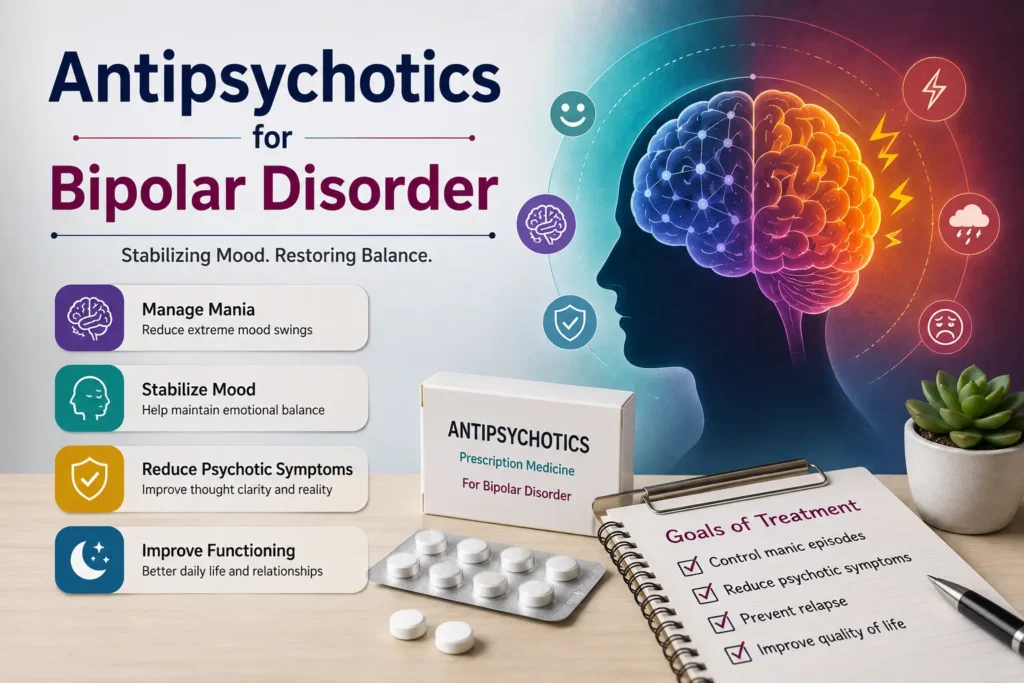
Antipsychotics for Bipolar Disorder: Antipsychotics, specifically the newer “atypical” or second-generation group, are one of the main medication classes used to treat bipolar disorder. Depending on the specific drug, they’re used for acute mania, acute depression, or long-term maintenance to prevent relapse. Despite the name, they’re not just for psychosis — several, like quetiapine, olanzapine, and cariprazine, are core bipolar medications in their own right. Their main tradeoff as a class is a risk of weight gain, metabolic changes, and movement-related side effects, though the extent varies a lot from one drug to the next.
That’s the overview. Below, we break down which antipsychotics are approved for which phase of bipolar disorder, how they compare to each other and to mood stabilizers, and what to know about side effects before starting one.
Table of Contents
Introduction
If you’ve been prescribed an antipsychotic for bipolar disorder and wondered why, given that you don’t have psychosis, you’re not alone in that question. Atypical antipsychotics turned out to have genuine, well-studied mood-stabilizing effects, and today they’re some of the most prescribed medications for both manic and depressive episodes of bipolar disorder.
This guide covers the class as a whole — what antipsychotics are, how they differ from mood stabilizers, and which specific drugs are used for which phase of illness. For deep dives into individual medications, see our dedicated guides on quetiapine and olanzapine. If you’re newer to the diagnosis itself, start with what bipolar disorder is and bipolar disorder symptoms.
Key Takeaways
- Atypical antipsychotics are FDA-approved across all three phases of bipolar I disorder — mania, depression, and maintenance — though no single drug covers all three.
- Only a handful of antipsychotics have specific FDA approval for bipolar depression: quetiapine, cariprazine, lurasidone, lumateperone, and the olanzapine-fluoxetine combination.
- Most antipsychotics used for mania are also approved as add-on treatment alongside lithium or valproate, not just alone.
- Weight gain and metabolic risk vary significantly between individual antipsychotics — some, like lurasidone and ziprasidone, tend to be more weight-neutral than others, like olanzapine.
- Long-acting injectable versions exist for some antipsychotics, which can help with medication adherence in maintenance treatment.
- Movement-related side effects, including a rare but potentially permanent condition called tardive dyskinesia, are a class-wide risk worth understanding.
What Are Antipsychotics, and Why Are They Used for Bipolar Disorder?
Antipsychotics are a class of medications originally developed to treat psychotic symptoms like hallucinations and delusions, most often associated with schizophrenia. There are two broad generations: first-generation (“typical”) antipsychotics, like haloperidol, and second-generation (“atypical”) antipsychotics, like quetiapine and olanzapine.
In bipolar disorder specifically, it’s almost always the atypical antipsychotics that come up, since they’ve been far more extensively studied and approved for mood symptoms. They work primarily by blocking dopamine receptors, and most also affect serotonin receptors, which is thought to explain why they can calm mania and, for some of them, lift depression, not just treat psychosis.
Antipsychotics are sometimes prescribed in bipolar disorder specifically because a manic or mixed episode includes psychotic features, such as delusions or psychosis in mania, but they’re just as often prescribed purely for their mood-stabilizing effect, with no psychosis present at all.
How Antipsychotics Differ From Mood Stabilizers
This distinction confuses a lot of people, so it’s worth spelling out. “Mood stabilizer” isn’t a strict pharmacological category — it’s a functional term used for medications that reduce the frequency or severity of mood episodes in bipolar disorder. Lithium and anticonvulsants like valproate and lamotrigine are the classic examples.
Atypical antipsychotics are a distinct drug class by chemistry and mechanism, but many of them function as mood stabilizers in practice, which is why you’ll often see them listed under both categories. Some psychiatrists and resources use “mood stabilizer” loosely to include certain antipsychotics; others reserve it strictly for lithium and anticonvulsants. Either way, what matters clinically is which phase of bipolar disorder a specific drug is approved and effective for — not which category label it gets.
Which Antipsychotics Are FDA-Approved for Bipolar Disorder, and For What?
This is where things get specific, and it’s also where a lot of general health content oversimplifies. Not every antipsychotic used in bipolar disorder is approved for every phase of the illness — the approvals are drug-specific.
| Antipsychotic | Brand Name | Acute Mania | Bipolar Depression | Maintenance |
| Quetiapine | Seroquel | Yes | Yes | Yes (adjunct) |
| Olanzapine | Zyprexa | Yes | Only with fluoxetine (Symbyax) | Yes |
| Aripiprazole | Abilify | Yes | No | Yes |
| Risperidone | Risperdal | Yes | No | Limited (long-acting injectable only) |
| Ziprasidone | Geodon | Yes | No | No |
| Asenapine | Saphris | Yes | No | No |
| Cariprazine | Vraylar | Yes | Yes | No |
| Lurasidone | Latuda | No | Yes | No |
| Lumateperone | Caplyta | No | Yes | No |
A few patterns are worth noticing here. Mania coverage is broad — most atypical antipsychotics work for it. Depression coverage is narrow — only a handful of drugs have earned that specific approval, since bipolar depression has historically been harder to treat effectively than mania. And maintenance approval is narrower still, generally reserved for drugs with longer-term trial data.
If you’re looking at a specific medication in more depth, our guides on quetiapine for bipolar disorder and olanzapine for bipolar disorder go into dosing and side effects for those two individually.
Antipsychotics for Acute Mania
For a manic or mixed episode, antipsychotics are typically chosen because they tend to act faster than lithium or valproate, often showing improvement within the first one to two weeks. They can be used alone or added to a mood stabilizer that’s already in place but not fully controlling symptoms.
This flexibility — monotherapy or add-on — is part of why antipsychotics are so commonly used during hospitalization for treatment of manic episodes, when rapid symptom control is often the priority.
Antipsychotics for Bipolar Depression
Bipolar depression has long been the harder side of the illness to treat with medication, which is exactly why only a small group of antipsychotics carry that specific approval. Quetiapine and cariprazine are notable for covering both mania and depression, while lurasidone and lumateperone are depression-specific, with no meaningful effect on mania.
This is also where a common myth causes real confusion: regular antidepressants used alone can carry a risk of triggering mania in bipolar disorder, so these antipsychotics — along with lamotrigine in some cases — fill a gap that standard antidepressant monotherapy generally shouldn’t be used for. For a fuller look at this phase specifically, see our guide to treatment for depressive episodes.
Antipsychotics for Long-Term Maintenance
Fewer antipsychotics carry maintenance approval, since that requires longer trials proving a drug prevents relapse over months, not just weeks. Olanzapine, quetiapine (as an add-on), and aripiprazole are among the options with this specific evidence base, alongside long-acting injectable formulations of certain antipsychotics that some people use specifically to simplify daily adherence.
Maintenance decisions tend to weigh a medication’s effectiveness against its long-term side-effect burden more heavily than acute treatment does, since maintenance means staying on the medication for months or years rather than weeks. This is a central part of bipolar relapse prevention planning.
How Antipsychotics Compare on Side Effects
This is often the deciding factor in which antipsychotic gets chosen, since effectiveness for mania is fairly similar across the group, but side-effect profiles differ a lot.
| Antipsychotic | Sedation | Weight Gain / Metabolic Risk | Movement-Related Side Effects |
| Quetiapine | High | Moderate–high | Lower |
| Olanzapine | Moderate–high | High | Lower–moderate |
| Aripiprazole | Low | Lower | Higher (akathisia, restlessness) |
| Risperidone | Low–moderate | Moderate | Moderate–higher |
| Ziprasidone | Low | Lower | Moderate |
| Cariprazine | Low | Lower | Moderate (akathisia) |
| Lurasidone | Low–moderate | Lower | Moderate |
| Asenapine | Moderate | Moderate | Moderate |
This table reflects general tendencies reported across clinical trials and reviews, not a guarantee of how any individual will respond. Two people can react quite differently to the same medication, which is part of why finding the right antipsychotic sometimes takes more than one attempt.
Common Side Effects Across Antipsychotics
| Side Effect Category | Examples | Notes |
| Very common | Sedation, dizziness, dry mouth | Varies significantly by specific drug |
| Metabolic | Weight gain, elevated blood sugar, elevated cholesterol | Higher risk with olanzapine and quetiapine; lower with lurasidone and ziprasidone |
| Movement-related | Restlessness (akathisia), tremor, stiffness | Higher risk with aripiprazole and risperidone |
| Rare but serious | Neuroleptic malignant syndrome, tardive dyskinesia, severe hyperglycemia | Require prompt medical evaluation |
Tardive Dyskinesia and Movement Disorders: What to Know
Tardive dyskinesia is a movement disorder that can develop after months or years of antipsychotic use, causing repetitive, involuntary movements, often of the face, tongue, or limbs. It’s uncommon with atypical antipsychotics compared with older, first-generation drugs, but it can occur, and it can sometimes persist even after stopping the medication.
Because of this, prescribers periodically check for early signs during routine follow-ups, especially with longer-term use. If you or a family member notices new, unusual, repetitive movements, mention it at your next appointment rather than waiting, since catching it early generally leads to better outcomes.
Metabolic Monitoring While on an Antipsychotic
Because weight gain and metabolic changes are such a consistent theme across this drug class, regular monitoring is considered standard practice, not an extra precaution:
| What’s Monitored | How Often (Typical Practice) |
| Weight / BMI | Baseline, then regularly, especially in the first several months |
| Fasting blood glucose or HbA1c | Baseline, then periodically |
| Lipid panel | Baseline, then periodically, especially in year one |
| Blood pressure | Baseline and at follow-up visits |
This applies across the class, though the intensity of concern typically scales with the individual drug’s known metabolic risk — closer attention for olanzapine or quetiapine, for example, than for lower-risk options like lurasidone.
Myths vs. Facts About Antipsychotics in Bipolar Disorder
| Myth | Fact |
| “Antipsychotics mean you have psychosis.” | Most people taking an antipsychotic for bipolar disorder don’t have psychosis. These drugs are used for their mood-stabilizing effects. |
| “All antipsychotics work the same way for bipolar disorder.” | Approvals and effectiveness vary significantly by phase — mania, depression, and maintenance each have different approved options. |
| “Antipsychotics always cause major weight gain.” | Risk varies a lot by specific drug. Some, like lurasidone and ziprasidone, tend to be more weight-neutral. |
| “You can’t be on an antipsychotic and a mood stabilizer together.” | Combining an antipsychotic with lithium or valproate is common and often more effective than either alone for acute mania. |
| “Antipsychotics work instantly.” | Most take one to two weeks to show meaningful benefit, even though some side effects, like sedation, appear right away. |
What to Expect When Starting an Antipsychotic
Expect the earliest effects — usually sedation or, less often, restlessness — within the first days, while the actual mood-stabilizing benefit typically builds over one to two weeks. Dose adjustments are common early on as your prescriber balances symptom control against side effects like sedation, weight changes, or restlessness.
Because individual response varies so much within this drug class, it’s not unusual to try more than one antipsychotic before finding the best fit. That’s a normal part of the process, not a sign that nothing will work.
Checklist: Starting an Antipsychotic Safely
- ✅ Ask your prescriber specifically which phase of bipolar disorder this medication is meant to treat
- ✅ Get baseline weight, blood sugar, and cholesterol checked before starting
- ✅ Know which side effects are most likely for your specific medication, since they vary a lot by drug
- ✅ Keep scheduled follow-ups for metabolic and, where relevant, movement-related monitoring
- ✅ Avoid driving or operating machinery until you know how sedation affects you
- ✅ Report new, unusual, repetitive movements at your next appointment
- ✅ Never stop an antipsychotic abruptly without medical guidance
Frequently Asked Questions
Do all antipsychotics treat bipolar depression? No. Only a small group — quetiapine, cariprazine, lurasidone, lumateperone, and the olanzapine-fluoxetine combination — have FDA approval specifically for bipolar depression. Many antipsychotics that work well for mania have no proven effect on depression.
Are antipsychotics considered mood stabilizers? Some are used functionally as mood stabilizers, even though “mood stabilizer” is more strictly used for lithium and certain anticonvulsants. What matters clinically is the specific drug’s approved use, not the label applied to it.
Which antipsychotic causes the least weight gain? Lurasidone and ziprasidone are generally considered more weight-neutral compared with options like olanzapine, though individual response varies and this should be discussed with a prescriber.
Can antipsychotics be used long-term for bipolar disorder? Yes, for maintenance treatment, though long-term antipsychotic use is generally weighed carefully against risks like metabolic changes and, less commonly, tardive dyskinesia, with regular reassessment of ongoing need.
Is an antipsychotic or a mood stabilizer better for bipolar disorder? Neither is universally “better” — they’re often used together, and the right choice depends on which phase of the illness (mania, depression, or maintenance) is the priority, along with individual side-effect tolerance.
Do antipsychotics for bipolar disorder cause addiction? No, antipsychotics aren’t classified as addictive or habit-forming, though stopping them abruptly, especially after long-term use, can affect mood stability and should be done under medical supervision.
Can antipsychotics be combined with lithium or valproate? Yes, this is a common and often FDA-approved approach, particularly for acute mania that isn’t fully controlled by a mood stabilizer alone.
What’s the difference between typical and atypical antipsychotics? Typical (first-generation) antipsychotics, like haloperidol, are older and carry a higher risk of movement-related side effects. Atypical (second-generation) antipsychotics, which are the ones almost always used in bipolar disorder today, generally carry lower movement-related risk but more metabolic risk.
Warning Signs That Need Medical Attention
Contact your prescriber or seek urgent care if you notice:
- High fever, severe muscle stiffness, confusion, or irregular heartbeat (possible signs of neuroleptic malignant syndrome)
- New, unusual, repetitive movements of the face, tongue, or limbs (possible signs of tardive dyskinesia)
- Signs of very high blood sugar, such as extreme thirst, frequent urination, or unusual fatigue
- Significant, rapid weight gain over a short period
- Fainting or a rapid, irregular heartbeat
When to Get Emergency Help
If you or someone taking an antipsychotic develops a very high fever with muscle rigidity and confusion, chest pain, fainting, or signs of a severe allergic reaction such as facial swelling or difficulty breathing, treat this as a medical emergency and call emergency services right away.
Separately, if you or someone you know is having thoughts of suicide or is in immediate danger, contact 911 (US) or your local emergency number, or call or text the 988 Suicide & Crisis Lifeline.
Summary
Antipsychotics have become central to bipolar disorder treatment precisely because they cover ground that older mood stabilizers alone often can’t — particularly the depressive side of the illness, which has historically been harder to treat well. The tradeoff is a side-effect profile, especially around weight and metabolic health, that varies significantly from one drug to the next and needs ongoing attention rather than a one-time conversation.
Choosing the right antipsychotic, or deciding whether one is needed at all, depends on your specific symptom pattern and treatment history. That’s worth mapping out directly with a psychiatrist, alongside a look at your own bipolar disorder symptoms and bipolar disorder diagnosis. For the full picture of how medication fits with therapy and lifestyle strategies, see our complete bipolar disorder treatment guide.
This article is for educational purposes only and is not a substitute for professional medical advice. Always talk to a qualified healthcare provider, such as a psychiatrist or your prescribing doctor, before starting, stopping, or adjusting any bipolar medication.
Sources referenced for accuracy include FDA prescribing information for individual antipsychotic medications, peer-reviewed clinical reviews of atypical antipsychotics in bipolar disorder, and clinical education material published in Psychiatric Times.