
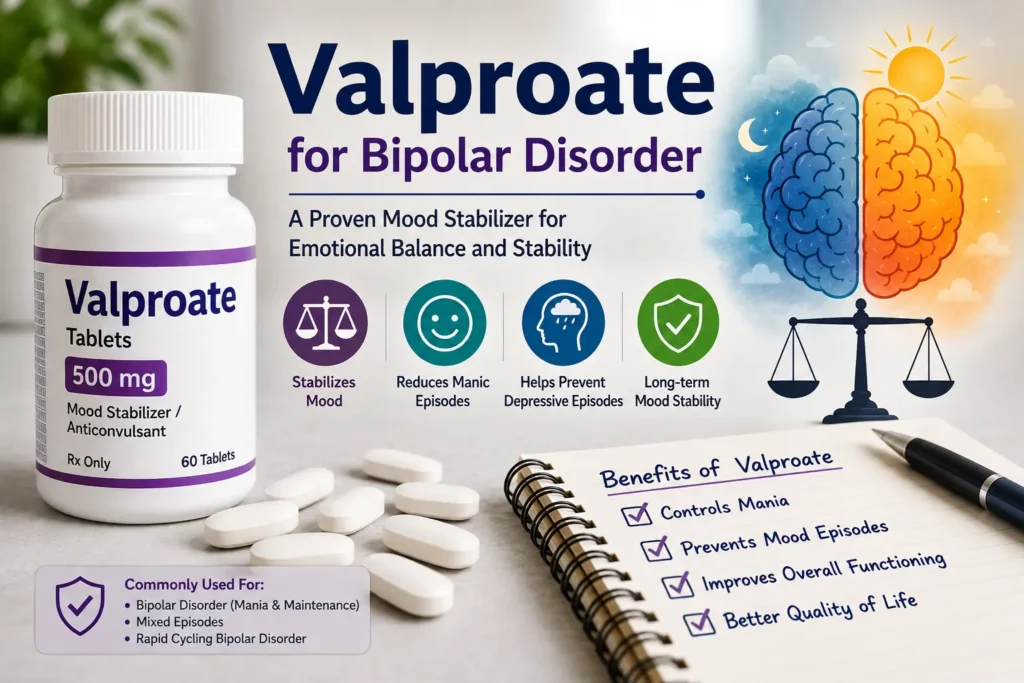
Valproate for Bipolar Disorder: Valproate — also called valproic acid or divalproex sodium, and sold under the brand name Depakote — is an anticonvulsant medication that’s FDA-approved for treating acute manic episodes in bipolar I disorder. It’s not FDA-approved for long-term maintenance or for bipolar depression, though it’s often used off-label for maintenance in practice. Its biggest limitation isn’t effectiveness, which is well established for mania — it’s safety in specific groups: valproate carries a serious risk of birth defects during pregnancy and requires regular blood tests to monitor drug levels and organ function.
That’s the essential picture. Below, we go through how valproate works, dosing and blood level targets, the pregnancy warning in detail, side effects, and how it stacks up against lithium and other bipolar medications.
Table of Contents
Introduction
Valproate has been used for bipolar mania since it received FDA approval in 1994, and it remains one of the most prescribed mood stabilizers for acute manic episodes. It has a particular reputation for working well in situations where mania looks angry, agitated, or mixed with depressive symptoms, rather than the classic euphoric high.
This article covers valproate specifically for bipolar disorder — not its use in epilepsy or migraine prevention, where it’s also prescribed. For background on the condition itself, see our guides on what bipolar disorder is and bipolar disorder symptoms. For how valproate fits into the bigger treatment picture, our bipolar disorder treatment guide covers medication alongside therapy and lifestyle approaches.
Key Takeaways
- Valproate is FDA-approved for acute manic or mixed episodes in bipolar I disorder, not for maintenance or depression, though off-label maintenance use is common.
- It requires regular blood tests, both to check drug levels and to monitor liver function and blood cell counts.
- It carries a serious risk of birth defects if taken during pregnancy and is generally avoided or used with extreme caution in people who could become pregnant.
- It tends to work especially well for mixed episodes and “dysphoric” mania — irritable, agitated mania rather than euphoric mania.
- Rare but serious risks include pancreatitis and liver toxicity, both of which need prompt medical attention if symptoms appear.
- It’s frequently combined with an antipsychotic or lithium for more severe manic episodes.
What Is Valproate?
Valproate is an anticonvulsant, originally developed to treat epilepsy, that was later found to have strong mood-stabilizing properties in bipolar disorder. You’ll see it under several names depending on the exact formulation: valproic acid, sodium valproate, and divalproex sodium (a compound that converts to valproic acid in the body) are all part of the same drug family, most commonly sold under the brand name Depakote.
It’s believed to work mainly by boosting the activity of GABA, the brain’s primary calming neurotransmitter, which helps quiet the racing, overactive brain state involved in mania. It’s classified as a mood stabilizer, alongside medications like lithium and lamotrigine, though its evidence and use case differ meaningfully from both.
Is Valproate FDA-Approved for Bipolar Disorder?
Yes, but the approval is narrower than many people assume. Valproate (as divalproex sodium) is FDA-approved specifically for the treatment of acute manic or mixed episodes associated with bipolar I disorder, based on short-term trials of about three weeks.
It is not FDA-approved for long-term maintenance treatment of bipolar disorder, and it’s not approved for treating bipolar depression. Long-term use for maintenance is extremely common in clinical practice, and many psychiatrists consider it effective based on real-world experience and observational data, but this use is technically off-label, meaning outside what clinical trials specifically established and the FDA specifically approved.
This matters for expectations: valproate is fundamentally a medication built and proven for calming an active manic episode, not one with the same maintenance evidence base as lithium.
Who Is Valproate Typically Prescribed For?
Valproate tends to be reached for in a few particular situations:
- Acute manic or mixed episodes, especially when symptoms are severe enough to need hospitalization
- Mixed episodes or “dysphoric mania” — irritability, agitation, and misery layered on top of manic energy, rather than a classic euphoric high, where some clinicians find valproate especially useful
- People with a history of rapid cycling bipolar disorder
- Situations where lithium hasn’t worked well or caused intolerable side effects
It’s generally avoided, or used only with significant caution and informed consent, in anyone who is pregnant, planning a pregnancy, or could become pregnant without reliable contraception, given its teratogenic risk (more on that below).
Valproate Dosing and Blood Level Monitoring
Valproate dosing isn’t just about milligrams — it’s guided by blood levels, since the effective and safe range varies by weight, metabolism, and other individual factors.
| Use | Typical Blood Level Target | Notes |
| Acute mania | Roughly 50–125 mcg/mL | Higher end of the range sometimes used for more severe symptoms |
| Off-label maintenance | Often similar range, individualized | Not an FDA-approved use; dosing guided by clinical response |
| Toxic level | Above roughly 175 mcg/mL | Associated with increased risk of side effects and toxicity |
Dosing usually starts at a moderate level and is adjusted based on blood tests taken a few days after any dose change, plus how well symptoms are responding and how the person is tolerating it. Because valproate is highly protein-bound in the blood, levels can need extra interpretation in people with low blood protein (albumin), so this is genuinely something for a prescriber and lab to manage together, not something to estimate on your own.
Routine Monitoring While on Valproate
| What’s Monitored | Why | Typical Frequency |
| Valproate blood level | Confirms the dose is in an effective, non-toxic range | After dose changes, then periodically |
| Liver function tests (LFTs) | Detects liver toxicity early | Baseline, then periodically, especially in the first 6 months |
| Complete blood count (CBC) with platelets | Detects blood cell abnormalities | Baseline, then periodically |
| Pregnancy test (if relevant) | Confirms pregnancy status before and during treatment | Baseline and as clinically indicated |
| Weight | Tracks a common side effect over time | Ongoing |
Valproate and Pregnancy: A Critical Warning
This is the single most important safety issue with valproate, and it deserves its own section rather than a passing mention. Valproate carries the highest teratogenic risk — meaning risk of causing birth defects — of any medication commonly used in bipolar disorder. Exposure during pregnancy has been linked to neural tube defects and other structural abnormalities, along with risks to a child’s cognitive development.
Because of this, valproate is generally considered a last-resort option for anyone who is pregnant or could become pregnant, and it typically requires a documented conversation about contraception before starting. If you’re of childbearing potential and valproate comes up as an option, it’s worth directly asking your prescriber about:
- Reliable contraception requirements while taking valproate
- Alternative medications with a better safety profile in pregnancy, such as certain antipsychotics
- What to do if pregnancy is confirmed or suspected while on valproate — this should never be managed by simply stopping the medication on your own
This warning doesn’t mean valproate can never be used in someone who might become pregnant, but it does mean the decision needs to be made carefully, deliberately, and with full information, not by default.
How Valproate Compares to Other Bipolar Medications
| Medication | FDA-Approved For | Blood Monitoring Needed? | Pregnancy Safety | Main Concern |
| Valproate (Depakote) | Acute mania | Yes, regularly | High risk — generally avoided | Teratogenicity, liver/pancreas risk |
| Lithium | Acute mania & maintenance | Yes, regularly | Some risk, individualized | Thyroid/kidney effects, narrow safety margin |
| Quetiapine | Mania, depression, maintenance | No | Considered lower risk | Sedation, metabolic changes |
| Olanzapine | Mania & maintenance | No | Some risk, individualized | Significant weight gain/metabolic risk |
| Lamotrigine | Maintenance | No | Considered lower risk | Rash risk during titration |
This is a general comparison, not a substitute for an individualized conversation with a psychiatrist, especially given how much the pregnancy and monitoring considerations can shift the right choice for a given person.
Side Effects of Valproate
| Side Effect Category | Examples | Typical Timing |
| Common | Nausea, tremor, drowsiness, dizziness, hair thinning | First weeks, sometimes ongoing |
| Common, longer-term | Weight gain, changes in menstrual cycle | Weeks to months |
| Less common | Elevated liver enzymes, low platelet count | Variable, monitored via blood tests |
| Rare but serious | Pancreatitis, severe liver toxicity, significant drop in platelets or white blood cells | Can occur at any point in treatment |
Tremor and gastrointestinal symptoms like nausea are among the most commonly reported early side effects and often improve somewhat over time or with dose adjustment. Hair thinning is a frequently mentioned but less dangerous side effect that some people find distressing even though it’s not medically serious.
Warning Signs of Pancreatitis and Liver Problems
Two rare but serious risks are specifically associated with valproate and are worth knowing by name, since early recognition matters.
Pancreatitis (inflammation of the pancreas) can occur at any point during treatment, even after years of stable use. Watch for:
- Abdominal pain, especially in the upper abdomen
- Nausea, vomiting, or loss of appetite that’s new or worsening
Liver toxicity is another serious, though uncommon, risk, particularly in the first six months of treatment. Watch for:
- Yellowing of the skin or eyes (jaundice)
- Unusual fatigue, weakness, or loss of appetite
- Swelling of the face
- Dark urine
Either of these symptom clusters warrants prompt medical evaluation, not a wait-and-see approach. This is exactly why routine blood monitoring exists — it can catch problems before symptoms even appear.
Myths vs. Facts About Valproate and Bipolar Disorder
| Myth | Fact |
| “Valproate is approved for long-term bipolar maintenance.” | It’s FDA-approved only for acute mania. Maintenance use is common but off-label. |
| “It’s safe to take during pregnancy if the dose is low.” | Valproate carries teratogenic risk across its therapeutic dose range and is generally avoided in pregnancy regardless of dose. |
| “Blood tests are only needed at the start of treatment.” | Ongoing monitoring of levels, liver function, and blood counts continues throughout treatment, not just during the first weeks. |
| “Valproate works the same for all types of mania.” | Some evidence and clinical experience suggest it may work particularly well for mixed or dysphoric mania, though it’s used across mania generally. |
| “Hair thinning means you have to stop the medication.” | It’s a recognized side effect that’s usually not dangerous, though it’s worth discussing with your prescriber if it’s distressing. |
What to Expect When Starting Valproate
Valproate typically works faster than some other mood stabilizers for acute mania, with meaningful improvement often seen within the first one to two weeks, since it was studied and approved specifically for short-term acute treatment. Blood levels are usually checked a few days after starting or adjusting the dose, so expect more frequent lab visits early on compared with later, more stable phases of treatment.
Nausea and drowsiness are common in the first days and often ease as the body adjusts. If gastrointestinal side effects are a significant problem, switching between formulations (such as to divalproex sodium, which tends to be gentler on the stomach than plain valproic acid) is sometimes an option worth discussing with your prescriber.
Checklist: Starting Valproate Safely
- ✅ Confirm pregnancy status and discuss contraception before starting, if this applies to you
- ✅ Get baseline liver function tests, complete blood count, and a valproate level scheduled after dose changes
- ✅ Know the early warning signs of pancreatitis and liver problems before you start
- ✅ Tell your prescriber about all other medications and supplements you take
- ✅ Keep all scheduled blood test appointments, even once you feel stable
- ✅ Track side effects like tremor, nausea, or hair thinning to discuss at follow-up visits
- ✅ Never stop valproate abruptly without medical guidance, especially if it’s controlling mania
Frequently Asked Questions
Is valproate the same as Depakote? Depakote is the brand name for divalproex sodium, a specific formulation of valproate. Valproic acid and sodium valproate are closely related forms of the same underlying medication.
How long does it take for valproate to work for mania? Valproate was studied and approved for acute mania based on trials lasting about three weeks, with many people showing improvement within the first one to two weeks of reaching an effective blood level.
Is valproate safe during pregnancy? No, not generally. Valproate carries the highest known teratogenic risk of any bipolar medication and is typically avoided in pregnancy or used only when no safer alternative is appropriate, under close specialist supervision.
Why does valproate require blood tests? Blood tests confirm the drug level is in an effective, non-toxic range, and they monitor liver function and blood cell counts, since valproate carries a rare risk of liver toxicity and blood cell abnormalities that can be detected early through routine labs.
Can valproate be used for bipolar depression? It’s not FDA-approved for bipolar depression, and evidence for that use is limited compared with medications like quetiapine or lamotrigine, which have stronger evidence specifically for the depressive side of bipolar disorder.
Is valproate addictive? No, valproate isn’t classified as addictive or habit-forming, though it should never be stopped abruptly without medical guidance, since doing so can risk a return of manic symptoms.
Can valproate be combined with lithium or an antipsychotic? Yes, this is common for more severe manic episodes, where combination treatment may control symptoms more effectively than either medication alone.
What happens if I miss a dose of valproate? A single missed dose usually isn’t an emergency, but consistent dosing matters for keeping blood levels stable. Contact your prescriber if you miss doses regularly or are unsure how to handle a missed dose.
When to Get Emergency Help
Seek urgent medical care if you experience severe abdominal pain with nausea and vomiting (possible pancreatitis), yellowing of the skin or eyes, unusual bruising or bleeding, or confusion and extreme drowsiness, which can be signs of a serious reaction requiring immediate evaluation.
Separately, if you or someone you know is experiencing a mental health crisis, having thoughts of suicide, or is in immediate danger, contact 911 (US) or your local emergency number, or call or text the 988 Suicide & Crisis Lifeline.
Summary
Valproate has earned a lasting place in bipolar treatment because it works, and works relatively quickly, for acute mania — particularly the irritable, mixed, or rapid-cycling presentations that don’t always respond as well to other options. Its real limitations are safety-related rather than effectiveness-related: the pregnancy risk is serious enough to shape the entire decision-making process for many people, and ongoing blood monitoring is a non-negotiable part of using it responsibly.
Whether valproate is the right choice depends heavily on individual factors — pregnancy potential, episode type, and response to other medications — that are worth working through directly with a psychiatrist. For a fuller picture of how mood stabilizers fit into overall care, see our bipolar disorder treatment guide.
This article is for educational purposes only and is not a substitute for professional medical advice. Always talk to a qualified healthcare provider, such as a psychiatrist or your prescribing doctor, before starting, stopping, or adjusting any bipolar medication.
Sources referenced for accuracy include FDA prescribing information for Depakote and related valproate products, peer-reviewed clinical trial data on valproate in bipolar mania, and clinical reviews published in Psychiatric Times.