
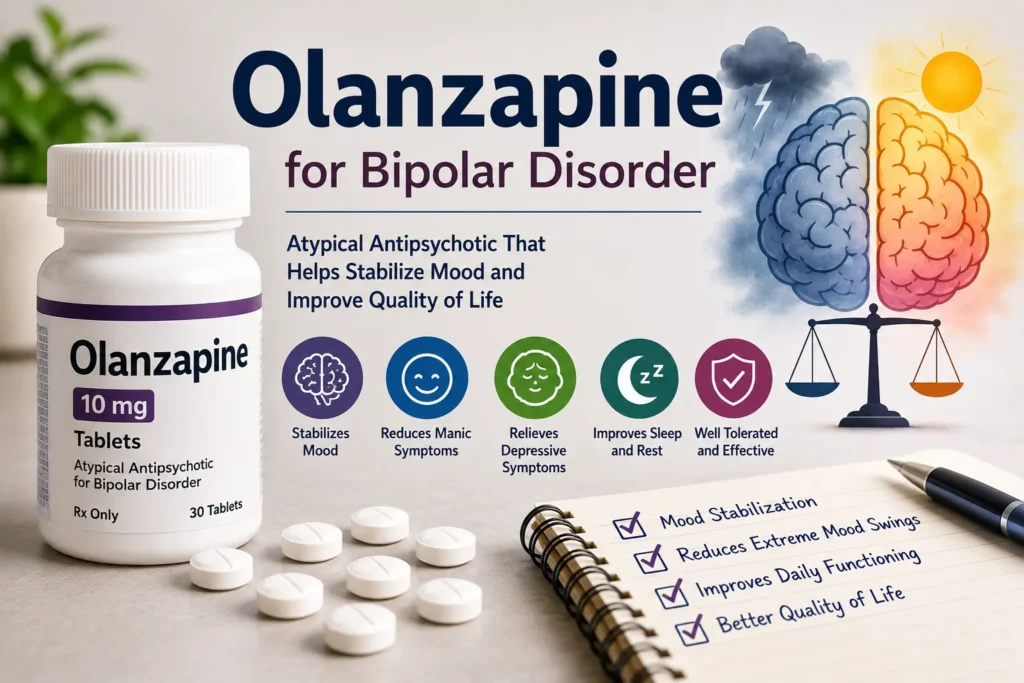
Olanzapine for Bipolar Disorder: Olanzapine (brand name Zyprexa) is an atypical antipsychotic that’s FDA-approved to treat acute manic or mixed episodes of bipolar I disorder and to help prevent relapse as a long-term maintenance treatment. On its own, it’s not approved for bipolar depression — for that, it’s combined with the antidepressant fluoxetine, a pairing sold under the brand name Symbyax. Olanzapine works fast and effectively for mania, but it carries one of the highest weight-gain and metabolic risks of any bipolar medication, so that tradeoff shapes most of the decision-making around it.
That’s the summary. Below, we go through exactly what olanzapine treats, how the olanzapine-fluoxetine combination works for depression, dosing ranges, and the metabolic monitoring that should come with it.
Table of Contents
Introduction
Olanzapine was one of the first atypical antipsychotics to earn a strong reputation for treating acute mania, and it remains one of the more effective options for calming a manic episode quickly. It’s also one of the only medications with FDA approval to prevent relapse across the full course of bipolar I disorder. The catch is that this effectiveness comes bundled with real metabolic risk, more so than most other options covered in our bipolar disorder treatment guide.
This article focuses specifically on olanzapine’s role in bipolar disorder — not schizophrenia, where it’s also used. If you’re newer to the diagnosis, our guides on what bipolar disorder is and bipolar disorder symptoms are good starting points before diving into medication specifics.
Key Takeaways
- Olanzapine is FDA-approved for acute manic or mixed episodes of bipolar I disorder and for long-term maintenance to prevent relapse.
- It is not FDA-approved as monotherapy for bipolar depression — for that, it’s combined with fluoxetine (Symbyax).
- Typical starting doses for mania are 10–15 mg/day, usually taken once daily.
- Weight gain and metabolic changes, including blood sugar and cholesterol shifts, are more pronounced with olanzapine than with many other antipsychotics, so ongoing monitoring is essential.
- It’s often combined with lithium or valproate for manic or mixed episodes when monotherapy isn’t enough.
- Sedation is common, especially early in treatment, which is why it’s usually dosed in the evening.
What Is Olanzapine?
Olanzapine belongs to the atypical (second-generation) antipsychotic class, the same broad category as quetiapine and several other medications used in bipolar disorder. It’s sold under the brand name Zyprexa, with generic versions available, and comes as standard tablets, orally disintegrating tablets, and a short-acting intramuscular injection used for acute agitation.
It works mainly by blocking dopamine and serotonin receptors in the brain, which helps calm the racing thoughts, impulsivity, and overstimulation that define a manic episode. That same receptor activity, combined with strong effects on histamine and other pathways, is also behind its most talked-about downside: a notably higher tendency toward weight gain compared with several other antipsychotics.
Is Olanzapine FDA-Approved for Bipolar Disorder?
Yes, and its approval is broad on the manic side of the illness. The FDA has approved olanzapine for:
- Acute manic or mixed episodes associated with bipolar I disorder, as monotherapy or as an add-on to lithium or valproate
- Maintenance treatment of bipolar I disorder, to help prevent the return of mood episodes — olanzapine is one of the few atypical antipsychotics with this specific standalone maintenance approval
- Acute agitation associated with bipolar mania, via a short-acting injectable form, for use in urgent clinical settings
- Bipolar depression, only when combined with fluoxetine (marketed as Symbyax) — olanzapine by itself is not approved for this use
That last point trips people up often enough that it’s worth repeating: olanzapine monotherapy is not indicated for the depressive episodes of bipolar I disorder. If depression is the bigger problem in someone’s illness pattern, that’s usually where a different medication, such as quetiapine or lamotrigine, comes into the conversation instead.
Olanzapine and Fluoxetine for Bipolar Depression
Because olanzapine alone hasn’t shown benefit for bipolar depression, the FDA-approved approach pairs it with fluoxetine, an SSRI antidepressant. This combination is sold as a fixed-dose product called Symbyax, though the two medications can also be prescribed separately at equivalent doses.
Clinical trials found that adding fluoxetine to olanzapine produced a meaningfully greater reduction in depressive symptoms than olanzapine alone. The combination is typically started at a low dose, in the evening, and adjusted based on response and tolerability. This is one of the only antidepressant-containing regimens with specific FDA approval for bipolar depression, which matters because antidepressants used without a mood stabilizer carry a theoretical risk of triggering mania or hypomania in bipolar disorder.
Olanzapine Dosing for Bipolar Disorder
| Use | Typical Dose | Notes |
| Acute mania (monotherapy) | 10–15 mg/day, once daily | May be adjusted in 5 mg increments at intervals of a week or more |
| Acute mania (adjunct to lithium/valproate) | Added at a starting dose in a similar range | Combined based on response and tolerability |
| Maintenance treatment | Individualized, based on the dose that controlled the acute episode | Ongoing reassessment of need for continued treatment |
| Bipolar depression (with fluoxetine) | Often starts around 5 mg olanzapine / 20 mg fluoxetine, evening dosing | Adjusted within an established dose range based on response |
| Acute agitation (injectable) | Short-acting intramuscular dose, used in urgent settings | Administered by a healthcare provider, not for home use |
Olanzapine is generally taken once a day, most often in the evening, partly because of its sedating effect. Dose changes are usually spaced out by at least a week, since it takes time for a new dose to reach a steady level in the body.
How Olanzapine Compares to Other Bipolar Medications
| Medication | Covers Acute Mania? | Covers Depression? | Covers Maintenance? | Main Concern |
| Olanzapine (Zyprexa) | Yes | Only combined with fluoxetine | Yes | Significant weight gain/metabolic risk |
| Quetiapine | Yes | Yes (monotherapy) | Yes (adjunct) | Sedation, metabolic changes |
| Lithium | Yes | Moderate | Yes | Requires blood level monitoring |
| Valproate | Yes | Limited | Yes | Weight gain, liver effects, blood monitoring |
| Lamotrigine | No | Yes | Yes (depression-focused) | Rash risk during titration |
Olanzapine tends to be reached for when mania needs to be brought under control relatively quickly, or when someone needs a reliable long-term option for preventing manic relapse specifically. It’s less often the first pick for someone whose main struggle is depression, or for someone already managing weight or metabolic health concerns.
Side Effects of Olanzapine
| Side Effect Category | Examples | Typical Timing |
| Very common, early | Sedation, dry mouth, dizziness | First days to weeks |
| Common | Increased appetite, weight gain, constipation | Weeks to months, can continue long-term |
| Metabolic | Elevated blood sugar, elevated cholesterol/triglycerides, insulin resistance | Can develop over weeks to months |
| Less common | Orthostatic hypotension, elevated liver enzymes, tremor | Variable |
| Rare but serious | Neuroleptic malignant syndrome, tardive dyskinesia, severe hyperglycemia or diabetic ketoacidosis | Rare, but require urgent care |
Olanzapine’s weight-gain and metabolic profile is one of the more significant among atypical antipsychotics, which is why some prescribers reserve it for situations where its speed and reliability for mania outweigh that risk, or pair it with closer monitoring and lifestyle support from the start.
Weight Gain and Metabolic Monitoring
This deserves its own section because it’s the single biggest long-term consideration with olanzapine. Weight gain with olanzapine tends to be more pronounced, on average, than with several other atypical antipsychotics, and it can be accompanied by rises in blood sugar and cholesterol that increase the risk of type 2 diabetes and cardiovascular disease over time.
Standard practice includes monitoring:
| What’s Monitored | How Often (Typical Practice) |
| Weight / BMI | Baseline, then regularly during the first several months, then periodically |
| Fasting blood glucose or HbA1c | Baseline, then periodically |
| Lipid panel (cholesterol, triglycerides) | Baseline, then periodically, especially in the first year |
| Blood pressure | Baseline and at follow-up visits |
There is also a combination product that pairs olanzapine with samidorphan, specifically designed to reduce the amount of weight gain associated with olanzapine, for people who need olanzapine’s benefits but are especially concerned about this side effect. This is a separate conversation to have directly with a prescriber, since it isn’t the same medication as standard olanzapine.
If you notice rapid weight gain, unusual thirst, frequent urination, or fatigue that feels different from your baseline, raise it with your prescriber rather than waiting for a scheduled check-in.
Myths vs. Facts About Olanzapine and Bipolar Disorder
| Myth | Fact |
| “Olanzapine treats bipolar depression on its own.” | Olanzapine monotherapy is not FDA-approved for bipolar depression. It’s combined with fluoxetine for that purpose. |
| “All antipsychotics cause the same amount of weight gain.” | Weight gain risk varies by medication, and olanzapine’s risk tends to be higher than several other options in its class. |
| “Once you’re stable, you can stop metabolic monitoring.” | Ongoing monitoring is recommended for as long as someone remains on olanzapine, not just during the first few months. |
| “Olanzapine only works for severe mania.” | It’s used across a range of manic and mixed episode severity, and for maintenance treatment as well, not only the most severe cases. |
| “Symbyax and olanzapine are completely different drugs.” | Symbyax is simply a fixed-dose combination of olanzapine and fluoxetine — the same olanzapine used for mania and maintenance. |
What to Expect When Starting Olanzapine
Sedation is usually the first thing people notice, often within the first dose, which is part of why it’s typically taken in the evening. The antimanic effects tend to build over the following days, with meaningful improvement in manic symptoms often visible within one to two weeks in clinical trials, though individual responses vary.
Because dose adjustments are generally spaced at least a week apart, expect a gradual process rather than daily changes. Appetite and weight changes can start early, so it’s worth discussing a plan for nutrition and activity with your care team right from the start rather than after weight gain has already occurred.
Checklist: Starting Olanzapine Safely
- ✅ Take it at the same time each day, usually in the evening, unless your prescriber advises otherwise
- ✅ Get baseline weight, blood sugar, and cholesterol checked before starting, if not already done
- ✅ Set up a nutrition and activity plan early, rather than waiting to see if weight gain happens
- ✅ Keep scheduled follow-ups for metabolic monitoring throughout treatment, not just the first few months
- ✅ Avoid driving or operating machinery until you know how sedation affects you
- ✅ Tell your prescriber about all other medications, especially other centrally acting drugs
- ✅ Report unusual muscle stiffness, high fever, or confusion right away
Frequently Asked Questions
Is olanzapine the same as Zyprexa? Yes. Zyprexa is the brand name for olanzapine. Symbyax is a related but different product — a fixed-dose combination of olanzapine and fluoxetine used for bipolar depression.
How long does it take for olanzapine to work for mania? Sedation is usually noticeable right away, and meaningful reduction in manic symptoms is often seen within one to two weeks, though full response can take somewhat longer for some people.
Does olanzapine cause more weight gain than other bipolar medications? Research generally places olanzapine among the antipsychotics with a higher tendency toward weight gain and metabolic changes compared with several other options, such as quetiapine or lamotrigine, though individual response varies.
Can olanzapine be used for bipolar II disorder? Olanzapine’s FDA approval is specific to bipolar I disorder. It’s sometimes used off-label in bipolar II disorder, but that decision depends on individual symptoms and should be made with a prescriber.
Is olanzapine addictive? No, olanzapine isn’t classified as addictive or habit-forming, though stopping it abruptly, especially after long-term use, can cause withdrawal-type symptoms and should be done gradually under medical guidance.
Why is olanzapine combined with fluoxetine instead of used alone for depression? Clinical trials found olanzapine alone didn’t show meaningful benefit for bipolar depression, but adding fluoxetine produced a significantly better response, which led to FDA approval for that specific combination rather than olanzapine monotherapy.
Can olanzapine be combined with lithium or valproate? Yes, this is an FDA-approved and common approach for manic or mixed episodes, particularly when monotherapy isn’t providing enough symptom control.
Does olanzapine help with sleep in bipolar disorder? Its sedating effect can improve sleep during a manic episode, which is often disrupted, but it’s not specifically prescribed as a sleep medication and shouldn’t be used that way outside of bipolar treatment.
Warning Signs That Need Medical Attention
Contact your prescriber or seek urgent care if you notice:
- High fever, severe muscle stiffness, confusion, or irregular heartbeat (possible signs of neuroleptic malignant syndrome, a rare but serious reaction)
- Uncontrollable, repetitive movements of the face, tongue, or limbs (possible signs of tardive dyskinesia)
- Signs of very high blood sugar, such as extreme thirst, frequent urination, nausea, or unusual fatigue (possible signs of hyperglycemia or diabetic ketoacidosis)
- Significant, rapid weight gain over a short period
- Yellowing of the skin or eyes (possible signs of liver problems)
These reactions are uncommon but serious enough to need prompt evaluation rather than waiting for a routine visit.
When to Get Emergency Help
If you or someone taking olanzapine develops a very high fever with muscle rigidity and confusion, signs of diabetic ketoacidosis such as severe nausea, vomiting, and rapid breathing, or a severe allergic reaction with facial swelling or difficulty breathing, treat this as a medical emergency and call emergency services immediately.
Separately, if you or someone you know is having thoughts of suicide or is in immediate danger, contact 911 (US) or your local emergency number, or call or text the 988 Suicide & Crisis Lifeline.
Summary
Olanzapine earned its place as a mainstay bipolar medication because it works reliably and relatively quickly for acute mania, and it’s one of the few options with dedicated FDA approval for long-term relapse prevention in bipolar I disorder. That effectiveness comes with a real tradeoff in weight and metabolic risk, which is why ongoing monitoring isn’t optional — it’s part of using this medication responsibly over the long run.
Whether olanzapine is the right fit depends on your specific symptom pattern, especially how much of your illness is mania-driven versus depression-driven, and your personal risk factors for metabolic issues. That’s a conversation worth having directly with a psychiatrist, alongside a look at your own bipolar disorder symptoms and treatment history. For the bigger picture on how medication fits with therapy and lifestyle strategies, see our full bipolar disorder treatment guide.
This article is for educational purposes only and is not a substitute for professional medical advice. Always talk to a qualified healthcare provider, such as a psychiatrist or your prescribing doctor, before starting, stopping, or adjusting any bipolar medication.
Sources referenced for accuracy include the FDA prescribing information for Zyprexa and Symbyax, peer-reviewed clinical trial data on olanzapine in bipolar mania and maintenance, and metabolic monitoring literature published in peer-reviewed journals.