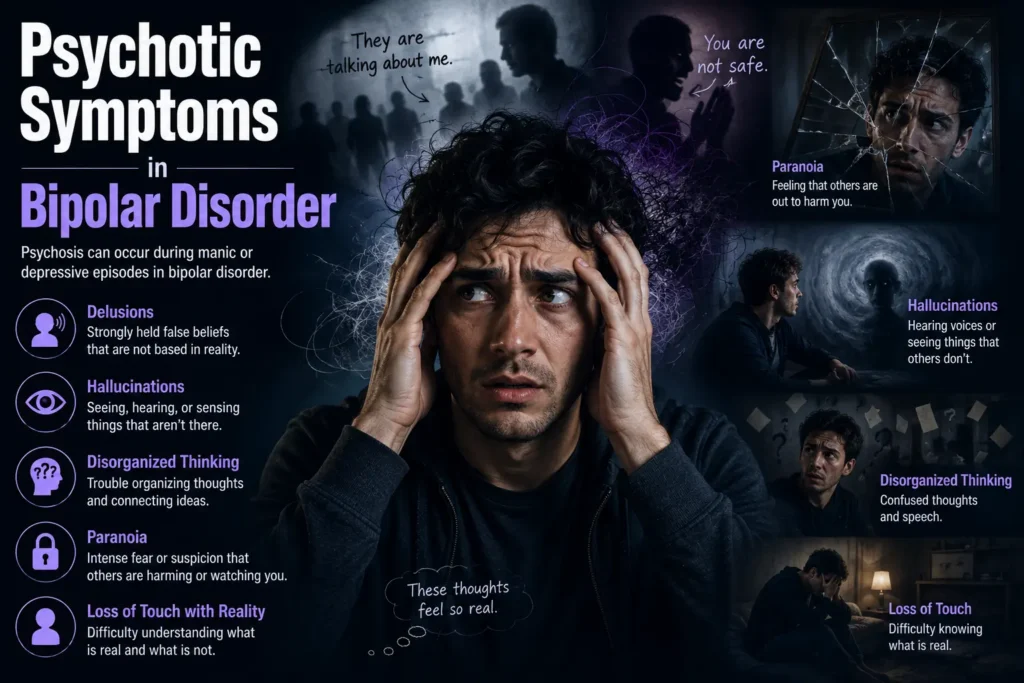
Psychotic symptoms in bipolar disorder — mainly delusions (firmly held false beliefs) and hallucinations (seeing, hearing, or sensing things that aren’t there) — can occur during severe manic or depressive episodes, most commonly in Bipolar 1. These symptoms typically match the mood of the episode, meaning grandiose or paranoid delusions during mania, and delusions of guilt or worthlessness during depression, though this isn’t always the case. Psychosis in bipolar disorder is a medical emergency requiring prompt treatment. For the broader symptom picture, see bipolar disorder symptoms, and for psychosis occurring specifically during a manic episode, see psychosis in mania.
Table of Contents
Introduction
Most conversations about bipolar disorder focus on mood — the highs and lows. But in its more severe form, bipolar disorder can also involve a break from shared reality: believing things that aren’t true, or perceiving things that aren’t there. This is psychosis, and understanding it matters, both because it changes the urgency of treatment and because it’s one of the more frightening and misunderstood aspects of the condition.
Psychotic features aren’t universal in bipolar disorder — many people never experience them. But when they do occur, according to clinical literature referenced by organizations like the American Psychiatric Association, they typically show up during the most severe manic or depressive episodes, not as a constant feature of the illness. This guide covers what psychotic symptoms in bipolar disorder actually look like, how they differ from conditions like schizophrenia, and what to do if you or someone you love experiences them. For the broader condition, see bipolar disorder and what bipolar disorder is.
Key Takeaways
- Psychotic symptoms — delusions and hallucinations — can occur during severe manic or depressive episodes in bipolar disorder, most often in Bipolar 1.
- Psychosis in bipolar disorder is typically episodic, appearing during acute mood episodes rather than continuously.
- Symptoms are often “mood-congruent,” matching the emotional tone of the episode, though “mood-incongruent” psychosis can occur too.
- Bipolar disorder with psychotic features is different from schizophrenia and schizoaffective disorder, though they can share overlapping symptoms.
- Psychosis during a mood episode is a medical emergency requiring prompt professional treatment.
- Antipsychotic medication, alongside mood stabilizers, is typically part of treatment when psychotic features are present.
What Psychosis Means in the Context of Bipolar Disorder
Psychosis refers to a disruption in a person’s ability to distinguish between what’s real and what isn’t. In bipolar disorder, this happens as part of a mood episode — DSM-5 criteria from the American Psychiatric Association specify psychotic features as an added dimension that can accompany a manic or major depressive episode when it’s severe enough.
This is an important distinction from a condition like schizophrenia, where psychosis is the central, defining feature. In bipolar disorder, psychosis is a possible complication of a mood episode’s severity, not the core illness itself.
Delusions in Bipolar Disorder
Delusions are firmly held false beliefs that persist even when presented with clear evidence against them. In bipolar disorder, delusions tend to reflect the mood state of the episode:
During Mania
- Grandiose delusions — a false belief in extraordinary talent, importance, wealth, or a special mission (for example, believing one has been chosen for a unique purpose, or possesses special powers or abilities)
- Paranoid or persecutory delusions — believing others are plotting against, monitoring, or trying to harm the person, sometimes tied into the grandiose belief (for example, believing others are jealous of one’s special status)
- Religious delusions — believing oneself to have a special religious identity or divine mission
During Depression
- Delusions of guilt — an exaggerated, false belief that one is responsible for terrible harm or wrongdoing
- Delusions of worthlessness or nihilism — a false belief that one doesn’t exist, has no value, or that the world itself is ending
- Somatic delusions — a false belief about having a severe illness or bodily defect, despite evidence to the contrary
Hallucinations in Bipolar Disorder
Hallucinations involve perceiving something that isn’t actually present. In bipolar disorder, these are typically:
- Auditory hallucinations — hearing voices or sounds that aren’t there, which may be critical, threatening, or, less often, praising or encouraging (particularly during severe mania)
- Visual hallucinations — seeing things that aren’t present, which occur less commonly than auditory hallucinations
- Less commonly, hallucinations involving smell, touch, or taste
Mood-Congruent vs Mood-Incongruent Psychotic Features
Clinicians use this distinction to describe how closely psychotic symptoms match the underlying mood episode:
- Mood-congruent psychotic features align with the emotional tone of the episode — grandiose delusions during mania, or delusions of guilt during depression.
- Mood-incongruent psychotic features don’t match the mood — for example, persecutory delusions unrelated to grandiosity during a manic episode, or bizarre beliefs during depression that don’t tie into feelings of worthlessness.
This distinction matters clinically because mood-incongruent psychotic features are sometimes associated with a somewhat different course of illness and may prompt a clinician to more carefully consider related diagnoses, such as schizoaffective disorder.
Comparison Table: Psychosis by Episode Type
| Episode Type | Common Delusion Themes | Common Hallucination Patterns | Mood-Congruent Example |
| Manic episode | Grandiosity, special mission, persecution | Auditory (voices affirming importance) | Believing one has unique powers tied to grandiosity |
| Depressive episode | Guilt, worthlessness, nihilism, somatic illness | Auditory (critical or accusatory voices) | Believing one is responsible for global harm |
| Mixed features | Combination of both patterns | Variable | Persecutory beliefs alongside hopelessness |
For the full clinical picture of manic-episode psychosis specifically, see psychosis in mania and Bipolar 1 with psychotic features.
How Bipolar Psychosis Differs From Schizophrenia and Schizoaffective Disorder
This distinction trips up a lot of people, so it’s worth breaking down clearly:
- Schizophrenia involves psychosis as the core, ongoing feature of the illness, generally without the full mood episodes seen in bipolar disorder.
- Bipolar disorder with psychotic features involves psychosis that appears specifically during severe manic or depressive episodes, and typically resolves as the mood episode resolves.
- Schizoaffective disorder involves a combination of mood episodes and psychotic symptoms that persist even when the mood episode has resolved — a key differentiating feature from bipolar disorder with psychotic features, where psychosis and mood symptoms tend to track together.
Because these conditions share overlapping symptoms, an accurate diagnosis requires careful evaluation by a psychiatrist over time, often observing how symptoms behave across multiple episodes rather than during a single crisis.
Myths vs Facts About Psychosis in Bipolar Disorder
| Myth | Fact |
| “Everyone with bipolar disorder eventually experiences psychosis.” | Many people with bipolar disorder never experience psychotic symptoms; it occurs specifically during the most severe episodes. |
| “Bipolar psychosis means someone has schizophrenia too.” | Bipolar disorder with psychotic features is distinct from schizophrenia, and the two involve different underlying patterns. |
| “Psychosis in bipolar disorder is permanent.” | Psychotic symptoms during a bipolar mood episode typically resolve as the episode is treated, though ongoing monitoring matters. |
| “People experiencing psychosis are always aware something is wrong.” | Insight is often significantly reduced during psychosis, meaning the person may not recognize their beliefs or perceptions as false. |
For a broader look at common misconceptions about bipolar disorder, see bipolar disorder myths.
Risk Factors for Psychotic Features in Bipolar Disorder
Certain factors are associated with a higher likelihood of psychotic features occurring during a bipolar mood episode, based on clinical literature:
- A diagnosis of Bipolar 1, since full manic episodes carry a higher likelihood of psychosis than the hypomanic episodes seen in Bipolar 2
- More severe manic or depressive episodes overall
- A family history of psychotic symptoms within mood disorders
- Significant sleep deprivation, which can worsen mood episode severity
- Substance use, which can trigger or worsen psychotic symptoms
For the broader picture of causes, see bipolar disorder causes and causes of mania.
Warning Signs and Emergency Situations
Psychosis during a bipolar mood episode is a medical emergency. Seek immediate professional help if you notice:
- Firmly held beliefs that clearly don’t match reality (special powers, extreme guilt over things not one’s fault, being monitored or persecuted)
- Hearing voices or seeing things that aren’t there
- Disorganized speech or behavior that doesn’t make sense in context
- Any statements suggesting the person may act on delusional beliefs, including self-harm tied to guilt-based delusions
- Extreme agitation or fear in response to perceived threats that aren’t present
If someone is experiencing psychosis and there’s any concern for their safety or the safety of others, seek emergency medical care immediately, including calling 911 or going to an emergency room. If suicidal thoughts are also present, contact the 988 Suicide & Crisis Lifeline (call or text 988 in the US). Approach the person calmly, avoid arguing about the content of their beliefs, and focus on getting them to safety and professional care.
Diagnosis: How Psychotic Features Are Identified
Diagnosis relies on a clinical evaluation during and around the mood episode, using DSM-5 criteria as the reference standard, similar to the approach described by Mayo Clinic and Cleveland Clinic. A psychiatrist will typically assess:
- Whether psychotic symptoms occurred exclusively during a mood episode, or persisted outside of it (a key differentiator from schizoaffective disorder)
- The content and theme of delusions or hallucinations, and whether they align with the mood (mood-congruent) or not
- The severity and duration of the underlying manic or depressive episode
- Family history and any substance use that could contribute to symptoms
For the full diagnostic process used for bipolar disorder generally, see bipolar disorder diagnosis.
Treatment for Psychotic Symptoms in Bipolar Disorder
When psychotic features are present, treatment typically combines:
- Antipsychotic medication, often alongside a mood stabilizer, to address both the psychosis and the underlying mood episode
- Hospitalization, in many cases, for safety and close monitoring during the acute phase
- Ongoing mood stabilization, since preventing future severe mood episodes reduces the likelihood of psychosis recurring
- Psychotherapy, once the acute episode has stabilized, to support recovery and long-term management
For the broader treatment picture, see bipolar disorder treatment, mania treatment, and Bipolar 1 treatment.
Supporting Someone Experiencing Psychosis: Dos and Don’ts
| Do | Don’t |
| Stay calm and speak in a steady, reassuring tone | Argue about whether their beliefs or perceptions are real |
| Focus on immediate safety | Leave the person alone if there’s any safety concern |
| Encourage and help arrange professional evaluation | Wait to see if it resolves on its own |
| Speak simply and give the person space | Overwhelm them with too much information or too many people at once |
| Contact emergency services if there’s any danger | Attempt to physically restrain someone unless trained and necessary for immediate safety |
Complications and Prognosis
Untreated psychosis during a bipolar mood episode carries significant safety risks and can prolong the episode itself. With appropriate treatment, psychotic symptoms typically resolve as the mood episode is brought under control, though ongoing management reduces the risk of recurrence during future severe episodes. For more detail, see bipolar disorder complications and bipolar disorder prognosis.
Checklist: Recognizing Possible Psychotic Symptoms
- [ ] Firmly held beliefs that clearly conflict with reality (grandiosity, persecution, extreme guilt)
- [ ] Reports of hearing voices or seeing things that others don’t perceive
- [ ] Disorganized or difficult-to-follow speech during a mood episode
- [ ] Occurring specifically during a severe manic or depressive episode
- [ ] A noticeable break from the person’s usual thinking and perception
- [ ] Safety concerns tied to the content of the delusions or hallucinations
If several of these apply, this is not a wait-and-see situation — seek professional evaluation promptly.
Frequently Asked Questions
Can bipolar disorder cause hallucinations? Yes, hallucinations can occur during severe manic or depressive episodes in bipolar disorder, most commonly auditory hallucinations, though they don’t occur in everyone with the condition.
Is bipolar disorder with psychosis the same as schizophrenia? No. In bipolar disorder, psychosis occurs specifically during mood episodes and typically resolves as the episode resolves, while schizophrenia involves psychosis as an ongoing, central feature independent of mood episodes.
Does everyone with Bipolar 1 experience psychosis? No. Psychosis occurs in some, but not all, severe manic or depressive episodes, and many people with Bipolar 1 never experience psychotic features.
Can Bipolar 2 involve psychosis? By definition, hypomanic episodes in Bipolar 2 don’t include psychosis, since psychotic features would classify the episode as full mania instead. Psychosis can occur during a severe depressive episode in Bipolar 2, though this is less common than in Bipolar 1.
What’s the difference between mood-congruent and mood-incongruent psychosis? Mood-congruent psychotic features match the emotional tone of the episode (grandiosity during mania, guilt during depression), while mood-incongruent features don’t align with the mood in an expected way.
How is bipolar psychosis treated differently from mood episodes without psychosis? Treatment typically adds an antipsychotic medication alongside a mood stabilizer, and often involves hospitalization for closer monitoring during the acute phase.
Can psychosis in bipolar disorder be prevented? Consistent long-term mood stabilization, medication adherence, and avoiding known triggers like severe sleep deprivation can reduce the likelihood of psychotic features occurring during future episodes, though prevention can’t be guaranteed.
Summary
Psychotic symptoms in bipolar disorder — delusions and hallucinations — can occur during the most severe manic or depressive episodes, most often in Bipolar 1, and typically match the emotional tone of the episode. This is different from schizophrenia, where psychosis is the central, ongoing feature of the illness rather than something tied to a mood episode. Because psychosis represents a medical emergency, prompt professional treatment — not a wait-and-see approach — is essential whenever these symptoms appear.
For related reading, see our guides on psychosis in mania, Bipolar 1 with psychotic features, and our broader bipolar symptoms guide for the full picture across all mood episodes.
This article is for educational purposes and is not a substitute for a professional diagnosis. If you or someone you know is experiencing psychosis or thoughts of suicide, please seek emergency medical care or contact the 988 Suicide & Crisis Lifeline (call or text 988) immediately.